 ProMapRanker
Best Electronic Data Interchange Software in 2026


Retail suppliers with many trading partners · Pricing starts at: See website
Key takeaways
- Orderful is the clearest priced option for growing brands, with Web EDI from $189 per month per trading partner and no per-transaction fees.
- SPS Commerce and TrueCommerce suit suppliers with many retail partners, but final pricing is quote-based and scales with partner count.
- Cleo, Celigo, and Boomi fit teams that want EDI inside a wider integration platform rather than as a standalone service.
- Wholesale buyers should count trading partners first, because partner count drives cost more than document volume on several platforms.
Quick comparison
| Pick | Great for | Pricing starts at | Free tier | |
|---|---|---|---|---|
| SPS Commerce | Retail suppliers with many trading partners | See website | No | Visit |
 TrueCommerce | Suppliers wanting EDI plus related tools | See website | No | Visit |
 Orderful | Growing brands wanting transparent pricing | $189 per month | No | Visit |
 Cleo | Teams combining EDI, API, and file transfer | See website | No | Visit |
 Celigo | Teams that want to own their EDI maps | See website | No | Visit |
 Boomi | Organizations already standardized on Boomi | See website | No | Visit |
 DiCentral | First-time EDI users with a few partners | See website | No | Visit |
 Cin7 Core | Product businesses needing inventory plus EDI | $349 per month | Free trial | Visit |
The best electronic data interchange software
Electronic data interchange, usually called EDI, is the structured exchange of purchase orders, invoices, shipment notices, and similar documents between businesses. We compared platforms that handle those documents reliably, connect to retail and wholesale partners, and stay compliant when partner requirements change.
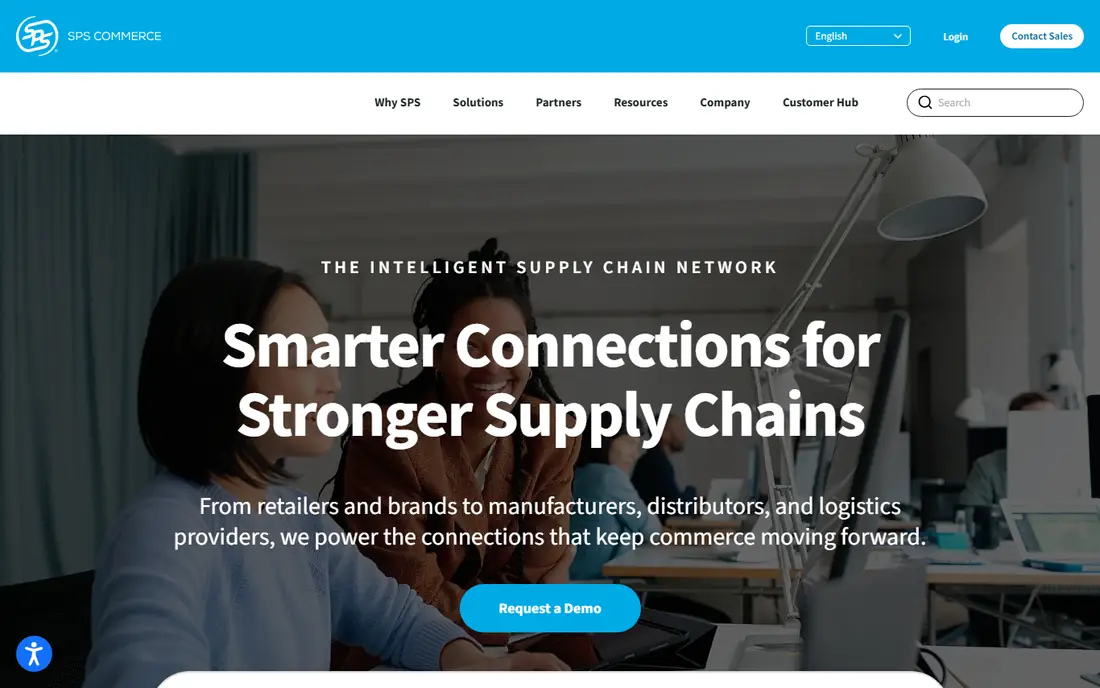
SPS Commerce is a full-service EDI provider built for suppliers selling to retailers such as Walmart, Target, Costco, and Home Depot. The company handles mapping, partner setup, and compliance updates, so a supplier team does not need deep EDI knowledge to start trading. That managed model is a real advantage when a retailer changes its requirements and the supplier would otherwise face chargebacks for non-compliant documents.
The honest catch is cost transparency. SPS Commerce does not publish a price list, and pricing scales with trading partners and volume, so a supplier with many small partners can face a larger bill than expected. Ask for a written quote that lists each partner, document type, and fee before signing. For a supplier whose main risk is retail compliance, the managed service is often worth that conversation.
- Very large retail partner network
- Fully managed service
- Strong compliance tooling for big-box retailers
- Pricing is quote-based and rises with partner count
- Less control for teams that want self-service
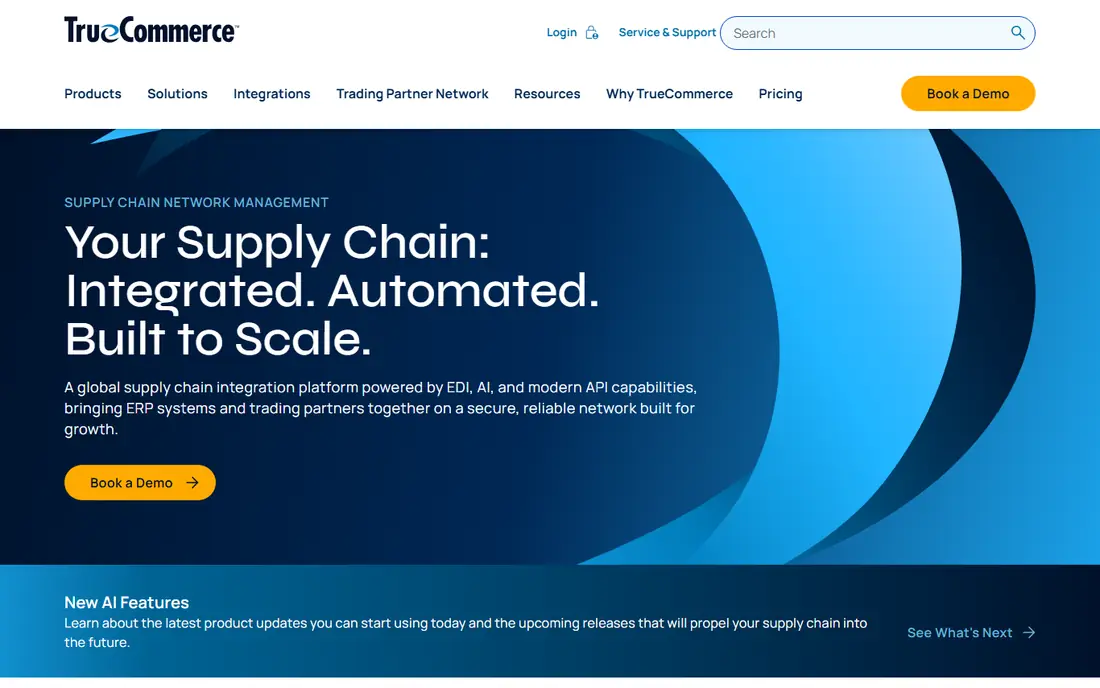
TrueCommerce combines EDI with e-invoicing, vendor-managed inventory, and business-to-business ecommerce, which suits companies that want several supply chain tools from one vendor. Its Transaction Manager gives staff a web view of documents, partner status, and errors, and its map library covers tens of thousands of partners. Integrations with common ERPs and storefronts help orders flow into the systems a team already uses.
The trade-off is that pricing is quoted per customer, so budgeting requires a sales conversation and a clear list of partners and volumes. Some users also report that daily document work takes more clicks than on simpler tools. For a mid-market supplier that values a bundled platform over a single-purpose EDI tool, TrueCommerce is a strong candidate.
- Large pre-built partner map library
- EDI plus e-invoicing and vendor-managed inventory
- Web EDI option for smaller teams
- Pricing is quote-based
- Interface can feel click-heavy for daily users
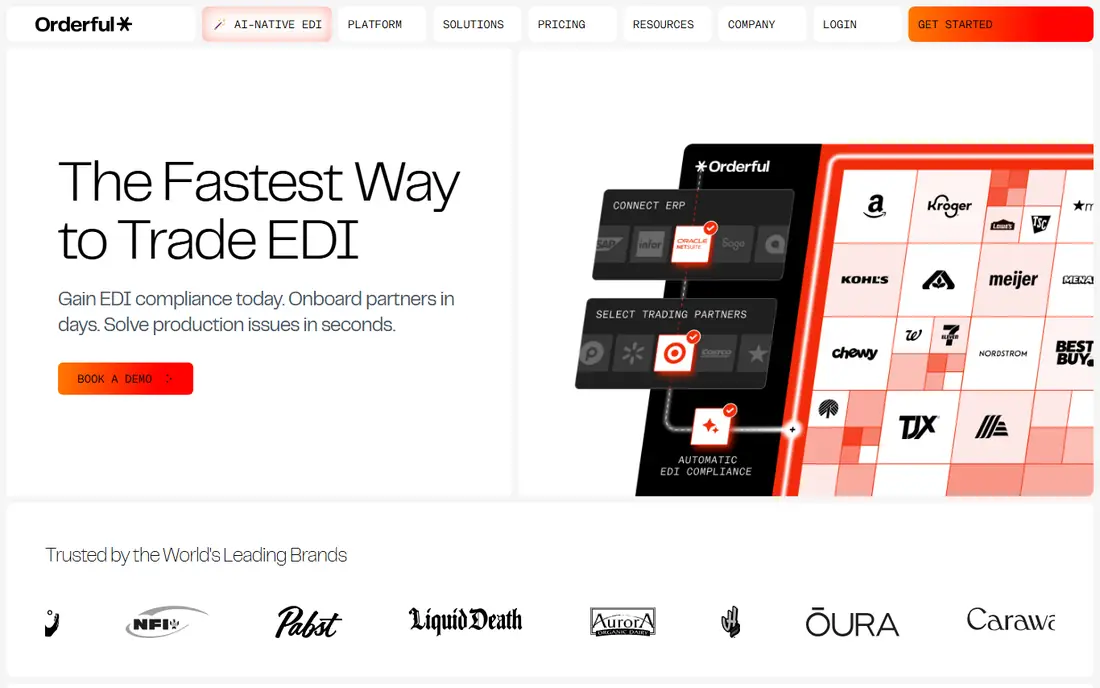
Orderful is an API-first EDI platform with a modern web interface and a clear pricing model: Web EDI starts at $189 per month per trading partner, Integrated EDI at $399 per month, and managed services from $1,999 per month. Every plan includes built-in mapping, partner testing, real-time validation, and support, with no per-transaction charges. That clarity makes it easy to model cost as the partner list grows, which is rare in this market.
The catch is the per-partner math itself. A brand with three partners pays about $567 a month on Web EDI, which is fair, but a brand with twenty partners needs to compare managed tiers carefully. Orderful suits tech-forward small and mid-size businesses, brands moving from direct sales into wholesale, and teams replacing an older value-added network. If your team wants a published price before a demo, start here.
- Published per-partner pricing
- No transaction or VAN fees
- Fast onboarding with built-in validation
- Price is per trading partner, so many partners add up
- Some technical knowledge still helps
Cleo Integration Cloud covers EDI, application programming interfaces, and managed file transfer in one platform, with self-service, managed, blended, and project-based delivery options. That breadth helps companies that move data in several ways, not only through EDI documents, and that want one team and one platform to watch. Its managed EDI service includes error categorization that aims to resolve common problems without manual work.
The honest catch is scope and pricing. Cleo does not publish prices, and a company that only needs retail EDI may pay for platform depth it never uses. For an enterprise or mid-market team consolidating integration types, though, the single platform can cut vendor sprawl. Ask for a scoped quote tied to partner count and document types, and compare it with a focused EDI provider before deciding.
- One platform for EDI, API, and managed file transfer
- Managed service options
- AI-assisted error handling
- Pricing is not published
- Broader platform can be more than a small supplier needs
Celigo offers a B2B manager inside its intelligent automation platform, letting teams build and maintain their own EDI maps while also connecting business apps such as NetSuite, Salesforce, and Shopify. That self-service control appeals to operations and IT staff who dislike waiting on a vendor for every partner change. It also means EDI sits next to the rest of the company's integrations, not in a separate silo.
The trade-off is staffing. Celigo rewards teams that can own mapping and testing, and it is less suited to a supplier that wants a vendor to run everything. Pricing is quoted based on trading partners and document types, so get that quote in writing with your real partner list. For a team with integration skills and a growing app stack, Celigo is a practical middle path.
- Self-service B2B manager
- Pairs EDI with wider app integration
- Good for teams with integration skills
- Pricing is quoted by partner and document type
- Needs in-house skills to get full value
Boomi is an integration platform with B2B and EDI management for exchanging documents with trading partners, managing partner onboarding through a portal, and connecting to core business systems. Companies already using Boomi for app integration get the most value, because EDI becomes one more flow on a platform their team already knows. Its connector library and cloud architecture suit multi-system environments.
The catch is fit for newcomers. A company that only needs EDI will find a focused provider simpler and often cheaper, and Boomi pricing is quote-based. If your organization already runs Boomi and wants to bring EDI under the same governance and monitoring, it is a natural choice. If not, compare a dedicated EDI platform first.
- B2B and EDI management inside a proven integration platform
- Partner portal
- Broad connector library
- Quote-based pricing
- Best value comes with wider Boomi use
DiCentral is a managed EDI service with a focus on retail supplier compliance, which suits a small business landing its first big-box or wholesale accounts. The vendor handles much of the setup and compliance work, so a team without EDI experience can start trading without hiring a specialist. That hand-holding matters when a first retailer sends a long requirements document and a tight go-live date.
The honest catch is that pricing is quoted per customer, so small suppliers should ask for the full cost at their actual partner count and volume. DiCentral also has a smaller public footprint than SPS Commerce or TrueCommerce, so ask for references from suppliers in your retail category. For a first-time EDI buyer with one or two partners, the managed approach is a sensible start.
- Managed service focus
- Retail supplier compliance help
- Approachable for non-technical teams
- Pricing is quote-based
- Smaller public profile than the largest networks
Cin7 Core is an inventory and order management platform for product businesses, with EDI available among its many integrations. Its Standard plan at $349 per month covers five users, multi-location inventory, purchasing, and warehouse management, which suits a brand whose main problem is stock accuracy across channels. Orders from wholesale partners flow into the same system that tracks purchasing and fulfillment, reducing manual re-entry.
The trade-off is that Cin7 is not a dedicated EDI network, so a supplier with complex retail compliance needs may still need a specialist EDI provider alongside it. The $349 monthly floor also makes it a poor fit for a tiny seller with one partner. For a growing product business that needs inventory control first and EDI second, Cin7 Core earns its place on this list.
- Real inventory, purchasing, and warehouse tools
- EDI among many integrations
- Published plan prices
- EDI is part of a larger system, not a standalone specialty
- $349 floor prices out very small sellers
How we picked these
We compared official product pages, pricing disclosures, and partner network descriptions, and we kept only platforms live in October 2026 that genuinely handle EDI documents. We favored a mix of fully managed networks, transparently priced platforms, and wider integration tools, and we marked quote-based pricing as such rather than guessing a number. We did not claim hands-on testing; our comparison rests on vendor documentation and public buyer guides.
What to check before you buy
Start with a list of every trading partner and the exact documents each one requires, because partner count and document types drive most quotes. Ask each vendor which partners already have pre-built maps, how long onboarding takes for a new partner, and what happens when a partner changes its requirements. A vendor with a ready map for your largest retailer can save weeks of testing.
Next, ask about total cost, not just the headline price. Confirm whether transaction fees, value-added network charges, mapping fees, and support are included, and get the answer in writing. Finally, run a pilot with your largest partner before migrating the full list, and measure error rates, chargebacks avoided, and staff time saved. EDI pays for itself when documents flow without manual fixes, so pilot results matter more than a feature list.
Frequently asked questions
What is the best EDI software for a wholesale business?
Orderful is the easiest to budget, with published per-partner pricing, while SPS Commerce and TrueCommerce suit wholesale suppliers with many retail partners. Pick based on partner count: few partners favor Orderful, many partners favor a managed network quote comparison.
What are the alternatives to EDI?
Some partners accept API connections, managed file transfer, or portal uploads instead of EDI, and tools such as Celigo and Boomi support those routes alongside EDI. For retail compliance, though, most large retailers still require EDI, so an alternative only helps if the specific partner accepts it.
How much does EDI software cost?
Published entry points on this list run from $189 per month per partner for Orderful Web EDI to $349 per month for Cin7 Core, while managed networks are quote-based. Total cost depends on partner count, document types, and whether the service is self-service or fully managed.
Is EDI software hard to set up?
Fully managed services such as SPS Commerce and DiCentral handle most setup, while self-service platforms such as Celigo need in-house skills. Expect testing with each trading partner in either case, because every retailer has its own document rules.
What is the top-rated EDI software for small businesses?
Orderful and DiCentral are strong small business options, for different reasons: Orderful for clear pricing and a modern platform, DiCentral for managed help with a first retail account. Compare a quote from both against your actual partner list before choosing.
Sources
See where you really rank - block by block
ProMapRanker scans Google Maps across a grid of your service area. Simple monthly plans from $19, white-label on every plan.
Start freeKeep reading
 whats the best ai app to use
Whats the Best AI App to Use in 2026
Wondering whats the best ai app to use in 2026? We compare ChatGPT, Claude, Gemini, Copilot, and more on price, free plans, and best everyday uses today.
Read → life360 alternatives
Life360 Alternatives in 2026
Life360 alternatives compared: 9 family location apps with live maps, arrival alerts and privacy controls to help your family stay in touch every day.
Read → captcha alternatives
CAPTCHA Alternatives in 2026
CAPTCHA alternatives compared: 9 reCAPTCHA alternatives that block bots with less friction, from free Turnstile to privacy-first proof-of-work tools included.
Read →