 ProMapRanker
Best EHR Software in 2026


Independent practices with managed billing · Pricing starts at: See website
Key takeaways
- athenahealth suits independent practices that want billing and revenue cycle help handled as part of the EHR, priced as a share of collections.
- SimplePractice and Practice Fusion suit small practices and therapists that want clear per-provider monthly pricing.
- eClinicalWorks and Tebra suit multi-provider practices that want charting, billing and patient engagement in one suite.
- Epic and Oracle Health suit hospitals and large health systems, where pricing is quote-based and implementation is a major project.
Quick comparison
| Pick | Great for | Pricing starts at | Free tier | |
|---|---|---|---|---|
| athenahealth | Independent practices with managed billing | See website | No | Visit |
 SimplePractice | Therapists and small practices | $49 per month | No | Visit |
 Practice Fusion | Price-sensitive primary care | $199 per provider per month | No | Visit |
 eClinicalWorks | Multi-provider ambulatory practices | See website | No | Visit |
 DrChrono | Mobile-first and procedural practices | See website | No | Visit |
 Tebra | Small practices wanting built-in marketing | See website | No | Visit |
 Epic | Hospitals and large health systems | See website | No | Visit |
 Oracle Health | Large systems on Oracle infrastructure | See website | No | Visit |
The best EHR software fits practice size, specialty and billing needs first
An electronic health record, or EHR, holds clinical notes, orders, prescriptions, lab results and patient history. Modern EHR platforms also bundle scheduling, billing, patient portals and telehealth, so the choice is really about a practice system, not just charting. Pricing is usually quote-based for larger systems, and per-provider monthly for small-practice tools, so we use See website where a vendor does not publish a firm starting price.
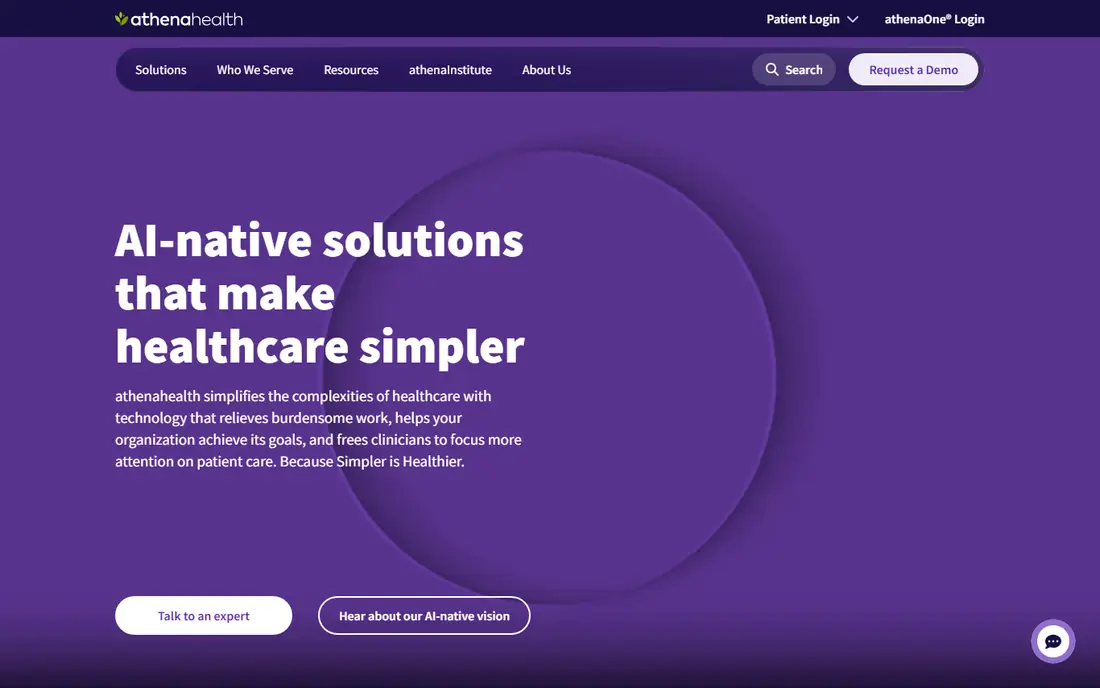
athenahealth, sold as athenaOne, combines EHR charting, practice management and revenue cycle services in one cloud platform. The vendor submits claims, follows up on denials and handles payer rules as part of the service, which is why many independent practices choose it when billing is their main pain point. Scheduling, e-prescribing, telehealth and a patient portal sit in the same system.
Pricing is typically a percentage of collections, reported around 4 to 8 percent depending on practice and services, rather than a fixed per-provider fee. That model can be cheap for a low-volume practice and expensive for a high-revenue one, so model it against your collections before you sign. athenahealth fits growing independent practices that want billing help, not just software.
- Managed billing and claims follow-up included
- Cloud-based with no servers to run
- Strong patient portal
- Priced as a share of collections, so cost rises with revenue
- Template customization is more limited

SimplePractice is built for therapists, counselors and small behavioral health practices. The Starter plan starts at $49 per month, with higher plans adding more features and an AI notes add-on around $35 per month. Charting, scheduling, a client portal, telehealth and billing sit in one system, with monthly billing and no long-term contract on most plans.
The limits show for medical practices with complex orders, labs or procedures, where a medical EHR such as eClinicalWorks or athenahealth fits better. SimplePractice also charges extra for some billing and AI features, so check the plan that includes the tools you actually use. For solo therapists and small counseling groups, it is the clearest, lowest-friction choice on this list.
- Clear per-provider pricing
- Strong tools for therapists
- Client portal and telehealth included
- Less suited to complex medical specialties
- AI notes and some billing features cost extra

Practice Fusion offers cloud-based EHR charting for primary care and small practices at $199 per provider per month in recent listings. It covers notes, e-prescribing, lab integrations, scheduling and a patient portal, with an optional billing service priced per visit. That published price makes budgeting easier than with quote-based rivals.
The trade-off is depth. Practice Fusion does not match athenahealth on managed billing, or eClinicalWorks on multi-specialty templates, and its billing service adds cost on top of the base price. It fits solo practitioners and small primary care practices that want a straightforward, cloud EHR at a known monthly price, without a large implementation project.
- Published per-provider price
- Cloud-based charting and e-prescribing
- Patient portal included
- Billing service is optional and priced separately
- Customization is more limited than larger suites
eClinicalWorks, often called eCW, serves ambulatory practices across many specialties, with charting, practice management, billing, telehealth and patient engagement in one suite. Its AI scribe, Sunoh.ai, helps reduce documentation time by drafting notes from the visit, and the platform supports a large network of providers and integrations. Multi-location practices benefit from a single system across sites.
Pricing is quote-based, with third-party listings reporting around $449 to $599 per provider per month for fuller bundles, so we list See website and advise getting a written quote for your bundle. Implementation and training also take time, especially for larger groups. eClinicalWorks fits multi-provider practices that want a broad, proven ambulatory suite rather than a small-practice-only tool.
- Broad ambulatory feature set
- AI scribe tool Sunoh.ai
- Large provider user base
- Pricing is quote-based and varies by bundle
- Interface feels dated to some users
DrChrono is known for mobile-first charting, especially on iPad, which suits clinicians who chart at the point of care or move between rooms and sites. It combines EHR notes, scheduling, billing, e-prescribing and a patient portal, with templates that can be customized by specialty and procedure. That mobile focus helps procedural practices where charting happens away from a desk.
Pricing is quote-based, with third-party listings around $199 per provider per month for some plans, so confirm the current price and what is included before you compare. Support quality and add-on pricing for telehealth and AI notes vary by plan. DrChrono fits practices that value mobile charting and integrated billing over the managed billing model of athenahealth.
- Strong iPad and mobile charting
- Integrated billing
- Customizable templates
- Pricing is quote-based
- Some users report support limits
- Telehealth and AI features vary by plan
Tebra, formed from Kareo and PatientPop, combines an EHR and practice management system with patient acquisition and reputation tools. Practices get charting, scheduling, billing, a patient portal and telehealth, plus website, review and marketing features that help attract new patients. That combination suits small practices that still need to grow their patient base.
Pricing is quote-based, with third-party listings around $150 per provider per month for some plans, so we list See website. Established practices that already have a full patient panel may not need the marketing layer, and contract terms should be checked before signing. Tebra fits small, growing practices that want clinical, billing and growth tools in one vendor relationship.
- EHR plus practice growth tools
- Patient portal and telehealth
- Integrated billing options
- Pricing is quote-based
- Marketing tools may not suit established practices
- Contract terms vary
Epic is the leading EHR for hospitals and large health systems in the United States. It covers inpatient, ambulatory, emergency, surgery, pharmacy, lab and revenue cycle in one integrated system, with patient portal tools and virtual visit workflows. Its scale means many hospitals, specialists and labs already work with Epic, which helps referrals and record sharing.
Epic is not a small-practice product. Pricing is quote-based, implementation often runs into millions of dollars for a health system, and go-live projects take one to three years for large organizations. Small practices should not consider Epic unless they are part of a larger system that already uses it. For hospitals and large groups, Epic remains the benchmark for depth and integration.
- Deepest enterprise EHR functionality
- Wide hospital and health system adoption
- Strong interoperability tools
- Quote-based pricing with very high implementation cost
- Not suited to small practices
Oracle Health, formerly Cerner, is the other major enterprise EHR for hospitals and large health systems. It offers clinical, revenue cycle and population health tools, now tied to Oracle cloud infrastructure and data services. Large systems that already use Oracle for other workloads may find integration and contracting simpler under one vendor.
Like Epic, Oracle Health is quote-based, with implementation cost and timeline driven by system size, data migration and workflow redesign. It is not a practical choice for a solo or small practice, where SimplePractice, Practice Fusion or athenahealth fit better. Oracle Health fits large hospitals and health systems that need enterprise scale and already lean on Oracle technology.
- Enterprise EHR with Oracle cloud and data tools
- Broad hospital functionality
- Large system adoption
- Quote-based pricing
- Implementation is a major project
- Less suited to small practices
How we picked these
We compared official product pages, pricing models, specialty coverage, documentation and app store listings for EHR platforms available in October 2026, plus public reviews and industry rankings. We kept only platforms with a current, supported EHR product, and we left out tools that had closed or merged without a standalone offering. Practice size fit, billing model, charting depth and specialty coverage decided the order. Where pricing is quote-based, we wrote See website rather than repeating an unverified third-party figure as a vendor price.
What to check before you sign
Ask for a total cost quote that includes implementation, training, data migration, e-prescribing, clearinghouse fees and support, because those items can double a headline price. Confirm contract term, renewal terms, data ownership and export terms in writing before you sign, not when you want to leave. Test charting, orders and billing with your real workflows during a demo, and check uptime, support hours and the process for adding providers or locations. A careful contract review now saves a costly switch later.
Frequently asked questions
What is the difference between an EHR and practice management software?
An EHR holds the clinical record: notes, orders, prescriptions and lab results. Practice management software handles scheduling, registration, billing and claims. Modern platforms bundle both, which is why athenaOne, Tebra and eClinicalWorks sell integrated suites rather than charting alone.
How much does EHR software cost?
It ranges from $49 per month for SimplePractice Starter to $199 per provider per month for Practice Fusion, a share of collections for athenahealth, and custom quotes for eClinicalWorks, Tebra, Epic and Oracle Health. Implementation, migration and add-ons can add substantially to the first-year total.
Which EHR is best for a small practice?
athenahealth suits practices that want managed billing, SimplePractice suits therapists and solo practices, and Practice Fusion suits price-sensitive primary care. The best choice depends on specialty, billing needs and whether you want a fixed monthly price or a share-of-collections model.
How long does EHR implementation take?
Small practices can often go live in weeks on cloud platforms with guided onboarding. Mid-size groups typically need two to four months including data migration and training. Hospital implementations run one to three years, driven by data migration and workflow redesign rather than software installation alone.
Do these EHRs support telehealth?
Yes, across the board now. SimplePractice, eClinicalWorks, DrChrono and Tebra include integrated telehealth, while athenahealth and Oracle Health offer it as part of patient engagement suites. Epic supports virtual visits within enterprise workflows. Confirm telehealth shares one schedule and one chart, rather than a separate video link.
Can I switch EHRs later if I need to?
Yes, but switching is a major project involving data migration, retraining and contract exit terms. Get data export terms, format and cost in writing before you sign your first contract, so a future switch is possible without losing patient history.
Sources
See where you really rank - block by block
ProMapRanker scans Google Maps across a grid of your service area. Simple monthly plans from $19, white-label on every plan.
Start freeKeep reading
 best employee time tracking app
Best Employee Time Tracking Apps in 2026
We compare the best employee time tracking app options for teams, from simple timers to shift tools, with honest notes on privacy and consent in 2026.
Read → best employee recognition software
Best Employee Recognition Software in 2026
We compared the best employee recognition software for peer praise, rewards, and service awards, with pricing, integrations, and honest limits for teams.
Read → best ecommerce shipping software
Best Ecommerce Shipping Software in 2026
Compare the best ecommerce shipping software for labels, rates, and automation, including ShipStation, Shippo, Pirate Ship, Easyship, and Veeqo for 2026.
Read →