 ProMapRanker
Best Ecommerce Shipping Software in 2026


Multichannel sellers who need automation · Pricing starts at: $14.99 per month
Key takeaways
- Pirate Ship and Veeqo cost nothing to use, which makes them hard to beat for low volume sellers who mainly need labels.
- ShipStation suits sellers who sell on several channels and want automation rules, branded tracking, and batch label printing in one place.
- Shippo gives a useful free start and an API, so it works well for small stores that may later need custom shipping features.
- Easyship is the clearest pick for cross border orders, because it shows duties and taxes and offers many international courier services.
- Your monthly shipment count matters more than the headline price, since most paid plans cap labels or shipments.
Quick comparison
| Pick | Great for | Pricing starts at | Free tier | |
|---|---|---|---|---|
| ShipStation | Multichannel sellers who need automation | $14.99 per month | Free trial (30 days) | Visit |
 Shippo | Low volume sellers who want a free start | Free | Yes | Visit |
 Pirate Ship | US sellers who ship mainly with USPS and UPS | Free | Yes | Visit |
 Easyship | Cross border ecommerce sellers | Free | Yes | Visit |
 Veeqo | Amazon and multichannel sellers | Free | Yes | Visit |
 ShippingEasy | Small stores that want guided setup | $19.99 per month | Yes | Visit |
 EasyPost | Developers and high volume shippers | Free | Yes | Visit |
 AfterShip Shipping | Stores that want labels plus tracking pages | $9 per month | Yes | Visit |
The best ecommerce shipping software
We compared these tools on carrier coverage, label costs, automation, integrations, and how the free plan actually works. Postage is charged on top of every subscription below, so compare the software cost and the label discount together.
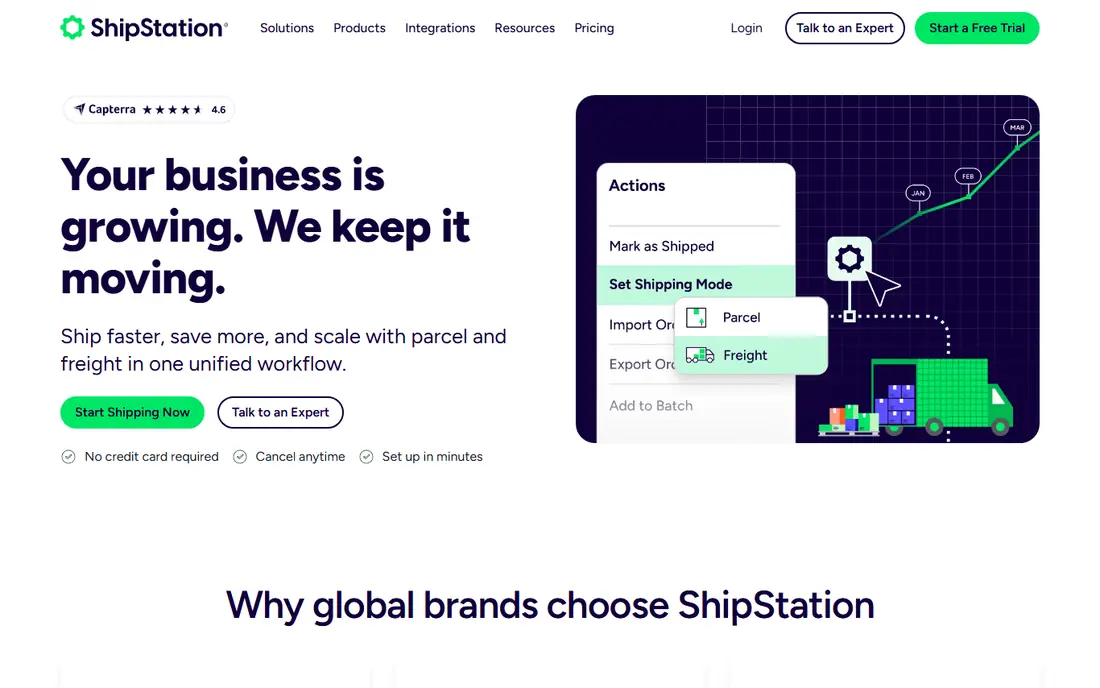
ShipStation pulls orders from stores and marketplaces into one queue, so a seller does not need to open five tabs to print labels. Automation rules can assign a carrier, a service level, or a package preset based on weight, destination, or order value. That setup takes time at the start, but it saves repeated manual choices once orders grow.
The catch is the shipment cap on each plan. A store that grows past its monthly limit needs to move up a tier, even if it does not need new features. Small sellers should also check whether their own carrier accounts can be connected on their chosen plan, since some options are limited to higher tiers.
- Wide carrier and store integrations
- Strong automation rules
- Batch label printing
- No permanent free plan
- Costs rise quickly with shipment volume
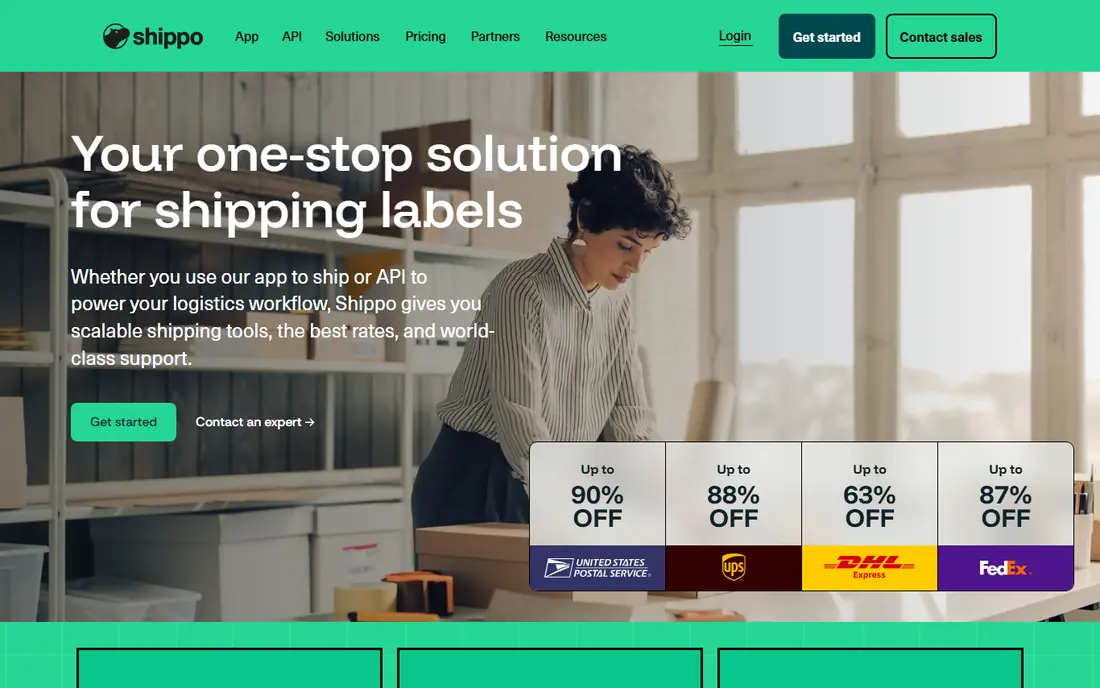
Shippo is a good first step for a store that is still finding its footing. The free tier lets a seller print labels and compare rates without committing to a monthly fee, and the interface stays simple for single orders. Its carrier list covers the major US carriers plus many international options, which is more than enough for most small stores.
We like Shippo for sellers who may later build custom checkout or fulfillment features, because API access is not locked behind an expensive plan. The trade off is that advanced returns and branded tracking are not its strongest areas, so larger brands may need a second tool for the post purchase experience.
- Free tier with labels each month
- Access to many carriers
- API on all plans
- Paid plan starts at $19 per month for higher label limits
- Returns tools are limited
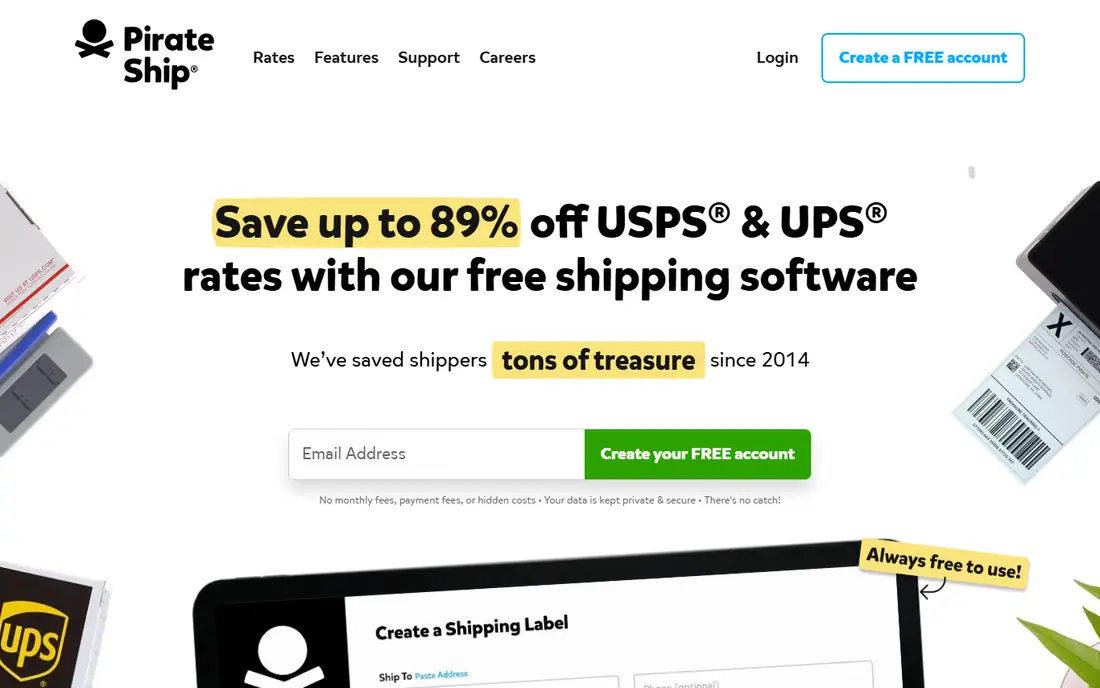
Pirate Ship does one job and does it with very little fuss. Sellers buy discounted labels, print them in batches, and move on, with no subscription to justify each month. For a shop that ships a few dozen parcels a week inside the United States, that simplicity is worth more than a long feature list.
The limit is obvious from the carrier list. If a seller needs FedEx, DHL, or a regional carrier, Pirate Ship will not cover it. It also lacks an API, so teams that want to build shipping into their own system should look at Shippo or EasyPost instead.
- No monthly fee
- Discounted USPS and UPS rates
- Simple label buying
- Only USPS and UPS
- No API for custom integrations
Easyship stands out when an order crosses a border. It can show landed costs, help with customs paperwork, and compare courier services that many US focused tools do not list. That reduces surprise fees for buyers and fewer support messages about held parcels for sellers.
For a purely domestic store, much of that power goes unused. The free tier is still useful for testing, but sellers who never ship abroad will get better value from a simpler domestic label tool. Check the per label fees on each plan too, since they add up at higher volumes.
- Duties and taxes shown at checkout
- Many international courier services
- Free tier for small volumes
- Paid plans start at $29 per month
- Domestic US sellers may not need its international depth
Veeqo is owned by Amazon, and that shows in its strengths. It handles orders from Amazon, Shopify, eBay, and other channels in one place, and it includes inventory management alongside shipping. For sellers who already live in the Amazon system, the fit is natural, and the free price removes the usual risk of trying a new tool.
The catch is that the most complete inventory features sit on paid plans, so a seller who needs full warehouse management should price that separately. Carrier coverage is also narrower than ShipStation, so check that your preferred carriers are supported before moving a whole catalog over.
- Free shipping software with unlimited users
- Inventory tools included
- Amazon and Shopify integrations
- Inventory features on paid plans cost extra
- Carrier list is narrower than ShipStation
ShippingEasy aims at sellers who want help getting started rather than a blank dashboard. Its setup guides, rate comparisons, and basic automation cover the daily work of a small store without a long learning curve. The free tier is a fair way to test whether the workflow suits a shop before paying.
As volume grows, the plan steps matter. A store that passes the free shipment limit moves to a paid plan, and larger stores may find the automation rules less flexible than ShipStation. It remains a solid middle choice for US sellers who value clear guidance over raw power.
- Discounted USPS and UPS rates
- Simple automation
- Free tier for up to 25 shipments per month
- Paid plans rise with shipment volume
- International options are less deep than Easyship
EasyPost is built for teams that want shipping inside their own software, not inside a separate dashboard. Its API lets developers rate, buy, track, and insure shipments from their own checkout or warehouse system. The free tier is generous for testing and for smaller technical projects.
That strength is also its weakness for ordinary store owners. A seller who wants a point and click dashboard with guided setup will find EasyPost more work than ShipStation or Shippo. It is best when a developer is already part of the team, or when label volume is high enough to justify custom integration.
- API first design
- Access to many carriers
- Free tier up to 3,000 labels per month
- Less friendly for non technical sellers
- Support and dashboard features suit technical teams
AfterShip Shipping appeals to stores that care about what happens after the label is printed. Buyers can follow a branded tracking page instead of a plain carrier page, which can cut "where is my order" messages. The label tool itself covers many carriers, so it does not feel like an add on bolted to a tracking product.
Sellers who only need cheap labels may find the wider platform more than they need. Some post purchase features also sit on higher tiers, so compare the full AfterShip pricing if branded tracking and returns are the main reason for choosing it.
- Label buying plus branded tracking
- Many label carriers
- Useful post purchase tools
- Shipping is part of a wider platform
- Some features need higher plans
How we picked these
We compared official pricing pages, carrier lists, integration pages, and public documentation for each tool, and we checked third party comparisons published in October 2026 for plan limits. We favored tools that are still actively sold in the United States, that publish clear pricing or a real free tier, and that truly fit ecommerce shipping rather than general freight or warehouse software. We did not claim hands on testing, and we used "See website" in other articles where a price could not be verified.
What to check before you choose
Start with your real monthly order count, not your hoped for count. A plan that looks cheap at 50 shipments can double in cost at 500 shipments, and a free tool can be cheaper than any paid plan until volume or automation needs change the math.
Next, list the carriers and sales channels you actually use. A tool with 200 carriers is no help if it lacks the one regional carrier your customers prefer, and a tool with deep Amazon support may matter less for a Shopify only store. Test label printing, returns, and tracking with a few real orders before moving a full catalog.
Finally, check international needs early. If even one in five orders goes abroad, duties, taxes, and customs forms deserve as much weight as the domestic label price. A tool that shows landed costs at checkout can prevent refused parcels and unhappy buyers, even if its monthly fee is higher.
Questions to ask on a trial
Ask how shipment caps are counted, whether unused labels roll over, and what happens when you exceed a cap mid month. Ask whether your own carrier rates can be connected, and whether that costs extra. Ask how returns are handled, since a cheap label tool with no returns flow can create manual work later.
Frequently asked questions
What is the best ecommerce shipping software for a small store?
For most small US stores, Pirate Ship or Shippo are strong starting points because they cost nothing to start and cover the main carriers. ShipStation becomes a better fit when orders come from several channels and automation rules would save real time each week.
Which ecommerce platform has the best shipping?
Shopify Shipping is convenient for Shopify only stores because it is built in, but it is not a separate shipping tool in this list. Among standalone tools, Veeqo and ShipStation offer the widest multichannel coverage, while Easyship leads for international orders.
What is the best shipping service for ecommerce?
The best service depends on destination and speed. USPS often wins for light parcels, UPS and FedEx often win for heavier or faster deliveries, and the tools above let sellers compare those rates side by side instead of guessing.
Is there a best shipping app for ecommerce that is free?
Yes. Pirate Ship, Veeqo, and the free tiers of Shippo, Easyship, and AfterShip Shipping all let sellers start without a monthly fee. Postage is still charged, and free tiers usually cap labels or shipments per month.
How much does ecommerce shipping software cost?
Costs range from free to about $15 to $30 per month for entry paid plans, with higher plans for larger volumes. Always add postage, per label fees, and any charge for connecting your own carrier accounts to get the true monthly total.
Sources
See where you really rank - block by block
ProMapRanker scans Google Maps across a grid of your service area. Simple monthly plans from $19, white-label on every plan.
Start freeKeep reading
 best employee time tracking app
Best Employee Time Tracking Apps in 2026
We compare the best employee time tracking app options for teams, from simple timers to shift tools, with honest notes on privacy and consent in 2026.
Read → best employee recognition software
Best Employee Recognition Software in 2026
We compared the best employee recognition software for peer praise, rewards, and service awards, with pricing, integrations, and honest limits for teams.
Read → best ehr software
Best EHR Software in 2026
Compare the best EHR software in 2026 for small practices, specialty groups and hospitals, with pricing models, charting and billing features compared in full.
Read →