 ProMapRanker
Best E-Merchandising Software in 2026

Key takeaways
- E-merchandising software shapes what shoppers see first: search results, category pages, recommendations, and promotions.
- Bloomreach and Constructor lead for large stores, while Searchspring and Doofinder suit mid-sized and smaller teams.
- Most enterprise tools are quote only, so budget by traffic, catalogue size, and modules, not by a public price list.
- Merchandisers still need control: pins, boosts, and business rules matter as much as any ranking model.
- Test with your own catalogue and traffic, and measure conversion and revenue per session, not clicks alone.
Quick comparison
| Pick | Great for | Pricing starts at | Free tier | |
|---|---|---|---|---|
 Bloomreach | Large stores unifying discovery | See website | No | Visit |
 Constructor | Revenue-focused product discovery | See website | No | Visit |
 Searchspring | Merchandiser-led search and browsing | See website | No | Visit |
 Nosto | Mid-market personalisation | See website | No | Visit |
 Algolia | Developer-flexible search | See website | Free trial | Visit |
 Klevu | Search and recommendations for mid-sized stores | See website | No | Visit |
 Dynamic Yield | Personalisation and testing at scale | See website | No | Visit |
 Doofinder | Smaller stores needing fast setup | $49 per month | Free trial | Visit |
The best e-merchandising software
E-merchandising software decides how products are searched, sorted, promoted, and recommended on an online store. It covers site search, category page ordering, product recommendations, and the rules merchandisers use to pin, boost, or hide items. The eight tools below serve that job for stores of different sizes, from a small shop needing fast setup to a large retailer with millions of sessions.
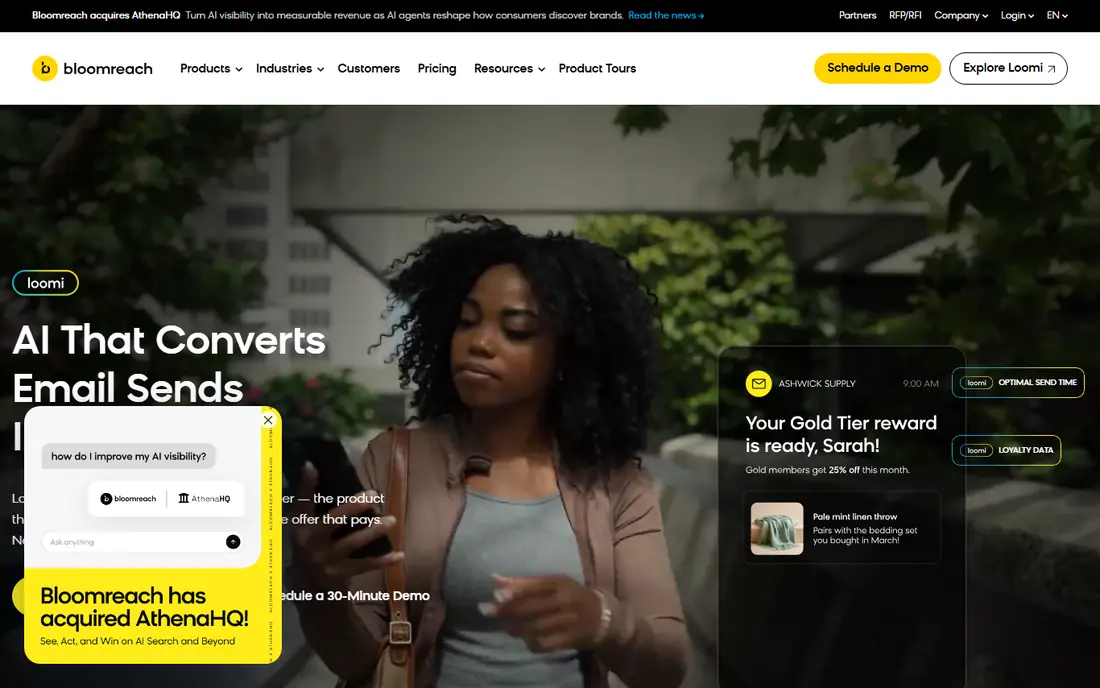
Bloomreach combines product discovery, merchandising, content, and marketing automation, with its Loomi AI layer shaping search and personalisation. For a large store, that breadth matters: search results, category pages, recommendations, and campaigns can draw on the same customer and product data, rather than living in separate tools with separate rules. Merchandisers can adjust ranking, test changes, and review performance in one place.
The catch is cost and scope. Pricing is quote-based, tied to traffic, catalogue size, and modules, and most brands in this tier spend at enterprise levels. Bloomreach fits best for large retailers that want one discovery platform across channels. Smaller stores should compare Searchspring, Nosto, or Doofinder first, and revisit Bloomreach when traffic and catalogue complexity justify it.
- Search, merchandising, and customer data in one platform
- Natural language search with AI assistance
- Strong fit for large brands
- Pricing is quote only and enterprise-level
- Implementation needs planning
- Smaller stores may not need the full suite
Constructor is an enterprise product discovery platform that ranks search and browse results to maximise conversion and basket value, rather than clicks alone. Its models learn from shopper behaviour at scale, and merchandisers can see per-product ranking scores, which makes the system unusually explainable for a machine-learning tool. That transparency helps merchandising teams trust, test, and adjust the ranking.
The trade-off is access. Constructor sells through an enterprise process, with proposals grounded in analysis of your own data, and no public pricing. It fits best for large retailers with high traffic, where small ranking gains pay for the platform. Mid-sized stores should shortlist Nosto or Searchspring instead, unless traffic and revenue already justify an enterprise contract.
- Ranking tuned to conversion and basket value
- Transparent per-product ranking scores
- Strong natural language handling
- Pricing is quote only and enterprise-level
- Sales process includes data analysis
- Smaller stores are not the target buyer
Searchspring is built only for ecommerce, and that focus shows in its merchandising tools. Teams can shape search results, category pages, and recommendations with rules, pins, boosts, and banners, while personalisation adjusts ordering for different shoppers. For merchandisers who want hands-on control over browsing, not just search, Searchspring is a natural pick.
The catch is price transparency. Public price lists have changed over time, and most buyers now get a quote based on traffic and modules, so get a written figure before judging value. Searchspring fits best for mid-sized to large stores where merchandisers run campaigns, seasons, and promotions and need to see the effect quickly. Test rule changes on a live category page during the trial, not just in a demo.
- Strong merchandising controls for search and category pages
- Recommendations and personalisation included
- Built only for ecommerce
- Pricing is quote only for most buyers
- Setup needs catalogue and merchandising planning
- Reporting depth varies by plan
Nosto is a commerce personalisation platform for mid-market stores, covering personalised search, category merchandising, recommendations, dynamic bundles, and on-site content. Shoppers see different ordering and offers based on behaviour and segment, while merchandisers keep control through rules, pins, and tests. That balance suits stores that want personalisation without a full enterprise build.
The trade-off is scale. Pricing depends on traffic, revenue, and modules, and personalisation quality improves as traffic grows, so very small stores may see less gain. Nosto fits best for growing stores with steady traffic that want recommendations and category personalisation in one package. Run a controlled test on one category first, and measure revenue per session before rolling it out store-wide.
- Personalised search, category merchandising, and recommendations in one platform
- Dynamic bundles and post-purchase offers
- Segment-based control
- Pricing is quote-based and tied to traffic and revenue
- Personalisation improves with traffic volume
- Setup can take time for small teams
Algolia is a search platform known for speed and developer flexibility, and many stores use it for product search, category browsing, and recommendations. Developers can tune ranking, synonyms, filters, and personalisation through APIs and rules, while merchandisers can adjust key settings once the build is in place. Analytics show what shoppers search for, what they find, and where they leave.
The catch is skill. Algolia rewards teams with developer time, and merchandisers without that support may find setup slower than with a packaged merchandising tool. It fits best for stores with developers on staff, or agencies that can build and maintain the integration. If your team is merchandiser-led with little developer help, Searchspring or Nosto will feel easier day to day.
- Fast, flexible search with deep developer control
- Strong analytics and ranking rules
- Works beyond ecommerce too
- Developer skill needed for best results
- Merchandising features need configuration
- Pricing depends on usage and plan
Klevu offers AI-powered site search, category merchandising, and product recommendations for mid-sized online stores. Its search understands shopper intent, including synonyms and natural phrases, and its merchandising tools let teams boost, pin, and promote products within search and category pages. Connectors for major ecommerce platforms shorten setup compared with a fully custom build.
The trade-off is comparison effort. Klevu is less widely covered than the largest rivals, so buyers should test it directly against Searchspring or Nosto on their own catalogue. It fits best for mid-sized stores that want AI search plus merchandising without enterprise pricing. Check synonym handling, filter behaviour, and mobile search during the trial, because those details shape daily shopper experience.
- AI search and recommendations tuned for commerce
- Category merchandising tools
- Connectors for major platforms
- Pricing is quote only
- Smaller brand presence than Bloomreach or Algolia
- Feature depth varies by plan
Dynamic Yield, part of Mastercard, is a personalisation and experimentation platform used by large retailers and brands. It covers product recommendations, personalised content, audience targeting, and A/B testing across web and app, so merchandisers and marketers can test different orderings, offers, and layouts for different shopper groups. That testing depth is its main advantage over search-only tools.
The catch is scale and skill. Pricing is enterprise and quote-based, and getting value needs staff who can design tests, read results, and act on them. Dynamic Yield fits best for large stores with steady traffic, where testing can reach clear results quickly. Smaller stores should start with a packaged merchandising tool and add a testing platform only when traffic supports reliable tests.
- Strong testing and personalisation across site and app
- Audience targeting and recommendations
- Part of Mastercard
- Pricing is quote only and enterprise-level
- Setup and testing need skilled staff
- Smaller stores may not need the full suite
Doofinder is the easiest entry point in this list for smaller stores. It offers site search with merchandising and recommendation features, public pricing from 49 dollars per month, and a setup that most small teams can complete without a large project. Search relevance, filters, and promotional tools cover the daily needs of a growing shop, and higher plans scale with catalogue and traffic.
The honest limit is depth. Doofinder will not match Constructor or Bloomreach on large-scale ranking models, testing, or enterprise personalisation, and very large catalogues may outgrow it. It fits best for small and mid-sized stores that want better search and merchandising this month, not after a long implementation. Start here if budget and speed matter most, and upgrade only when traffic proves the need.
- Public pricing from 49 dollars per month
- Fast setup for small and mid-sized stores
- Search, merchandising, and recommendations included
- Less depth than enterprise platforms
- Larger catalogues may need higher plans
- Advanced personalisation is more limited
How we picked these
We compared official product pages, pricing pages, and public reviews for e-merchandising tools that exist and work today, and we kept only tools that handle product search, category merchandising, or recommendations for online stores. We favoured a mix of enterprise discovery platforms, mid-market personalisation tools, a developer-flexible option, and a budget option with public pricing. Where pricing was quote only, we wrote See website rather than guessing. We did not claim hands-on testing, and we compared public pages, pricing, and documented features.
What to check before you buy e-merchandising software
Start with your own catalogue and traffic, not a vendor demo catalogue. Load your products, test search for misspellings, synonyms, and long phrases, and check category pages on mobile, where most shoppers now browse. Watch how filters, sorting, and out-of-stock items behave, because those details decide whether shoppers find products or leave.
Next, test merchandiser control. Pin a product, boost a promotion, hide an item, and run a simple A/B test, then check how fast changes go live and how clearly results are reported. If merchandisers cannot make and measure changes without developer help, the tool will slow campaigns and seasonal work. Also check integration with your ecommerce platform, analytics, and inventory, so stock and price changes flow through promptly.
Finally, agree on how success will be measured before you sign. Track conversion rate, revenue per session, search exit rate, and average order value on test and control groups, and compare like with like across seasons. Get a written price tied to traffic, catalogue size, and modules, and check what happens when traffic grows. A tool that looks cheap at signup can become expensive as the store grows, so model that growth now.
Frequently asked questions
What is the best e-merchandising software?
Bloomreach and Constructor lead for large stores, thanks to discovery depth and ranking quality, while Searchspring and Nosto suit mid-sized stores that want merchandiser control. Doofinder is the best starting point for smaller stores, thanks to fast setup and public pricing. The best choice depends on traffic, catalogue size, and team skill.
How does e-merchandising software differ from site search software?
Site search software finds products from a query, while e-merchandising software also shapes category pages, recommendations, promotions, and ordering rules. Many tools in this guide do both, but merchandising control, pins, boosts, and testing separate a full merchandising platform from a basic search box. Check both sides before you buy.
How much does e-merchandising software cost?
Most enterprise tools are quote only, with price tied to traffic, catalogue size, and modules, while Doofinder publishes pricing from 49 dollars per month. Get a written quote for your current traffic and catalogue, and ask how price changes as both grow. Budget separately for setup, integration, and staff time to run tests.
Do I still need merchandisers if the software uses AI ranking?
Yes. AI ranking learns from shopper behaviour, but merchandisers still set business rules, promotions, seasonal priorities, and brand standards. The best results come from AI ranking plus human control, with pins, boosts, and tests checked against revenue and conversion, not clicks alone.
How long does it take to see results from e-merchandising software?
Simple search and merchandising improvements can show within weeks, while personalisation and ranking models need traffic and time to learn. Run controlled tests on one category first, measure revenue per session, and allow several weeks before judging. Seasonal traffic can distort short tests, so compare similar periods where possible.
Sources
See where you really rank - block by block
ProMapRanker scans Google Maps across a grid of your service area. Simple monthly plans from $19, white-label on every plan.
Start freeKeep reading
 who has best internet service
Who Has the Best Internet Service in 2026
Who has best internet service for US homes? We compare fiber, cable, fixed wireless and satellite providers on speed, price, availability and terms today.
Read → which survey tool has the best analytics
Which Survey Tool Has the Best Analytics in 2026
Find which survey tool has the best analytics in 2026, comparing Qualtrics, SurveyMonkey, Typeform, Alchemer, and more on reports, text, and stats today.
Read → which streaming service has the best movies
Which Streaming Service Has the Best Movies in 2026
Answering which streaming service has the best movies, with Netflix, Max, Criterion and more compared on libraries, prices and free options in this guide.
Read →