 ProMapRanker
Best Data Annotation Companies in 2026

Key takeaways
- Scale AI and Labelbox suit large teams building production AI, while SuperAnnotate and V7 suit teams that want a usable platform without enterprise sales first.
- Appen and Sama suit large multilingual projects that need a managed workforce, not just software.
- Image annotation covers boxes, polygons and masks, but 3D, video and language work need specialist tools, so match the tool to your data type.
- Quality control matters more than raw speed: consensus review, gold tasks and audit trails catch errors that a fast label pass misses.
- Most enterprise pricing is quote-based, so pilot on a real sample and measure accuracy before you commit to a large volume.
Quick comparison
| Pick | Great for | Pricing starts at | Free tier | |
|---|---|---|---|---|
 Scale AI | Enterprise data and GenAI programmes | See website | No | Visit |
 Labelbox | Frontier labs and evaluation work | See website | Yes | Visit |
 Appen | Global multilingual data collection | See website | No | Visit |
 SuperAnnotate | Mid-market labeling pipelines | See website | Free trial | Visit |
 Encord | Multimodal and robotics data | See website | No | Visit |
 Sama | Managed workforce with impact focus | See website | No | Visit |
 CloudFactory | Managed teams for steady volume | See website | No | Visit |
 iMerit | Healthcare and regulated work | See website | No | Visit |
 V7 Labs | Image and video teams needing automation | See website | Free trial | Visit |
The best data annotation companies
We compared official platform pages, service descriptions and published 2026 comparisons for companies that label image, video, text, audio and 3D data for AI training. These cover both software platforms and managed workforce providers, since buyers need both models depending on team size and data type.
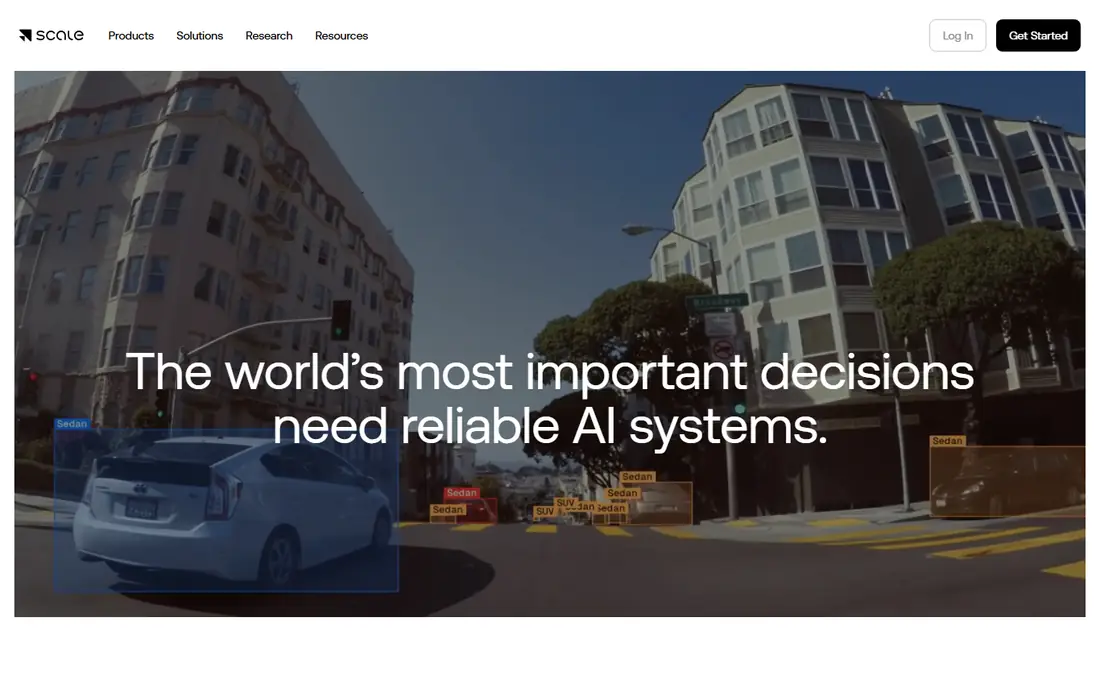
Scale AI is the enterprise pick for teams that need data at production scale. Its platform covers labeling, curation and evaluation, and its managed services can run large programmes that an in-house team could not staff alone. That breadth suits frontier labs and large companies building vision, language and multimodal models.
The trade-off is access and cost. Pricing is enterprise and sales-led, with published summaries pointing to large minimum commitments. Smaller teams should start with a self-serve platform and move to Scale when volume and governance needs justify it.
- Full data platform plus managed services
- Strong fit for large GenAI and vision programmes
- Broad data types
- Enterprise contracts and pricing
- Smaller teams may find it heavier than a self-serve tool
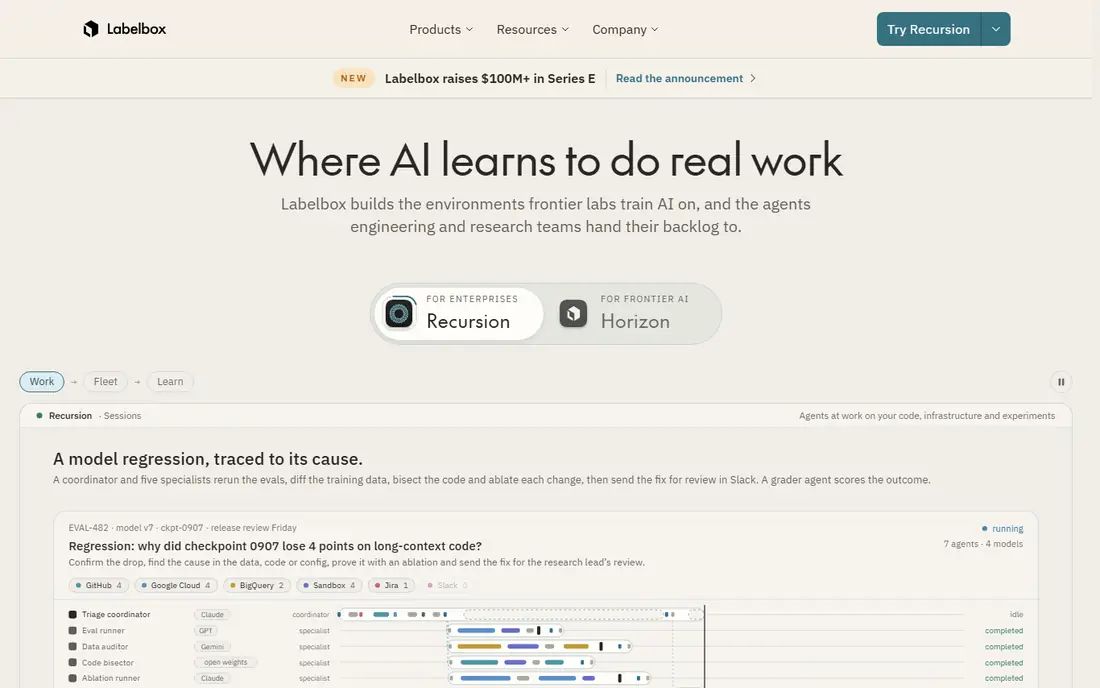
Labelbox combines a labeling platform with workforce services, and it has grown strongly in evaluation and reinforcement learning work for frontier labs. Teams can label images, video, text and documents, build evaluation tasks, and manage quality in one system. A free tier lets small teams test the platform before talking to sales.
Costs need careful modelling, since platform fees and workforce costs are separate. For a lab that needs both software and expert labelers, that split is normal, but budget both parts before you commit to a large programme.
- Platform plus expert workforce options
- Strong for RL environments and evaluations
- Free tier for getting started
- Workforce costs sit apart from platform pricing
- Enterprise features need a sales conversation
Appen suits large, multilingual projects that need many contributors across countries and languages. Its crowd platform can collect speech, text, image and search evaluation data at a scale few rivals match. That reach matters for global products that need local language data, not just English.
Quality control is the work. Crowd output varies, so buyers need gold tasks, reviewer checks and clear guidelines to keep accuracy up. Appen fits best when you have a quality process to run alongside the crowd, rather than expecting perfect labels with no review.
- Very large global crowd workforce
- Multilingual collection and evaluation
- Long history in data services
- Quality varies by task and language without strong controls
- Project minimums vary
SuperAnnotate gives mid-market teams a complete labeling pipeline without starting with an enterprise contract. It covers image, video and text, with AI-assisted tools that pre-label common objects and speed up human review. Team roles, progress tracking and export formats fit teams building an internal pipeline for the first time.
It is more than a casual tool, so very small projects may find a simpler open tool enough. For a team labeling regularly across several data types, SuperAnnotate balances usability, automation and control well.
- Image, video and text annotation in one platform
- AI-assisted labeling
- Team roles and project tracking
- Pricing is sales-led for larger plans
- Advanced features need a higher tier
Encord is built for teams working with complex data, including video, images and robotics or physical AI data. Its platform supports detailed annotation types, model-assisted labeling and quality workflows, with deployment options that include private cloud for sensitive data. That fit matters for healthcare, robotics and autonomous systems teams.
Pricing is enterprise, and the platform is aimed at production teams rather than hobby projects. If your data is mainly simple image boxes, a lighter tool may be cheaper. For multimodal production work, Encord is a strong shortlist pick.
- Strong multimodal support including video and 3D
- Cloud and private deployment options
- Automation and active learning
- Enterprise pricing
- Less suited to a tiny one-off labeling job
Sama provides a managed workforce for data annotation, with a focus on training, quality and worker welfare in its published model. Clients hand over data and guidelines, and Sama teams label, review and deliver it, which suits companies without an internal labeling team. Computer vision work is a core strength.
It is not a self-serve platform you can try in an afternoon. Pricing is project-based and enterprise-focused, so it fits companies with steady, larger volumes that want a managed service rather than software alone.
- Managed workforce model
- Focus on training and worker welfare
- Strong for computer vision at scale
- Project-based enterprise pricing
- Less of a self-serve software product
CloudFactory offers managed labeling teams that work on your data over time, learning your edge cases and guidelines as they go. That continuity helps accuracy on long-running projects, where a rotating crowd can drift. Its model suits companies with steady weekly volume rather than a single burst of labeling.
Pricing is custom and volume-based, so small or one-off projects may be a poor fit. For a company that needs reliable, ongoing labeling without hiring its own team, CloudFactory is a practical managed option.
- Managed teams that learn your guidelines over time
- Steady-volume focus
- Quality workflows
- Custom quotes with volume expectations
- Not a quick self-serve signup
iMerit combines a managed workforce with a platform, and it is often shortlisted for healthcare and other regulated work where accuracy and handling rules matter. Expert reviewers, domain training and quality checks are central to its model, which helps on medical imaging, documents and other sensitive data types.
As a managed provider, it is enterprise and sales-led, not a free trial tool. Teams in regulated industries should ask about security certifications, data handling and audit trails early, since those controls often decide the choice more than price alone.
- Managed workforce plus platform
- Strength in healthcare and regulated data
- Expert-led quality processes
- Enterprise contracts
- Narrower self-serve path than platform-only tools
V7 Labs, formerly known for its Darwin platform, gives image and video teams a modern annotation tool with strong automation. AI-assisted labeling can pre-label objects, and reviewers can correct and approve work in a clear workflow. That speed helps teams with large image and video datasets who still need human-checked accuracy.
Smaller teams can test it, but larger production use moves to sales-led pricing. For vision teams that want automation without losing review control, V7 is a strong alternative to Labelbox and SuperAnnotate.
- Strong image and video annotation
- AI-assisted labeling and auto-annotation
- Flexible workflow and review tools
- Pricing for larger teams is sales-led
- Some advanced AI features need a higher plan
How we picked these
We compared official platform and service pages plus published 2026 annotation comparisons, and checked that each company still offers annotation services or software in October 2026. We favoured companies with clear data type coverage, quality workflows and security information. We left out pure crowdsourcing marketplaces with no annotation platform or managed quality process, and tools that only annotate documents for review rather than AI training.
What to check before you buy
Start with your data type. Image boxes, segmentation masks, video tracking, 3D point clouds, text entities and audio transcription each need different tools, and a platform strong on images may be weak on 3D. List your data types, volumes and accuracy targets before you talk to vendors.
Next, pilot on a real sample with your own guidelines. Measure accuracy against a gold set, check how the tool handles edge cases, and test export formats against your training pipeline. Also ask about security: data handling, access controls, certifications and whether your data is used to train vendor models.
Finally, model total cost, not just platform fees. Include workforce costs, review time, rework and management overhead. A cheap per-label price with high rework can cost more than a managed service with a higher headline rate but cleaner output.
Frequently asked questions
What is the best data annotation company for image annotation?
For image work, Labelbox, SuperAnnotate and V7 Labs are strong platform picks, while Sama and CloudFactory suit managed image programmes. The best choice depends on whether you want software, a managed team, or both, and on image volume and complexity.
How much does data annotation cost?
Most enterprise pricing is quote-based and depends on data type, volume, complexity and quality requirements. Platform fees, workforce costs and review time all add to the total, so ask for a pilot price on a real sample before committing to a large volume.
What is the difference between a platform and a managed workforce?
A platform gives you software to label data with your own team, while a managed workforce provider labels the data for you with its own trained team. Some companies, such as Labelbox and iMerit, offer both, which suits teams that want software plus expert help on complex tasks.
How do annotation companies check quality?
Common methods include consensus review by multiple labelers, gold tasks with known answers, reviewer audits, and automated checks for missing or inconsistent labels. Ask how a provider measures accuracy, how errors are corrected, and whether you get an audit trail for each label.
Is my data safe with an annotation company?
It depends on the provider and contract. Ask about access controls, security certifications, data retention, and whether your data is used to train other models. For sensitive or regulated data, private deployment or a managed provider with clear handling rules may be required.
Sources
See where you really rank - block by block
ProMapRanker scans Google Maps across a grid of your service area. Simple monthly plans from $19, white-label on every plan.
Start freeKeep reading
 who has best internet service
Who Has the Best Internet Service in 2026
Who has best internet service for US homes? We compare fiber, cable, fixed wireless and satellite providers on speed, price, availability and terms today.
Read → which survey tool has the best analytics
Which Survey Tool Has the Best Analytics in 2026
Find which survey tool has the best analytics in 2026, comparing Qualtrics, SurveyMonkey, Typeform, Alchemer, and more on reports, text, and stats today.
Read → which streaming service has the best movies
Which Streaming Service Has the Best Movies in 2026
Answering which streaming service has the best movies, with Netflix, Max, Criterion and more compared on libraries, prices and free options in this guide.
Read →