 ProMapRanker
Best Customer Journey Orchestration Tools in 2026


Mobile-first brands needing real-time journeys · Pricing starts at: See website
Key takeaways
- Braze leads for mobile-first, real-time journeys, while Salesforce Marketing Cloud leads for teams standardized on Salesforce.
- Adobe Journey Optimizer suits enterprises that already run Adobe data and content tools.
- Iterable and MoEngage are the more approachable enterprise options, with Iterable winning on workflow ease and MoEngage on marketer-friendly builds.
- Most tools in this list use quoted pricing, so budget for implementation and data work alongside the license.
Quick comparison
| Pick | Great for | Pricing starts at | Free tier | |
|---|---|---|---|---|
| Braze | Mobile-first brands needing real-time journeys | See website | No | Visit |
 Salesforce Marketing Cloud | Teams standardized on Salesforce | See website | No | Visit |
 Adobe Journey Optimizer | Enterprises running Adobe data tools | See website | No | Visit |
 Iterable | Cross-channel lifecycle teams | See website | No | Visit |
 MoEngage | Teams that want marketer-friendly flows | See website | No | Visit |
 Insider One | Personalized journeys for commerce and media | See website | No | Visit |
 Bloomreach | Commerce teams needing data plus journeys | See website | No | Visit |
 Cordial | Retail and media messaging teams | See website | No | Visit |
 Genesys Cloud | Contact centers adding journey orchestration | See website | No | Visit |
The best customer journey orchestration tools
We compared official product pages, journey builder documentation, and channel coverage for tools that coordinate messages across email, push, SMS, in-app, and web. Journey orchestration here means timed, triggered, branching paths across channels, not a single campaign send.
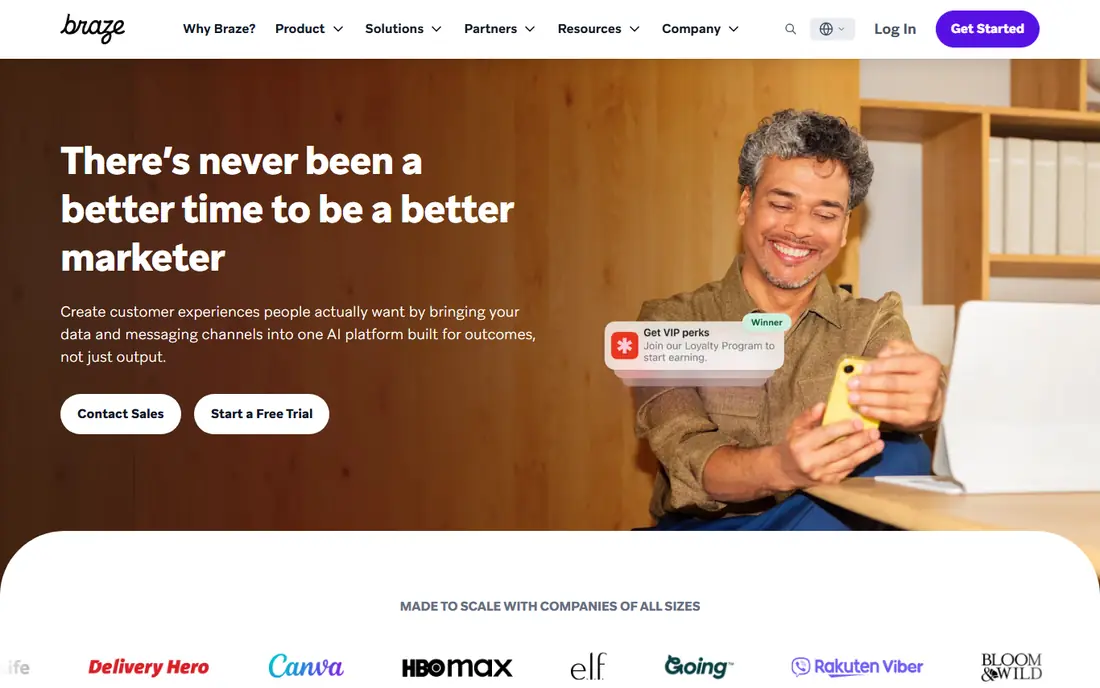
Braze fits consumer brands whose customers live on mobile. Its Canvas builder lets marketers design multi-step journeys with branching, waits, experiments, and message paths across push, in-app, email, SMS, and WhatsApp. Real-time triggers mean a purchase, a browse, or a long silence can start a relevant path within minutes, not overnight.
The catch is cost and setup. Pricing is quoted and sits at enterprise levels, and teams need clean event data to get full value. For mobile-first brands with the budget and data team to run it, Braze is the leading pick in this list.
- Canvas builder for multi-step, event-triggered journeys
- Broad channel coverage
- Real-time triggers and experiments
- Quoted pricing at enterprise levels
- Data setup needs technical input
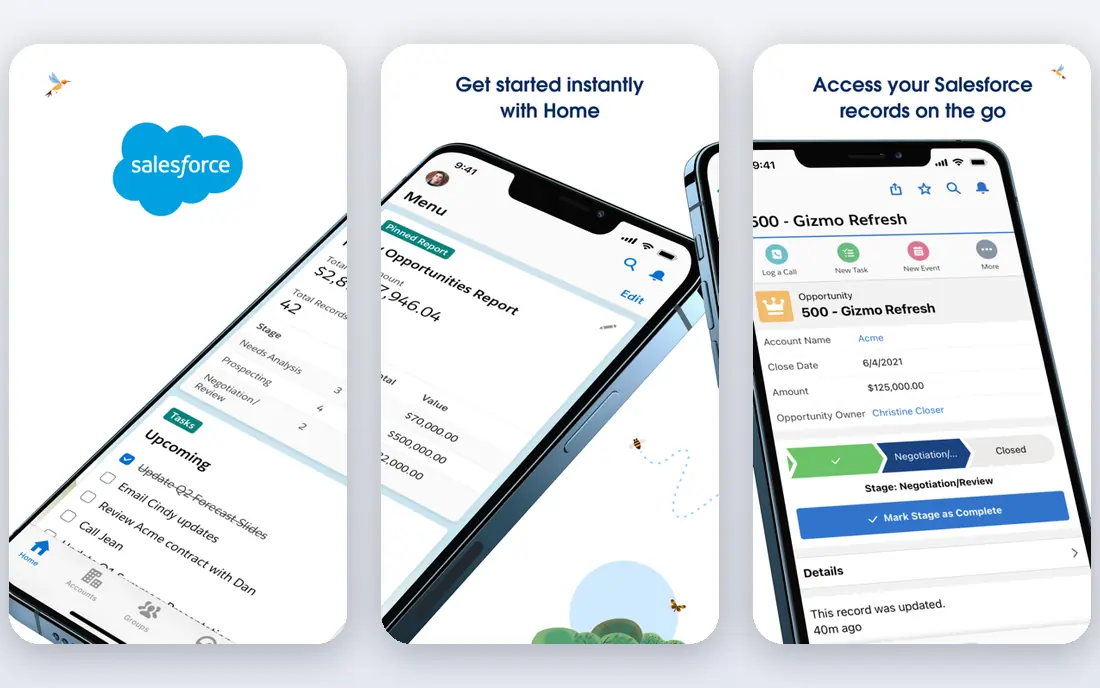
Salesforce Marketing Cloud suits companies that already run Salesforce CRM and want journeys built on the same customer records. Journey Builder supports single sends, transactional messages, and multi-step paths, with Einstein AI features for scoring and send-time suggestions. The permission and approval model also suits large teams with many stakeholders.
The tradeoff is complexity. New teams face a steep learning curve, and pricing is quoted by organization and edition. For Salesforce-centered companies, the shared data and governance outweigh those costs, while teams outside Salesforce should compare Braze or Iterable first.
- Journey Builder tied to Salesforce CRM data
- Governed multi-user setup
- Broad channel and advertising options
- Quoted pricing
- Learning curve is steep for new teams
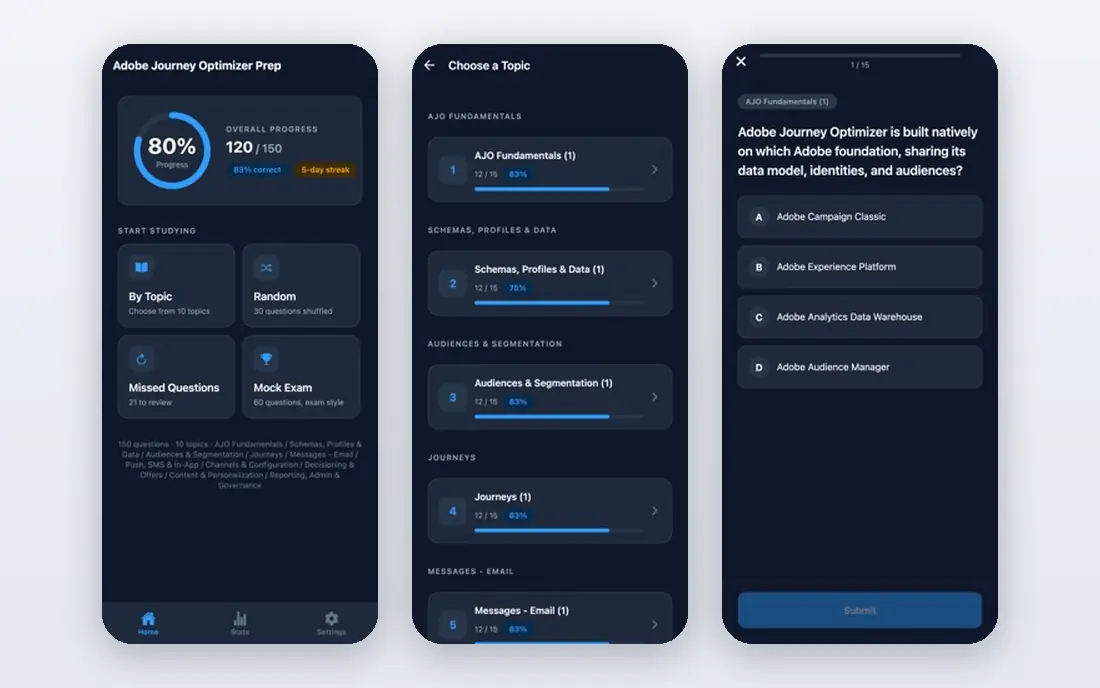
Adobe Journey Optimizer fits enterprises that already use Adobe Experience Platform and Real-Time CDP. Journeys draw on unified profiles, so a web visit, a purchase, and a support case can shape the next message in one path. Personalization tools help tailor content, offers, and timing, and the platform supports governed, large-scale programs.
The catch is stack dependence. Journey Optimizer works best inside Adobe licensing, and implementation is a real project. For Adobe-centered enterprises, it is a strong pick, while other teams will find a standalone tool faster to adopt.
- Journeys built on Adobe real-time profiles
- Strong personalization and content tools
- Enterprise governance
- Quoted pricing
- Needs Adobe platform licensing and setup
Iterable suits growth and lifecycle teams that need email, push, SMS, and in-app messages in one workflow. Its builder handles branching, experiments, and audience paths without forcing marketers into code for common cases. AI features support send-time choice and content help, and the platform scales to large consumer audiences.
The tradeoff is that pricing is quoted, and teams with complex data pipelines still need engineering support. For midsize and large consumer brands that want a workflow-first tool, Iterable is one of the most balanced picks here.
- Visual workflow builder for journeys
- Strong cross-channel orchestration
- AI help for send time and content
- Quoted pricing
- Advanced data setups still need technical help
MoEngage fits teams that want strong journey tools without a heavy technical ramp. Its Flows builder supports event-triggered branching, path optimization, and cross-channel steps across email, push, SMS, WhatsApp, and in-app messages. Push Amplification helps improve delivery on devices that restrict notifications, and analytics show journey performance in plain terms.
The limit is depth for the most complex cases, where some users report friction with intricate logic. Pricing is also quoted, so budgeting needs a sales conversation. For retail, travel, finance, and consumer goods teams, MoEngage is a friendly and capable pick.
- Flows builder that non-technical marketers can run
- Real-time analytics
- Broad channel coverage
- Quoted pricing
- Very complex use cases can hit limits
Insider One suits midsize and enterprise brands that want journeys, on-site personalization, and messaging in one platform. Predictive segments help teams target likely buyers or churn risks, and journey automation covers web, mobile, email, push, and messaging apps. That breadth helps commerce and media teams run one program instead of several point tools.
The catch is setup depth. The platform is easy for basic journeys, but the full personalization layer needs data mapping and testing. For teams that want personalization and journeys together, Insider One is a strong shortlist pick.
- Unified platform for journeys, personalization, and messaging
- Predictive segmentation
- Broad channel support
- Quoted pricing
- Deeper features need setup time
Bloomreach combines a customer data platform with engagement tools, so journeys can draw on unified commerce data without a separate CDP project. AI features support personalization, product recommendations, and content, and journeys cover email, SMS, push, and web. That pairing suits retailers and direct-to-consumer brands with large catalogs.
The tradeoff is sector fit and cost. Non-commerce teams will find less value in the commerce depth, and pricing is quoted. For retailers that want data and journeys together, Bloomreach is a compelling option.
- Customer data platform plus engagement in one product
- AI personalization
- Commerce-focused journeys
- Quoted pricing
- Best value for commerce, less so for other sectors
Cordial fits retail and media teams that want messaging built on native customer data, rather than a journey tool bolted onto a separate database. Journeys support email, SMS, and push with data-driven segments, and newer AI agent features help with campaign work. Global SMS expansion also helps brands with international audiences.
The limit is visibility. Cordial is less widely discussed than the largest platforms, so buyers should ask for references in their own sector. For retail teams that want data and messaging in one place, it deserves a trial.
- Native customer data plus orchestration
- Strong email and SMS journeys
- AI agents for messaging work
- Quoted pricing
- Smaller public community than Braze or Salesforce
Genesys Cloud suits companies where the journey includes service, not just marketing. Its journey orchestration links web behavior, predictive engagement, and contact center routing, so a struggling customer can be offered help at the right moment. Analytics show where journeys break, and AI features support agent assistance and automation.
The catch is focus. Pure marketing teams that only need email and push journeys will find a marketing platform simpler. For service-led companies, Genesys turns journey data into staffing and routing decisions, which marketing tools do not.
- Journey analytics tied to contact center work
- Predictive engagement
- Agentic AI features for service paths
- Quoted pricing
- Best value for service-led journeys, not pure marketing sends
How we picked these
We compared official product pages, journey builder documentation, and channel coverage, and we checked each homepage listed here. We favored tools with a live product in October 2026, real cross-channel orchestration, and a clear enterprise or midmarket customer base. We left out single-channel senders and mapping-only tools with no message execution.
What to check before you buy
Start with entry triggers and exit rules, not the canvas screenshot. Confirm which events can start a journey, how fast triggers fire, how suppression and frequency caps work, and how a customer leaves a path. Test one real journey end to end, including a branch, a wait, an experiment, and a suppression case, before signing.
Data and identity
Check how profiles are built, how identities merge across devices and channels, and how fast segments refresh. A journey that runs on stale data will send the wrong message at the wrong time. Confirm which data sources are native, which need a CDP, and who owns that pipeline.
Channels and consent
Confirm which channels are native in your region, which need partners, and how consent and opt-outs sync across them. A tool that covers WhatsApp in one market may not cover it in yours, and SMS costs vary by country. Test consent handling on every channel you plan to use.
Frequently asked questions
What is the best customer journey orchestration tool for a small business?
Most tools in this list are enterprise-priced, so small businesses should start with a marketing automation tool and move to orchestration when cross-channel journeys become complex. Braze, Iterable, and MoEngage suit growing teams once that point arrives.
What is the difference between journey orchestration and marketing automation?
Marketing automation usually covers email-led campaigns and lead nurture, while orchestration coordinates timed, triggered paths across many channels from one customer view. Orchestration also adds real-time triggers, suppression, and journey analytics.
Which tool is best for mobile apps?
Braze leads for mobile-first journeys, with push, in-app, and real-time triggers built for app audiences. MoEngage and Iterable are strong alternatives for app teams that want a gentler setup.
Do these tools need a CDP?
Some include data platform features, such as Bloomreach and Cordial, while others work best beside a CDP or a clean warehouse feed. Check profile building and segment refresh speed during a trial, since that decides whether a separate CDP is needed.
How much do journey orchestration tools cost?
Most enterprise tools in this list use quoted pricing, and costs vary with audience size, channels, and message volume. Budget for implementation and data work on top of the license, and ask for a full-year cost model before signing.
Can I run journeys without coding?
Yes, most builders here are visual and marketer-friendly for common paths, but complex data, custom channels, and advanced logic still need technical help. Test your hardest journey in a trial, not just a welcome series.
Sources
See where you really rank - block by block
ProMapRanker scans Google Maps across a grid of your service area. Simple monthly plans from $19, white-label on every plan.
Start freeKeep reading
 who has best internet service
Who Has the Best Internet Service in 2026
Who has best internet service for US homes? We compare fiber, cable, fixed wireless and satellite providers on speed, price, availability and terms today.
Read → which survey tool has the best analytics
Which Survey Tool Has the Best Analytics in 2026
Find which survey tool has the best analytics in 2026, comparing Qualtrics, SurveyMonkey, Typeform, Alchemer, and more on reports, text, and stats today.
Read → which streaming service has the best movies
Which Streaming Service Has the Best Movies in 2026
Answering which streaming service has the best movies, with Netflix, Max, Criterion and more compared on libraries, prices and free options in this guide.
Read →