 ProMapRanker
Best Customer Engagement Platforms in 2026

Key takeaways
- Braze and Iterable suit large lifecycle teams, while Intercom and Zendesk suit teams that blend messaging with support.
- HubSpot suits teams already using its CRM, because engagement data stays on one customer record.
- Pricing models differ sharply: per-seat, per-contact, and quote-based plans can produce very different totals for the same team.
- Start with your main channel and your main job, whether that is support, email, or cross-channel campaigns, rather than buying every channel at once.
Quick comparison
| Pick | Great for | Pricing starts at | Free tier | |
|---|---|---|---|---|
 Braze | Enterprise cross-channel lifecycle | See website | No | Visit |
 Intercom | In-app messaging and support | $29 per seat per month | Free trial | Visit |
 Zendesk | Ticket-based customer service | $19 per agent per month | Free trial | Visit |
 HubSpot | CRM-centred engagement | Free | Yes | Visit |
 Klaviyo | Ecommerce email and SMS | Free | Yes | Visit |
 Iterable | Cross-channel campaign orchestration | See website | No | Visit |
 Salesforce Marketing Cloud | Enterprise marketing at scale | See website | No | Visit |
 ActiveCampaign | Marketing automation for small teams | $15 per month | Free trial | Visit |
 Freshdesk | Affordable helpdesk support | Free | Yes | Visit |
The best customer engagement platforms
We compared engagement platforms on channels, automation, support workflows, CRM and data connections, and pricing model. Some tools here are mainly messaging platforms, some are mainly support platforms, and some are mainly campaign platforms, so the right pick depends on the job you need done first.
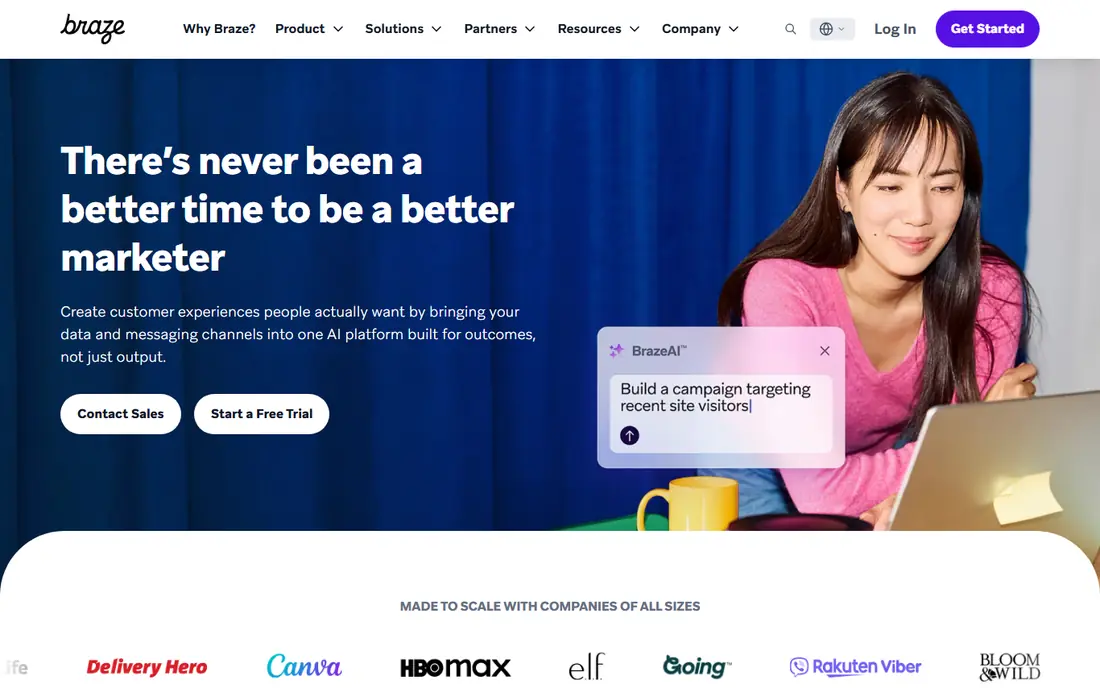
Braze is an enterprise customer engagement platform built for cross-channel lifecycle messaging at scale. Teams can orchestrate email, push, SMS, WhatsApp, in-app messages, and web messages from one journey canvas, using customer data in real time. That breadth suits large consumer brands with many channels and a dedicated lifecycle team.
The drawback is access and cost. Braze works through a sales process with custom quotes, and there is no free tier to test the full platform casually. Small teams that only need email and push will find it more than they need, and will pay for depth they do not use. For a large brand with complex journeys, though, Braze is one of the most complete options on this list.
- Broad channel coverage from one canvas
- Real-time data and journey orchestration
- Built for large message volumes
- Quote-only pricing
- No self-serve start
- Needs dedicated lifecycle staff to get full value
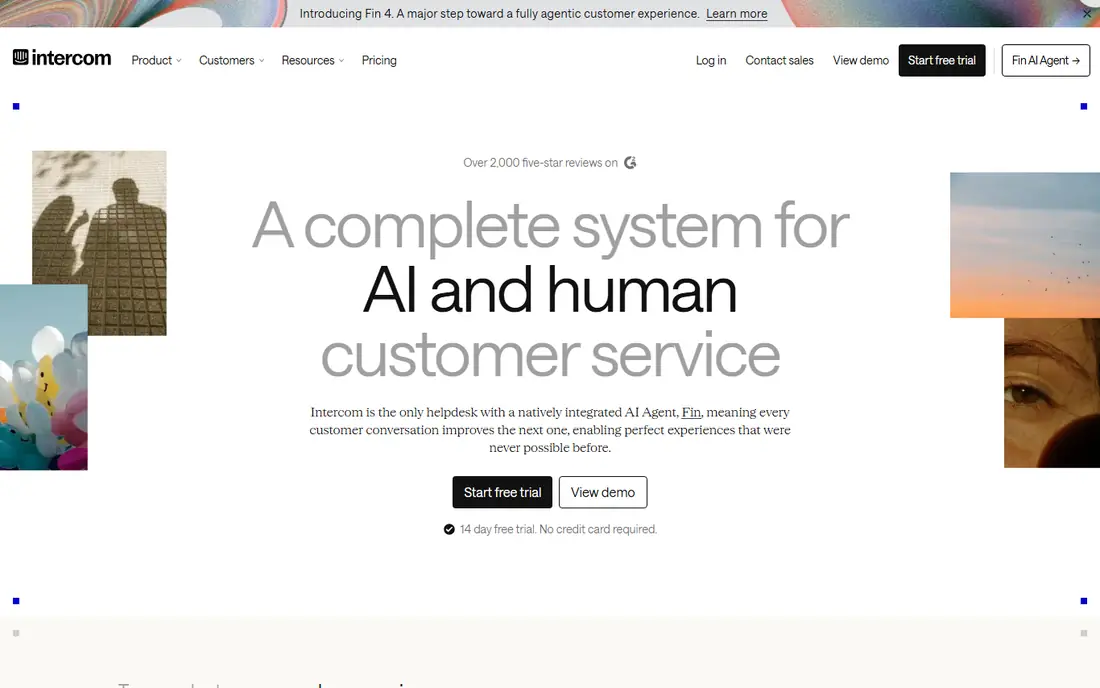
Intercom blends lifecycle messaging with customer support, which suits product-led companies that talk to users inside their own app. The Messenger handles live chat and in-app messages, the help centre supports self-service, and ticketing keeps follow-up work organised. Product tours and guides help onboard new users without a separate tool.
Pricing starts at $29 per seat per month for the Essential plan in sources checked in 2026, with higher plans adding workflow automation and compliance features. AI resolutions are charged separately on some plans, so a team with high support volume should model that cost. If your main engagement happens inside a product, Intercom is a strong, focused pick.
- Messenger, help centre, and ticketing in one place
- AI agent for common questions
- Product tours and in-app guides
- Costs rise with seats and AI resolutions
- Advanced automation sits on higher plans
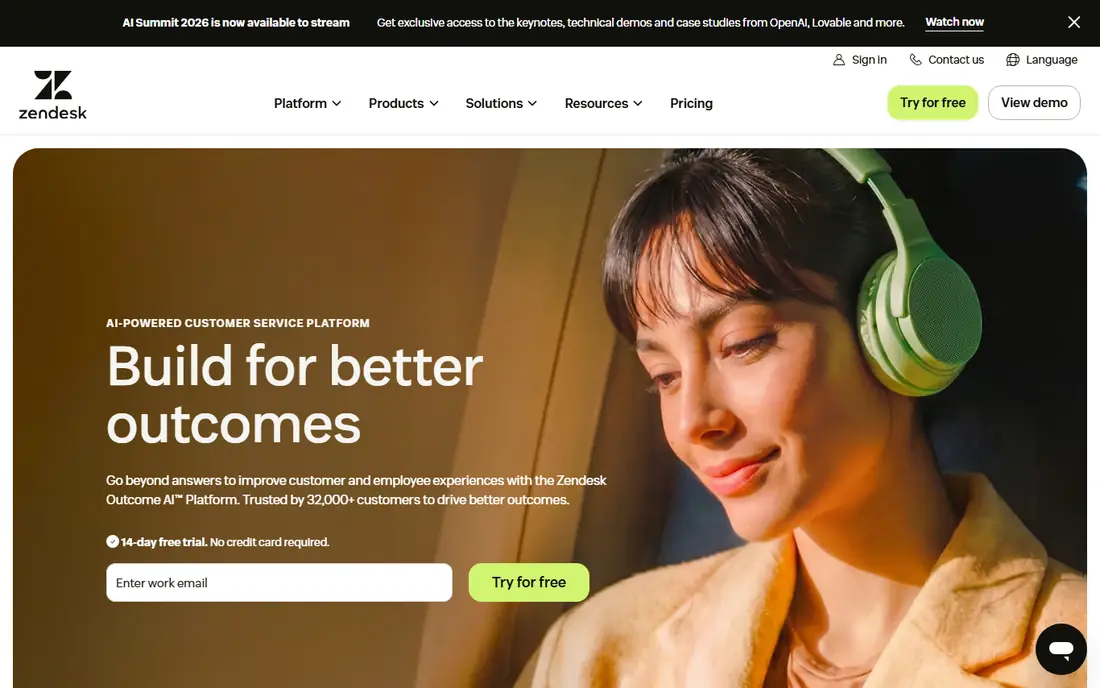
Zendesk is a customer service platform centred on ticketing, routing, and agent workflows. It brings email, chat, phone, and social messages into one agent workspace, with automations, triggers, and reporting to manage volume. That structure suits service teams that need clear ownership of each request and a record of how it was resolved.
Entry pricing is listed from $19 per agent per month in sources checked in 2026, but the full feature set spreads across higher plans, and admin setup takes time. A small team with simple chat needs may find Zendesk heavier than Intercom or Freshdesk. A larger service team that lives in tickets, however, will value its routing depth and reporting.
- Mature ticketing and routing
- Wide channel coverage
- Strong reporting and automation for service teams
- Full suite can feel complex for small teams
- Higher plans add cost quickly
- Setup needs admin time
HubSpot suits teams that already use, or want to use, one CRM for marketing, sales, and service. Engagement tools sit on the same customer record, so a support conversation, a marketing email, and a sales note can be seen together. Free tools cover basic CRM, forms, and email, which makes it easy to start without a sales call.
The cost picture changes as you add hubs. Service Hub and Marketing Hub have their own paid tiers, charged per seat, and the total can grow quickly for a larger team. Onboarding is also a separate cost on some plans. If your team already lives in HubSpot, the shared record is a real advantage. If you only need one channel, a focused tool may be cheaper.
- Shared CRM record across marketing, sales, and service
- Free tools to start
- Broad hub structure
- Paid hubs add cost per seat
- Advanced features spread across hubs
- Onboarding can be an extra cost
Klaviyo is built for ecommerce engagement, with email and SMS campaigns and automated flows driven by store data. Abandoned cart, post-purchase, welcome, and win-back flows are core use cases, and the platform connects with major ecommerce systems. For an online store, that data link means messages can reflect what a customer actually bought or browsed.
A free plan covers small lists, with paid pricing scaling by contacts and message volume, so costs grow as the list grows. That is fair, but a store with a large list and heavy SMS use should model both email and SMS costs together. Outside ecommerce, Klaviyo is less compelling, since its strength is store data rather than general support or in-app messaging.
- Strong ecommerce data and flows
- Email and SMS in one platform
- Free plan for small lists
- Pricing rises with contacts and SMS volume
- Best fit is ecommerce, less so for other industries
Iterable is a cross-channel marketing platform for teams that run email, push, SMS, and in-app campaigns from one journey builder. Segmentation and personalisation are central, and campaigns can react to customer behaviour across channels. That suits mid-size and large consumer brands with a lifecycle team and a clear campaign calendar.
Pricing is quote-based, so smaller teams cannot compare it quickly against a published price, and the platform is not a helpdesk replacement. If your main need is support tickets, pair Iterable with a support tool rather than expecting it to cover both jobs. If your main need is campaign orchestration at scale, it is a strong rival to Braze.
- Cross-channel journey building
- Strong segmentation
- AI-assisted campaign tools for larger teams
- Quote-based pricing
- Needs marketing operations skill
- Not a support helpdesk
Salesforce Marketing Cloud is the enterprise marketing arm of Salesforce, built for large programs that run across email, mobile, social, and advertising channels. Journey Builder lets teams design multi-step campaigns, and data tools connect customer records from across the Salesforce system. For a company already on Salesforce, that shared data is a major advantage.
The trade-offs are cost and complexity. Pricing is quote-based, setup can be involved, and most teams need skilled admins or implementation help to use the platform well. A small team will find it slow to start and expensive to run. A large enterprise with a Salesforce estate and a dedicated marketing operations team will get the most from it.
- Deep Salesforce ecosystem
- Journey builder and data tools for large programs
- Wide channel options
- Quote-based pricing
- Complex setup
- Needs skilled admins and often implementation help
ActiveCampaign combines email marketing, automation, and a small CRM in one tool, which suits small and mid-size teams that want behaviour-based journeys without enterprise cost. The automation builder can trigger emails from site visits, purchases, or form fills, and segmentation keeps messages relevant. Entry pricing starts at $15 per month in sources checked in 2026.
It is not a full support platform, so teams with heavy ticket volume will still need a helpdesk. Pricing also rises with contacts, so a growing list should be modelled over time. For a team whose main engagement job is email automation and lead nurturing, ActiveCampaign offers a practical balance of power and price.
- Automation builder for email and CRM
- Affordable entry price
- Good fit for small and mid-size teams
- Support features are limited compared with Zendesk
- Pricing rises with contacts
- Learning curve for complex automations
Freshdesk is an affordable helpdesk from Freshworks, built for teams whose main engagement job is answering customers well. Ticketing, a knowledge base, and chat cover the core support workflow, and the free plan supports a small team getting started. Setup is simpler than larger service suites, which helps a small team go live quickly.
The limit is scope. Freshdesk does not match Braze or Iterable for cross-channel lifecycle campaigns, and its strength is support rather than marketing journeys. If your team mainly needs to resolve requests and help customers help themselves, Freshdesk is a sensible, low-cost pick. If you need campaign orchestration too, pair it with a marketing tool.
- Free plan for small teams
- Ticketing, knowledge base, and chat
- Simple setup for support-first teams
- Lifecycle messaging is limited
- Advanced automation needs paid plans
- Reporting depth grows only on higher tiers
How we picked these
We compared official product and pricing pages, plus recent independent comparisons checked in October 2026. We kept platforms that are live, that cover at least one major engagement channel well, and that serve a clear team type, from small support teams to enterprise lifecycle teams. We included support-led, CRM-led, ecommerce-led, and campaign-led tools, so the list reflects how differently teams define engagement in practice.
What to check before you buy
Name your main job first. Support teams should weight ticket routing, agent workspace, and self-service. Marketing teams should weight journey building, segmentation, and channel coverage. Ecommerce teams should weight store data and SMS costs. Buying a platform for a job it does not lead on usually means paying for unused depth.
Next, model the full price, not the headline price. Per-seat costs grow with headcount, per-contact costs grow with list size, and AI resolutions or SMS credits can add a separate bill. Ask for a quote based on your actual seats, contacts, and message volume, and trial the workflow your team will use daily, not just a demo journey. Finally, check data connections: engagement is only as good as the customer record behind it, so confirm CRM, store, and app connections before you commit.
Frequently asked questions
What is the best customer engagement platform?
There is no one winner. Braze and Iterable suit large cross-channel campaign teams, Intercom suits in-app messaging and support, Zendesk suits ticket-based service, and HubSpot suits CRM-centred teams. Pick by your main channel and team size, not by feature count alone.
What is the best customer engagement software for small businesses?
Freshdesk, HubSpot free tools, and ActiveCampaign are good small-business starting points, because they offer free or low-cost entry and simpler setup. Klaviyo suits small ecommerce stores. Start with one clear job, such as support or email automation, before adding more channels.
How much do customer engagement platforms cost?
It varies by model. Sources checked in 2026 list Intercom from $29 per seat per month, Zendesk from $19 per agent per month, and ActiveCampaign from $15 per month, while Braze, Iterable, and Salesforce use quote-based pricing. Always model seats, contacts, and message volume together.
Is a CRM the same as a customer engagement platform?
No. A CRM stores customer data and manages relationships, while an engagement platform acts on that data to run conversations and campaigns. Most teams use both, connected, so the engagement tool works from the CRM record rather than from a separate list.
Which platform is best for email and SMS together?
Klaviyo is a strong pick for ecommerce email and SMS, while Braze and Iterable cover email, SMS, push, and in-app messages for larger brands. Check SMS pricing separately, since SMS credits can change the total cost more than the email plan alone.
Sources
See where you really rank - block by block
ProMapRanker scans Google Maps across a grid of your service area. Simple monthly plans from $19, white-label on every plan.
Start freeKeep reading
 best freelance platforms for beginners
Best Freelance Platforms for Beginners in 2026
Best freelance platforms for beginners compared, with fees, job types, and first-gig tips to help new freelancers pick a strong starting place in our guide.
Read → best foreign language apps
Best Foreign Language Apps in 2026
Best foreign language apps compared in 2026: Duolingo, Babbel, Rosetta Stone, Pimsleur and more, with prices, free plans and honest trade-offs for learners.
Read → best foraging apps for plant identification
Best Foraging Apps for Plant Identification in 2026
These 8 best foraging apps for plant identification help you name wild plants, but never eat a plant based on an app alone. Check our safety notes first.
Read →