 ProMapRanker
Best CTV Ad Platforms in 2026

Key takeaways
- Vibe offers the lowest daily entry point in this list, from 50 dollars per day, which makes a first streaming TV test affordable.
- Roku, Disney and Paramount offer self-serve routes from about 500 dollars per campaign, with direct access to their own streaming inventory.
- MNTN and Tatari are built around performance measurement, with higher minimums for prospecting campaigns.
- Programmatic platforms such as The Trade Desk offer wider reach, but pricing is custom and the learning curve is steeper.
- Creative quality and a clear measurement plan matter more than the platform alone, because a weak TV ad will underperform anywhere.
Quick comparison
| Pick | Great for | Pricing starts at | Free tier | |
|---|---|---|---|---|
 Vibe | Small budget first CTV tests | $50 per day | No | Visit |
 MNTN | DTC performance TV | $5,000 per month | No | Visit |
 Roku Ads Manager | Roku household reach | $500 per campaign | No | Visit |
 Disney Campaign Manager | Hulu and Disney Plus inventory | $500 per campaign | No | Visit |
 Paramount Ads Manager | Sports, news and entertainment reach | $500 per campaign | No | Visit |
 Tatari | TV measured like performance marketing | $350 per week | No | Visit |
 Simpli.fi | Local and agency CTV buying | See website | No | Visit |
 The Trade Desk | Enterprise programmatic CTV | See website | No | Visit |
The best ctv ad platforms
These eight platforms buy ads on connected TV, which means smart TVs and streaming devices connected to the internet, rather than traditional cable alone.
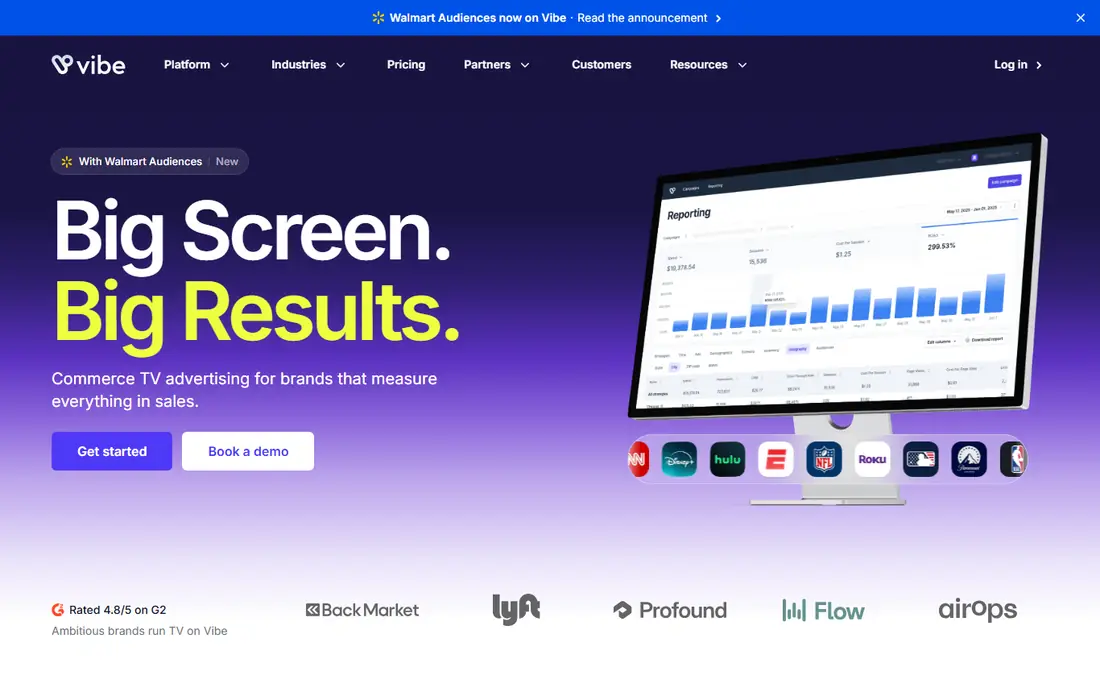
Vibe, now part of Walmart, is the easiest place for a small business to start with streaming TV. The daily minimum of 50 dollars removes the large insertion orders that once kept TV out of reach, and the dashboard is closer to social advertising than to traditional media buying. Vibe also offers creative help, which matters because many small advertisers do not arrive with a finished TV spot.
The trade-off is that Vibe buys across many streaming apps, so it cannot offer the same first-party viewing data as a platform owner such as Roku. Targeting is still useful, and conversion reporting helps a performance team judge results, but buyers should test with a clear offer and a clean landing page. For a first test, Vibe is our pick, provided the creative is ready or can be built with its tools.
- Low daily minimum
- Self-serve dashboard
- AI creative help and conversion reporting
- Inventory is aggregated across many apps
- CPMs vary by targeting
- No free plan
MNTN is built for direct-to-consumer brands that want TV treated as a measurable channel, not just a brand exercise. Its Verified Visits reporting links household TV exposure to later site visits, and its QuickFrame tool can help turn existing assets into TV-ready creative. That combination suits brands that already convert well online and want to test whether TV can add incremental visits and sales.
The 5,000 dollar monthly minimum puts MNTN above the small test tier, and the measurement only works well when a brand has enough site traffic to read the results. A brand with a weak site or a long sales cycle may struggle to judge success in the first month. For a DTC brand ready to spend at that level and to test properly, MNTN is a strong performance choice.
- Performance tracking with Verified Visits
- AI creative tool
- Self-serve with support
- Higher monthly minimum
- Best suited to brands with site traffic to measure
- Creative still needs a strong offer
Roku Ads Manager gives advertisers direct access to Roku inventory, including The Roku Channel, plus its first-party household and viewing data. That data is the real advantage: Roku knows what households watch on its platform, which allows targeting by genre and viewing behaviour that an aggregator cannot match. The self-serve tool is aimed at growth marketers, not only large agencies.
The limit is reach. A campaign bought only through Roku will miss households that mainly use other devices, so Roku works best as part of a wider plan or for a brand whose customers skew toward Roku. The 500 dollar per campaign starting point is still accessible, and the platform offers formats that let viewers take action from the TV screen. For Roku-heavy audiences, it is hard to beat.
- Direct Roku inventory and viewing data
- Self-serve buying
- Action and shoppable ad formats
- Reach is concentrated in Roku households
- CPMs can run higher than aggregated buys
- Minimum is per campaign
Disney Campaign Manager opens self-serve access to Hulu and Disney Plus inventory, which is premium, brand-safe streaming content with large audiences. For brands that want to appear beside well-known shows and films, rather than across a long tail of smaller apps, that quality matters. The dashboard lets advertisers set budgets, choose audiences and track delivery without going through a large agency deal.
Premium inventory usually means premium CPMs, so the 500 dollar campaign minimum is a starting point, not a promise of large reach. Creative must also meet Disney standards, which can slow a first launch. Brands that value context and scale in entertainment, and that can afford a higher CPM for that context, should put Disney near the top of the list.
- Premium Hulu and Disney Plus inventory
- Self-serve dashboard
- Genre and demographic targeting
- Premium inventory can cost more
- No free plan
- Brand safety and approval rules apply
Paramount Ads Manager gives self-serve access to Paramount streaming inventory, including entertainment, news and sports content. Live sports and news can be powerful for brands that want attention at a specific moment, and the self-serve route lowers the barrier that once kept smaller brands out of that inventory. Creative help is also useful for advertisers without a TV background.
The catch is variability. Reach and CPMs shift with the calendar, the event and the show, so a budget that works well in one month may buy less in a busy sports period. Advertisers should plan around the events they care about and set expectations for that swing. For brands tied to sports or news moments, Paramount deserves a test alongside Roku and Disney.
- Sports, news and entertainment inventory
- Self-serve buying
- Creative help for new TV advertisers
- Reach varies by show and season
- No free plan
- Premium live events can cost more
Tatari takes a different angle: it treats TV, both linear and streaming, as a channel that can be planned and measured like digital marketing. Its reporting covers attribution and lift, which helps brands judge whether TV exposure actually moved sales rather than just counting impressions. The self-serve retargeting entry point, from 350 dollars per week, makes a first test more affordable than the prospecting minimum, which is reported at 5,000 dollars per week.
That split matters. A brand that only retargets past site visitors will learn something, but it will not learn how TV performs with new audiences until it spends at the prospecting level. Tatari suits brands with a clear measurement setup and a budget that can grow from retargeting to prospecting. For those brands, its converged view of linear and streaming is a genuine advantage.
- Converged linear and streaming buying
- Attribution and lift reporting
- Self-serve retargeting entry point
- Prospecting minimum is much higher
- Measurement needs clean data
- Smaller budgets may be limited to retargeting
Simpli.fi is a programmatic platform that many agencies use for local and multi-location CTV campaigns. Its strength is geographic precision: advertisers can target by ZIP code and by local area, which suits franchises, car dealers, clinics and other businesses that serve a defined area. The platform also supports multi-location reporting, so a brand can compare areas rather than guessing which market worked.
Pricing is custom, so the total depends on the campaign, the inventory and the agency arrangement. Simpli.fi is less of a plug-and-play test tool for a single small business than Vibe, and it works best when an agency or a marketing team manages it. For local campaigns at scale, though, its targeting and reporting make it a strong choice.
- Hyperlocal targeting down to ZIP code level
- Agency and multi-location tools
- No published campaign minimum in some reports
- Custom pricing
- Agency-focused interface
- Creative and measurement setup still need care
The Trade Desk is an independent demand-side platform that buys CTV inventory across many publishers and streaming services, rather than selling one publisher's inventory. Its targeting tools, including identity options such as UID 2.0, and its measurement features suit enterprise teams and agencies that run CTV as part of a larger programmatic plan. For a large brand, that breadth and control are hard to match.
For a small advertiser, The Trade Desk is usually the wrong first step. Pricing is custom, minimums are widely reported as high, and the platform rewards teams that already understand programmatic buying. A small business should start with Vibe or a publisher platform, learn what works, and only move to The Trade Desk when CTV spend and complexity justify it.
- Broad streaming inventory across publishers
- Advanced targeting and identity tools
- Strong measurement options
- Custom pricing with high minimums widely reported
- Steep learning curve
- Overkill for a single small test
How we picked these
We compared vendor pricing pages, platform guides and recent CTV comparisons, and we kept only platforms that still offer CTV buying in October 2026. We weighed the entry budget, the inventory source, the targeting options and the measurement tools, because a low minimum with no measurement is a poor test. We also separated publisher platforms, which sell their own inventory, from programmatic platforms, which buy across many publishers, so readers can see the trade-off clearly.
How to choose the right CTV platform
Start with your audience and your budget, not with the platform name. If your customers are concentrated on Roku, start there. If you need a low-cost test, start with Vibe. If you want premium entertainment context, test Disney or Paramount. If you serve a local area, Simpli.fi or a local agency route may beat a national buy. Set a test budget that can buy enough impressions to read, and remember that creative production is part of the cost, not an extra afterthought.
Measurement needs a plan before launch. Decide what counts as success: site visits, app installs, store visits or sales, and how you will separate TV impact from other channels. Ask each platform about incrementality testing with holdout groups, because view-through attribution alone can overstate TV results. Run one clear offer, one clear audience and one clear landing page for the first test, then scale only the combinations that beat your baseline.
Frequently asked questions
What is the best ctv ad platform for a small business?
Vibe is the most accessible starting point, with a 50 dollar per day minimum and a self-serve dashboard. Roku Ads Manager is also accessible at about 500 dollars per campaign, and it suits brands whose customers use Roku heavily. The best choice depends on where your audience watches.
How much does CTV advertising cost?
Self-serve minimums in this list run from 50 dollars per day at Vibe to 500 dollars per campaign at Roku, Disney and Paramount, and 5,000 dollars per month at MNTN for performance campaigns. Media CPMs and creative production sit on top of those minimums, so a realistic first test often runs into the low thousands of dollars.
Do I need a TV commercial to run CTV ads?
You need TV-ready creative, usually a 15 or 30 second video in the right format, but several platforms offer tools to build it from existing assets. Vertical social video usually needs reframing and a faster hook for TV, and each platform has its own specs and approval rules.
What is the difference between a CTV platform and a DSP?
A CTV platform is often built for TV buying with a simpler dashboard, while a DSP is general programmatic buying software that covers many channels and inventory sources. Some platforms, such as The Trade Desk, are DSPs, while publisher tools such as Roku Ads Manager sell their own inventory directly.
How do I measure whether CTV ads worked?
Use site visits, app installs, purchases or store visits tied to household exposure, plus incrementality tests with holdout groups where possible. View-through attribution alone can flatter results, so compare exposed and unexposed groups and check whether sales rose beyond what other channels explain.
Sources
See where you really rank - block by block
ProMapRanker scans Google Maps across a grid of your service area. Simple monthly plans from $19, white-label on every plan.
Start freeKeep reading
 who has best internet service
Who Has the Best Internet Service in 2026
Who has best internet service for US homes? We compare fiber, cable, fixed wireless and satellite providers on speed, price, availability and terms today.
Read → which survey tool has the best analytics
Which Survey Tool Has the Best Analytics in 2026
Find which survey tool has the best analytics in 2026, comparing Qualtrics, SurveyMonkey, Typeform, Alchemer, and more on reports, text, and stats today.
Read → which streaming service has the best movies
Which Streaming Service Has the Best Movies in 2026
Answering which streaming service has the best movies, with Netflix, Max, Criterion and more compared on libraries, prices and free options in this guide.
Read →