 ProMapRanker
Best Competitive Intelligence Software in 2026

Key takeaways
- Crayon and Klue are the strongest dedicated competitive intelligence platforms, built for formal CI programs and sales enablement.
- Similarweb and Semrush answer market and digital questions, such as traffic and search visibility, rather than sales battlecards.
- Kompyte is a lower cost entry point for small teams that need automated tracking and battlecards without an enterprise budget.
- Owler, Contify, and AlphaSense cover different lanes: company news, curated market monitoring, and financial research.
- Dedicated CI platforms are usually quote based and costly, so a small team should start with a digital tool and add a CI platform only when sales enablement needs it.
Quick comparison
| Pick | Great for | Pricing starts at | Free tier | |
|---|---|---|---|---|
 Crayon | Enterprise CI and sales enablement | See website | No | Visit |
 Klue | Battlecards and win loss insights | See website | No | Visit |
 Kompyte | Automated tracking for small teams | $300 per month | No | Visit |
 Similarweb | Traffic and market share benchmarking | $125 per month | Yes | Visit |
 Semrush | SEO and paid search competitor research | $139.95 per month | Yes | Visit |
 Contify | Curated market and competitor monitoring | See website | Free trial | Visit |
 Owler | Company news and alerts | See website | Yes | Visit |
 AlphaSense | Financial and strategic research | See website | No | Visit |
 SpyFu | Affordable PPC and SEO competitor history | $39 per month | Yes | Visit |
The best competitive intelligence software
Competitive intelligence software tracks rivals, collects their pricing, messaging, product, and hiring changes, and turns that data into battlecards, alerts, and reports that sales and marketing teams can use. The tools on this list split into dedicated CI platforms, digital intelligence tools, and research platforms, and the right choice depends on whether you need sales enablement, market sizing, or financial research. We compared official product pages, pricing pages, and feature descriptions, and we kept only tools that are live in October 2026.
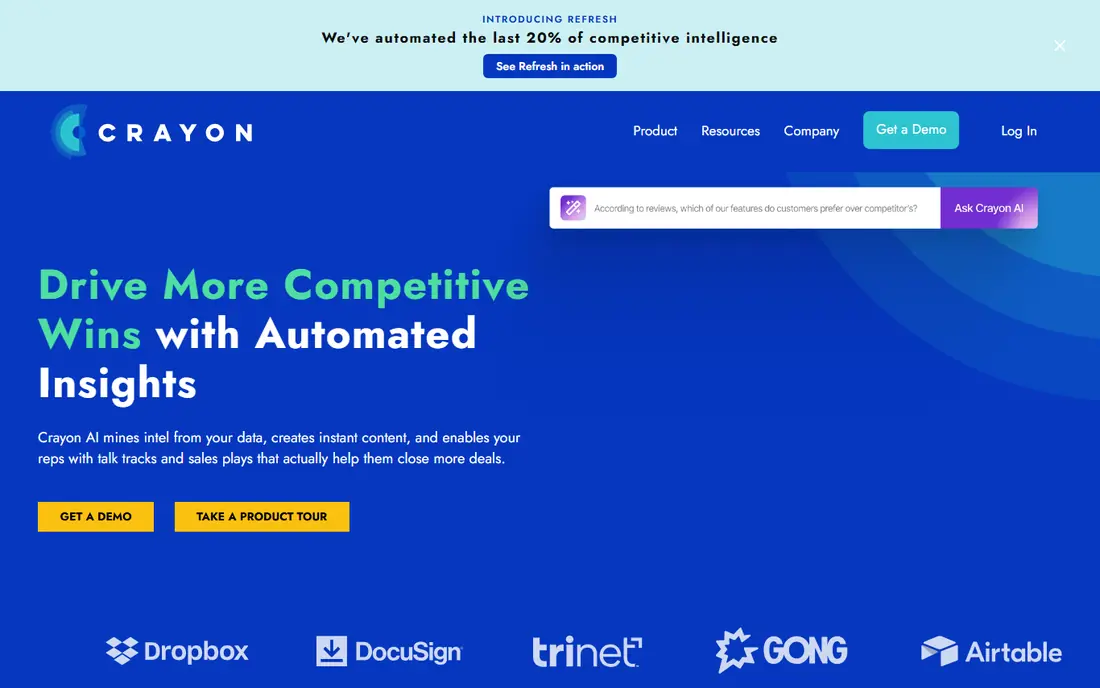
Crayon is a dedicated competitive intelligence platform built for revenue teams that run a formal CI program. It tracks competitor websites, pricing pages, reviews, news, and product changes, classifies those changes, and pushes battlecards and alerts into Salesforce and Slack where sellers actually work. That distribution is the point: CI that stays in a dashboard does not help a seller on a live deal.
Pricing is quote based, with third party estimates often near 20,000 to 40,000 dollars per year, and some sources citing around 30,000 dollars per year, so we list it as See website. Setup also takes time, since classification and battlecard curation need tuning for each competitor set. Crayon suits a mid market or enterprise team with a dedicated CI owner. A small team with two rivals and no CI owner will struggle to justify the cost.
- Real time competitor tracking across many sources
- Dynamic battlecards
- Salesforce and Slack distribution
- Quote based pricing is high for small teams
- Setup and classification take time to tune
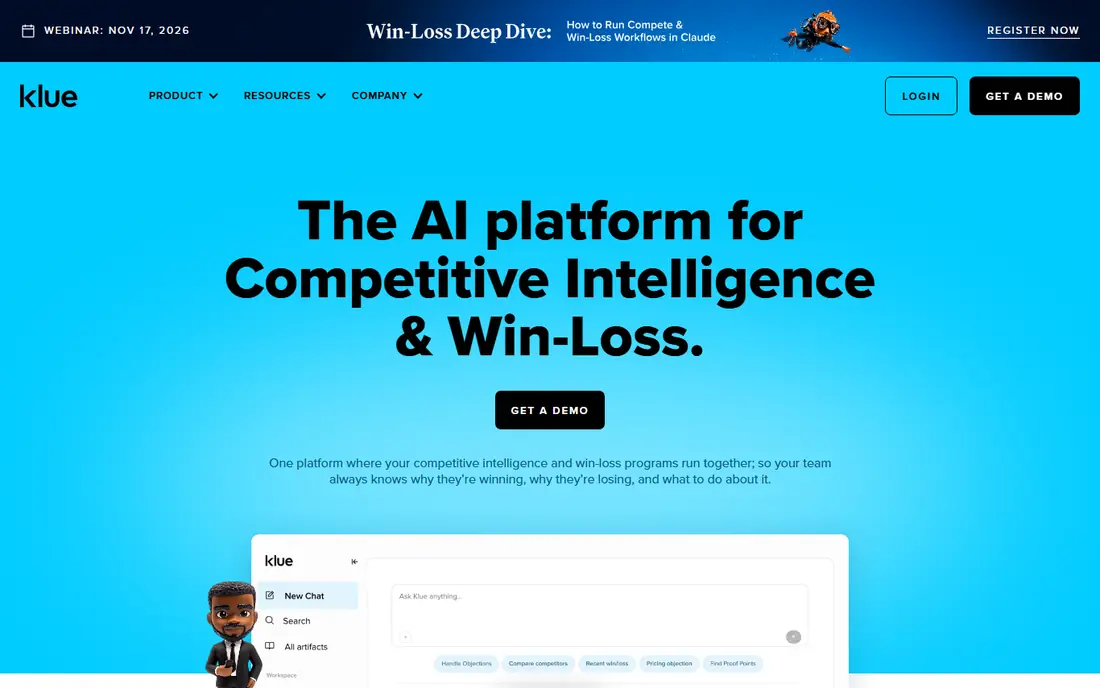
Klue is the other leading dedicated CI platform, with a strong focus on battlecards and on win loss insights from buyer interviews. It tracks competitor changes, builds battlecards that sellers can open inside their CRM or chat tools, and adds deal based insights that show why deals were won or lost against each rival. That combination helps product marketing teams move from collecting news to coaching sellers on real deals.
Pricing is also quote based, with third party estimates in the same 20,000 to 40,000 dollars per year range as Crayon, so we list it as See website. Battlecards are not set and forget: published comparisons note that maintaining cards for ten or more competitors can take several hours a week. Klue suits a sales led organization that will invest in enablement, not a team that wants a passive news feed.
- High quality battlecards
- Win loss research in the same system
- Integrations with Salesforce, HubSpot, and Slack
- Quote based pricing
- Battlecards need regular curation to stay useful
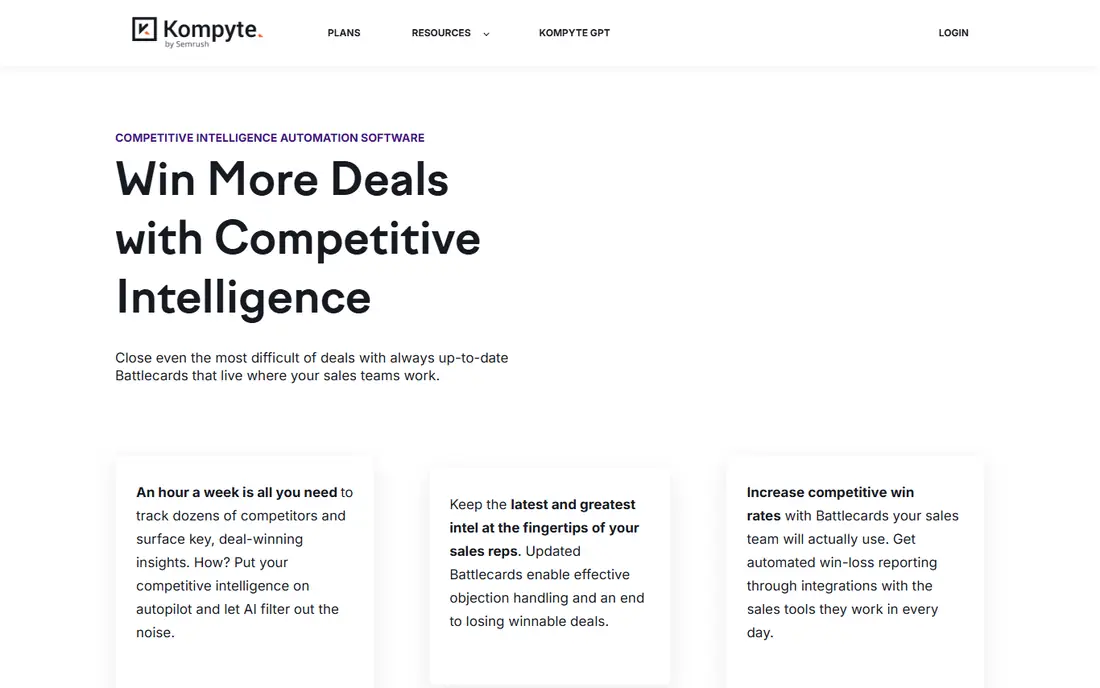
Kompyte offers automated competitor tracking, website change alerts, and battlecards at a lower entry price than the enterprise platforms. Published comparisons list an Essentials tier near 300 dollars per month, with higher tiers by quote, which makes Kompyte accessible to a small or mid sized B2B team that cannot justify a 20,000 dollar annual platform. Salesforce, HubSpot, and Slack integrations help push insights to sellers.
Depth is the trade-off. Kompyte tracks websites, product pages, reviews, PR, and jobs, but it does not match Crayon or Klue on enterprise governance, win loss research, or large scale enablement analytics. For a small CI team that needs a set and forget tracking engine plus usable battlecards, Kompyte is the best value dedicated option on this list. For a large enterprise program, Crayon or Klue will go further.
- Automated competitor tracking and alerts
- Battlecards included
- Lower entry price than Crayon or Klue
- Less depth than enterprise platforms
- User interface takes time to learn in some reviews
Similarweb answers a different question from Crayon: how big is a rival online, where does its traffic come from, and how does that mix change over time. It estimates website traffic, channel mix, keywords, and audience overlap, and it benchmarks companies within a market segment.
Pricing starts near 125 dollars per month billed yearly in recent comparisons, or 199 dollars per month billed monthly, with a limited free tier for basic data. Traffic figures are estimates from modelled data, not a rival's internal analytics, so treat small differences with caution. Similarweb is best as a market intelligence companion to a CI platform, not as a replacement for battlecards.
- Website traffic and channel mix estimates
- Market share and audience benchmarking
- Large data coverage
- No sales battlecards or CRM enablement
- Estimates are modelled, not exact traffic counts
Semrush is the best tool on this list for search led competitive research. It shows which keywords a rival ranks for, which ads it runs, which backlinks it earns, and where your content gaps sit against it. That data helps marketing teams plan content, paid search, and outreach with a clear view of a rival's digital footprint. A capped free plan lets a small team test the core reports before paying.
The starting paid plan costs 139.95 dollars per month in published comparisons, with lower annual billing equivalents in some listings, so check the current pricing page. Semrush does not provide sales battlecards, win loss research, or product change tracking in the same way as Crayon or Klue.
- Deep SEO and PPC competitor data
- Keyword gaps and backlink analysis
- Content and advertising research in one account
- Focus is search and digital marketing, not full CI
- Data depth varies by market and language
Contify is a market and competitive intelligence platform that centralizes news, company updates, and market signals into curated feeds for strategy, marketing, and product teams. It covers many sources and languages, which helps global teams that need to track rivals, partners, and market trends in more than one country. A central hub also helps when several teams track the same rivals in separate spreadsheets and inboxes.
Pricing is quote based, with third party estimates from around 1,000 to 2,500 dollars per month, so we list it as See website and recommend a demo. Setup needs a taxonomy, meaning a structured set of topics, rivals, and keywords, plus ongoing curation to keep feeds clean. Contify suits a cross functional strategy team that wants a shared intelligence hub, rather than a sales team that only needs battlecards.
- Curated newsfeeds across many sources and languages
- Central market intelligence hub
- Taxonomy and alert controls
- Quote based pricing
- Needs taxonomy setup and ongoing curation to stay relevant
Owler is a simple, low cost way to follow companies. It provides company profiles, news, funding updates, and competitor lists, with alerts when a followed company makes news. That makes it useful for a quick background check before a sales call, for tracking a long tail of smaller rivals, and for a small team that cannot justify a full CI platform yet. A free tier covers basic profiles and alerts.
Paid tiers add deeper data, more alerts, and export options, with pricing listed on the site, so we list it as See website. Owler does not track website changes, pricing pages, or battlecards in the depth of Crayon, Klue, or Kompyte, and its data is best used as a news layer, not as a full CI system.
- Free company profiles and news alerts
- Simple competitor lists
- Useful for quick background checks
- Depth is thinner than dedicated CI platforms
- Full data and alerts sit on paid tiers
AlphaSense is a research platform for strategy, finance, and corporate development teams that need to search earnings calls, filings, broker research, and expert transcripts for competitor signals. Its AI search helps a team find what a rival said about pricing, margins, or expansion, without reading every document by hand.
Pricing is quote based and high per user, with third party estimates from around 10,000 to 24,000 dollars per user per year depending on the package, so we list it as See website. AlphaSense does not replace operational CI: it will not alert a seller when a rival changes a pricing page or launches a feature. Use AlphaSense for financial and strategic research, and pair it with a CI platform for day to day sales enablement.
- Earnings transcripts, filings, and expert research in one search
- Strong for strategy and investment teams
- AI search across documents
- Quote based, high per user pricing
- Limited real time operational CI such as pricing page changes
SpyFu focuses on a narrow but useful job: showing what keywords a rival has bought on Google Ads, what ads it has run, and how its organic rankings have changed over time. That history helps a small marketing team plan paid search, spot a rival's best performing ads, and find keyword gaps without paying for a full Semrush or Similarweb plan. Basic costs 39 dollars per month in published comparisons, with limited free searches.
The narrow focus is also the limit. SpyFu does not track product changes, pricing pages, hiring, or sales battlecards, and it is not a full competitive intelligence platform. Use it as a cheap, focused add on for PPC research, alongside Semrush for broader SEO work or Kompyte for automated tracking. For a small team on a tight budget, SpyFu gives real competitor data at a low price.
- Long history of rival PPC keywords and ads
- Low entry price
- Simple competitor keyword research
- Narrow focus on search advertising
- No battlecards or full CI tracking
How we picked these
We compared official product pages, pricing pages, and feature descriptions for tools that track competitors, whether through dedicated CI, digital intelligence, or financial research. We included enterprise platforms, mid priced tools, and low cost options, because the other keywords cover tools, platforms, and top software, not just one price tier. Where pricing was quote based or varied between sources, we wrote See website rather than publishing a figure we could not verify on the vendor site.
What to check before you buy
Start with the job, not the tool category. If sellers need battlecards on live deals, a dedicated platform such as Crayon, Klue, or Kompyte is the right lane. If marketing needs traffic and search data, Similarweb, Semrush, or SpyFu fit better. If strategy needs financial research, AlphaSense fits. Buying a digital tool for a sales job, or a CI platform for a traffic question, wastes budget even if the tool itself is good.
Next, count rivals and owners. A CI platform needs a named owner to curate battlecards, review alerts, and train sellers, or the data will go stale. A team tracking three rivals with one owner can run Kompyte well, while a team tracking 30 rivals needs the governance and automation of Crayon or Klue. Finally, test distribution in a trial. Check that alerts and battlecards reach Salesforce, Slack, or HubSpot where sellers work, since CI that lives only in a separate dashboard rarely gets used.
Best competitive intelligence tools for small teams
For a small team, start with Owler for free news alerts, Semrush or SpyFu for search data, and Kompyte when automated tracking and battlecards become worth 300 dollars per month. Add Crayon or Klue only when a formal CI program, with a dedicated owner and a sales enablement goal, justifies an enterprise quote. That ladder keeps cost in line with use.
Best competitive intelligence platform for sales teams
For sales teams, Klue and Crayon lead, thanks to battlecards, CRM and Slack distribution, and win loss insight in Klue's case. Kompyte is the budget alternative, with battlecards and tracking at a lower price. Whichever platform you pick, measure use: battlecard views, seller feedback, and win rates against key rivals matter more than the number of alerts a tool generates.
Frequently asked questions
What is the best competitive intelligence tool overall?
There is no single winner, because the job splits. Crayon and Klue lead for dedicated CI and sales enablement, Similarweb leads for traffic and market share, Semrush leads for SEO and PPC research, and AlphaSense leads for financial research. Pick by job first, then by budget and by the team that will own the tool.
How much does competitive intelligence software cost?
Prices range widely. SpyFu starts at 39 dollars per month, Semrush at 139.95 dollars per month, Similarweb near 125 dollars per month billed yearly, and Kompyte near 300 dollars per month. Crayon, Klue, Contify, and AlphaSense are quote based, with third party estimates from thousands to tens of thousands of dollars per year. Always get a vendor quote for your rival count and seat count.
What is the difference between Crayon and Klue?
Both are dedicated CI platforms with tracking, alerts, and battlecards. Crayon leans toward real time tracking and revenue enablement across many sources, while Klue leans toward battlecard quality and win loss research from buyer interviews.
Can I use Similarweb or Semrush as my only competitive intelligence tool?
Yes, if your job is digital and market research. Similarweb and Semrush give traffic, search, and advertising insight that dedicated CI platforms do not match. They do not give sales battlecards, product change tracking, or win loss research, so a sales led team will still need a CI platform or a manual battlecard process alongside them.
What is a competitive intelligence platform versus a tool?
A platform, such as Crayon or Klue, combines tracking, analysis, battlecards, and distribution into one system for a formal CI program. A tool, such as SpyFu or Owler, covers one job well, such as PPC history or company news. Platforms cost more and need an owner, while tools are cheaper and easier to start, but need manual work to turn data into sales help.
How often should battlecards be updated?
Battlecards should be reviewed whenever a rival makes a material change, such as a pricing change, a product launch, or a messaging shift, and on a regular cycle even when nothing obvious changes. Published comparisons suggest several hours a week for a set of ten or more rivals. A stale battlecard is worse than no battlecard, since it can mislead a seller on a live deal.
Sources
See where you really rank - block by block
ProMapRanker scans Google Maps across a grid of your service area. Simple monthly plans from $19, white-label on every plan.
Start freeKeep reading
 whats the best ai app to use
Whats the Best AI App to Use in 2026
Wondering whats the best ai app to use in 2026? We compare ChatGPT, Claude, Gemini, Copilot, and more on price, free plans, and best everyday uses today.
Read → life360 alternatives
Life360 Alternatives in 2026
Life360 alternatives compared: 9 family location apps with live maps, arrival alerts and privacy controls to help your family stay in touch every day.
Read → captcha alternatives
CAPTCHA Alternatives in 2026
CAPTCHA alternatives compared: 9 reCAPTCHA alternatives that block bots with less friction, from free Turnstile to privacy-first proof-of-work tools included.
Read →