 ProMapRanker
Best Catalog Management Software in 2026

Key takeaways
- Plytix and Pimcore offer the lowest-cost entry points, while Akeneo, Salsify, and inRiver suit larger, complex catalogs.
- The best catalog management tools keep one clean product record, then syndicate it to stores, marketplaces, and retailers.
- Data quality checks matter as much as storage: incomplete or inconsistent fields cause listing errors downstream.
- Match the tool to team skills, since enterprise PIMs often need partners or developers for setup.
Quick comparison
| Pick | Great for | Pricing starts at | Free tier | |
|---|---|---|---|---|
 Plytix | Small and mid-size catalogs | Free | Yes | Visit |
 Akeneo | Flexible enterprise PIM | See website | Free trial | Visit |
 Salsify | Retailer syndication | See website | No | Visit |
 Pimcore | Developer-led customization | Free | Yes | Visit |
 Sales Layer | Easy PIM for manufacturers | See website | Free trial | Visit |
 inRiver | Complex B2B catalogs | See website | No | Visit |
 Syndigo | Content syndication | See website | No | Visit |
 Catsy | Mid-size ecommerce catalogs | See website | Free trial | Visit |
 Bluestone PIM | Structured enterprise catalogs | See website | No | Visit |
The best catalog management software
Catalog management software, often called product information management or PIM, keeps product names, attributes, images, and specs in one place. From that single record, teams can publish to a store, marketplace, or retailer without retyping data for each channel. We compared official product pages, pricing pages, and documentation, and we kept tools that are live and focused on catalog or PIM work.

Plytix is the easiest entry point in this list for a small or mid-size team. The free tier covers a limited number of SKUs, which is enough to organize a first catalog and test the workflow. Built-in digital asset management means images and documents sit with the product record, rather than in a separate drive folder that goes out of date.
Paid plans add more SKUs, users, and features. Plytix does not match the deepest retailer syndication of enterprise tools, but for a team that sells through its own store and a few marketplaces, it is a practical, low-cost start. It is our pick for most small catalogs.
- Free tier for smaller catalogs
- Built-in digital asset tools
- Easy onboarding for small teams
- Enterprise syndication depth is lighter than Salsify or inRiver
- Larger catalogs need paid plans
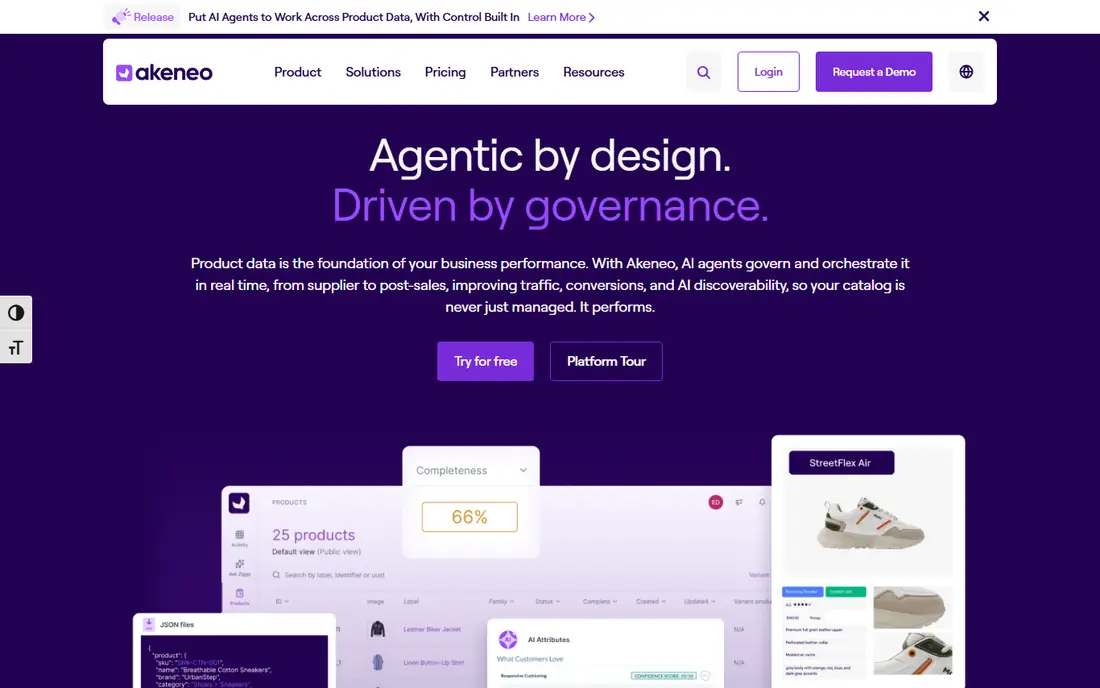
Akeneo is a widely used PIM for brands that sell many products across many locales and channels. Its data model can handle varied attributes, variants, and translations, and its completeness checks show which products are ready to publish and which fields are missing. That visibility helps a catalog team fix gaps before a listing goes live.
Commercial pricing is aimed at mid-market and enterprise buyers, and complex implementations often need a partner. The Community Edition gives technical teams a free starting point, but hosting and maintenance are their responsibility. Choose Akeneo when flexibility and localization matter more than the lowest price.
- Flexible data modeling
- Strong localization for many markets
- Open-source Community Edition option
- Commercial pricing is enterprise-level
- Complex setups often need a partner
Salsify is built for brands that must get accurate product content to many retailers and marketplaces, and keep it accurate as products change. It combines PIM with syndication and digital shelf analytics, so a brand can see how its content appears on retailer sites and where it falls short. That closed loop is the main reason large consumer brands choose it.
Pricing is quote based and enterprise-level, and onboarding needs dedicated staff. For a small catalog, Salsify is more than needed. For a brand whose retailer content drives sales, it is the strongest syndication pick here.
- Deep retailer and marketplace syndication
- Digital shelf analytics
- Strong content workflows
- Enterprise pricing
- Onboarding takes time and staff
Pimcore is an open platform that combines product information, digital assets, and master data in one system. Technical teams value its control: data models, workflows, and integrations can be shaped to fit unusual catalogs, rather than forcing the catalog into a fixed template. The Community Edition is free to use, which makes it a good evaluation starting point.
That control comes with work. Self-hosted setups need developers for installation, upgrades, and maintenance, and support plans are paid. Pimcore suits organizations with developer capacity that want a platform they can shape, not a turnkey tool for a non-technical team.
- Open-source Community Edition
- Combines PIM, DAM, and data platform features
- High customization control
- Needs developer resources
- Hosting and upgrades are your responsibility on self-hosted setups
Sales Layer is known for ease of use, which matters when the people who own product data are marketers or product managers, not developers. Manufacturers and B2B distributors can build catalogs, manage variants and specs, and publish to channels without a long training period. A trial lets a team test it on a real catalog before committing.
Pricing is not published as a simple list price, so you will need a quote based on catalog size and features. Syndication coverage should also be checked channel by channel. For a product team that wants a PIM it can actually adopt, Sales Layer is a strong candidate.
- Easy to learn for product teams
- Strong for manufacturers and B2B distributors
- Clean catalog workflows
- Pricing is quote based
- Syndication depth varies by channel
inRiver suits B2B catalogs where products have deep specs, relationships, and channel rules. It can model complex product structures, manage content for many buyers, and syndicate to marketplaces and retailers. Digital shelf tools add visibility into how content performs once published, which helps a team improve listings over time.
Pricing is enterprise-level and quoted, and implementation needs planning, especially for a catalog that must integrate with ERP or ecommerce systems. For a mid-size or large B2B seller with a complex catalog, inRiver is a solid enterprise pick.
- Strong for complex B2B data
- Syndication and digital shelf tools
- Multi-tenant SaaS platform
- Enterprise pricing
- Implementation needs planning and resources
Syndigo combines product content management with a broad syndication network for retailers and marketplaces. Brands can create, validate, and distribute product content, then track whether it meets each retailer's requirements. Validation helps catch missing images, wrong specs, or incomplete attributes before a listing is rejected.
Pricing is quote based, and the strongest value comes for brands with wide retail distribution. A small direct-to-consumer brand may not need that network. For a brand selling through many retailers, Syndigo is a strong syndication-focused option.
- Broad retailer and marketplace content network
- PIM plus syndication
- Content validation tools
- Enterprise pricing
- Best value for brands with wide retail distribution
Catsy is a PIM built for ecommerce teams that need to manage product data and publish to stores and marketplaces. Its workflows focus on the day-to-day work of a catalog team: importing data, enriching attributes, managing images, and pushing updates to channels. That focus makes it easier to learn than a broad enterprise platform.
Its partner and integration ecosystem is smaller than the largest PIM vendors, so check your specific store and marketplace connections before buying. Pricing is plan based and should be confirmed with sales. For a mid-size ecommerce catalog, Catsy is a practical, focused pick.
- Built for ecommerce catalogs
- Straightforward product workflows
- Channel publishing tools
- Smaller ecosystem than Akeneo or Salsify
- Pricing needs a sales check
Bluestone PIM is a SaaS PIM for brands that need structured, well-governed product data. It supports detailed data models, workflows, and channel publishing, with a focus on keeping catalog data consistent as teams grow. That structure helps when many people edit product data and errors would otherwise spread to listings.
Pricing is enterprise-level and quoted, and its brand recognition is lower than Akeneo or Salsify in some markets. For a team that values clean data governance and a SaaS model, Bluestone PIM is worth shortlisting alongside the larger names.
- Clean data modeling for structured catalogs
- SaaS delivery
- Good fit for brands with strict data rules
- Enterprise pricing
- Less well known than the largest PIM brands
How we picked these
We compared official product pages, pricing pages, and documentation, and we kept tools that manage product records and publish them to sales channels. We weighed data modeling, localization, digital asset handling, syndication breadth, and ease of adoption. We left out simple spreadsheet tools and single-channel listing tools, since the topic is catalog management as a central system.
What to check before you pay
Start with a sample of your real catalog, not a demo catalog. Import a few hundred products with messy attributes, missing images, and variants, and see how the tool handles them. Check completeness scoring, bulk editing, and image handling, because those features decide whether your team will actually use the system daily.
Next, list every channel you publish to, and confirm each one is supported with a live connector or feed, not just a manual export. Also check ERP, ecommerce, and marketplace integrations, since a PIM that cannot sync with your store will create manual work. Finally, budget for implementation: enterprise PIMs often need partner time, data cleanup, and training, which can cost as much as the first year of licensing.
Frequently asked questions
What is the best catalog management software for a small business?
Plytix is the best starting point for most small businesses, because its free tier covers a smaller catalog and its onboarding is simple. Pimcore Community Edition is another low-cost option, but it needs developer help. Move to Akeneo or Sales Layer when catalog size, locales, or channel count grows.
What are the best catalog management tools for large brands?
Akeneo, Salsify, inRiver, and Syndigo suit large brands, with different strengths. Akeneo offers flexible modeling, Salsify and Syndigo lead on retailer syndication, and inRiver suits complex B2B catalogs. Shortlist based on your main channel mix, not on feature lists alone.
What is the difference between a PIM and a spreadsheet?
A spreadsheet stores product data, but a PIM adds structure, validation, workflows, and channel publishing. A PIM can flag missing fields, control who edits what, manage images alongside data, and push updates to many channels from one record. Spreadsheets break down when many people edit them and many channels must stay in sync.
How long does PIM implementation take?
It depends on catalog size and data quality. A small, clean catalog on Plytix or Catsy can go live in weeks, while a large enterprise PIM with ERP integration can take months. Data cleanup is often the longest step, so start that work early and test with real products.
Do I need a DAM with my PIM?
Not always, but it helps when images, videos, and documents are central to listings. Plytix and Pimcore include digital asset features, while other PIMs integrate with a separate DAM. If your team already stores assets in a separate system, check the integration before choosing a PIM.
Can a PIM improve marketplace listings?
Yes, when it is used well. A PIM keeps attributes, specs, and images consistent, which reduces listing rejections and mismatched information. Syndication tools in Salsify, Syndigo, and inRiver also validate content against retailer rules, which helps listings go live faster and stay accurate.
Sources
See where you really rank - block by block
ProMapRanker scans Google Maps across a grid of your service area. Simple monthly plans from $19, white-label on every plan.
Start freeKeep reading
 who has best internet service
Who Has the Best Internet Service in 2026
Who has best internet service for US homes? We compare fiber, cable, fixed wireless and satellite providers on speed, price, availability and terms today.
Read → which survey tool has the best analytics
Which Survey Tool Has the Best Analytics in 2026
Find which survey tool has the best analytics in 2026, comparing Qualtrics, SurveyMonkey, Typeform, Alchemer, and more on reports, text, and stats today.
Read → which streaming service has the best movies
Which Streaming Service Has the Best Movies in 2026
Answering which streaming service has the best movies, with Netflix, Max, Criterion and more compared on libraries, prices and free options in this guide.
Read →