 ProMapRanker
Best B2B Lead Generation Tools in 2026

Key takeaways
- The best B2B lead generation tools for most teams are Apollo for value and ZoomInfo for enterprise depth.
- Lusha and Hunter suit quick lookups, while Clay suits teams that enrich lists from many sources at once.
- LinkedIn Sales Navigator is best for research on people and accounts, not for bulk list building alone.
- Credit limits matter more than headline price, so check how many contacts and enrichments a plan truly includes.
Quick comparison
| Pick | Great for | Pricing starts at | Free tier | |
|---|---|---|---|---|
 Apollo.io | All-in-one prospecting value | Free | Yes | Visit |
 ZoomInfo | Enterprise contact and intent data | See website | No | Visit |
 LinkedIn Sales Navigator | LinkedIn research and outreach | See website | Free trial | Visit |
 Lusha | Quick browser lookups | Free | Yes | Visit |
 Cognism | European phone-verified data | See website | No | Visit |
 Clay | Waterfall enrichment workflows | Free | Yes | Visit |
 Hunter | Domain email finding | Free | Yes | Visit |
 Snov.io | Small team data plus outreach | Free | Yes | Visit |
 Dealfront | Website visitor identification | Free | Yes | Visit |
The best B2B lead generation tools
We compared tools on data quality, coverage, credits, CRM links, outreach features, and price. The list covers lead generation software for B2B teams, from solo sellers to enterprise sales teams.
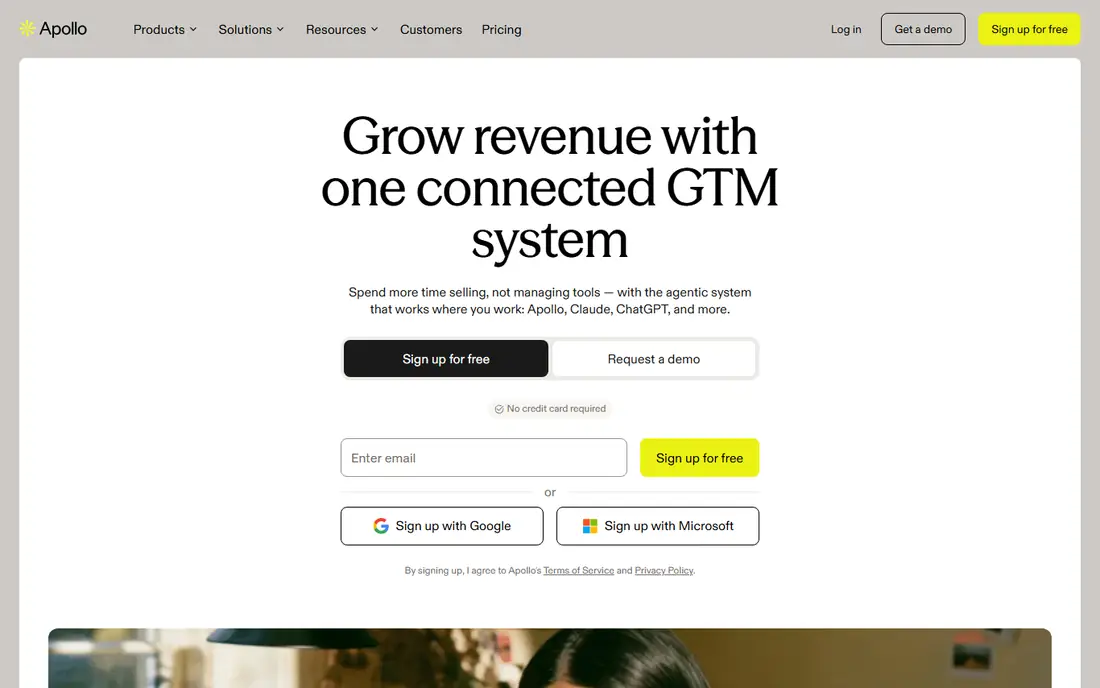
Apollo is the best value all-in-one B2B lead generation tool for most small and mid-size teams. It combines a contact database, enrichment, email sequencing, and CRM sync in one system, with a free tier to test data quality. Paid plans start at $49 per user per month billed annually, with monthly credits included.
Data quality is the watch point. No database is perfect, and some Apollo records will be outdated, so verify key contacts before a major campaign. For teams that need one tool for finding, enriching, and emailing prospects, Apollo is still the easiest starting point.
- Large contact database
- Sequencing and CRM links
- Free tier for testing
- Data accuracy varies by record
- Credits limit exports on lower plans
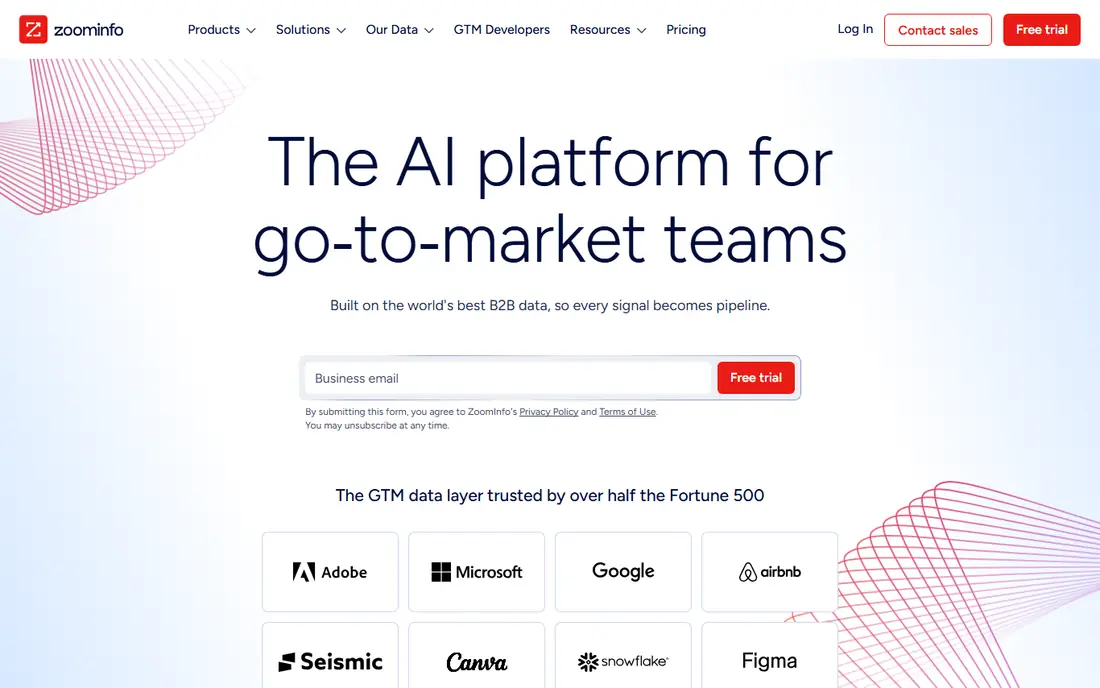
ZoomInfo is the enterprise pick for teams that need deep contact data, company data, and buying intent signals at scale. It links well to Salesforce and other CRMs, and its intent data helps sales teams focus on accounts showing buying activity. Large teams use it as a core go-to-market database, not just a lookup tool.
Price and contract terms are the barriers. ZoomInfo is quote based, usually sold annually, and reported at a level far above Apollo or Lusha. Solo sellers and small teams should start elsewhere, while enterprise teams with a large sales force will get the most from it.
- Deep company and contact data
- Intent signals
- Strong Salesforce and CRM links
- Quote based and expensive
- Annual contracts
- Overkill for solo sellers
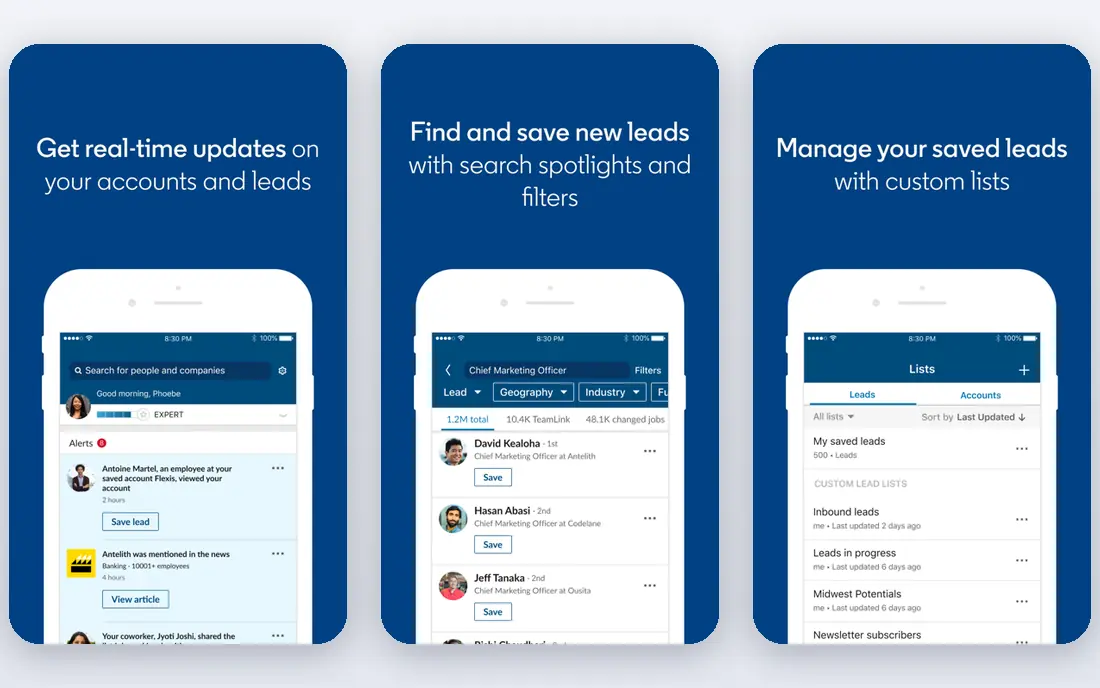
LinkedIn Sales Navigator is the best research tool for B2B prospecting on LinkedIn. It offers advanced lead and account search, saved lists, alerts on job changes, and InMail messaging. Sellers use it to find the right person at the right account, even when a database record is thin.
It is not a full list-building or email tool on its own. Exporting contacts and finding verified emails usually needs Apollo, Lusha, or Clay alongside it. Use Sales Navigator for research and relationship work, and pair it with a data tool for bulk outreach.
- Best LinkedIn search and lead lists
- Account alerts
- InMail for outreach
- No bulk email export on its own
- Per-seat price is high for large teams
Lusha suits sellers who work account by account in a browser. Its extension shows contact details on LinkedIn and company sites, and a free tier lets a user test a few lookups before paying. Paid plans are credit based, with a starting point around $36 per user per month in recent listings.
Credits run out fast for bulk work, and phone accuracy varies by region. For quick lookups during research, Lusha is excellent. For building a list of thousands, Apollo or Clay will usually be more efficient and cheaper per contact.
- Fast browser extension lookups
- Free tier
- Simple CRM export
- Credit limits are tight on lower plans
- Accuracy varies, especially for phones
Cognism is the best pick for teams prospecting in Europe, where phone-verified mobile numbers and compliance matter more. Its Diamond Data approach focuses on verified mobiles, which helps call-heavy teams reach decision makers. It also emphasizes data compliance, which matters for European outreach.
Pricing is quote based and annual, which puts it out of reach for many solo sellers. US-only teams may get similar value from ZoomInfo or Apollo at lower cost. European and global teams that call prospects will find Cognism data quality worth testing.
- Phone-verified mobile data
- Strong European coverage
- Compliance focus
- Quote based
- Annual pricing
- Less suited to US-only small teams
Clay is different from a simple database. It lets a team build a list, then enrich it through a waterfall of data providers, AI research, and scoring, all in one workflow. That approach improves accuracy, since a second source can fill gaps left by the first. A free tier covers basic testing, with paid plans from $149 to $185 per month in recent listings depending on tier.
The learning curve is real. Clay rewards teams that design workflows carefully, while a seller who wants a quick list may prefer Apollo. For operations and growth teams that build repeatable prospecting systems, Clay is one of the most powerful tools on this list.
- Enrichment from many sources in one workflow
- AI research and scoring
- Flexible list building
- Learning curve
- Credit and tier costs rise with heavy enrichment
Hunter is a simple, focused tool for finding email addresses tied to a company domain. Enter a domain, get a list of public emails and patterns, and verify an address before sending. A free tier covers a small monthly allowance, with paid plans from around $34 to $49 per month in recent listings.
It does not provide phone numbers, intent data, or deep company profiles. That narrow scope is also its strength: for a small team that only needs emails for a target list, Hunter is fast and cheap. For full prospecting, pair it with LinkedIn Sales Navigator or Apollo.
- Fast domain search
- Email verification
- Simple Chrome extension
- Email only, no phone data
- Some results are pattern guesses, not verified contacts
Snov.io suits small teams that want finding, verification, and email outreach in one affordable system. It offers a free tier, with paid plans from $39 per month in recent listings, and it covers domain search, verification, and sequences. That bundle saves a small team from buying three separate tools.
Database depth is the limit. For niche industries or large enterprise lists, Apollo or ZoomInfo will find more contacts. For a startup or small agency running its first outbound campaigns, Snov.io offers a good balance of price and features.
- Email finding, verification, and outreach in one tool
- Free tier
- Affordable paid plans
- Database depth is smaller than Apollo or ZoomInfo
- Deliverability needs careful setup
Dealfront, formerly Leadfeeder, identifies which companies visit your website, even when no form is filled. That helps sales teams follow up with warm accounts instead of cold lists. A free Lite plan covers basic identification, with paid plans from around $99 per month in recent listings.
It does not give individual contact emails on its own. Use it to spot interested companies, then use LinkedIn Sales Navigator, Lusha, or Apollo to find the right person there. As a second signal alongside outbound data, Dealfront adds real value.
- Identifies visiting companies
- Free Lite plan
- Useful for inbound follow-up
- Company level only, no direct contact data
- Best as a complement, not a sole source
How we picked these
We compared official pricing pages and public product comparisons, and we favored tools still sold in 2026. We looked for real contact data, enrichment, or visitor identification, not just a CRM or email sender. Where pricing is quote based or varies by credits, we wrote See website or noted the range rather than presenting a guess as a fixed price.
How to choose a B2B lead generation tool
Start with your motion. Outbound teams need a database and outreach, inbound teams need visitor identification and enrichment, and account-based teams need company and intent data. A tool that is excellent for one motion may be weak for another.
Test data on your market
Run the same 50 target accounts through two tools and check email accuracy, phone coverage, and job title freshness. Database quality varies by industry and region, so a general ranking matters less than your own test. Verify a sample before you sign an annual contract.
Watch credits and contracts
A low monthly price means little if credits run out in week two. Check how many contacts, enrichments, and exports a plan includes, what happens to unused credits, and whether the contract is monthly or annual. Monthly plans cost more per month but reduce risk while you test.
Frequently asked questions
What is the best B2B lead generation software?
Apollo is the best value all-in-one pick for most teams, while ZoomInfo is best for enterprise depth. Lusha suits quick lookups, Clay suits enrichment workflows, and LinkedIn Sales Navigator suits research. Test data on your own target accounts before choosing.
What are the best lead generation tools for B2B small businesses?
Apollo, Lusha, Hunter, and Snov.io all offer free tiers and low-cost paid plans for small businesses. Start with a free tier, test data quality, and upgrade only when credits or features limit real campaigns. Avoid annual enterprise contracts until outbound is proven.
How do B2B lead generation platforms get data?
Most platforms combine public web data, partnerships, user contributions, and verification checks. That is why accuracy varies and decays over time as people change jobs. Verify key contacts, use enrichment waterfalls, and refresh lists regularly rather than trusting one export forever.
Is cold email legal with these tools?
Cold email rules vary by country and region, and business email rules differ from consumer rules. In Europe, GDPR and ePrivacy rules apply, while US rules include CAN-SPAM requirements. Always check local law, use verified business contacts, offer a clear opt-out, and avoid buying scraped consumer lists.
Do I still need LinkedIn Sales Navigator if I have Apollo?
Many teams use both. Apollo is better for bulk lists, enrichment, and email outreach, while Sales Navigator is better for LinkedIn research, account alerts, and InMail. If your buyers live on LinkedIn, Sales Navigator adds research value that a database alone does not replace.
Sources
See where you really rank - block by block
ProMapRanker scans Google Maps across a grid of your service area. Simple monthly plans from $19, white-label on every plan.
Start freeKeep reading
 twitch alternatives
Twitch Alternatives in 2026
Explore the best Twitch alternatives in 2026 for live streaming, with free platforms, monetisation options, audiences, chat tools, and tips for new streamers.
Read → firebase alternatives
Best Firebase Alternatives in 2026
Looking for Firebase alternatives? We compare 9 backend platforms for auth, databases, realtime, storage, functions, self-hosting, and pricing for your app.
Read → companies with best work life balance
Companies With Best Work Life Balance in 2026
See companies with best work life balance in 2026, ranked by employee ratings, with flexible work options, benefits, and what to check before applying.
Read →