 ProMapRanker
Best Artificial Intelligence Companies in 2026

Key takeaways
- OpenAI, Anthropic and Google DeepMind lead foundation models, with ChatGPT, Claude and Gemini as their main consumer and business products.
- NVIDIA leads AI infrastructure, since its hardware and data center products power much of the training and inference behind other firms.
- Microsoft and Meta matter most where their platforms already live: Microsoft 365 and Azure for work, and Meta apps and open-weight models for distribution.
- Mistral, Cohere and DeepSeek offer distinct paths: European open-weight models, enterprise search and embeddings, and low-cost open-weight reasoning.
- The best artificial intelligence company depends on layer: model, cloud, hardware or application. Most firms use two or three providers, not one alone.
Quick comparison
| Pick | Great for | Pricing starts at | Free tier | |
|---|---|---|---|---|
 OpenAI | Broad consumer and business AI | Free | Yes | Visit |
 Anthropic | Professional work and coding | Free | Yes | Visit |
 Google DeepMind | Multimodal models and Google Cloud | Free | Yes | Visit |
 Microsoft | Enterprise productivity AI | See website | No | Visit |
 NVIDIA | AI hardware and infrastructure | See website | No | Visit |
 Meta AI | Open-weight models and consumer AI | Free | Yes | Visit |
 Mistral AI | European open-weight enterprise AI | Free | Yes | Visit |
 Cohere | Enterprise search and embeddings | See website | No | Visit |
 DeepSeek | Low-cost open-weight reasoning | Free | Yes | Visit |
The best artificial intelligence companies
We compared AI companies on foundation models, business products, cloud and infrastructure, openness and practical fit for teams. Starting prices below refer to flagship consumer or entry products where a company offers one, and are marked See website where pricing is enterprise or hardware-based. This article covers companies, not only apps, so the field lines describe each company through its main AI offering.
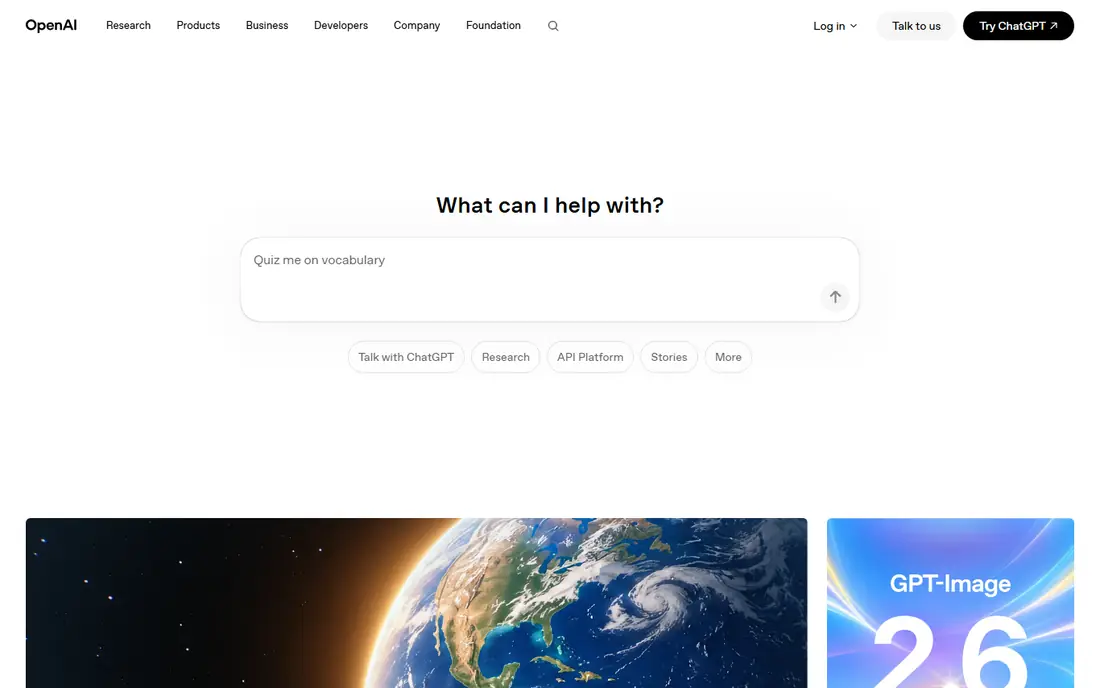
OpenAI remains the most widely known AI company, through ChatGPT and its GPT model series. Its products cover chat, image and video generation, coding help, agents and an API platform used by many other firms. For a team that wants one vendor for consumer, business and developer AI, OpenAI offers the broadest single catalog.
The trade-off is pricing and change. Consumer plans range from free to $20 per month for Plus, with higher Pro tiers, while enterprise pricing is custom. Model names and limits also change often, so teams should check current docs before building a product on a specific model. For breadth and reach, OpenAI still leads the field.
- Broadest product range
- Strong API platform
- Large consumer reach through ChatGPT
- Enterprise pricing is custom
- Model lineup changes often
- Business controls need higher tiers

Anthropic, maker of Claude, is known for careful reasoning, long documents and coding help. Its models are popular with professional teams that need structured writing, code review and analysis of large files. Anthropic also puts weight on safety research and enterprise controls, which appeals to regulated firms.
Consumer pricing mirrors OpenAI, with a free tier and Pro at $20 per month, or $17 per month billed annually. Enterprise plans add usage costs on top of seat pricing, so total cost depends on volume. For professional work where accuracy and long context matter more than consumer breadth, Anthropic is a leading choice.
- Strong long-context reasoning
- Safety and controls focus
- Popular for coding work
- Consumer reach is smaller than OpenAI
- Enterprise pricing adds usage on top of seats
Google DeepMind builds the Gemini model family and powers AI across Google Search, Workspace and Cloud. Its strengths are multimodal work, meaning text, image, audio and video in one model, plus distribution to billions of users through Google products. For firms already on Google Cloud or Workspace, Vertex AI and Gemini offer a natural path.
The product surface can be confusing, with Gemini, Google AI plans and Workspace add-ons priced separately. Consumer AI Pro costs $19.99 per month, while business pricing depends on Workspace or Cloud plans. For a Google-centered firm, DeepMind offers scale and integration that standalone labs cannot match.
- Multimodal Gemini models
- Deep Google distribution
- Vertex AI for business
- Product naming changes often
- Business pricing sits inside Google Cloud and Workspace
Microsoft matters for AI because it embeds Copilot in Word, Excel, Outlook, Teams and Windows, and runs Azure as a major AI cloud. Firms that already use Microsoft 365 can add AI where work already happens, rather than asking staff to learn a separate app. Azure also hosts models from OpenAI and other labs, which gives firms choice inside one cloud.
Pricing is layered. Microsoft 365 Copilot for business is around $30 per user per month plus a Microsoft 365 base, with other plans from $21 per user per month in some listings. That stacking makes total cost hard to read from one page. For a Microsoft shop, the integration benefit is real, but buyers should get a written quote at their seat count.
- Copilot inside Microsoft 365
- Azure AI platform
- Strong enterprise controls
- Full Copilot value needs Microsoft 365
- Business pricing is layered and complex
NVIDIA is an infrastructure company, not a chatbot vendor, and that distinction matters. Its graphics processing units and data center systems power training and inference for many of the firms in this list. Its August 2026 fiscal results showed very large data center revenue, which reflects how central its hardware is to the AI boom.
For a buyer, NVIDIA matters when planning self-hosting, large-volume inference or GPU cloud capacity. Pricing is enterprise and varies by chip, cloud and supply, so no single consumer price applies. For a team choosing a model vendor, NVIDIA is the layer underneath, and its roadmap affects cost and availability across the field.
- Leading AI chips and data center scale
- Software platform for training and inference
- Broad cloud partnerships
- Not a consumer chatbot vendor
- Hardware pricing is enterprise and supply-dependent
Meta AI covers two areas: a free assistant inside Facebook, Instagram, WhatsApp and Messenger, and the Llama family of open-weight models used by developers and firms. The free assistant suits everyday chat, while Llama models let teams run, fine-tune and build on open weights without a single vendor lock-in.
For enterprise buyers, Meta offers less of a managed business suite than Microsoft or Google. Its strength is distribution and openness, not a full productivity platform. For a team that wants open-weight models, a free consumer assistant or AI inside Meta apps, Meta AI is a distinct and valuable option.
- Free consumer assistant
- Open-weight Llama models
- Huge distribution through Meta apps
- Enterprise AI tools are thinner than Microsoft or Google
- Model strategy changes often
Mistral AI, based in Paris, is the leading European foundation-model provider. Its open-weight models suit firms that want European data handling, sovereign deployment or lower-cost inference. Its consumer assistant, Mistral Vibe, offers a free tier and Pro at $14.99 per month, which undercuts the $20 standard of several rivals.
The ecosystem is smaller than Google, Microsoft or OpenAI, so firms that need deep office integration may need extra work. For European firms, regulated teams and developers who value open weights, Mistral offers a credible alternative to US labs with a clear privacy and cost story.
- European base and data options
- Open-weight models
- Lower consumer Pro price
- Smaller ecosystem than US giants
- Enterprise reach is still growing
Cohere focuses on enterprise language AI, especially retrieval, semantic search and embeddings that help firms find and use their own documents. That focus suits companies that need AI over private data, such as support knowledge, contracts and internal search, rather than a general consumer chatbot.
Cohere offers less consumer visibility than OpenAI or Anthropic, and larger deployments are priced by quote. For a firm whose main AI problem is finding the right document or answer inside its own data, Cohere is a specialist worth shortlisting alongside the larger labs.
- Strong enterprise search, retrieval and embeddings
- On-premise and private options
- Business focus
- Less consumer reach
- Pricing is enterprise and quote-based for larger use
DeepSeek, a Chinese lab, is known for efficient open-weight models that perform well on reasoning, math and coding at low cost. Its chat app is free, with no paid consumer tier, and its API is pay-per-use for developers. Teams can also run open-weight models themselves where that fits their infrastructure.
The trade-offs are ecosystem and support. DeepSeek does not offer the office, cloud or enterprise suite of Microsoft, Google or OpenAI. For a team that wants low-cost reasoning, coding help or self-hosted models, DeepSeek is a strong and distinct choice. For a firm that needs managed enterprise controls, a larger vendor may fit better.
- Free chat app
- Strong math, logic and coding
- Open-weight models for self-hosting
- Smaller product ecosystem
- Support and enterprise tools are thinner than large rivals
How we picked these
We compared AI companies on model quality, business products, cloud and infrastructure, openness and current availability in October 2026. We kept companies that build models, run major AI clouds or supply core AI infrastructure, and that are relevant to US readers as users, buyers or job seekers. We left out pure application startups that only resell another lab's models.
We also noted where pricing is consumer, enterprise or hardware-based, since a single price cannot describe a company like NVIDIA or Microsoft. Where a company does not publish a single entry price, we marked it as See website rather than inventing a figure.
What to check before you choose
Start with the layer you need. If you need a chatbot for staff, compare Claude, Gemini and ChatGPT on real tasks. If you need AI over your own documents, compare retrieval and embedding tools such as Cohere. If you need to run models yourself, compare open-weight options from Meta, Mistral and DeepSeek, plus NVIDIA hardware or GPU cloud costs.
Next, check data handling and lock-in. Ask where your data is stored, whether it is used for training, and how easily you can export prompts, fine-tunes and history. Firms that use two providers for redundancy often find that portability matters more than a small quality gap on one task.
Working at an AI company
Job seekers often ask which company is best for artificial intelligence work. The answer depends on role: research roles cluster at OpenAI, Anthropic and Google DeepMind, product and platform roles at Microsoft and Meta, hardware roles at NVIDIA, and open-weight and European roles at Mistral. Check current openings, team focus and location, since hiring shifts fast in this field.
Best new AI companies to watch
Beyond the leaders here, newer labs and application firms appear each quarter, often focused on coding, voice, video or agents. Treat a new company as a watchlist item until it shows a stable product, clear pricing and support. For production work, a proven provider with a service agreement is usually safer than a new lab with a strong demo.
Frequently asked questions
Which company is best for artificial intelligence overall?
There is no single winner. OpenAI leads on breadth, Anthropic on professional reasoning, Google DeepMind on multimodal models and distribution, Microsoft on workplace integration, and NVIDIA on infrastructure. Pick by layer and task, and expect most firms to use more than one provider.
What is the best artificial intelligence company to work for?
It depends on role and location. Research-focused candidates often target OpenAI, Anthropic and Google DeepMind, while platform and product candidates target Microsoft and Meta, and hardware candidates target NVIDIA. Compare team, compensation, location and current hiring, since all four change quickly.
What are the top AI software companies for business use?
For business use, OpenAI, Anthropic, Google and Microsoft are the usual top four, with Cohere as a specialist for enterprise search. Microsoft and Google win where their office or cloud tools already live, while OpenAI and Anthropic win where a standalone model and API matter most.
What are the best new AI companies?
New AI companies often focus on a single layer, such as coding agents, voice, video or vertical tools for health, legal or finance. Mistral and DeepSeek are among the newer labs that have reached scale, while many application startups build on top of the larger labs. Check funding, product stability and support before relying on a new vendor for production work.
Is NVIDIA an AI company or a chip company?
NVIDIA is both, but its core role is AI infrastructure. It designs chips and software that other AI companies use to train and run models. That is why it appears in AI company lists even though it does not sell a mainstream consumer chatbot.
Sources
See where you really rank - block by block
ProMapRanker scans Google Maps across a grid of your service area. Simple monthly plans from $19, white-label on every plan.
Start freeKeep reading
 twitch alternatives
Twitch Alternatives in 2026
Explore the best Twitch alternatives in 2026 for live streaming, with free platforms, monetisation options, audiences, chat tools, and tips for new streamers.
Read → firebase alternatives
Best Firebase Alternatives in 2026
Looking for Firebase alternatives? We compare 9 backend platforms for auth, databases, realtime, storage, functions, self-hosting, and pricing for your app.
Read → companies with best work life balance
Companies With Best Work Life Balance in 2026
See companies with best work life balance in 2026, ranked by employee ratings, with flexible work options, benefits, and what to check before applying.
Read →