 ProMapRanker
Best Apps for Handyman Business in 2026

Key takeaways
- Jobber is the best starting point for most solo handymen, with Core at $29 per month on annual billing and a clean quote-to-payment flow.
- Housecall Pro suits owners who want stronger marketing and review tools, though its jump from one user to five users costs more.
- Joist and ServiceM8 offer free plans that help a new handyman start without a monthly bill, with paid tiers for growth.
- ServiceTitan and FieldEdge fit larger crews, but both are quote-based, so small shops should trial the published-price tools first.
Quick comparison
| Pick | Great for | Pricing starts at | Free tier | |
|---|---|---|---|---|
 Jobber | Solo handymen and small crews | $29 per month | Free trial | Visit |
 Housecall Pro | Owners who want marketing built in | $59 per month | Free trial | Visit |
 Joist | Simple estimating and invoicing | Free | Yes | Visit |
 ServiceTitan | Larger crews and complex operations | See website | No | Visit |
 Workiz | Growing teams wanting an all-in-one platform | See website | No | Visit |
 FieldEdge | Established teams with deep QuickBooks use | See website | No | Visit |
 Service Fusion | Shops that want unlimited users | See website | No | Visit |
 Kickserv | Small teams wanting simple plan tiers | $60 per month | No | Visit |
 ServiceM8 | Solo pros wanting a free start | Free | Yes | Visit |
The best apps for handyman business
We compared tools that handle the daily work of a handyman business: scheduling, estimates, invoicing, payments, and customer records. Our pick for most readers is Jobber for its balance of price and polish, with Housecall Pro close behind for marketing-heavy owners.
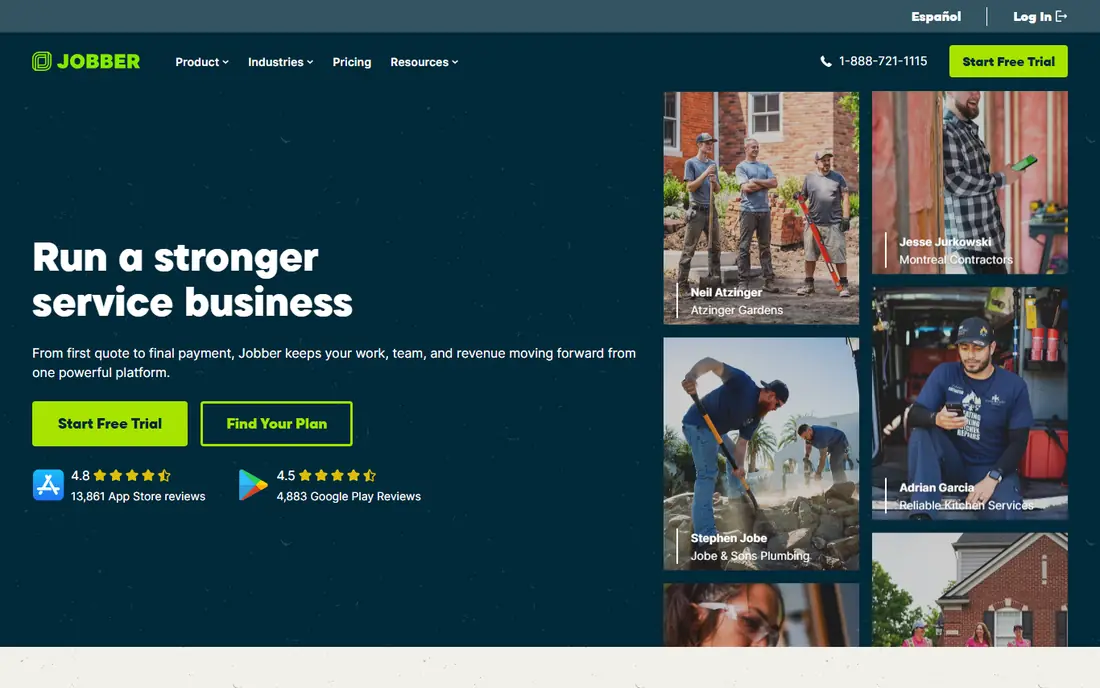
Jobber covers the core chain for a handyman business: online booking, a drag-and-drop schedule, professional quotes, invoices, online payments, and a client hub where customers approve quotes and pay. Core at $29 per month on annual billing, or $49 month to month, covers one user, while Connect and Grow add users, GPS tracking, and automated follow-ups. The 14-day trial needs no card, which makes a real trial easy.
The honest catch is that marketing stays light compared with Housecall Pro, and every extra team member adds cost. For a solo owner or a crew of up to five, though, Jobber is hard to beat on ease and price. Start with Core, and move up only when automated reminders or job costing become a daily need rather than a nice extra.
- Clean scheduling, quoting, and invoicing flow
- Client hub for approvals and payments
- QuickBooks and Xero links
- Marketing tools are basic
- Price rises with team size
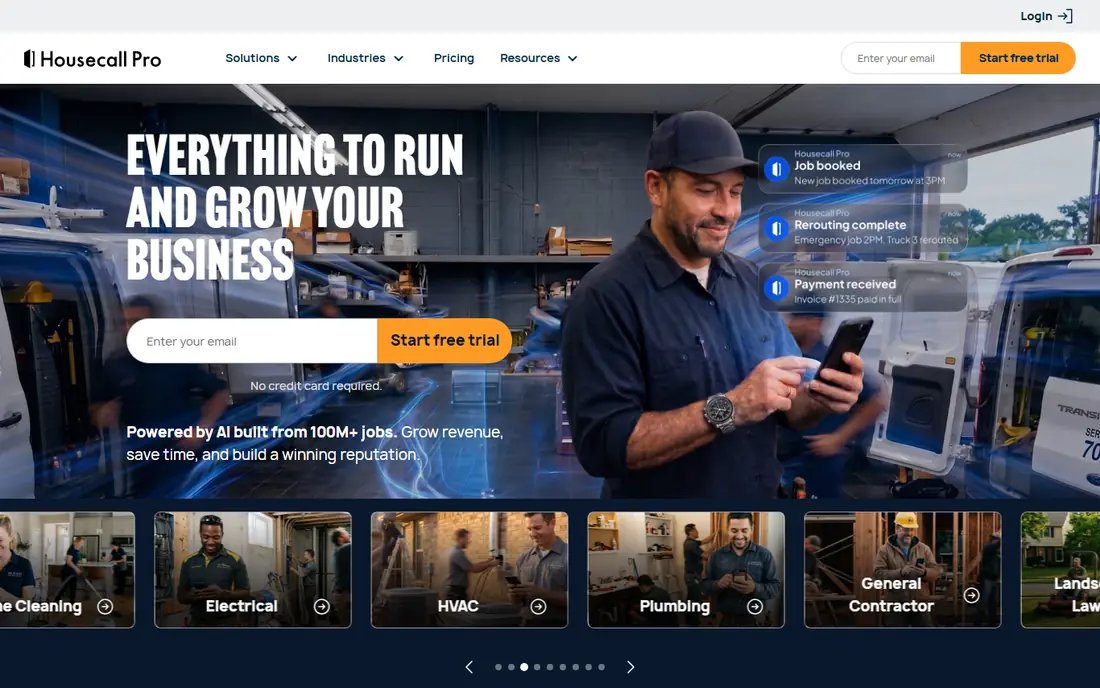
Housecall Pro is built for home service pros who want scheduling, dispatch, quoting, payments, and customer communication in one place, with marketing tools on top. Basic at $59 per month on annual billing covers one user, Essentials at $149 covers five, and Max at $299 covers eight, each with a 14-day trial. Built-in review requests, postcard campaigns, and consumer financing help owners win repeat work, not just complete jobs.
The catch is the seat math. Basic covers one user with no published add-user rate, so adding a helper usually means moving to Essentials at $189 month to month. That jump is worth it if marketing and review tools bring in work, but a solo owner who only needs scheduling will pay less with Jobber. Compare the five-user price, where the two tools tie, before deciding on team size alone.
- Strong review management and marketing tools
- Consumer financing options
- Same-day payment deposits
- Steep jump from Basic to Essentials for a second user
- QuickBooks Desktop is not supported
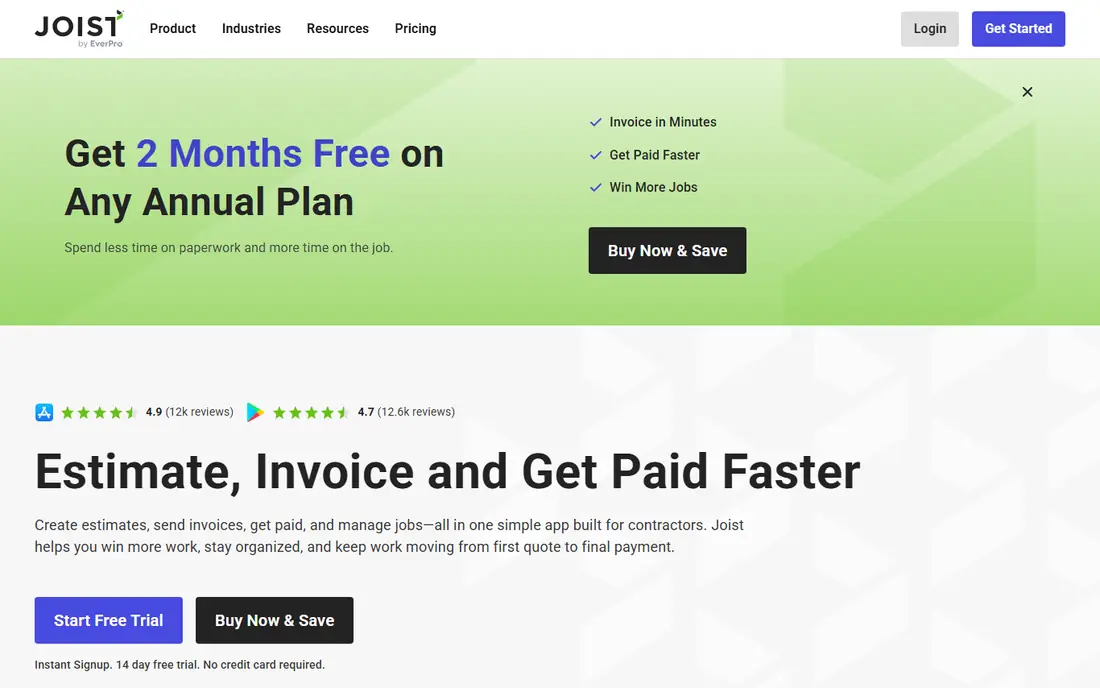
Joist focuses on the two documents every handyman sends most: estimates and invoices. The free plan lets a new owner create professional estimates, convert them to invoices, and accept payments without a monthly subscription. That simplicity is the point, and owners who hate complex software often stick with Joist longer than expected.
The trade-off is scope. Joist does not match Jobber or Housecall Pro for dispatch, team scheduling, or marketing, so a growing crew will eventually outgrow it. For a solo handyman starting out, or for an owner who already manages the calendar elsewhere, Joist is a smart free starting point that can be replaced later without losing client history.
- Free plan covers estimates and invoices
- Very easy to learn
- Quick professional-looking documents
- Lacks deep scheduling and dispatch
- Smaller feature set than full field service platforms
ServiceTitan is a field service platform for larger operations, with dispatching, scheduling, invoicing, payments, marketing, and reporting in one system. Its dispatch board, call tracking, and job costing suit companies with several technicians, office staff, and a steady flow of booked work. Membership and agreement tools also help shops that sell recurring service plans.
The honest catch is price and complexity. ServiceTitan does not publish dollar pricing, it prices per technician, and small shops often face setup fees and a longer contract. A solo handyman does not need this depth, and should trial Jobber or Housecall Pro first. For a crew of ten or more with office staff, ServiceTitan gives control that smaller tools cannot match.
- Advanced dispatch board
- Call tracking and booking tools
- Strong reporting and membership handling
- Quote-only pricing
- Contract and onboarding costs can be high for small shops
Workiz is a field service management platform for home service businesses, covering online booking, scheduling, dispatch, estimates, invoicing, payments, and customer communication. It also offers a phone system add-on, which helps shops that book much of their work by phone. Automation for reminders, follow-ups, and review requests cuts the admin work that piles up after a busy day in the field.
The catch is that pricing is request-based rather than published, so budgeting needs a demo and a quote. Workiz also rewards a team willing to set it up properly, rather than an owner who wants a tool running in an hour. For a growing handyman business that has outgrown simple estimating apps, Workiz is a serious step up.
- Scheduling, dispatch, invoicing, and payments in one place
- Phone system options
- Solid automation tools
- Pricing is quote-based
- Setup takes more time than simpler tools
FieldEdge is a field service platform for service contractors, with scheduling, dispatch, quoting, invoicing, and customer management, plus strong accounting links. It supports both QuickBooks Online and QuickBooks Desktop, which matters for shops that have used Desktop for years and do not want to switch. Higher plans add service agreement handling and deeper reporting.
The trade-off is pricing transparency. FieldEdge quotes by plan and mobile licence count, so a small shop needs a sales conversation to get a real number. It is also built for established teams rather than a solo starter. For a crew that lives in QuickBooks and needs dispatch depth, FieldEdge is worth a demo alongside ServiceTitan.
- Strong QuickBooks Online and Desktop links
- Dispatch and invoicing depth
- Agreement handling on higher plans
- Quote-only pricing
- Mobile licences vary by plan
Service Fusion is a field service platform with scheduling, dispatch, estimates, invoicing, payments, and customer management, and it stands out by offering unlimited users on every plan. That model helps shops where office staff, dispatchers, and technicians all need access without a per-seat bill for each person. Its plan tiers step up by feature access rather than headcount.
The honest catch is that the vendor site now leans toward quote-led pricing, so the published figures from comparison guides may not match your quote. Recurring invoicing is also an add-on rather than a standard feature on some plans, so check that point if you sell maintenance visits. For a team with many logins, the unlimited-user model can still beat per-seat rivals.
- Unlimited users on every plan
- Scheduling, dispatch, and invoicing included
- Published plan history
- Current pricing is quote-led on the site
- Recurring invoicing may need an add-on
Kickserv is a field service tool for small service businesses, with scheduling, job management, estimates, invoicing, and payments. Its plans start at $60 per month for five users, then $119 for ten and $199 for twenty, with a 20 percent saving on annual billing. That team-size pricing is easy to understand and suits a crew that wants predictable costs as it hires.
The trade-off is ecosystem size. Kickserv has fewer integrations and marketing tools than the market leaders, so owners who rely on a specific accounting or marketing app should check compatibility first. For a small handyman crew that wants a straightforward tool without per-user surprises, Kickserv is a solid, affordable option.
- Clear Start, Run, and Scale tiers
- Scheduling and invoicing included
- Team-size based pricing
- Smaller ecosystem than Jobber or Housecall Pro
- Fewer marketing tools
ServiceM8 is a job management app for trade and service businesses, covering quoting, scheduling, invoicing, payments, and client records. Its free plan suits a solo handyman with a light job load, and paid plans scale by monthly job allowance rather than by seat count, with unlimited users on paid plans. That model helps a small crew where several people need access but job volume is modest.
The catch is the job allowance. A busy month can push a growing business into a higher tier, so track job count alongside price when comparing with seat-based tools. For a new handyman who wants to start free and pay only as work grows, ServiceM8 is one of the best low-risk entries on this list.
- Free plan for a single user
- Job management, quoting, and invoicing included
- Unlimited users on paid plans
- Paid plans run from $29 to $349 per month by job allowance
- Job caps need watching on busy months
How we picked these
We compared official pricing pages, feature lists, and trial terms, and we kept only tools live in October 2026 that genuinely serve handyman and small field service businesses. We favored published prices where available and marked quote-based tools as such, and we included free options so new owners have a starting point. We did not claim hands-on testing; our comparison rests on vendor pages and public pricing guides.
What to check before you buy
Start by listing the jobs you do each week and the admin steps that follow each one: booking, estimate, approval, scheduling, invoice, payment, and follow-up. The best app is the one that covers that chain without forcing you to keep a separate spreadsheet. Check that estimates look professional on a phone, because many customers approve work from a mobile screen, not a desktop.
Next, price the whole crew, not just the owner. A tool that is cheap for one user can double when a helper joins, so compare the two-user and five-user prices before signing. Finally, trial the app on real jobs for two weeks, including a payment and a reschedule, and ask customers whether booking and payment felt easy. An app that saves office time but confuses customers will cost work in the long run.
Frequently asked questions
What is the best software for a handyman business?
Jobber is our pick for most solo owners and small crews, thanks to its clean workflow and $29 per month annual starting price. Housecall Pro is better for owners who want stronger marketing, and Joist or ServiceM8 suit owners who want to start free.
What is the best handyman estimating software?
Joist is the simplest estimating tool, with a free plan for professional estimates and invoices. Jobber and Housecall Pro also handle estimating well, and they add scheduling and payments for owners who want one tool for the whole job.
Is there a free app for a handyman business?
Yes. Joist and ServiceM8 both offer free plans, and Jobber and Housecall Pro offer 14-day trials. Free plans suit a light job load, while paid plans add scheduling depth, automation, and team features as work grows.
How much does handyman business software cost?
Entry prices on this list run from free to $60 per month, with Jobber at $29 and Housecall Pro at $59 on annual billing. Larger platforms such as ServiceTitan and FieldEdge are quote-based and cost more, so trial the published-price tools first.
What is the best app for handyman businesses with a small crew?
Jobber and Housecall Pro tie at $149 per month on annual billing for five users, so the choice comes down to features: Jobber for a cleaner workflow, Housecall Pro for marketing. Kickserv is a cheaper alternative at $119 per month for ten users on monthly billing.
Sources
See where you really rank - block by block
ProMapRanker scans Google Maps across a grid of your service area. Simple monthly plans from $19, white-label on every plan.
Start freeKeep reading
 whats the best ai app to use
Whats the Best AI App to Use in 2026
Wondering whats the best ai app to use in 2026? We compare ChatGPT, Claude, Gemini, Copilot, and more on price, free plans, and best everyday uses today.
Read → life360 alternatives
Life360 Alternatives in 2026
Life360 alternatives compared: 9 family location apps with live maps, arrival alerts and privacy controls to help your family stay in touch every day.
Read → captcha alternatives
CAPTCHA Alternatives in 2026
CAPTCHA alternatives compared: 9 reCAPTCHA alternatives that block bots with less friction, from free Turnstile to privacy-first proof-of-work tools included.
Read →