 ProMapRanker
Best App for Strength Training in 2026

Key takeaways
- Strong and Hevy are the best low-cost loggers for lifters who already know their program and want fast set tracking.
- Fitbod and Alpha Progression suit lifters who want each session planned for them, with equipment and progression handled by the app.
- Boostcamp and Caliber offer strong free program libraries, while JEFIT suits long-time lifters with years of data to keep.
- This article is general information only, not medical advice, and new lifters should learn safe form before chasing heavier loads.
Quick comparison
| Pick | Great for | Pricing starts at | Free tier | |
|---|---|---|---|---|
 Strong | Fast simple logging | Free | Yes | Visit |
 Hevy | Social logging at low cost | $2.99 per month | Yes | Visit |
 JEFIT | Large exercise library | Free | Yes | Visit |
 Fitbod | Auto-generated sessions | $15.99 per month | Free trial | Visit |
 Alpha Progression | Prescribed per-set targets | $12.99 per month | Yes | Visit |
 StrongLifts 5x5 | Simple beginner program | $11.99 per month | Free trial | Visit |
 Boostcamp | Free proven programs | Free | Yes | Visit |
 Caliber | Coaching-led programs | Free | Yes | Visit |
 StrengthLog | Ad-free logging plus programs | Free | Yes | Visit |
The best app for strength training
We compared logging speed, program quality, progression logic, exercise libraries and pricing for strength apps live in October 2026. General information only: these apps track workouts and suggest loads, but they do not replace a coach, a clinician or safe technique coaching. If you have an injury, a health condition or pain during lifting, stop and seek professional advice.
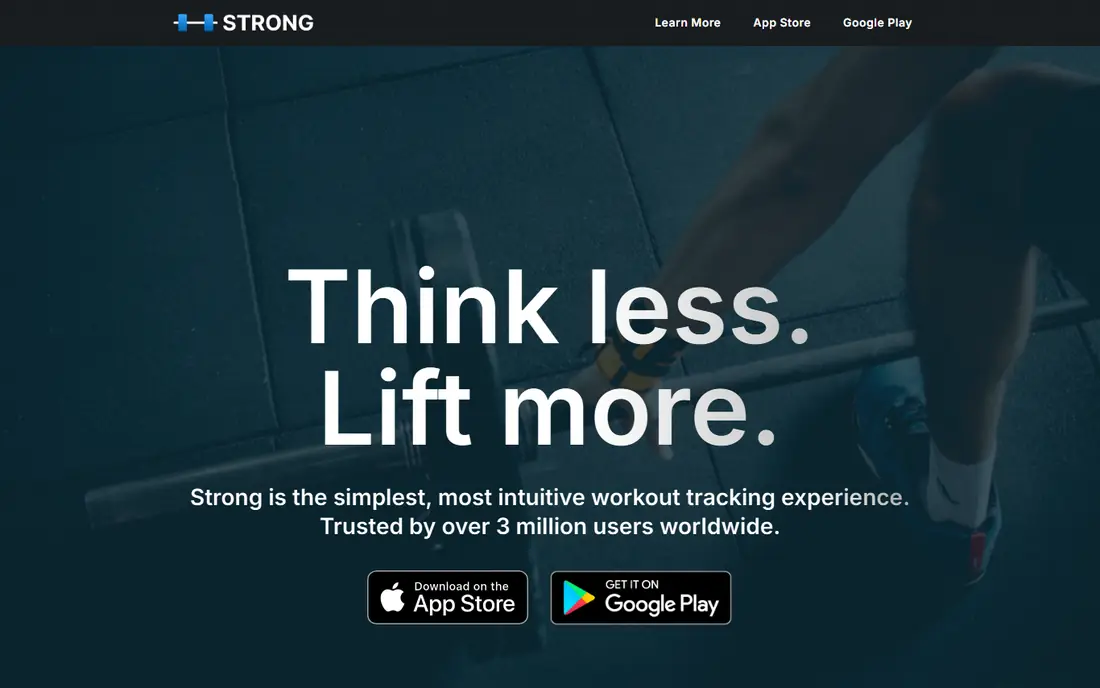
Strong is our pick for lifters who already know what to train and just want a fast notebook. Logging a set takes a few taps, rest timers run on the phone and on Apple Watch, and the interface stays out of the way between sets. That speed matters in a busy gym, where a slow app can break focus and add minutes to a session.
The trade-off is guidance. Strong does not build your program or pick your next weights for you, so beginners must bring their own plan or use another source for programming. The free tier covers unlimited logging with a limit on custom routines, while Pro adds more routines, charts and export. For self-directed lifters, it is the simplest tool that still feels complete.
- Very fast set logging
- Apple Watch support with rest timers
- Clean interface with no clutter
- No auto-generated programs
- Advanced charts and export need the Pro plan
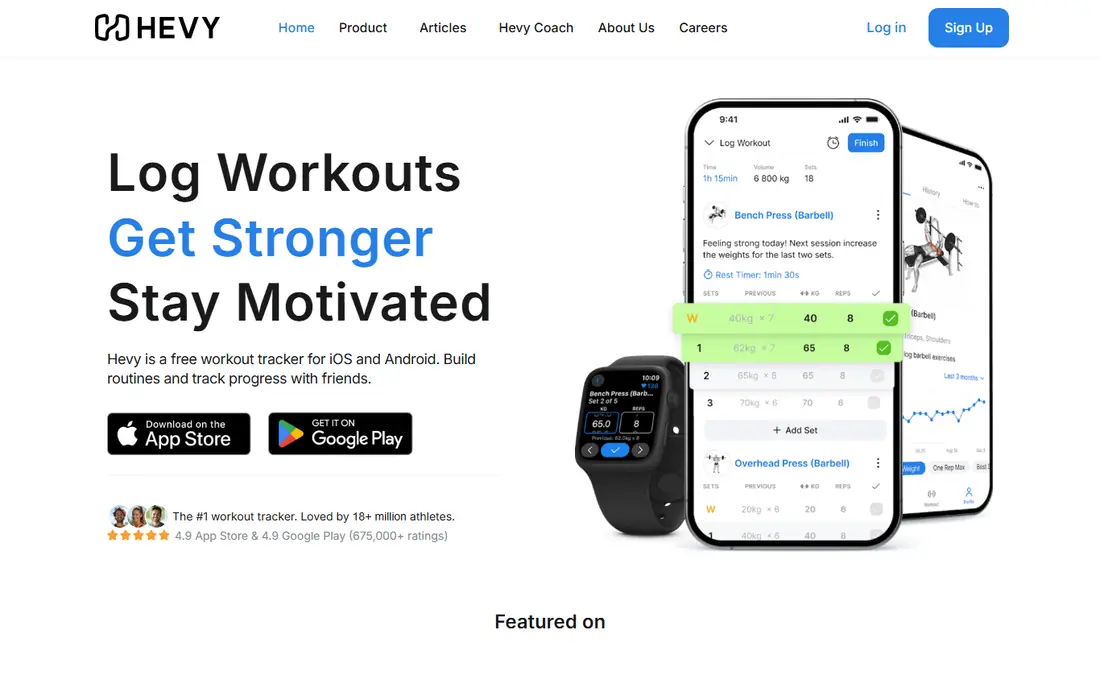
Hevy pairs fast logging with a social feed, so lifters who enjoy sharing workouts and following friends get more than a private notebook. The free tier covers unlimited logging with limits on routines, custom exercises and history, which is generous for a free app. Pro is among the cheapest paid plans in this category, with monthly, yearly and lifetime options.
Program guidance is lighter than Fitbod or Alpha Progression, since Hevy leans on templates you choose rather than generating each session. Private lifters can ignore the social feed, but they may still prefer Strong for a quieter interface. For lifters who want a low-cost logger with a community feel, Hevy is excellent value.
- Unlimited free logging
- Social feed for friends and workouts
- Low Pro price with lifetime option
- No auto-generated program in the free tier
- Social features may not suit private lifters
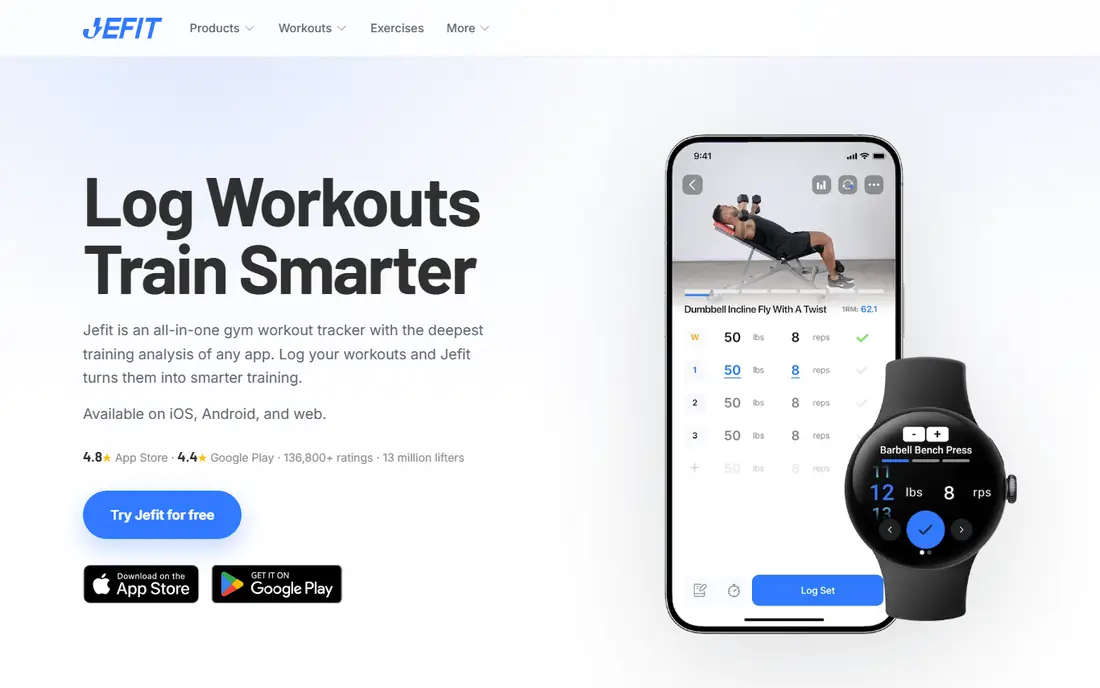
JEFIT has one of the largest exercise libraries in this category, with demos, muscle maps and community programs built over many years. Lifters who like variety, from machines to free weights, will find most movements covered, and body measurements, rest timers and superset support round out the tracker. Long-time users often stay because years of workout history live in the app.
The free version includes ads and upsells, and the most advanced progression analysis sits behind the Elite plan. That can frustrate lifters who want full analytics without paying. Still, the free tier is usable for daily logging, and the library alone makes JEFIT worth trying if you train with varied equipment.
- Very large exercise library with demos
- Community programs and challenges
- Body measurement tracking
- Ads in the free version
- Some progression tools sit behind the Elite plan
Fitbod suits lifters who do not want to plan workouts at all. Tell it your equipment, goals, available time and recent training, and it builds each session, adjusting sets, reps and loads as you log progress. That hands-off planning helps people who train in different gyms, at home, or with limited equipment, since the app adapts to what is available.
The price is the catch. Fitbod offers a trial but no permanent free logging tier, and its monthly cost is the highest on this list. Auto-generated plans also depend on honest inputs: if you log weights carelessly, the next session will reflect bad data. For lifters who value zero planning and can justify the cost, Fitbod is the most polished auto-planner here.
- Builds each session from your equipment, goals and recovery
- Large exercise variety
- Apple Watch support
- No permanent free logging tier
- Highest monthly price on this list
- Auto plans need honest input to work well
Alpha Progression stands out for lifters who want precise guidance without a full coach. Its Pro plan gives a weight and rep target for each set, based on your past performance, so you walk into the gym knowing what to aim for. The interface stays clean, with exercise videos, rest timers and notes that support focused training.
Free users can log workouts and build manual plans, but the plan generator and next-set advice need Pro, which costs a monthly or yearly fee with no lifetime option. That paywall matters if you want the core selling point without a subscription. For gym lifters who like a prescribed target each set, Alpha Progression is one of the most exact tools available.
- Gives a target for each set based on past performance
- Clean interface
- Free logging and manual plans
- Plan generator and next-set advice need Pro
- No lifetime plan option
StrongLifts 5x5 is built around one simple idea: five sets of five reps on a small set of compound lifts, three times a week, with weight rising each session. That simplicity makes it ideal for true beginners, since there is no program choice to agonize over and progression is automatic. The app guides each workout, tracks the next weight and keeps rest simple.
The fixed program is also the limit. Lifters who want variety, isolation work or sport-specific training will outgrow it quickly, and continued use after the trial needs a subscription. Use StrongLifts to build a base of strength and habit over a few months, then move to a more flexible app such as Strong, Hevy or Boostcamp when you need more variety.
- Simple proven 5x5 program for beginners
- Automatic weight progression
- Clear workout structure
- Fixed program with little variety
- Continued use needs a subscription after the trial
Boostcamp offers one of the best free deals in strength training: a large library of coach-designed programs, a solid tracker and a plate calculator, all in a free tier. Programs cover beginner strength, powerlifting, bodybuilding and general fitness, with forums for each program where users share tips and progress. For a lifter who wants a proven plan without paying, that library is hard to beat.
Pro adds unlimited use of some tools and extra features, but the free tier already covers core training well. Program quality varies by author, so read the program notes and forum feedback before starting a long plan. For beginners and intermediates who want structure at no cost, Boostcamp is the best free starting point on this list.
- Large free program library from named coaches
- Strong tracker with plate calculator
- Community forums per program
- Pro features such as unlimited plate calculator use need a paid plan
- Program quality varies by author
Caliber combines free tracking with coaching-led programming, which suits lifters who want expert structure without building their own plan. The free tier covers unlimited tracking and a large exercise video library, so you can learn form cues while you log. Paid Plus adds more programming depth, and one-to-one coaching is available for lifters who want direct feedback.
Coaching costs far more than a basic subscription, so it only makes sense for lifters who will actually use it. The app is also less minimal than Strong, with more screens and options to learn. For lifters who want a guided path with a human option behind it, Caliber offers a strong free base plus a clear upgrade route.
- Unlimited free workout tracking
- Large exercise video library
- Optional human coaching for those who want it
- Plus and coaching prices add up
- Coaching availability varies
- App is less minimal than Strong
StrengthLog is a calm, ad-free logger with unlimited free logging, a large exercise library and many free programs. The absence of ads in the free tier is a real plus in a category where free apps often interrupt workouts with promotions. Programs cover strength and hypertrophy goals, and the interface stays focused on sets, reps and progression.
Premium features and some advanced programs need a paid plan, and the community is smaller than Hevy or JEFIT, so social lifters may miss that energy. For lifters who want a quiet, reliable notebook with free programs and no ad noise, StrengthLog is an underrated pick. Try the free tier first, since it already covers most daily training needs.
- Unlimited logging with no ads in the free tier
- Large exercise library
- Many free programs included
- Premium analytics and some programs need a paid plan
- Smaller community than Hevy or JEFIT
How we picked these
We compared official pricing pages, app store listings and strength training guides for apps live in October 2026. We favored apps with a clear strength focus, current support and a usable free tier or trial, and we mixed simple loggers, auto-planners and program libraries. We left out general fitness apps with only light strength features, and we used the most recent published prices, marking uncertain prices as See website.
How to choose a strength app that lasts
Start with your training style, not the app with the most features. Self-directed lifters should pick Strong, Hevy or StrengthLog for fast logging. Lifters who want a plan picked for them should try Fitbod, Alpha Progression or Caliber, while beginners on a budget should start with Boostcamp or StrongLifts 5x5. Test the free tier for two weeks of real workouts before paying, since gym flow matters more than a feature list.
Next, check the details that affect daily use: offline logging for gyms with weak signal, Apple Watch or Wear OS support if you train with a watch, and export options if you ever want to move your history. Finally, keep progression honest: log real weights, rest enough between hard sets, and learn safe form before adding load. An app can track progress, but it cannot replace good technique and recovery.
Frequently asked questions
What is the best app for strength training?
Strong and Hevy lead for fast, low-cost logging, while Fitbod and Alpha Progression lead for auto-planned sessions. Boostcamp is the best free program library, and Caliber suits lifters who want coaching-led plans. Pick based on whether you want to log, follow a plan, or get coaching.
Are strength training apps free?
Several offer strong free tiers, including Strong, Hevy, JEFIT, Boostcamp, Caliber and StrengthLog. Fitbod offers a trial but no permanent free logging, and StrongLifts 5x5 needs a subscription after its trial. Check current pricing, since free limits and prices change.
Do I need a strength app to get stronger?
No, progressive overload, good form, sleep and nutrition matter more than any app. An app helps by tracking weights, planning progression and showing trends over months, which makes it easier to stay consistent. A notebook can work too, but an app is faster in the gym.
What is the best strength training app for beginners?
Boostcamp is a strong free pick for beginners, thanks to coach-designed programs and a solid tracker. StrongLifts 5x5 suits absolute beginners who want one simple program, while Alpha Progression helps beginners who want per-set targets. Learn safe form first, and start lighter than you think you need.
Can a strength app replace a personal trainer?
An app can plan workouts and track progress, but it cannot watch your form, adjust for pain, or coach technique in real time. Caliber offers human coaching as an upgrade, which comes closer than a pure app. For complex needs or injuries, work with a qualified coach or clinician in person.
Sources
See where you really rank - block by block
ProMapRanker scans Google Maps across a grid of your service area. Simple monthly plans from $19, white-label on every plan.
Start freeKeep reading
 who has best internet service
Who Has the Best Internet Service in 2026
Who has best internet service for US homes? We compare fiber, cable, fixed wireless and satellite providers on speed, price, availability and terms today.
Read → which survey tool has the best analytics
Which Survey Tool Has the Best Analytics in 2026
Find which survey tool has the best analytics in 2026, comparing Qualtrics, SurveyMonkey, Typeform, Alchemer, and more on reports, text, and stats today.
Read → which streaming service has the best movies
Which Streaming Service Has the Best Movies in 2026
Answering which streaming service has the best movies, with Netflix, Max, Criterion and more compared on libraries, prices and free options in this guide.
Read →