 ProMapRanker
Best App for Scanning Sports Cards in 2026

Key takeaways
- CollX is the easiest free starting point for most collectors, with scanning, a marketplace, and collection tracking in one app.
- Ludex is stronger on parallels and modern inserts, and it also covers trading card games in the same app.
- Card Ladder and Sports Card Investor tools are better for value tracking from real sales, but they cost more and suit serious collectors.
- No scanner price is exact, since condition, grade, and the specific sale all change what a card actually sells for.
- Always check recent sold listings before buying or selling on the strength of a single app estimate.
Quick comparison
| Pick | Great for | Pricing starts at | Free tier | |
|---|---|---|---|---|
 CollX | Easy free scanning and trading | See website | Yes | Visit |
 Ludex | Parallels and mixed collections | See website | Yes | Visit |
 Cardbase | Simple collection tracking | See website | Yes | Visit |
 Sports Cards Pro | Casual value tracking | See website | Yes | Visit |
 Card Ladder | Portfolio value from real sales | See website | Free trial | Visit |
 Beckett | Price guide and grading data | See website | Yes | Visit |
 PSA Cert Verification | Checking graded cards | Free | Yes | Visit |
 StarSnap | Simple free scanning | Free | Yes | Visit |
The best app for scanning sports cards
A sports card scanning app uses a phone camera to identify a card, pull up its set, year, and number, and show an estimated value. The best app depends on whether you want a quick scan, a full collection tracker, a marketplace, or a serious price history. We compared official app listings, pricing pages, and feature descriptions, and we kept only apps that are live on iOS or Android in October 2026.
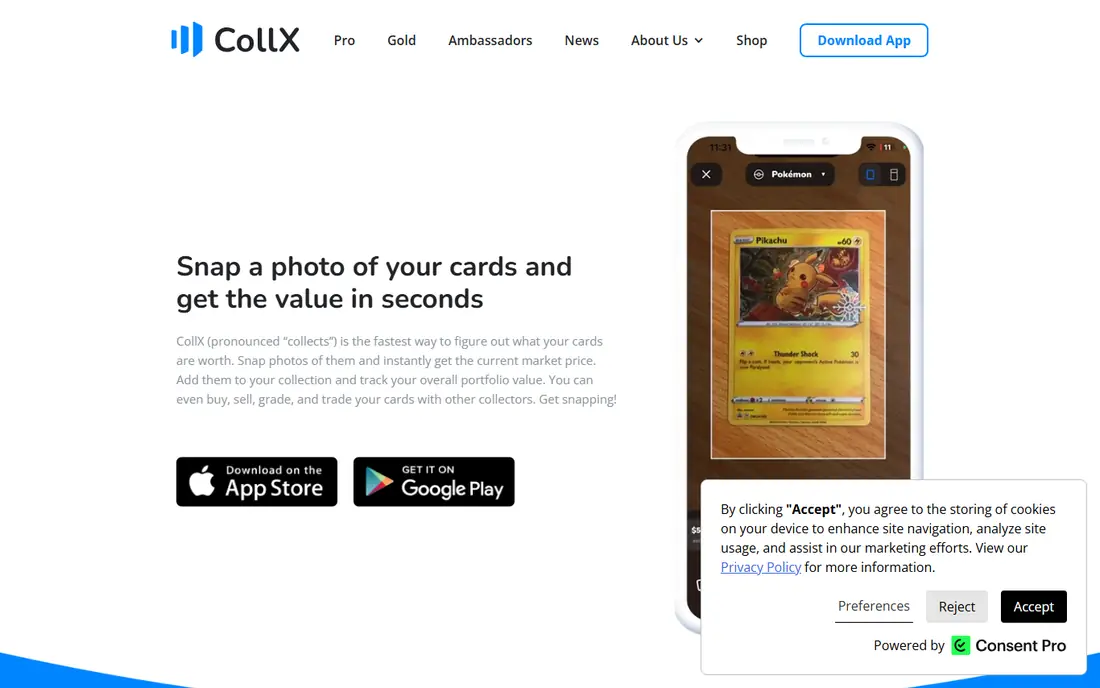
CollX is the app most new collectors should try first. Point the camera at a card, confirm the match, and save it to a collection with an estimated value, then trade or sell in the built in marketplace without opening another app. That all in one flow is why CollX appears at the top of many collector lists, and it works for baseball, football, basketball, hockey, and some trading card games.
The free tier is useful but limited, with a monthly scan limit and ads in published descriptions, and paid plans add unlimited scans, price charts, and export. Published paid prices have varied between sources, from around 8 dollars per month to around 10 dollars per month, so we list it as See website and recommend checking the in-app price. Treat CollX values as a starting estimate, and check sold listings before acting on a high value card.
- Simple scan and save workflow
- Built in marketplace for trades and sales
- Covers MLB, NFL, NBA, and NHL
- Free tier limits scans and shows ads
- Price estimates can differ from recent sold listings
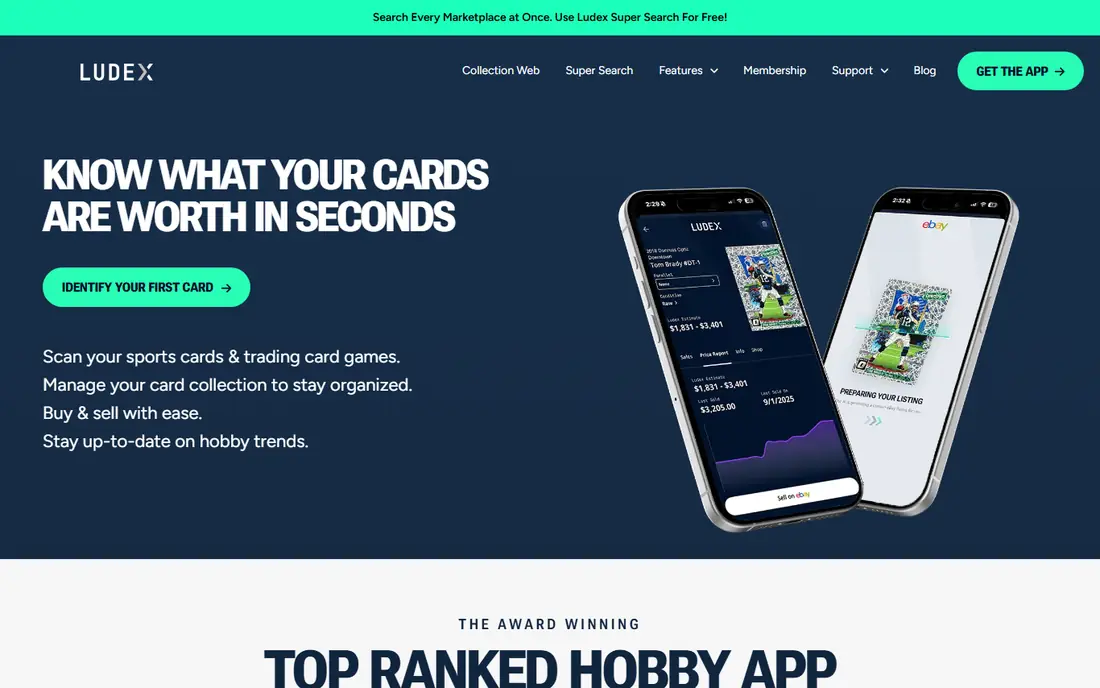
Ludex stands out when a card is not a plain base card. Parallels, short prints, and modern inserts are where many scanners struggle, and Ludex is often rated stronger in that area in collector comparisons. It also covers Pokemon and other trading card games, so a collector with mixed boxes can use one app for both sports and trading cards, rather than switching between scanners.
Pricing has changed over time, with app store listings showing a premium tier near 25 dollars per month in one recent listing, and older reviews citing far lower prices, so we list it as See website. The free tier limits scans to a small monthly number, which makes it impractical for building a large collection without paying. Ludex is best for a collector who needs accurate identification on tricky cards and is willing to pay for unlimited scans.
- Strong identification on parallels and inserts
- Covers sports and trading card games
- Community features
- Free tier limits scans heavily
- Sports pricing data is thinner than dedicated sports apps in some reviews
Cardbase focuses on the collection side of the hobby: scan or add cards, track them in sets, and watch a running collection value. That focus suits a collector who already knows what they own and wants a tidy record, rather than a buyer who needs a marketplace on every scan. The interface is straightforward, and set tracking helps when you are chasing a complete set rather than a single valuable card.
The trade-off is that Cardbase is less of a trading hub than CollX, and scanning accuracy can vary on rarer sets. Pricing is listed in app, so we list it as See website. Use Cardbase when organization matters most, and pair it with sold listings when you need a firm price for a sale. For a collector with a large, set based collection, that combination works well.
- Clean collection and value tracking
- Covers many sports sets
- Useful for organizing a growing collection
- Scanning depth varies by set
- Less marketplace depth than CollX
Sports Cards Pro is a straightforward option for casual collectors who want a quick value check and a simple collection list. It covers major sports, gives a price estimate for scanned or searched cards, and keeps the workflow short, which suits a collector who scans a handful of cards at a show or after opening packs. The low cost and simple design are the main appeal.
Advanced collectors will miss the deeper tools on this list. There is no full portfolio charting from real auction sales, no population report integration, and no marketplace depth to match CollX. That is fine for casual tracking, but not for investment decisions. Use Sports Cards Pro for a running list and a rough total, and check sold data before buying or selling a card that matters.
- Simple price lookup and collection tracking
- Low cost for casual use
- Covers major sports
- Price data is an estimate, not a full sales history
- Fewer advanced tools than Card Ladder
Card Ladder is the serious pick for collectors who treat cards as assets and need a price history they can trust more than a single estimate. It builds charts from actual eBay and auction house sales, tracks a portfolio over time, and lets a collector see how a card has moved, rather than just what it might be worth today. That history is valuable when deciding whether to hold, grade, or sell.
The subscription costs more than a casual scanner, with published figures near 20 dollars per month in recent comparisons, so we list it as See website and recommend checking the current plan page. Even with real sales data, a portfolio total assumes your copy matches the condition and grade being priced, so a raw card will not sell for a graded PSA 10 price. Card Ladder is best for collectors with a sizable collection and real money at stake.
- Price history built from real eBay and auction sales
- Portfolio charts
- Useful for buy and sell decisions
- Subscription cost is higher than casual scanners
- Value still assumes your card matches the graded condition priced
Beckett is a familiar name in the hobby, known for its price guides, grading service, and set checklists. The app and site give collectors a reference point for values, grading information, and set data that newer scanners do not always match. For a collector who wants to understand a set, a grade, and a price guide value in one place, Beckett remains a useful reference.
Scanning is not Beckett's strongest feature compared with CollX or Ludex, and full price guide access sits behind a paid tier, with pricing in app or on the site. Use Beckett as a reference and a grading companion, and use a dedicated scanner for fast camera identification. That pairing gives a better result than relying on either tool alone for every job.
- Long running price guide brand
- Grading and population context
- Deep set checklists
- App scanning is not the main strength
- Full price guide access is paid
PSA Cert Verification, in the PSA app, is a different kind of tool, and it belongs on this list because it solves a real problem for buyers. Enter or scan the cert number on a PSA graded card, and the app shows the card details, grade, and population context from PSA. That check helps a buyer confirm that a graded card matches its label before paying a premium price.
It does not value a raw card, scan an ungraded collection, or track a portfolio in the same way as CollX or Card Ladder. Its job is verification, and it does that job for free. Use it every time you buy a graded card, especially a high value one, and keep it alongside a scanner for raw cards. For football card collectors buying graded rookies, that check is a simple safety step.
- Free to use
- Verifies PSA graded cards by cert number
- Helps avoid fakes when buying graded cards
- It does not scan raw cards for value
- It only checks cards already graded by PSA
StarSnap is the simplest option on this list, and that simplicity is the point. It scans a card, identifies it, and shows a value estimate, without pushing a marketplace or a complex portfolio dashboard. For a collector who just wants to know what a card is and roughly what it is worth, StarSnap keeps the workflow short and the app uncluttered.
The limits follow from that simplicity. Collection tracking, price history, and trading features are thinner than in CollX or Card Ladder, and the value shown is still an estimate. Use StarSnap for quick scans at a show, in a shop, or while sorting a box, and use a fuller app when you need to track, trade, or sell at scale. For a free, low friction scanner, it is a good backup to CollX.
- Clean, simple scanning without a marketplace
- Free to start
- Works on iOS and Android in published descriptions
- Fewer tracking and marketplace features than CollX
- Price estimates still need a sold listing check
How we picked these
We compared official app listings, pricing pages, and feature descriptions for apps that scan sports cards with a phone camera. We included scanners, trackers, a price guide, and a verification tool, because collectors use all four for different jobs. We left out tools that only track prices without scanning, and tools that only list cards for sale without a scan feature. Where pricing varied between app store listings and reviews, we wrote See website rather than publishing a figure that might be out of date.
What to check before you trust a scan
Start with the match, not the price. A scanner can misread a parallel, a year, or a variation, and a wrong match gives a wrong value even if the app looks confident. Check the set, year, card number, and photo against your card, especially for parallels and inserts where the difference is a small foil pattern or a serial number.
Next, check condition and grade. A price for a PSA 10 graded card is not the price for a raw card with soft corners, and a price for a mint card is not the price for a played card. Look at corners, edges, surface, and centering, and be honest about flaws before using a value. Finally, check recent sold listings on eBay or an auction site for the same card in the same grade. An app estimate is a guide, while a sold listing shows what a buyer actually paid.
Best football card scanner app: what matters most
For football cards, the same rules apply, with one extra check: rookie cards, parallels, and short prints drive most of the value, so a scanner that handles parallels well matters more than one that only nails base cards. Ludex and CollX both cover NFL cards, and Ludex is often rated stronger on parallels. Whichever app you pick, confirm the parallel and the print run before trusting a high estimate.
Best card scanning app for sports cards: free versus paid
Free tiers work for casual scanning, but they limit scans, show ads, or hide price history. Paid tiers add unlimited scans, charts, and export, which matter when you scan hundreds of cards. Start free, scan a test batch of 20 cards you already know, and only pay when the app proves it identifies your cards correctly and its values track sold listings closely enough for your needs.
Frequently asked questions
What is the best app for scanning sports cards for free?
CollX is the best free starting point for most collectors, with a free tier, scanning, and a marketplace in one app. StarSnap is a simpler free alternative if you do not want marketplace features. Ludex also has a free tier, but its scan limit is small, so it is less useful for a large collection without paying.
What is the best sports card scanning app for football cards?
CollX and Ludex both scan NFL cards well, with Ludex often rated stronger on parallels and modern inserts. Card Ladder is better for tracking a football portfolio from real sales, but it costs more. For a quick scan at a show, start with CollX, and check the parallel carefully before trusting the value.
Are sports card scanner app prices accurate?
Prices are estimates, not guarantees. They come from marketplace averages, guide values, or recent sales, and they can lag the market or mix grades and conditions. A scanner value can be 10 to 30 percent off a real sold price in some comparisons, so always check recent sold listings for the same card and grade before buying or selling.
Can I sell cards directly from a scanning app?
Yes, in some apps. CollX has a built in marketplace for trades and sales, and eBay has a scan feature inside its selling flow that pre-fills a listing. Other apps, such as Card Ladder and StarSnap, focus on tracking and identification, so you will need a separate marketplace to sell. Check fees and seller protections before listing a high value card.
Do I need a paid sports card app?
Not for casual collecting. A free tier is enough to scan a few cards, learn a collection, and test an app. Paid plans make sense when you scan often, need unlimited scans, want price charts or export, or manage a collection worth real money. Start free, and pay only when a limit actually blocks your workflow.
What is the best app for scanning sports cards and tracking value over time?
Card Ladder is the strongest choice for value tracking from real sales, with portfolio charts and price history. Sports Cards Pro and Cardbase cover casual tracking at lower cost, while CollX adds tracking plus a marketplace. For investment level tracking, Card Ladder plus a sold listing check is the most reliable combination on this list.
Sources
See where you really rank - block by block
ProMapRanker scans Google Maps across a grid of your service area. Simple monthly plans from $19, white-label on every plan.
Start freeKeep reading
 whats the best ai app to use
Whats the Best AI App to Use in 2026
Wondering whats the best ai app to use in 2026? We compare ChatGPT, Claude, Gemini, Copilot, and more on price, free plans, and best everyday uses today.
Read → life360 alternatives
Life360 Alternatives in 2026
Life360 alternatives compared: 9 family location apps with live maps, arrival alerts and privacy controls to help your family stay in touch every day.
Read → captcha alternatives
CAPTCHA Alternatives in 2026
CAPTCHA alternatives compared: 9 reCAPTCHA alternatives that block bots with less friction, from free Turnstile to privacy-first proof-of-work tools included.
Read →