 ProMapRanker
Best AI Search Analysis Tools in 2026

Key takeaways
- Otterly.AI offers the lowest entry price, while Profound offers the widest enterprise coverage.
- Most tools charge by prompts, credits or workspaces, so compare the same prompt volume before judging price.
- AthenaHQ and Rankscale stand out for users who want a free or low-cost way to test AI visibility.
- No tool sees every AI answer: coverage, prompt choice and geography all shape the results.
Quick comparison
| Pick | Great for | Pricing starts at | Free tier | |
|---|---|---|---|---|
 Profound | Enterprise AI visibility depth | See website | Free trial | Visit |
 Peec AI | Competitive AI positioning | See website | Free trial | Visit |
 Otterly.AI | Low-cost AI visibility monitoring | $29 per month | Free trial | Visit |
 Scrunch | Brand presence and optimisation | See website | Free trial | Visit |
 AthenaHQ | Broad engine coverage with a free tier | See website | Yes | Visit |
 Goodie AI | AI visibility for brands and agencies | See website | Free trial | Visit |
 ZipTie | AI search monitoring for teams | See website | Free trial | Visit |
 Rankscale | Low-cost power-user tracking | See website | Free trial | Visit |
 Semrush AI Visibility Toolkit | AI visibility inside a wider SEO suite | See website | No | Visit |
The best AI search analysis tools
AI search analysis tools track how AI engines mention, cite and rank brands. They do not control those answers, and results depend heavily on the prompts you choose.
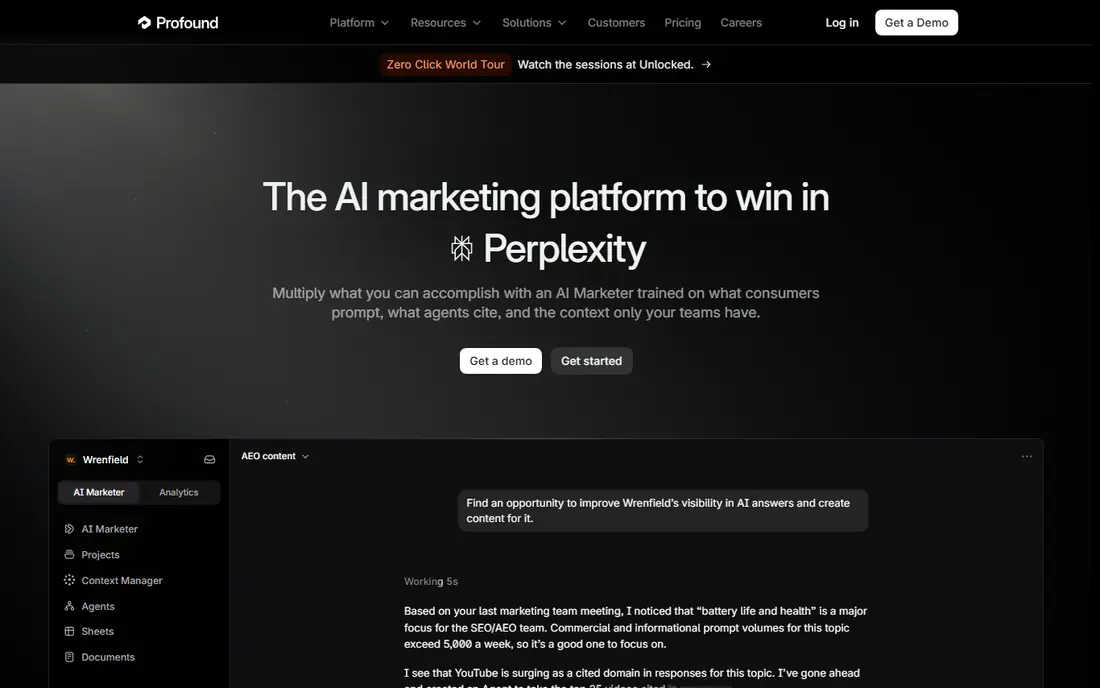
Profound is the most complete tool in this list for large brands that need depth. On enterprise tiers it tracks many answer engines, analyses citations and competitors, and connects AI crawler activity with analytics tools. Its reporting is polished, and its content tools turn findings into optimisation work.
The barrier is price and access. Brand pricing is custom, so small teams cannot simply sign up and see a fixed monthly cost, and trial prompt limits are modest. Profound suits enterprises with budget and a team to act on the data, not a solo site owner testing AI visibility for the first time.
- Wide engine coverage on enterprise tiers
- Citation and competitor analysis
- Analytics integrations
- Brand pricing is custom and quote-based
- Entry self-serve options have changed over time
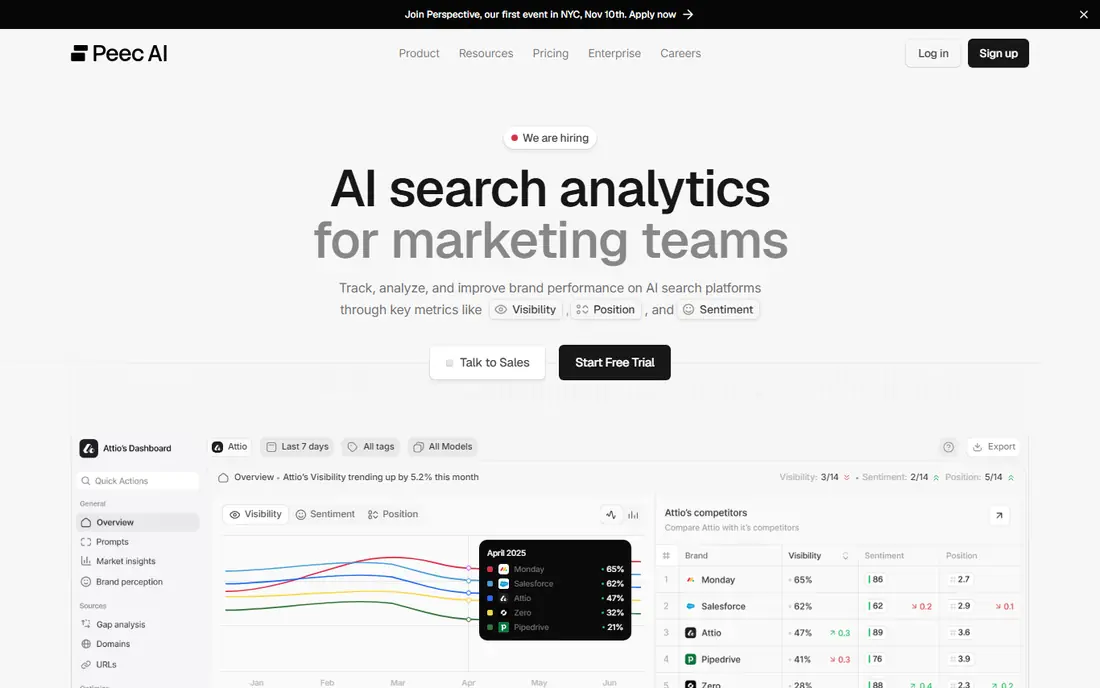
Peec AI suits teams that care about competitive position in AI answers, not just their own visibility. Daily prompt tracking shows how rankings shift, competitor comparisons reveal who AI engines cite instead of you, and unlimited users make it easy to share results across a team without seat fees.
Pricing clarity is a weakness. Entry prices have changed and are not always shown to logged-out visitors, so a team should request a current quote and confirm prompt counts and model coverage. It is a strong tool once pricing is confirmed, but do not budget from an old review.
- Daily prompt tracking
- Competitor comparisons
- Unlimited users on paid plans
- Entry pricing has varied and is not always public
- Claude and some models sit on higher tiers
Otterly.AI is the easiest entry point in this list. Its Lite tier is far cheaper than most rivals, yet it still covers core engines including Google AI surfaces, with daily tracking and unlimited team members. For a small business testing AI visibility, that low starting price removes the main excuse not to try.
Entry limits matter. Prompt counts are modest, and engines such as Claude and Gemini may need add-ons, so a team with many topics or markets will outgrow Lite quickly. Treat Otterly as a smart starting tier, and check Standard pricing before you build a large prompt set around it.
- Low entry price
- Google AI surfaces included
- Daily tracking and team access
- Some engines are paid add-ons
- Prompt limits are modest on the entry tier
Scrunch combines tracking with action. It monitors brand presence across several AI engines, then helps teams turn citation gaps into content work, which suits businesses that want more than a dashboard. Agency workspaces make it workable for firms managing several clients.
The entry price puts Scrunch out of reach for many small sites. Small teams should compare its starter prompt count and seat limits with cheaper rivals before committing, since a tool you cannot afford to keep is worse than a simpler tool you use weekly.
- Multiple engine coverage
- Content optimisation workflow
- Agency workspaces
- Entry price is high for small teams
- Some features sit on enterprise tiers
AthenaHQ is useful because you can test it without paying first. Its free credit tier lets a team run a small set of prompts across several engines and see whether AI visibility data is useful before committing. Paid tiers broaden coverage and add team features for larger operations.
The paid entry price is steep compared with Otterly, and API access costs extra on lower tiers, which matters for teams that want to pull data into other tools. AthenaHQ suits teams that want broad coverage and are willing to pay once the free tier proves the value.
- Free credit tier for testing
- Broad model coverage
- Credit-based tracking
- Paid entry price is high
- API access is an add-on on lower tiers
Goodie AI targets brands and agencies that need clear client-ready reporting on AI visibility. It tracks how AI engines mention and cite a brand, compares competitors, and presents results in a form that can be shared with stakeholders who do not live in search data every day.
Pricing detail is thinner in public than for some rivals, so teams should request a current quote and confirm prompt volume, engine coverage and reporting limits. Goodie suits agencies and brands that value presentation and client reporting, provided the quoted price fits the budget.
- Answer-engine tracking
- Competitor and citation insights
- Reporting for clients
- Pricing is quote-based for many plans
- Smaller public pricing detail than rivals
ZipTie, also shown as ZipTie.dev, focuses on monitoring how AI search surfaces treat a brand and its competitors. Its developer-friendly approach appeals to teams that want to work with the data directly, not just read a dashboard, and its tracking covers the major AI answer surfaces businesses care about.
As a newer entrant, ZipTie has less public history than Profound or Semrush, so teams should test it on their own prompts before committing. Confirm current pricing, prompt limits and engine coverage, and compare its reporting with a more established rival on the same prompt set.
- AI answer tracking
- Brand and competitor monitoring
- Developer-friendly data access
- Pricing and tier details vary
- Newer tool with a smaller public track record
Rankscale appeals to power users who want a lot of tracking for a modest price. Its annual entry tier is among the cheapest in this list, higher tiers add API access and wider coverage, and a free analysis tool lets you test a brand before paying. That combination suits freelancers and small agencies.
The credit system needs care: credits, dashboards and prompt counts interact in ways that are easy to misread. Check how many credits a daily prompt set actually uses over a month, and confirm dashboard limits before you build reporting around Rankscale.
- Low annual entry price
- Wide coverage and API options on higher tiers
- Free analysis tool
- Credit system needs careful reading
- Entry tier limits dashboards and credits
Semrush AI Visibility Toolkit suits teams already paying for Semrush. It adds AI visibility tracking to a suite that already covers keywords, rankings and site audits, so AI data sits next to the search data teams already use. Prompt tracking per domain keeps the scope clear for a single site.
The cost stacks up for new users, since the toolkit is an add-on per domain on top of a Semrush subscription, and entry prompt counts are modest. Teams that do not already use Semrush should compare a standalone tool such as Otterly or Rankscale before paying for a full suite they may not need.
- AI visibility data alongside classic SEO tools
- Prompt tracking per domain
- Large keyword data
- Priced per domain on top of Semrush
- Prompt counts are modest on the entry add-on
How we picked these
We compared official feature pages, pricing pages, privacy policies and app store listings for each option. We kept only products that are still offered in October 2026 and that fit the topic directly. We checked whether a free tier or trial is real, what the paid plan adds, and where each product falls short, so the list reflects trade-offs rather than marketing claims alone.
How to choose an AI search analysis tool
Start with your prompt set, not the tool. List the questions customers actually ask, the topics that drive revenue, and the competitors AI engines might cite instead of you. A tool that tracks fifty well-chosen prompts is more useful than a tool that tracks five hundred generic ones, and prompt choice affects every comparison you make.
Next, compare the same volume across tools. Check whether pricing is per prompt, per credit, per domain or per workspace, and work out the monthly cost for your exact prompt set. A low headline price with a small prompt limit can cost more than a higher price with generous limits, especially when you track daily.
Finally, test before you commit. Use free tiers and trials to run the same prompts in two tools for a week, and compare citation data, competitor coverage and reporting clarity. Pick the tool whose reports your team will actually open and act on, since a dashboard nobody reads does not improve visibility.
Frequently asked questions
What is the best AI search analysis tool?
Profound offers the widest enterprise coverage, while Otterly.AI offers the lowest entry price. Semrush AI Visibility Toolkit suits teams already using Semrush, and AthenaHQ suits teams that want to test with a free credit tier first.
What is the best AI search analysis software for small businesses?
Otterly.AI and Rankscale are the strongest low-cost starting points, with entry prices far below enterprise tools. Start with a small prompt set, prove the data is useful, and only then move to a higher tier.
How do AI search analysis tools work?
They run a set of prompts through AI engines such as ChatGPT, Gemini, Perplexity and Google AI surfaces, then record whether your brand is mentioned, cited or ranked, and who is cited instead. Results are sampled, so they show trends rather than every possible answer.
Can these tools improve my AI visibility?
They can show where you are cited, where competitors win, and which pages AI engines use as sources. Improvement still comes from content, structured data, reviews and authority work: the tool measures the result, it does not create it.
Are free AI visibility tools enough?
Free tiers and free checkers are enough to test whether AI visibility matters for your brand. Ongoing tracking, competitor comparisons and reporting usually need a paid tier, especially if you track many prompts daily.
Sources
See where you really rank - block by block
ProMapRanker scans Google Maps across a grid of your service area. Simple monthly plans from $19, white-label on every plan.
Start freeKeep reading
 best employee time tracking app
Best Employee Time Tracking Apps in 2026
We compare the best employee time tracking app options for teams, from simple timers to shift tools, with honest notes on privacy and consent in 2026.
Read → best employee recognition software
Best Employee Recognition Software in 2026
We compared the best employee recognition software for peer praise, rewards, and service awards, with pricing, integrations, and honest limits for teams.
Read → best ehr software
Best EHR Software in 2026
Compare the best EHR software in 2026 for small practices, specialty groups and hospitals, with pricing models, charting and billing features compared in full.
Read →