 ProMapRanker
Best Admissions Software in 2026

Key takeaways
- Admissions software covers both higher education and K-12 schools, and the right tool depends on institution size and type.
- Slate is the leading higher education choice for large universities, while Element451 suits colleges that want a modern CRM.
- OpenApply, SchoolAdmin and Ravenna serve K-12 and independent schools with simpler application and enrollment workflows.
- Most higher education tools price by quote or annual contract, so budget for implementation and training, not just the license.
Quick comparison
| Pick | Great for | Pricing starts at | Free tier | |
|---|---|---|---|---|
 Slate | Large higher education admissions | See website | No | Visit |
 Ellucian CRM Recruit | Universities already on Ellucian | See website | No | Visit |
 Element451 | Modern higher education CRM | $20,000 per year | No | Visit |
 OpenApply | K-12 and international schools | See website | No | Visit |
 Blackbaud Enrollment Management | Private schools and universities | See website | No | Visit |
 SchoolAdmin | Independent school admissions | See website | No | Visit |
 Ravenna | K-12 admissions and enrollment | See website | No | Visit |
 Full Fabric | Smaller institutions that want modular tools | See website | No | Visit |
The best admissions software
We compared official feature pages, pricing pages and public documentation for admissions tools live in October 2026, covering higher education, K-12 and independent schools.
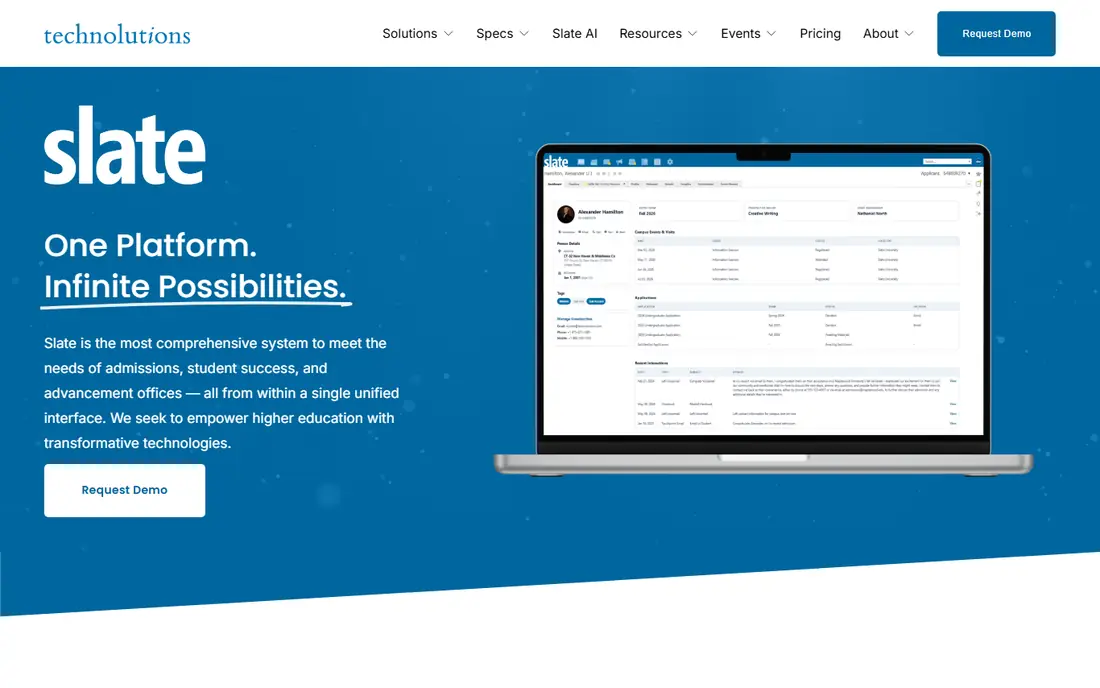
Slate by Technolutions is the reference point for higher education admissions. It handles inquiries, applications, reading, communications, events and enrollment in one configurable system, with reporting that lets admissions teams track the funnel without exporting data. Large universities value that depth, since they run many programs, deadlines and decision types at once. The trade-off is complexity and cost. Slate needs staff who can configure and maintain it, and its annual contract is a major budget line. Smaller colleges should test whether they will use its depth, or whether a simpler CRM would serve them faster and cheaper.
- Deep higher education CRM and application tools
- Highly configurable workflows
- Strong reporting and dashboards
- Quote-based pricing
- Needs trained staff and IT support
- More than a small college may need
Ellucian CRM Recruit suits a university already running Banner or Colleague, since admissions data can flow into the student system without a fragile custom link. It covers inquiry management, application tracking and yield campaigns with workflows built for higher education. For a large public university, that ecosystem fit can outweigh a prettier interface. The catch is implementation time and usability. Teams should plan for a long rollout, training and change management, and should test the daily reading and communication workflow with real admissions staff, not just IT, before signing.
- Deep link to Ellucian Banner and Colleague
- Prebuilt higher education workflows
- Enterprise security and scale
- Implementation can take many months
- Interface feels less modern than newer CRMs
- Pricing needs a quote
Element451 appeals to colleges that want a modern admissions CRM without the weight of a full student system. It combines prospect management, automated campaigns, messaging and analytics, with tools that help small teams reach more students with less manual work. Its published starting price gives budget planners a clearer starting point than many rivals. The limit is fit and scale. A very small program may still find $20,000 per year hard to justify, and a large university with complex SIS needs may need deeper integration work. Ask how pricing changes with application volume and what is included in implementation.
- Modern CRM with automation and messaging
- Campaign and analytics tools
- Implementation included in the base price on published terms
- Starting price is high for small programs
- Pricing rises with application volume
- Less suited to K-12 schools
OpenApply is a school-focused tool, not a university CRM. It helps independent and international schools manage inquiries, applications, documents, family messages and re-enrollment in one place, with forms that work for parents in different countries and languages. That school focus makes it easier for a small admissions office to adopt. The trade-off is scope. A university should not expect it to replace a higher education CRM, and a school should confirm current pricing, since third-party listings differ. Test the parent journey from inquiry to enrollment, since that is where school admissions succeed or fail.
- Built for school admissions
- Online forms, family communication and re-enrollment tools
- Strong for international schools
- Pricing is not published in a simple form
- Higher education features are limited
- Setup needs school staff time
Blackbaud Enrollment Management suits private schools and universities already using Blackbaud for fundraising, school management or advancement. Admissions, enrollment and family data can sit near advancement records, which helps schools that track a family from inquiry through alumni giving. Enrollment reporting is a clear strength. The limit is ecosystem dependence. A school that does not use Blackbaud elsewhere may find a standalone school tool simpler and cheaper. Check contract terms, data ownership and how admissions data moves if the school later changes systems.
- Enrollment and admissions tools linked to Blackbaud fundraising and school systems
- Strong for private schools
- Reporting for enrollment teams
- Pricing needs a quote
- Full value depends on other Blackbaud tools
- Implementation takes planning
SchoolAdmin focuses on the independent school funnel: inquiries, applications, visits, decisions and enrollment contracts. Its forms and communication tools are built for parents, not just staff, which helps a small admissions team keep families engaged without manual email chasing. That parent experience is often the deciding factor for schools. The catch is to confirm the current product and contract. SchoolAdmin is now linked to Finalsite, so schools should confirm which product they are buying, what support covers, and how data migrates if they change vendors later.
- Built for independent school admissions
- Application tracking, communication and enrollment tools
- Parent-friendly forms
- Pricing needs a quote
- Higher education use is limited
- Some schools now find it under a wider Finalsite offering, so confirm the product name
Ravenna serves K-12 schools that want a shared admissions hub for applications, family communication and enrollment. Parents can track application steps in one place, and schools can manage inquiries, documents and decisions without juggling spreadsheets and email. That shared view reduces missed documents and follow-up gaps. The limit is that Ravenna is school-focused, so a college should look elsewhere. Schools should also check integrations with their student information system and payment tools, since those links decide how much manual work remains after enrollment.
- Admissions and enrollment tools for K-12 schools
- Family portal and application tracking
- Used by many independent schools
- Pricing is quote-based
- Feature depth varies by school size
- Integration needs should be checked school by school
Full Fabric suits a smaller college or training provider that wants to buy admissions tools in modules rather than a full enterprise system at once. Its admissions, engagement, marketing and success packages can be combined as the institution grows, and its automation tools help small teams run campaigns that would otherwise need more staff. The trade-off is total cost. A modular start can look affordable, but the full suite for a mid-size institution can reach a much higher annual figure. Ask for pricing for the exact modules you need, and check contract length and data export terms before you commit.
- Modular packages for admissions, engagement, marketing and success
- Modern interface
- Automation for student engagement
- Pricing needs a quote and rises with institution size
- US market focus
- Smaller institutions should check total suite cost
How we picked these
We compared official feature and pricing pages and public documentation for admissions tools live in October 2026, covering higher education and K-12. We favored tools with application management, applicant tracking, communication automation and enrollment reporting as core functions. Where pricing was not published, we wrote See website rather than repeating a third-party estimate as fact.
What to check before you buy admissions software
Start with the applicant journey, not the admin dashboard. Test an inquiry, an application, a document upload, a decision letter and an enrollment deposit as a parent or student would see them. A tool that is powerful for staff but confusing for families will hurt yield, no matter how good its reports look. Next, check reading and decision workflows. Confirm how readers score applications, how committees share notes, how decisions are released, and how waitlists are managed. Those steps are where admissions teams spend their busiest weeks, so a small friction there costs more than a missing dashboard chart.
Integration and data
Check links to your student information system, payment tools, email and calendar systems, and confirm who owns applicant data and how it can be exported. A tool that traps data in a proprietary format creates a painful exit later.
Implementation and training
Ask how long implementation takes, who configures workflows, and what training is included. Budget staff time for data cleanup, form building and testing, even when the vendor leads implementation. A rushed go-live before an application deadline is a common and avoidable mistake.
Frequently asked questions
What is the best admissions software?
For large universities, Slate is the leading choice, while Element451 suits colleges that want a modern CRM. For K-12 and independent schools, OpenApply, SchoolAdmin and Ravenna are strong fits. The right pick follows institution type, size and existing systems.
How much does admissions software cost?
Higher education tools often price by quote or annual contract, with Element451 publishing a starting price around $20,000 per year. K-12 tools also usually quote by school size, so ask for a written quote that includes implementation and training.
What is the difference between admissions software and a student information system?
Admissions software manages inquiries, applications, decisions and enrollment. A student information system manages enrolled students, courses, grades and billing. Some vendors offer both, but many schools use an admissions tool that feeds data into a separate student system.
Does admissions software work for K-12 schools?
Yes. OpenApply, SchoolAdmin, Ravenna and Blackbaud Enrollment Management are built for schools, with parent portals, family communication and re-enrollment tools. Higher education CRMs like Slate are built for colleges and are usually too complex for a small school.
Can admissions software handle online applications and payments?
Most tools in this list handle online applications, document uploads and enrollment deposits, though payment tools and fee handling vary. Check which payment providers are supported and how deposit records flow into enrollment reports.
How long does it take to implement admissions software?
It varies widely, from weeks for a small school tool to many months for a large university CRM or SIS-linked system. Ask for a written timeline, a named implementation lead, and a go-live date that leaves time for testing before your next application cycle.
Sources
See where you really rank - block by block
ProMapRanker scans Google Maps across a grid of your service area. Simple monthly plans from $19, white-label on every plan.
Start freeKeep reading
 who has best internet service
Who Has the Best Internet Service in 2026
Who has best internet service for US homes? We compare fiber, cable, fixed wireless and satellite providers on speed, price, availability and terms today.
Read → which survey tool has the best analytics
Which Survey Tool Has the Best Analytics in 2026
Find which survey tool has the best analytics in 2026, comparing Qualtrics, SurveyMonkey, Typeform, Alchemer, and more on reports, text, and stats today.
Read → which streaming service has the best movies
Which Streaming Service Has the Best Movies in 2026
Answering which streaming service has the best movies, with Netflix, Max, Criterion and more compared on libraries, prices and free options in this guide.
Read →