 ProMapRanker
Alternatives to Vite in 2026

Key takeaways
- Webpack remains the best choice for large, complex apps with deep plugin and loader needs.
- esbuild suits libraries, CLIs, and fast build pipelines where speed matters more than a dev server.
- Parcel is the easiest Vite alternative for small projects that want little or no configuration.
- Rspack and Rsbuild suit teams moving from Webpack that want Rust speed without rewriting configs.
Quick comparison
| Pick | Great for | Pricing starts at | Free tier | |
|---|---|---|---|---|
 Webpack | Large complex apps | Free | Yes | Visit |
 esbuild | Fast library and CLI builds | Free | Yes | Visit |
 Parcel | Zero-config projects | Free | Yes | Visit |
 Rollup | JavaScript libraries | Free | Yes | Visit |
 Rspack | Webpack migration with speed | Free | Yes | Visit |
 Rsbuild | High-performance app builds | Free | Yes | Visit |
 Astro | Content sites with less JavaScript | Free | Yes | Visit |
 Bun | All-in-one runtime and bundler | Free | Yes | Visit |
The best alternatives to vite
We compared Vite alternatives on build speed, dev server experience, plugin ecosystem, configuration effort, and fit for apps versus libraries. Vite itself is not listed, since this article covers alternatives only. All of the tools below are open source and free to use, so the choice comes down to workflow, not price.
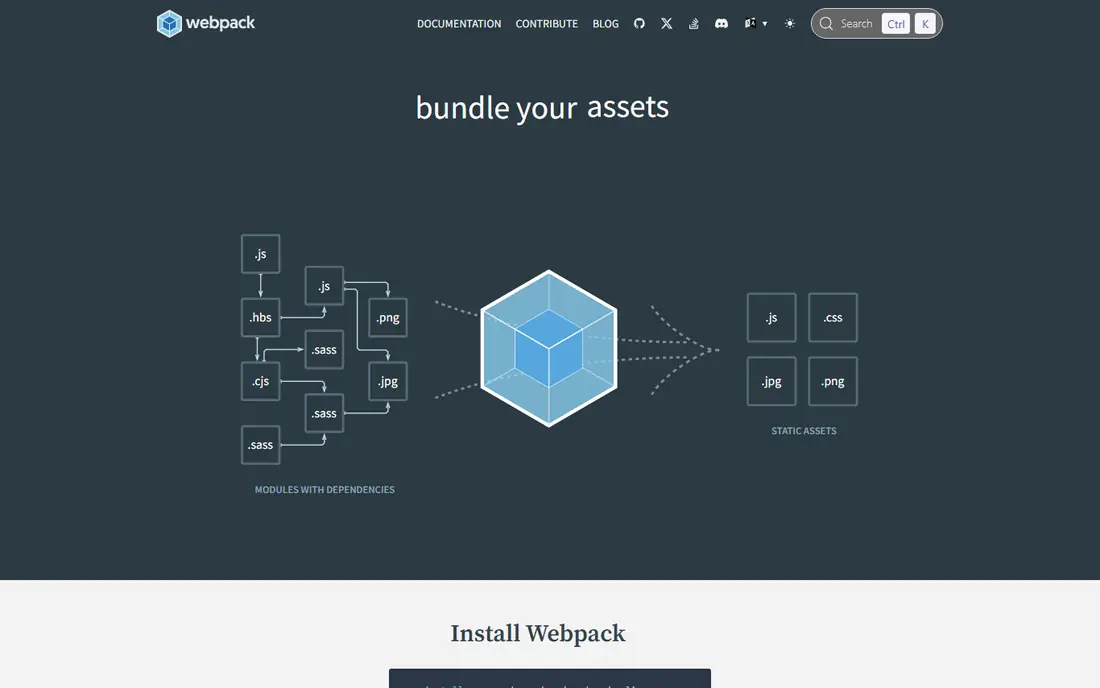
Webpack dominated web builds for years, and it still leads for apps with unusual requirements. Its loader and plugin system covers almost every asset type, legacy code pattern, and custom build step you can name. If your app depends on Webpack-only plugins or a complex loader chain, staying on Webpack may be cheaper than rewriting the build.
The cost is speed and setup time. Dev server startup and hot reload are slower than Vite on many large apps, and a Webpack config can run long. New projects rarely need that depth, but existing Webpack teams with working configs have a strong reason to stay. For legacy and enterprise apps, Webpack remains the safe default.
- Largest loader and plugin ecosystem
- Handles complex setups
- Long track record in production
- Slower dev startup than Vite on large apps
- Configuration can be long and hard to read
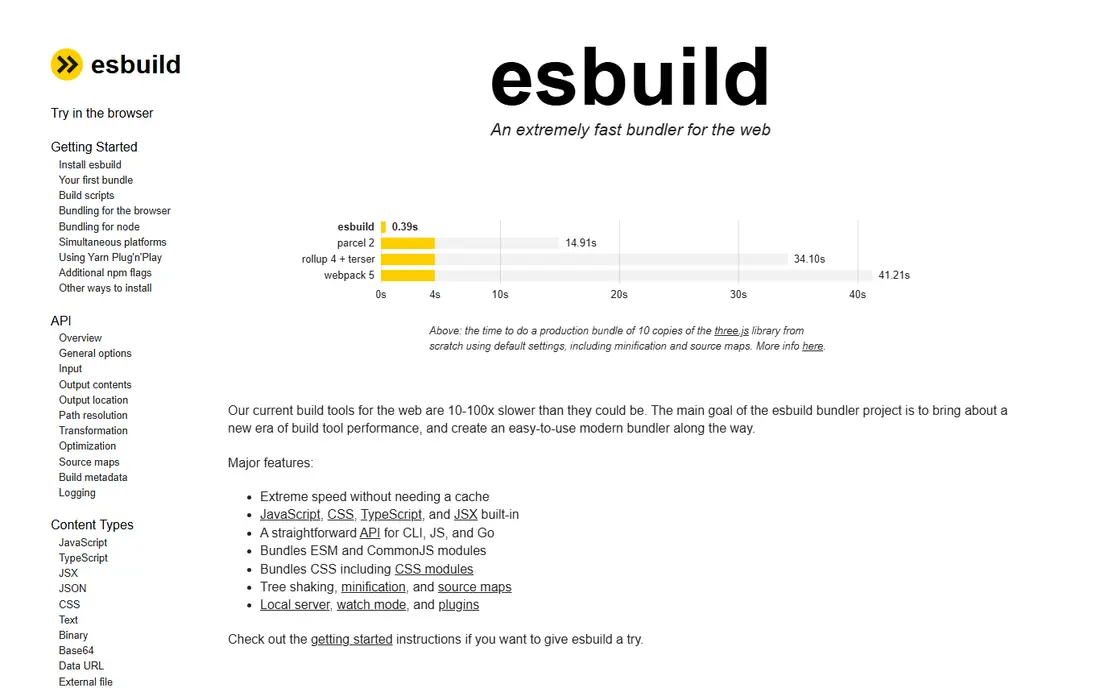
esbuild is written in Go and is known for build speed that feels instant next to JavaScript-based bundlers. It bundles, minifies, and strips TypeScript types in one fast step, which makes it ideal for libraries, CLIs, and build pipelines. Many other tools use esbuild under the hood for exactly that reason.
It is not a full Vite replacement for app development on its own. esbuild has no dev server with the same hot reload experience, and it does not type-check code, so you still need a TypeScript check alongside it. Use esbuild when you need a fast, simple bundler for a library or tool, and pair it with a framework or dev server when you need a full app workflow.
- Extremely fast builds
- Single binary
- Simple API
- Great for libraries and tools
- No full dev server with hot reload
- Limited plugin depth compared with Webpack
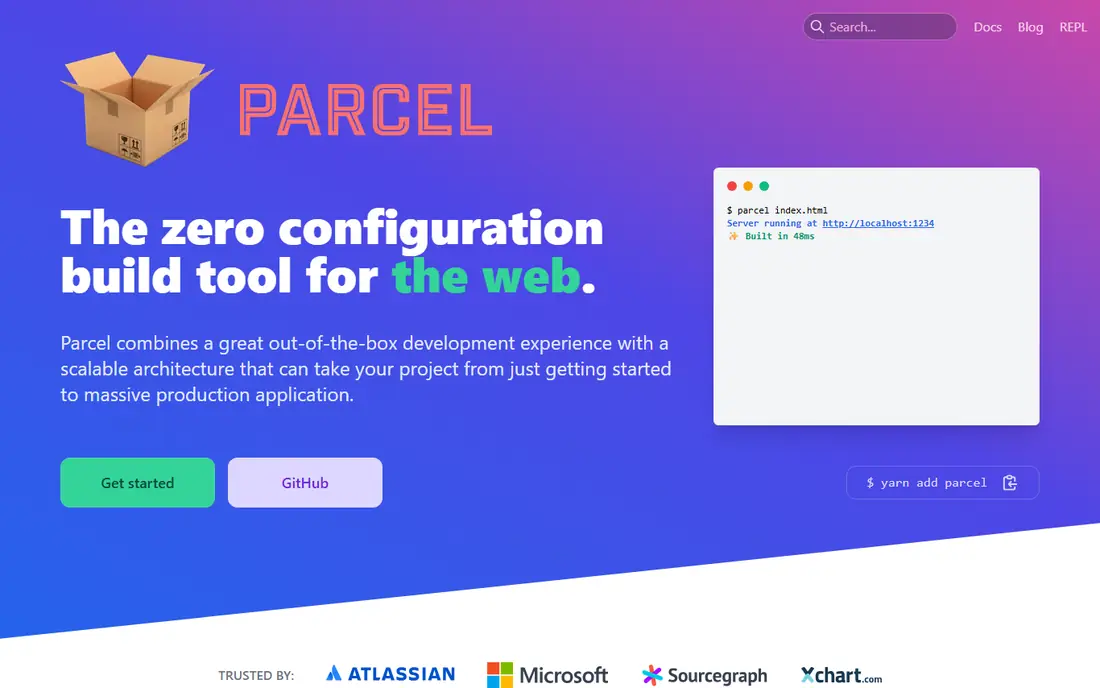
Parcel is the easiest Vite alternative to start with. It needs almost no configuration, detects file types automatically, and includes a dev server with hot reload. For a prototype, a small app, or a multi-page static site, Parcel lets you focus on code rather than build setup.
The trade-off is control. Complex apps with custom loaders, unusual asset handling, or deep plugin needs may hit limits faster than with Webpack or Rspack. Parcel also has a smaller plugin ecosystem than Webpack. If your project is small and you value speed of setup over build control, Parcel is a strong pick.
- Very little configuration
- Automatic dependency handling
- Built-in dev server and hot reload
- Less control than Webpack for complex builds
- Plugin ecosystem is smaller
Rollup was designed around ES modules from the start, and it remains the standard choice for publishing JavaScript libraries. Its tree-shaking removes unused code well, and its output is clean and easy to ship as a package. Vite itself used Rollup for production builds in earlier versions, which shows how trusted Rollup output is.
For a full web app, Rollup needs more setup than Vite or Parcel, including a dev server and plugins for common tasks. It is also slower than newer Rust-based bundlers on large builds. Choose Rollup when you are publishing a library and output quality matters most, not when you want the fastest app dev server.
- Built around ES modules
- Excellent tree-shaking
- Clean output for published packages
- Slower than Rust-based bundlers
- Needs plugins and setup for full app builds
Rspack is a Rust-based bundler that implements much of the Webpack configuration format and loader API. That compatibility is its main selling point: a Webpack team can often move to Rspack with a renamed config file and a few edits, then gain much faster builds. Recent guides report strong dev startup and production build times for Rspack on large codebases.
Compatibility is not complete. Some Webpack plugins have no Rspack equivalent yet, so teams with exotic plugins should test before migrating. For large Webpack apps where build time is painful, Rspack is the most practical speed upgrade without a full rewrite.
- Rust speed
- Webpack-compatible config and loaders
- Fast dev startup and hot reload
- Not every Webpack plugin works yet
- Smaller ecosystem than Webpack itself
Rsbuild is a build tool powered by Rspack, aimed at web applications rather than low-level bundling. It gives you sensible defaults, fast dev and production builds, and support for common frameworks, without forcing you to write a long bundler config. That makes it a closer Vite alternative than Rspack alone for app developers.
The ecosystem is newer, so you may find fewer blog posts, plugins, and ready answers than for Webpack or Vite. Rsbuild also suits teams that are comfortable with a Rust-based toolchain and a slightly opinionated setup. If you want Rspack speed with app-level defaults, Rsbuild is worth testing on a real project.
- Built on Rspack
- Sensible defaults for apps
- Fast builds
- Good for React and Vue projects
- Newer ecosystem than Webpack
- Fewer community plugins and examples
Astro is not a bare bundler, but it is a strong Vite alternative when the goal is a fast content site. It renders pages to HTML by default and only loads JavaScript for interactive parts, called islands. That means blogs, documentation, and marketing sites can load quickly without shipping a large app bundle.
For a heavy single-page app with constant interaction, Astro is less natural than a bundler paired with React or Vue alone. Its islands model also takes a little learning if you are used to a pure app framework. For content-heavy sites where speed and search visibility matter, Astro is one of the best choices here.
- Ships less JavaScript by default
- Strong for blogs, docs, and marketing sites
- Works with many frameworks
- Less suited to heavy single-page apps
- Islands model takes a short time to learn
Bun takes a different path from the other tools here: it bundles a fast JavaScript runtime with installs, TypeScript execution, testing, and bundling in a single binary. That consolidation can simplify a project, since one tool covers jobs that usually need several. Its bundler is fast, and its built-in TypeScript support removes a setup step.
The trade-off is maturity. Bun is newer than Node.js tooling, and some packages or workflows may need testing before you rely on them in production. Teams already deep in Node.js may prefer to keep Bun as a bundler and test runner first. For new projects that value speed and simplicity, Bun is a compelling Vite alternative.
- Runtime, bundler, package manager, and test runner in one binary
- Very fast
- TypeScript support built in
- Newer ecosystem than Node.js tooling
- Some Node.js packages may need checks
How we picked these
We compared Vite alternatives using their official docs and recent 2026 bundler comparisons that tested dev startup, hot reload, and production builds. We favored tools that are live, actively maintained, and genuinely usable as a Vite replacement for either apps or libraries. We excluded tools that are only frameworks with no bundler choice, and we did not repeat benchmark speed claims as guarantees, since real results depend on your codebase. All tools here are free and open source, so price did not decide the ranking.
What to check before you switch bundlers
Start by listing the Vite features you actually use each week: dev server, hot reload, plugins, environment handling, and output format. Test each alternative against that list on your own repository, not on a demo project. A bundler that wins a benchmark on a small app may struggle with your loader chain or plugin set.
Next, check migration cost. Webpack teams should test Rspack first, library authors should test Rollup or esbuild, and small teams should test Parcel or Astro. Keep your build behind standard scripts, such as a dev command and a build command, so teammates and hosting platforms do not need to learn a new workflow. Finally, check output quality: bundle size, code splitting, source maps, and long-term caching all matter more over a year than a few seconds saved on a single build.
Frequently asked questions
What are the best Vite alternatives?
Webpack, Rspack, Parcel, and esbuild are the most direct Vite alternatives, while Astro suits content sites and Bun suits teams that want one all-in-one tool. The best alternative to Vite depends on your project type: an app, a library, or a content site.
Is there a free alternative to Vite?
Yes. All of the tools in this list are free and open source, including Webpack, esbuild, Parcel, Rollup, Rspack, Rsbuild, Astro, and Bun. Cost is not the deciding factor here; workflow, speed, and ecosystem fit are.
Can I switch from Vite to another tool?
In most cases yes, but the effort varies. Parcel and Astro may need little config for small projects, while Webpack and Rspack need more setup for complex apps. Test the new tool on a copy of your project, and check plugins, loaders, and output before switching your main branch.
Is Webpack still worth using in 2026?
Yes, for large or complex apps that depend on its plugin and loader ecosystem. New projects often prefer Vite or a Rust-based tool for speed, but Webpack remains a sound choice when compatibility and depth matter more than dev server speed.
Should I pick a bundler or a framework?
Pick a bundler when you want control over a custom app or library. Pick a framework such as Astro or Next.js when you want routing, rendering, and conventions handled for you. Many frameworks use a bundler under the hood, so the choice is often about how much structure you want, not about avoiding bundlers entirely.
Sources
See where you really rank - block by block
ProMapRanker scans Google Maps across a grid of your service area. Simple monthly plans from $19, white-label on every plan.
Start freeKeep reading
 best chat tool for website
Best Chat Tool for Website in 2026
Best chat tool for website owners compared, with live chat, AI agents, free plans, and pricing for small stores, SaaS teams, and support teams of all sizes.
Read → best birdwatching app
Best Birdwatching App in 2026
Best birdwatching app picks for 2026: nine free and paid apps for bird ID by sight and sound, checklists, hotspots, and finding birds near you for all birders.
Read → best bird identification app
Best Bird Identification Apps in 2026
Find the best bird identification app for photos, songs and calls. We compare 9 bird apps, including Merlin, BirdNET and Audubon, to help you choose today.
Read →