 ProMapRanker
Best Alternatives to JUnit in 2026

Key takeaways
- TestNG is our pick for teams that need groups, dependencies, and parallel runs in one framework without leaving the JVM.
- Spock suits Groovy-friendly teams that want readable, data-driven tests with less boilerplate.
- Cucumber and Serenity BDD suit teams where non-developers need to read and own test scenarios.
- Selenide and Playwright for Java cover browser tests, while Testcontainers covers tests against real databases and services.
- Most of these tools are free and open source, so the real cost is learning time and migration effort, not licences.
Quick comparison
| Pick | Great for | Pricing starts at | Free tier | |
|---|---|---|---|---|
 TestNG | Large, grouped test suites | Free | Yes | Visit |
 Spock | Readable Groovy tests | Free | Yes | Visit |
 Cucumber | Behaviour-driven scenarios | Free | Yes | Visit |
 Serenity BDD | Living documentation and reports | Free | Yes | Visit |
 JBehave | Story-based behaviour tests | Free | Yes | Visit |
 Selenide | Concise browser tests in Java | Free | Yes | Visit |
 Playwright for Java | Modern browser automation | Free | Yes | Visit |
 Testcontainers | Tests against real services | Free | Yes | Visit |
The best alternatives to junit
JUnit is the default unit testing framework for Java, and for good reason, but it is not the only way to run tests on the JVM. Some teams need richer grouping, some want tests that read like plain language, and some need browser or integration coverage that a unit framework alone does not provide. The tools below cover those needs, and we compared official documentation and project pages for each one.
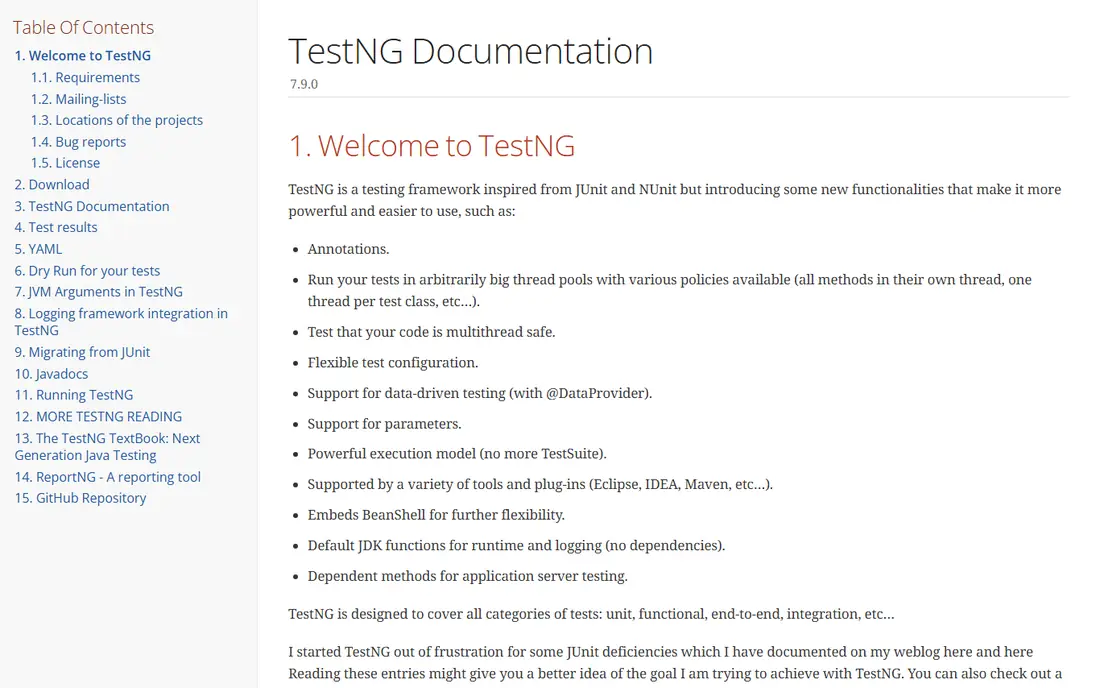
TestNG was inspired by JUnit and NUnit, and it adds features that large suites often need: test groups, dependencies between methods, data providers, and parallel execution with clear configuration. A team can run a smoke group on every commit and a full group nightly, without splitting the codebase into separate projects. That control is the main reason TestNG still has loyal users in enterprise and Selenium-heavy teams.
The framework is free and open source, and it integrates with Maven, Gradle, and major IDEs. The catch is that the wider Java community has largely settled on JUnit for new unit tests, so you will find fewer fresh tutorials for TestNG than for JUnit. Migration also needs care, because annotations and lifecycle names differ. If your suite already depends on groups and dependencies, though, TestNG gives you those features directly instead of through extensions.
- Groups and dependencies
- Parallel execution
- Flexible configuration
- Smaller community than JUnit today
- Migration needs care with annotations
Spock is a testing and specification framework for Java and Groovy applications, built on Groovy, and it is known for tests that read like specifications. A feature method is split into blocks such as given, when, and then, which makes the intent of each test easy to follow. Data tables let one test run over many inputs without duplicating code, and failure output points to the exact comparison that failed.
The framework is free and open source, and it runs on the JUnit Platform, so it can sit alongside existing tooling. The main trade-off is language: a team that does not already use Groovy must learn enough of it to write and maintain tests. For teams that accept that step, Spock often produces shorter, clearer tests than the equivalent Java code. It is a strong pick for data-driven and specification-style suites.
- Expressive specification style
- Data-driven tests
- Clear failure output
- Requires Groovy
- Less natural for pure Java teams
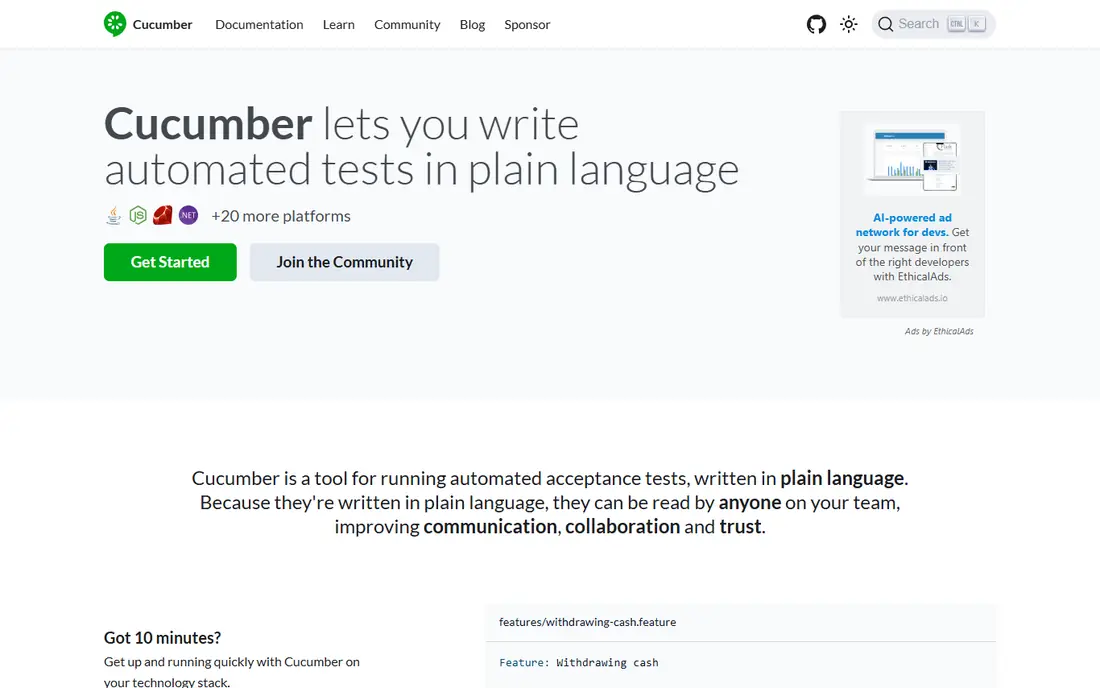
Cucumber lets teams write tests as Gherkin scenarios in plain language, using Given, When, and Then steps, and then bind those steps to code. A product manager, a tester, and a developer can all read the same scenario and agree on what the software should do. That shared document is the point: the test becomes a record of agreed behaviour, not just code that a developer alone understands.
Cucumber-JVM is free and open source, and it integrates with JUnit and TestNG as runners. The catch is upkeep: scenarios that no one maintains drift from the real product, and step definitions can become a tangled layer if teams reuse steps without care. The tool works best when a non-developer actually reads and owns the scenarios. If only developers read the tests, a simpler unit framework may serve you better.
- Plain language scenarios
- Shared understanding
- Many language bindings
- Scenarios need upkeep
- Step definitions can grow messy
Serenity BDD is an open source library that helps teams write better automated acceptance and regression tests, with a focus on reports that non-developers can read. It can run Cucumber scenarios or JUnit tests and produce living documentation that shows which features are covered, which tests passed, and where failures happened. For a team that needs to show test coverage to stakeholders, that reporting is a real advantage over a plain test runner.
The library is free and open source, and it integrates with Maven and Gradle. Setup is heavier than a bare test framework, because you configure drivers, reporting, and project structure together. The payoff is a report that reads like a product story rather than a log file. If your audience is only developers, that extra reporting may be more than you need. If managers and product owners need to see coverage, Serenity BDD earns its setup cost.
- Rich test reports
- Living documentation
- Works with Cucumber and JUnit
- Heavier setup
- Reports need a build step to view
JBehave is a Java framework for behaviour-driven development that uses stories to describe expected behaviour. A story contains scenarios written in plain language, and the framework maps those steps to Java methods. Teams that want behaviour tests without leaving Java, and without adopting Groovy or a separate specification language, often find JBehave a natural fit.
The framework is free and open source, and it has a long history in Java behaviour testing. Its community is smaller than Cucumber today, so fresh guides and integrations are fewer, and new teams may need to read older documentation. The story format still works well for teams that already think in stories and want a Java-first tool. If you are starting fresh and want the largest community, Cucumber is the safer behaviour pick, but JBehave remains a valid Java-native choice.
- Story format for behaviour
- Java native
- Flexible runners
- Smaller community today
- Fewer modern guides
Selenide is a concise framework for browser tests in Java, built on top of Selenium WebDriver, and it aims to remove much of the boilerplate that makes Selenium tests fragile. It adds automatic waits, concise element selectors, and clear assertions, so a test that would take many lines in raw Selenium becomes a few readable lines. That brevity also makes failures easier to read, because the framework reports what it waited for and what it found.
Selenide is free and open source, and it works with JUnit and TestNG as runners. The catch is scope: it is a UI testing tool, not a replacement for unit tests, so you still need a unit framework for code-level tests. For teams that spend a lot of time fighting flaky browser tests, Selenide is a practical upgrade over raw Selenium. It is best judged on UI suites, where its waiting and reporting features show their value.
- Short, stable browser tests
- Automatic waits
- Clear assertions
- Focused on browser UI
- Not a general unit framework
Playwright for Java is the Java binding of Microsoft Playwright, a library for automating Chromium, Firefox, and WebKit with a single API. It was built with auto-waiting in mind, so actions wait for elements to be ready before acting, which cuts down on the timing flakes that plague many UI suites. It also supports modern browser features, network interception, and tracing, which help when a UI test fails in CI.
The library is free and open source, and it pairs with JUnit or TestNG as the test runner. The Java API is newer than Selenium, so some teams will find fewer Java-specific examples than for Selenium-based tools, although the core Playwright documentation is strong. Browser binaries need to be installed, which adds a step to CI setup. For new browser suites in Java, Playwright for Java is a strong, modern choice.
- Fast, stable browser control
- Auto-waiting
- Cross-browser support
- Newer Java API than Selenium
- Browser downloads needed
Testcontainers is a Java library that lets tests use real services, such as databases, message brokers, and search engines, running in Docker containers. Instead of mocking a database and hoping the mock matches reality, a test starts a real container, runs against it, and throws it away after. That approach catches integration problems that unit tests and mocks miss, such as SQL dialect differences and configuration errors.
The library is free and open source, and it integrates with JUnit and TestNG. The main costs are Docker and time: containers take seconds to start, so a suite that uses them heavily runs slower than a pure unit suite. That makes Testcontainers best for integration tests, not for every small unit test. Used in that role, it gives a level of realism that mocks cannot match, and it has become a standard part of many Java stacks.
- Real databases and queues in tests
- Docker based
- Less mock drift
- Needs Docker
- Slower than pure unit tests
How we picked these
We compared official documentation and project pages for Java and JVM testing tools that are active in October 2026 and that can run tests without JUnit as the main framework or that cover a testing layer JUnit does not cover alone. We favoured tools with clear documentation, Maven or Gradle integration, and a distinct role, from unit and behaviour tests to browser and integration tests. We did not claim hands-on testing of private codebases, and we listed all of these tools as free because their core frameworks are open source.
What to check before you switch
Do not switch frameworks for novelty alone. List the pain in your current suite first: is it grouping, readability, flaky UI tests, or integration gaps. Then pick the tool that fixes that pain, and trial it on a small, real module before migrating a whole suite. Check IDE support, CI setup, and how reports look, because those daily details matter more than a feature list.
Watch migration costs closely. Annotations, lifecycle methods, and assertion styles differ, and a large suite can take weeks to move safely. A common safe path is to run the new framework alongside JUnit for new tests, migrate old tests only when you touch them, and keep the build green at each step. Finally, agree on who owns behaviour scenarios if you adopt Cucumber, Serenity BDD, or JBehave, because those tools only pay off when someone outside development actually reads them.
Frequently asked questions
What is the best direct replacement for JUnit?
TestNG is the closest direct replacement, because it is a full test framework with groups, dependencies, data providers, and parallel execution. Spock is another full framework choice, especially for Groovy-friendly teams. For most new Java unit suites, though, staying with JUnit and adding a specialised tool for UI or integration tests is often simpler than a full switch.
Is TestNG better than JUnit?
TestNG offers more built-in features for grouping and dependencies, while modern JUnit covers most unit testing needs with extensions and platform support. The better choice depends on your suite: large, grouped, parallel suites favour TestNG, while standard unit suites favour JUnit for community size and tooling. Try both on a small module if the choice is close.
Can I use Cucumber without JUnit?
Cucumber-JVM can run with JUnit or TestNG as a runner, and it can also run through other engines, but in practice most Java teams pair it with one of those runners. The scenarios themselves are language-neutral, and the step code is Java. If you want to avoid JUnit entirely, TestNG is the usual runner pairing for Cucumber in Java.
Do I still need JUnit if I use Selenide or Playwright?
You still need a runner, and that runner is often JUnit or TestNG, with Selenide or Playwright providing the browser control. These tools cover the UI layer, not the unit layer, so they complement a unit framework rather than replacing it outright. A full stack often uses JUnit or TestNG plus one UI tool plus Testcontainers for integration tests.
Are these alternatives free?
The core frameworks listed here are free and open source, including TestNG, Spock, Cucumber, Serenity BDD, JBehave, Selenide, Playwright for Java, and Testcontainers. Paid costs can still appear for CI time, Docker hosting, and commercial support, but the frameworks themselves do not require a licence fee. Check each project licence page if your company needs a specific licence type.
Sources
See where you really rank - block by block
ProMapRanker scans Google Maps across a grid of your service area. Simple monthly plans from $19, white-label on every plan.
Start freeKeep reading
 best chat tool for website
Best Chat Tool for Website in 2026
Best chat tool for website owners compared, with live chat, AI agents, free plans, and pricing for small stores, SaaS teams, and support teams of all sizes.
Read → best birdwatching app
Best Birdwatching App in 2026
Best birdwatching app picks for 2026: nine free and paid apps for bird ID by sight and sound, checklists, hotspots, and finding birds near you for all birders.
Read → best bird identification app
Best Bird Identification Apps in 2026
Find the best bird identification app for photos, songs and calls. We compare 9 bird apps, including Merlin, BirdNET and Audubon, to help you choose today.
Read →