 ProMapRanker
Alternatives to Consul in 2026

Key takeaways
- etcd is our pick for most Kubernetes and cloud-native teams, thanks to its strong consistency and wide adoption.
- Apache ZooKeeper suits legacy distributed systems and Kafka-era coordination, but it is heavier to run than newer options.
- Nacos and Eureka suit Java and Spring teams that want a simpler service registry without a full service mesh.
- Istio, Linkerd and AWS Cloud Map cover service mesh, lightweight mesh and managed cloud discovery, so match the tool to your platform.
Quick comparison
| Pick | Great for | Pricing starts at | Free tier | |
|---|---|---|---|---|
 etcd | Kubernetes and cloud-native discovery | Free | Yes | Visit |
 Apache ZooKeeper | Legacy distributed coordination | Free | Yes | Visit |
 Netflix Eureka | Spring Cloud service registry | Free | Yes | Visit |
 Nacos | Java microservices discovery and config | Free | Yes | Visit |
 Istio | Full service mesh | Free | Yes | Visit |
 Linkerd | Lightweight service mesh | Free | Yes | Visit |
 AWS Cloud Map | Managed discovery on AWS | See website | No | Visit |
 Traefik | Discovery-aware proxy and routing | Free | Yes | Visit |
The best alternatives to consul
We compared these alternatives on service discovery, health checking, consistency, platform fit, and operational effort. None of the tools below is Consul itself. Our pick for most cloud-native teams is etcd, while the mesh and managed options win for specific platforms.
etcd is a distributed key-value store that provides a reliable way to store data across a cluster, with strong consistency through Raft consensus. It is the backbone of Kubernetes, where it stores cluster state, and it is widely used for configuration and service discovery in cloud-native systems. Watches let services react to changes without polling, which keeps discovery fresh.
The limit is that etcd is not a full service registry out of the box. Health checking, service metadata and DNS-style discovery need to be built or added with other tools, such as Kubernetes itself or a proxy. For a team already running Kubernetes, that extra work is often already done by the platform. For a team outside Kubernetes, etcd alone may feel too low level compared with a registry such as Nacos.
- Strongly consistent key-value store using Raft
- Backbone of Kubernetes
- Reliable watches for config changes
- Open source with wide adoption
- Key-value model needs extra work for full service discovery
- Health checking must be built on top
- Operating a cluster needs care
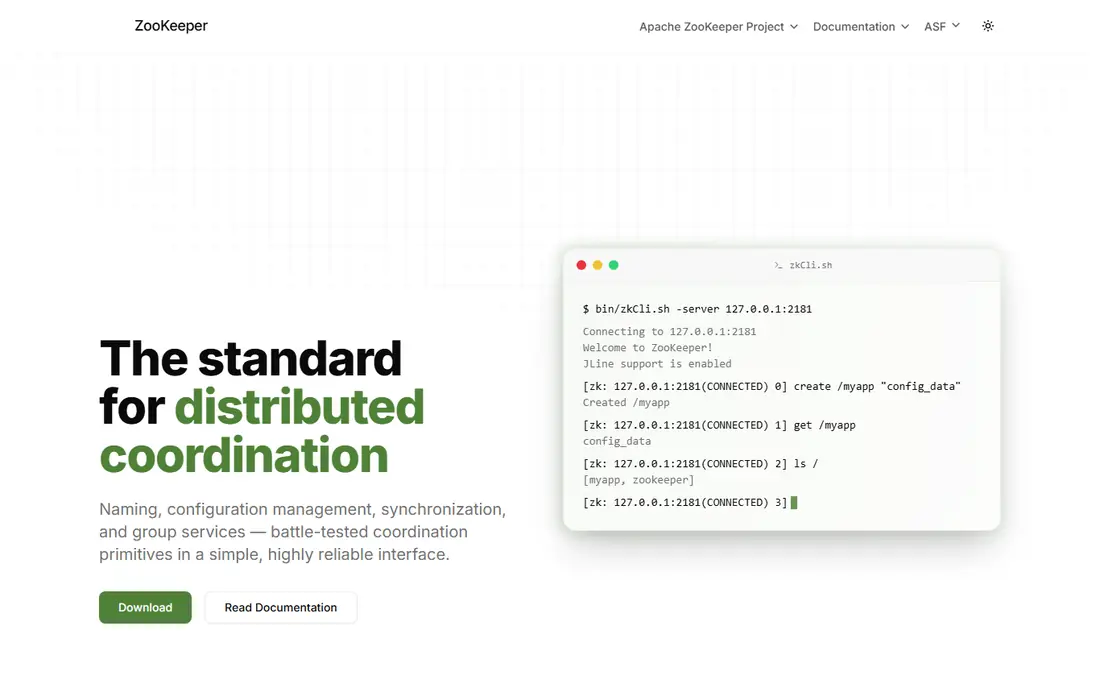
ZooKeeper is the classic distributed coordination service, used for leader election, configuration and service registration in many large systems. Its hierarchical znodes model suits teams that need a shared, consistent view of cluster state, and it has a long history with Kafka, Hadoop and other distributed platforms. For a legacy system already built on ZooKeeper, it remains a stable and well-understood choice.
For a new project, ZooKeeper is harder to justify. It is heavier to operate than etcd, its setup is Java-heavy, and its health checking is more basic than a modern registry. Many teams that once chose ZooKeeper now choose etcd or a Kubernetes-native approach for new work. Keep ZooKeeper for systems that already depend on it, and evaluate etcd for new coordination needs.
- Proven distributed coordination
- Hierarchical data model
- Widely used with Kafka and Hadoop-era systems
- Strong community history
- Heavier to operate than etcd
- Java-heavy setup
- Health checking is more basic than Consul
- Newer projects often choose etcd instead
Eureka is Netflix's service registry, widely used with Spring Cloud. Services register themselves via a REST API, and clients discover other services by name, with heartbeats keeping registrations fresh. That simplicity made Eureka popular for Spring Boot microservices, where a developer can add discovery with minimal configuration.
The trade-offs are consistency and future direction. Eureka uses eventual consistency, so a registry view can lag briefly during failures, and active development on the Eureka 2.0 line has been discontinued, with teams advised to consider other options for new projects. For an existing Spring Cloud system, Eureka remains usable. For a new system, Nacos or a Kubernetes-native approach may be a better long-term choice.
- Simple REST-based service registry
- Client-side discovery for Spring Boot
- Easy self-registration
- Familiar to Java teams
- Eventual consistency, not strong consistency
- Active development has slowed
- Less suited to multi-datacenter use than Consul
Nacos, from Alibaba, combines service discovery and dynamic configuration management in one open source platform. Services can register and discover each other via DNS or RPC, while configuration changes can be pushed without redeploying. That combination reduces the number of tools a Java microservices team must run, and it has a large user base in cloud-native Java work.
The main limit is familiarity outside that ecosystem. Teams that do not use Java may find the documentation and community less accessible, and operating a Nacos cluster still needs attention to availability and backups. For a Java team looking for a Consul alternative that covers both discovery and configuration, Nacos is one of the strongest options.
- Service discovery plus dynamic configuration in one tool
- Supports DNS and RPC discovery
- Popular in Java and cloud-native teams
- Open source
- Documentation and community support vary by language
- Operating a cluster needs care
- Less familiar to teams outside the Java ecosystem
Istio is a service mesh, not just a registry. It adds traffic routing, load balancing, mutual TLS, access policy and observability to services running on Kubernetes, with sidecar proxies handling traffic between services. For a team that needs fine-grained traffic control, canary releases and zero-trust security between services, Istio offers more than a simple registry can.
That power comes with complexity. Istio needs careful setup, resource planning for sidecars, and ongoing upgrades. A small team with a few services will find it heavy, and Linkerd may be a better mesh choice. For a large Kubernetes platform with strict traffic and security needs, Istio is the most complete mesh alternative on this list.
- Full traffic management, security and observability for microservices
- Mutual TLS and policy controls
- Works with Kubernetes
- Strong ecosystem
- Complex to operate at scale
- Resource overhead from sidecar proxies
- Learning curve for new teams
Linkerd is the lightweight counterpart to Istio. It installs simply on Kubernetes, adds mutual TLS between services by default, and provides observability with far less resource overhead than a full mesh. For a team that wants mesh security and visibility without the complexity of Istio, Linkerd is an attractive middle path.
The trade-off is feature depth. Linkerd offers fewer advanced traffic management features than Istio, and its ecosystem is smaller. It is also Kubernetes-focused, so it is not a standalone registry for services outside Kubernetes. For a Kubernetes team that wants a mesh that stays out of the way, Linkerd is often the best fit.
- Lightweight mesh with low overhead
- Simple installation on Kubernetes
- Mutual TLS by default
- Good observability for its size
- Fewer traffic features than Istio
- Smaller ecosystem
- Not a standalone registry outside Kubernetes
AWS Cloud Map is a managed discovery service for resources running on AWS. Services register with Cloud Map, and other services discover them via DNS or API queries, with integration for ECS, EKS and Lambda. Because it is managed, a team does not need to operate a registry cluster, handle Raft consensus or manage backups.
The limit is portability. Cloud Map is AWS-only, so a multi-cloud or on-premises strategy will need another tool alongside it. Pricing is usage based, covering registered resources and queries, so a large system should model the cost. For a team already committed to AWS, Cloud Map removes operational work and is a natural Consul alternative.
- Fully managed service discovery on AWS
- Integrates with ECS, EKS and Lambda
- DNS and API-based discovery
- No cluster to operate
- AWS-only, not portable to other clouds
- Pricing is usage based and needs modelling
- Less control than a self-hosted registry
Traefik is a modern reverse proxy and load balancer that discovers services dynamically. It watches providers such as Docker, Kubernetes and other registries, and routes traffic to healthy instances as services appear and disappear. That discovery-aware routing makes it useful as part of a Consul replacement, especially for HTTP services that need edge routing.
Traefik is not a full service registry on its own. It routes to services discovered elsewhere, and its health checking serves routing, not a general registry. Enterprise features, including advanced security and clustering, sit in a paid tier. For a team that needs dynamic edge routing alongside a registry such as etcd or Nacos, Traefik is a strong complement.
- Dynamic routing based on service discovery
- Integrates with Docker, Kubernetes and other providers
- Open source core
- Simple configuration
- Proxy and routing focus, not a full registry
- Health checking is tied to routing
- Enterprise features need a paid tier
How we picked these
We compared official documentation, project pages and public reviews, and we kept only tools that exist and work in October 2026 and that truly fit service discovery, configuration or service mesh use, which is the core job Consul covers. We deliberately excluded Consul itself, since this article lists alternatives only. We mixed registries, key-value stores, meshes and managed cloud services, because different teams replace different parts of Consul. Prices that could not be verified from a vendor page are listed as See website.
How to choose a Consul alternative
Start by naming which part of Consul you actually use. If you mainly need service discovery inside Kubernetes, etcd with Kubernetes-native discovery may already cover you, with Istio or Linkerd added for mesh features. If you need a registry for Spring services, Eureka or Nacos will feel more familiar. If you need managed discovery on AWS, Cloud Map removes operational work. Replacing the whole of Consul with one tool is rarely needed, so pick the part that matters most.
Next, test consistency and failure behaviour, not just the happy path. Kill a registry node, restart a service, and check how long discovery takes to recover and whether stale instances are removed. A registry that looks simple in a demo can cause outages if health checking is slow or if eventual consistency leaves stale entries. Run that failure test before committing to a new registry.
Finally, plan migration in stages. Run the new registry alongside Consul, move one service at a time, and keep DNS or proxy routing as a safety net during the switch. Monitor discovery errors, latency and health check failures for each migrated service before moving the next one. A staged migration takes longer, but it avoids a single cutover that can break many services at once.
Frequently asked questions
What are the best alternatives to Consul?
etcd is the best choice for most Kubernetes teams, Nacos suits Java microservices, and AWS Cloud Map suits teams committed to AWS. Istio and Linkerd cover service mesh needs, while ZooKeeper suits legacy systems. The best alternative depends on whether you need discovery, configuration, mesh security or managed operation.
Is etcd a direct replacement for Consul?
etcd replaces the consistent key-value and discovery backbone of Consul, especially inside Kubernetes, but it is not a drop-in replacement for all Consul features. Health checking, DNS discovery and service mesh features need to be added with other tools. For Kubernetes teams, that combination is often enough. For non-Kubernetes teams, a registry such as Nacos may be closer to Consul.
Is Eureka still maintained?
Eureka 1.x remains usable for existing Spring Cloud systems, but active development on Eureka 2.0 has been discontinued, and the Spring team points users toward other discovery options for new projects. If you start a new Spring system, evaluate Nacos, Kubernetes-native discovery or a managed cloud option before choosing Eureka.
Can I use Kubernetes service discovery instead of Consul?
Yes, for services inside Kubernetes. Kubernetes provides DNS-based discovery, load balancing and health checking via readiness probes, without an external registry. Add Istio or Linkerd if you need mesh traffic control and mutual TLS. Services outside Kubernetes will still need a registry or a managed discovery service.
What is the difference between a service registry and a service mesh?
A service registry answers the question of where a service lives, by listing healthy instances by name. A service mesh adds traffic control, security and observability between services, usually with sidecar proxies. Consul covers both areas, while tools such as etcd and Nacos focus on registry and configuration, and Istio and Linkerd focus on mesh.
Is AWS Cloud Map a good Consul alternative?
AWS Cloud Map is a good alternative for teams running on AWS, since it is fully managed and integrates with ECS, EKS and Lambda. It is less suited to multi-cloud or on-premises systems, where a portable registry such as etcd or Nacos will serve better. Model usage-based pricing for your service count and query volume before committing.
Sources
See where you really rank - block by block
ProMapRanker scans Google Maps across a grid of your service area. Simple monthly plans from $19, white-label on every plan.
Start freeKeep reading
 best chat tool for website
Best Chat Tool for Website in 2026
Best chat tool for website owners compared, with live chat, AI agents, free plans, and pricing for small stores, SaaS teams, and support teams of all sizes.
Read → best birdwatching app
Best Birdwatching App in 2026
Best birdwatching app picks for 2026: nine free and paid apps for bird ID by sight and sound, checklists, hotspots, and finding birds near you for all birders.
Read → best bird identification app
Best Bird Identification Apps in 2026
Find the best bird identification app for photos, songs and calls. We compare 9 bird apps, including Merlin, BirdNET and Audubon, to help you choose today.
Read →