 ProMapRanker
Best Alternatives to CockroachDB in 2026


Distributed Postgres you can self host · Pricing starts at: See website
Key takeaways
- YugabyteDB is the closest distributed Postgres replacement for teams that want to self host or run across clouds.
- TiDB is the natural pick for MySQL workloads that need horizontal scale plus analytics in the same system.
- Most teams do not need multi region writes, and Neon or Supabase will cost far less for ordinary Postgres work.
- Google Cloud Spanner and Amazon Aurora DSQL suit teams already committed to one cloud and willing to pay for managed scale.
- Check pricing with your own workload, because distributed databases charge in different ways and list prices hide that gap.
Quick comparison
| Pick | Great for | Pricing starts at | Free tier | |
|---|---|---|---|---|
| YugabyteDB | Distributed Postgres you can self host | See website | Yes | Visit |
 TiDB | MySQL scale with built in analytics | See website | Yes | Visit |
 Google Cloud Spanner | Managed global SQL on Google Cloud | See website | Free trial | Visit |
 Amazon Aurora DSQL | Serverless distributed SQL on AWS | See website | Free trial | Visit |
 Neon | Serverless Postgres for small teams | Free | Yes | Visit |
 Supabase | Postgres plus auth and storage | $25 per month | Yes | Visit |
 PlanetScale | MySQL and Postgres at high scale | $5 per month | No | Visit |
 SingleStore | Fast transactions plus analytics | See website | Free trial | Visit |
 Vitess | Explicit MySQL sharding control | Free | Yes | Visit |
The best alternatives to CockroachDB
CockroachDB is built for global, multi region SQL with strong consistency. These alternatives cover the same ground from different angles, from true distributed SQL to simpler cloud Postgres that fits most apps better.
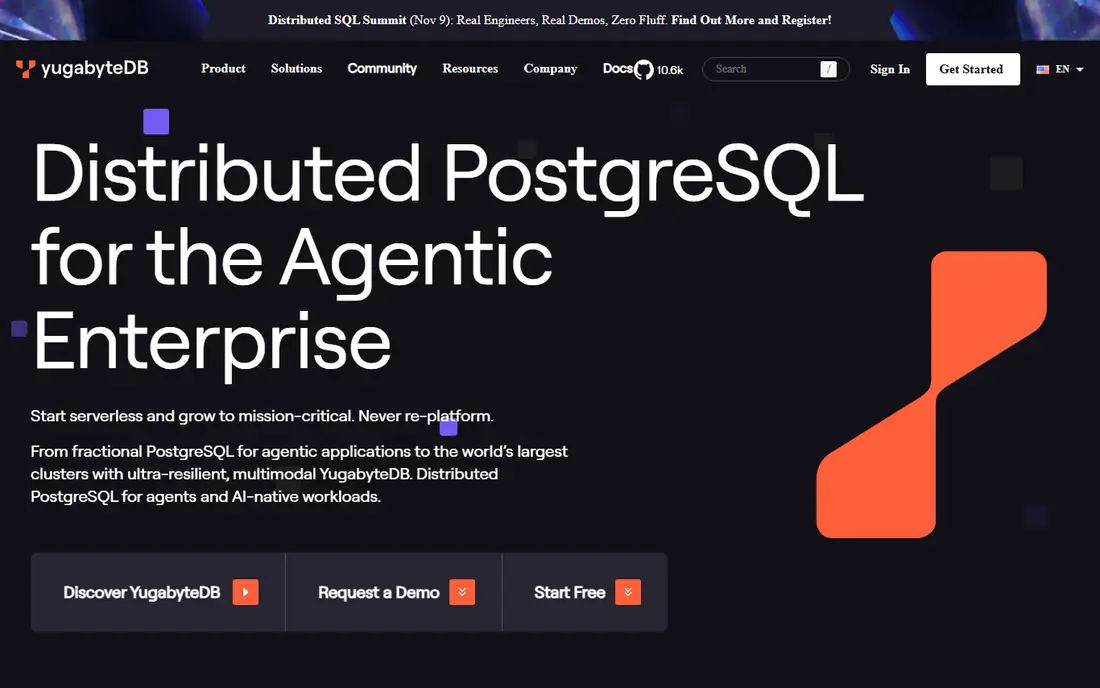
YugabyteDB is our first pick for teams that chose CockroachDB for distributed Postgres rather than for a managed cloud service. Its query layer is based on Postgres, so many existing Postgres tools and drivers keep working, and its storage layer spreads data across nodes for scale and fault tolerance. That combination matters when an app must keep writing during a node or zone failure.
The catch is operational. Running a distributed database well means thinking about replication, tablet placement and failure modes, and that learning curve is real even for experienced Postgres teams. A managed YugabyteDB Aeon deployment removes some of that work for a price. For teams that want control and portability, though, the open source core is a genuine advantage.
- Strong Postgres compatibility
- Self hosting and multi cloud deployment
- Horizontal scale with distributed transactions
- Distributed operations take learning
- Smaller ecosystem than plain Postgres
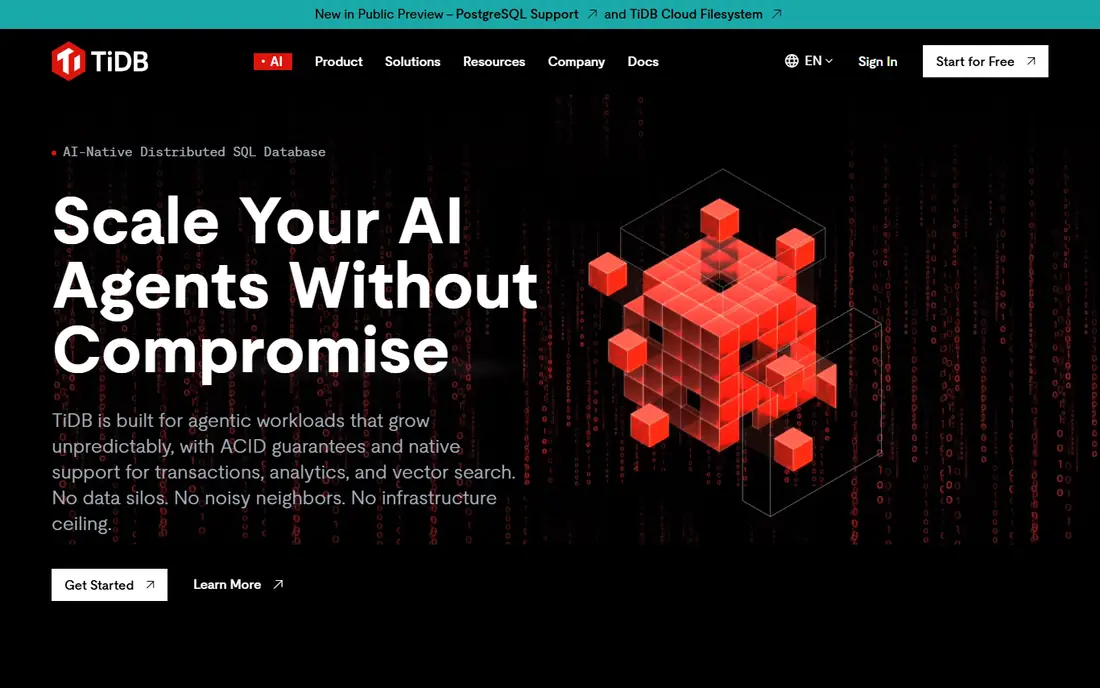
TiDB suits MySQL teams that have outgrown a single server. It speaks the MySQL protocol, so existing MySQL tools often connect without a rewrite, while its storage layer handles horizontal scale. The separate compute and storage design also lets teams add query capacity without copying all their data again.
The analytics side is a real differentiator. TiDB includes a columnar engine for analytical queries alongside transactional work, which helps teams that need fresh reports without a separate warehouse for every question. The trade off is topology. A production TiDB setup has more moving parts than a single Postgres or MySQL server, so plan for that operational cost.
- MySQL compatibility
- Separate compute and storage scaling
- Built in columnar analytics engine
- Minimum production setup is more complex
- MySQL shops only
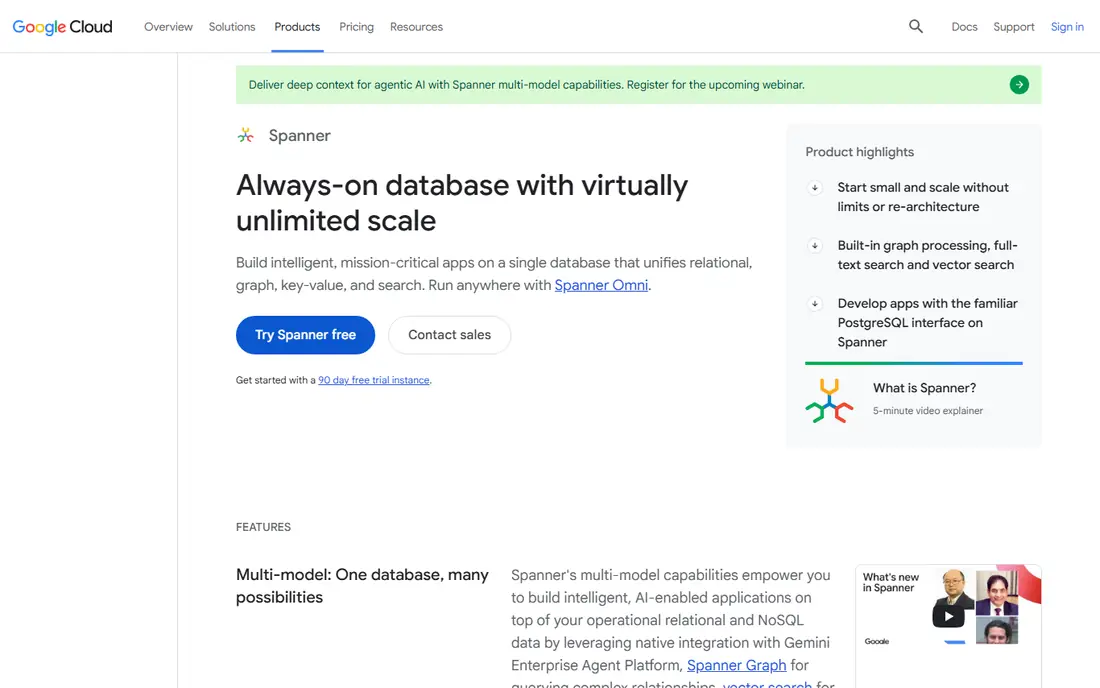
Spanner is the managed answer for Google Cloud teams that need global SQL without running the database themselves. Google operates the replication, scaling and maintenance, and Spanner is known for strong consistency across regions. For apps with users and data in several regions, that managed global story is hard to match with a self hosted setup.
The limits are vendor and cost. Spanner only runs on Google Cloud, so a multi cloud strategy gets harder, and its pricing rewards careful capacity planning. Small teams should test with real traffic patterns before committing, because a global database is a bigger bill than a single region Postgres instance.
- Fully managed global scale
- Strong consistency
- Deep Google Cloud integration
- Google Cloud only
- Costs can rise fast at scale
Aurora DSQL is Amazon's serverless distributed SQL option, aimed at variable workloads that do not want provisioned servers. It scales with demand and is designed for multi region active active use, which is the hardest part of distributed SQL to get right. AWS teams that already use Aurora, Lambda and other AWS services will find the integration familiar.
Because DSQL is newer than classic Aurora, teams should check region availability and feature coverage for their specific workload before migrating. It is not a drop in replacement for every Aurora feature. For greenfield AWS apps with spiky traffic, though, the serverless model is attractive.
- Serverless scaling on AWS
- Strong consistency
- No server provisioning for the database
- AWS only
- Newer service with fewer regions and patterns than Aurora itself
Neon is our pick for most teams that picked CockroachDB mainly for a free tier and Postgres compatibility. It is serverless Postgres with branching, so a developer can copy a database for a pull request almost like copying code. Idle projects can scale to zero, which keeps side projects and staging environments cheap.
Neon does not replace CockroachDB for global writes or multi region active active work. It is a single region Postgres service with great developer ergonomics, not a distributed consensus system. If your app fits in one region and needs Postgres, that trade is usually worth making.
- Generous free tier
- Instant database branching
- Scale to zero for idle projects
- Not a distributed multi region database
- Cold starts can add latency
Supabase gives small teams a whole backend around Postgres, not just a database. Authentication, file storage, realtime updates and generated APIs come with the platform, which cuts the number of services a team must wire together. The free tier lets a team build and launch a small app before paying, and Pro starts at $25 per month.
The honest limit is scope. Supabase is excellent Postgres hosting with backend extras, but it is not a distributed SQL engine for global multi region transactions. Teams that need that should look at YugabyteDB, TiDB or Spanner instead. Teams that need a fast start will rarely miss it.
- Postgres with auth, storage and realtime included
- Generous free tier for starting
- Large community and docs
- Free projects pause after inactivity
- Not built for multi region writes
PlanetScale is best known for Vitess based MySQL hosting that can scale to very large workloads, and it now also offers managed Postgres. Branching and deploy workflows are strong, which helps teams that ship schema changes often. Single node Postgres from $5 per month makes it reachable for small projects too.
The catch is the jump to sharded Vitess. That tier is built for high write throughput and costs much more than a single node, so it only makes sense when traffic truly demands it. There is also no free tier, so prototyping costs money from day one. For MySQL teams heading toward huge scale, PlanetScale is still a serious option.
- Vitess based sharding for very large MySQL workloads
- Database branching
- Managed Postgres single nodes from $5 per month
- No free tier
- Sharded Vitess clusters cost far more than single nodes
SingleStore targets teams that need transactions and analytics on the same data without waiting for a warehouse sync. It can run transactional workloads and analytical queries together, and it scales horizontally for larger data sets. Cloud and self managed deployments give teams deployment choice.
For a straight CockroachDB replacement, SingleStore is a different shape. It shines on real time analytics and fast queries more than on global multi region Postgres compatibility. Check the pricing page and trial terms carefully, because costs depend on cluster size and usage in ways a simple monthly list price does not show.
- Fast transactional and analytical queries in one engine
- Horizontal scale
- Cloud and self managed options
- Pricing is less transparent for small teams
- Postgres users face a learning curve
Vitess is the open source sharding system behind large MySQL deployments, and it is the right pick only when a team wants explicit control over how data is split. It handles connection pooling, query routing and resharding for MySQL, and it has proven itself at very large scale. The software itself is free to use.
That freedom comes with work. Vitess is not a managed database you switch on and forget, and it needs operators who understand MySQL sharding, topology and failure handling. Most teams should prefer a managed option such as PlanetScale or TiDB Cloud. Teams with the staff to run it get control that managed services do not offer.
- Open source MySQL sharding used at large scale
- Fine grained control over sharding
- No license cost for the core
- High operational complexity
- MySQL only and needs experienced operators
How we picked these
We compared official feature pages, pricing pages and documentation for distributed SQL, serverless Postgres and managed MySQL options, and we checked which products are actively offered in October 2026. We favored products that truly cover a CockroachDB use case, whether that is distributed transactions, MySQL or Postgres compatibility, or a cheaper serverless Postgres path. We did not list CockroachDB itself, since this article is about alternatives, and we used See website where a price depends on usage or is not published as a simple monthly figure.
What to check before you migrate
Start with the workload, not the brand. Write down whether you need multi region writes, MySQL or Postgres compatibility, and how much traffic you really have. Then test the candidate with a copy of your schema and a realistic query mix, because distributed databases behave differently under write contention than a single node database does.
Watch the billing model as closely as the features. Some products charge per compute unit hour, some per node, and some per storage and reads, so two similar sounding prices can mean very different monthly bills. Check region availability, backup and point in time recovery, and how schema changes work in production. A migration that looks easy in a demo can stall on one missing feature, so confirm that feature before you move data.
Frequently asked questions
Is there a free alternative to CockroachDB?
Yes, for many workloads. Neon and Supabase offer free tiers for Postgres, YugabyteDB and Vitess are open source, and TiDB Cloud offers a free starting tier. Free tiers have limits on storage, compute and activity, so check them against your app before relying on them in production.
What is the closest alternative to CockroachDB?
YugabyteDB is usually the closest for Postgres teams, because it pairs Postgres compatibility with distributed transactions and self hosting. TiDB is the closest equivalent for MySQL teams. The best choice depends on which database protocol your app already uses.
Do I really need a distributed database?
Many apps do not. If all your users and writes fit in one region, serverless Postgres from Neon or Supabase is simpler and cheaper. You need distributed SQL when you must survive region failures with writes, scale writes beyond one server, or serve low latency writes in several regions at once.
Can I migrate from CockroachDB to Postgres easily?
Postgres compatible options such as YugabyteDB, Neon and Supabase make migration easier, because they use the Postgres wire protocol and much of the same SQL. You should still test application queries, transactions and any CockroachDB specific syntax, and plan a data migration window with a rollback option.
Is TiDB better than YugabyteDB?
Neither is better in general. TiDB fits MySQL workloads and adds built in analytics, while YugabyteDB fits Postgres workloads and offers self hosting with distributed transactions. Choose by protocol first, then by whether you need analytics, managed hosting or multi cloud deployment.
What about cost at scale?
Distributed databases cost more at scale than a single server, because replication and coordination use extra compute and storage. Compare total cost with your own traffic, not list price alone, and include backups, network transfer and any managed service fees in the estimate.
Sources
See where you really rank - block by block
ProMapRanker scans Google Maps across a grid of your service area. Simple monthly plans from $19, white-label on every plan.
Start freeKeep reading
 best chat tool for website
Best Chat Tool for Website in 2026
Best chat tool for website owners compared, with live chat, AI agents, free plans, and pricing for small stores, SaaS teams, and support teams of all sizes.
Read → best birdwatching app
Best Birdwatching App in 2026
Best birdwatching app picks for 2026: nine free and paid apps for bird ID by sight and sound, checklists, hotspots, and finding birds near you for all birders.
Read → best bird identification app
Best Bird Identification Apps in 2026
Find the best bird identification app for photos, songs and calls. We compare 9 bird apps, including Merlin, BirdNET and Audubon, to help you choose today.
Read →