 ProMapRanker
Best 6sense Alternatives in 2026


Full account-based marketing replacement · Pricing starts at: See website
Key takeaways
- Demandbase is the closest full-platform replacement, while Bombora suits teams that only need intent data to feed their own tools.
- ZoomInfo and Apollo pair intent signals with contact data, which helps sales teams act on an account without buying a second database.
- Lower-cost options such as RollWorks and Dealfront suit smaller teams, but they offer less predictive scoring than enterprise platforms.
- Most enterprise intent platforms are quote-based, so budget for implementation and a dedicated owner, not just the licence.
Quick comparison
| Pick | Great for | Pricing starts at | Free tier | |
|---|---|---|---|---|
| Demandbase | Full account-based marketing replacement | See website | No | Visit |
 ZoomInfo | Intent signals inside a large contact database | See website | Yes | Visit |
 Bombora | Standalone intent data for your own stack | See website | No | Visit |
 Apollo | Budget intent plus prospecting in one tool | Free | Yes | Visit |
 Cognism | European outbound with intent and verified contacts | See website | No | Visit |
 RollWorks | Small team account-based marketing | Free | Yes | Visit |
 Warmly | Real-time website visitor identification | See website | No | Visit |
 Common Room | Cross-channel signal aggregation | See website | No | Visit |
 Dealfront | Website visitor identification with European compliance | See website | Yes | Visit |
The best 6sense alternatives
These are alternatives to 6sense only. We have not listed 6sense itself here, because the point of this article is what to use instead. The tools below cover the main reasons teams leave an enterprise intent platform: price, complexity, data needs, or a desire for faster setup. Match the tool to the job, since intent data, contact data and advertising orchestration are three different purchases.
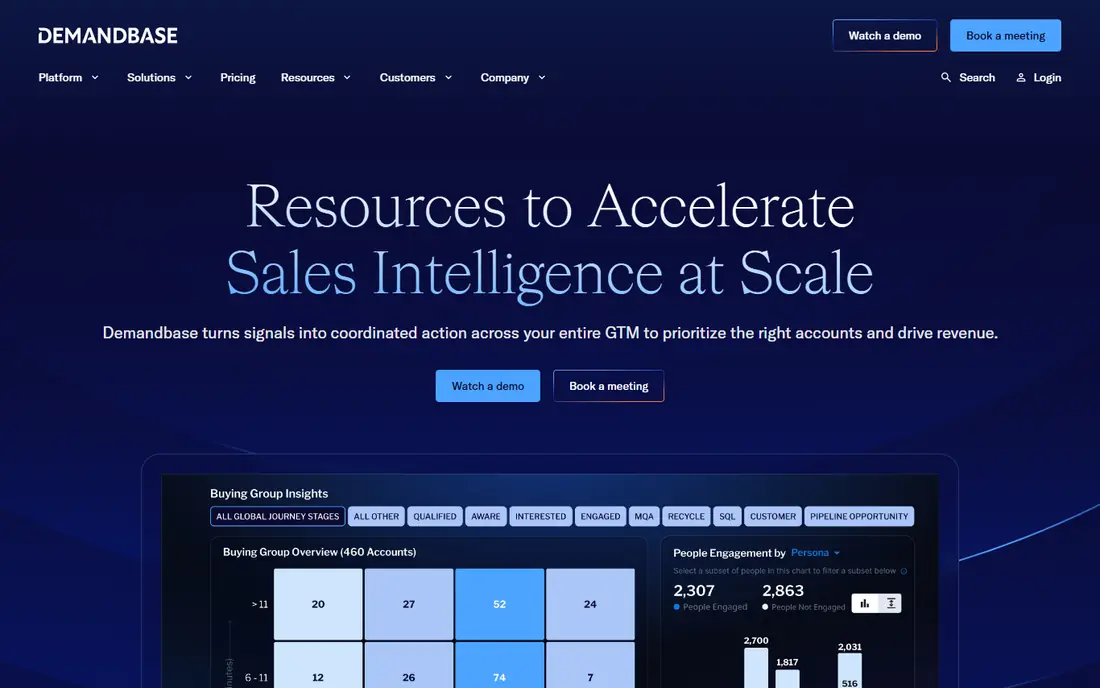
Demandbase is the closest like-for-like replacement for a team that wants account-based marketing, advertising and sales orchestration together. It combines account intent, firmographic and technographic data with tools to target accounts across display advertising and sales workflows. For a mid-market or enterprise team that already runs account-based campaigns, that breadth reduces the number of separate tools to manage.
The cost and setup are the main barriers. Demandbase is quote-based, with contracts reported in the tens of thousands of dollars a year, and implementation needs planning around data, integrations and campaign structure. A small team that only needs intent signals will find it heavy. For a team that will use advertising, orchestration and sales alerts together, it is the most complete alternative here.
- Account intelligence, advertising and sales orchestration in one platform
- Strong intent and technographic data
- Mature integrations
- Quote-based enterprise pricing
- Implementation takes time
- Smaller teams may use only part of the platform
ZoomInfo suits sales-led teams that want to move from an in-market account to a named contact in one workflow. Its contact database is one of the largest in B2B, and its intent features, including WebSights and Scoops, flag accounts showing buying behaviour and people changing roles. That link between account intent and contact data shortens the gap between signal and outreach.
The catch is packaging. Intent often sits as an add-on rather than in the base plan, and total cost rises with credits, add-ons and seat count. Annual contracts are standard, so a team should trial the data quality for its target market before signing. For US-focused outbound teams, the database depth often justifies the price, but a team that only needs intent data should compare Bombora first.
- Very large B2B contact database
- Intent signals tied to contacts and accounts
- Scoops and WebSights for buying signals
- Intent is often an add-on to the base platform
- Annual contracts
- Pricing rises with data and credit use
Bombora is the pick when you already have a CRM, marketing automation tool or advertising platform and just need better intent data. Its Company Surge product measures topic research across a cooperative of business publishers, which gives a clear signal about which accounts are researching a topic. That data can then feed scoring, advertising and sales alerts in tools you already own.
Bombora does not solve the next step on its own. It provides account-level intent, not contact details or campaign orchestration, so your team must build the workflow around it. Contracts are enterprise in scale, which rules it out for very small teams. For a team with a solid stack and a data gap, Bombora is a focused, credible alternative.
- Company Surge topic intent from a large publisher cooperative
- Clean data layer for CRM and marketing tools
- No need to buy a full ABM suite
- No contact data included
- Needs your own CRM or marketing platform to act on signals
- Enterprise contracts
Apollo is the budget pick for teams that cannot justify an enterprise intent contract but still want signals tied to prospecting. Its free plan lets a small team test contact search, enrichment and basic signals, while paid plans add sequences, more credits and team features. For a startup sales team, having data, signals and outreach in one login is a practical advantage.
Expect simpler intent than Bombora or Demandbase. Apollo signals help prioritise accounts, but they do not replace a dedicated predictive model or a large intent cooperative. Data accuracy also varies outside the US, so test it on your target accounts. For a small team that needs to start outbound quickly on a limited budget, Apollo offers the best balance of price and function here.
- Free plan to start
- Large contact database
- Signals, sequences and enrichment in one workflow
- Intent signals are simpler than enterprise platforms
- Data accuracy varies by market
- Paid plans rise with credits and seats
Cognism suits teams selling into Europe that need compliant, verified contact data alongside intent signals. Its European database is a key strength, with phone-verified numbers and a compliance approach that matters under European privacy rules. Intent data, available through its Bombora partnership, helps prioritise accounts before outreach begins.
US-focused teams may find ZoomInfo or Apollo stronger for North American data, and Cognism pricing is quote-based, so budgeting needs a sales conversation. The platform fee plus user costs can also surprise small teams. For a European outbound team that needs both intent and contacts it can trust, Cognism is a strong, focused alternative.
- Strong European coverage
- Phone-verified contact data
- Bombora intent available through partnership
- Compliance-focused approach
- Quote-based pricing
- US coverage is thinner than ZoomInfo
- Platform fee plus seat costs can add up
RollWorks fits small and mid-sized teams that want account-based advertising without an enterprise contract. Its free plan lets a team test account targeting, while paid plans add advertising, intent and sales insights. Setup is simpler than a full enterprise platform, which helps a team without a dedicated ABM operations person.
The trade-off is depth. RollWorks does not offer the same predictive scoring or orchestration as Demandbase, and advertising spend sits on top of the platform fee. Teams that need deep intent modelling or complex multi-channel orchestration should look higher up this list. For a small team starting account-based marketing, RollWorks is an accessible entry point.
- Free plan to start
- Account-based advertising and targeting for smaller teams
- Simpler setup than enterprise platforms
- Less predictive depth than enterprise ABM suites
- Advertising costs are separate
- Best for teams already comfortable with paid campaigns
Warmly suits teams with strong website traffic that want to act while a prospect is still on the site. It identifies visiting companies in real time, enriches the visit with firmographic data, and alerts sales staff so they can follow up quickly. For inbound-heavy teams, that speed can matter more than a weekly intent report.
Warmly is not a cheap add-on, and its value depends on traffic volume. A site with few visitors will generate few alerts, no matter how good the identification is. Identification rates also vary by visitor and setup, so expectations should be set in a trial. For a team with real inbound volume and a fast follow-up process, Warmly is a compelling alternative to a broad intent platform.
- Real-time identification of website visitors
- Fast alerts for sales teams
- Useful for inbound-heavy teams
- Pricing is mid-market, not budget
- Visitor identification rates vary
- Needs website traffic volume to be useful
Common Room fits product-led and community-led teams that get buying signals from many places at once. It pulls together signals from community platforms, product usage, social channels and other sources, then stitches them to a person or account. That view helps sales and marketing teams spot engaged accounts that a single intent feed would miss.
It is less of a fit for a team that only wants traditional third-party intent or advertising orchestration. Entry pricing is mid-market, and value depends on connecting enough signal sources to build a useful picture. For a team with an active community or product-led motion, Common Room offers a signal view that enterprise intent platforms do not match.
- Aggregates signals from community, product and social channels
- Person-level stitching across sources
- Useful for product-led teams
- Entry pricing is mid-market
- Setup needs signal sources to connect
- Less suited to pure advertising-led ABM
Dealfront, which includes Leadfeeder, suits European and international teams that want to know which companies visit their website. It identifies visiting firms, shows which pages they viewed, and feeds that data into CRM workflows. A free plan lets a team test identification rates on its own traffic before paying.
Dealfront is not a full predictive ABM platform. Its strength is first-party website intent, not third-party topic research across the web, so it pairs best with another data source for outbound prospecting. It also needs steady traffic to be useful. For a team that wants compliant visitor identification at a lower entry cost, Dealfront is a practical pick.
- Leadfeeder website visitor identification included
- European compliance focus
- Free plan to test visitor data
- Intent depth is narrower than Bombora
- Some features need paid tiers
- Best for teams with steady website traffic
How we picked these
We compared vendor pages, intent data sources, contact data coverage, advertising and orchestration features, and independent alternative comparisons checked in October 2026. We included only live platforms that cover intent, account-based marketing or visitor identification as a core job, and we left out 6sense itself, as this is an alternatives list. We marked prices as See website where the vendor quotes by contract, seats or data volume rather than publishing one fixed price.
How to choose a 6sense alternative without overbuying
Start by naming the gap you are trying to fill. If you need intent data alone, Bombora or Dealfront may be enough. If you need contacts to act on that intent, ZoomInfo, Apollo or Cognism matter more. If you need advertising and orchestration as well, Demandbase or RollWorks are the relevant shortlist. Buying a full platform for a single data need is the most common waste in this category.
Next, test data on your own accounts. Ask each vendor for a sample or trial covering your target industries, regions and company sizes, and check how many of your known customers and prospects appear with useful signals. Also confirm how signals flow into your CRM, how often they update, and who on your team will own scoring and follow-up. A tool without an owner becomes an unused dashboard, however good its data is.
Finally, model total cost over a year, including platform fees, seats, credits, advertising spend and implementation time. Enterprise platforms often need a dedicated operator to deliver value, while smaller tools need less setup but offer less depth. Choose the smallest tool that covers your real workflow, and upgrade only when you can point to signals you are missing today.
Frequently asked questions
What are the best 6sense alternatives?
The best 6sense alternatives are Demandbase for full account-based marketing, ZoomInfo for intent plus contact data, Bombora for standalone intent data, and Apollo for budget prospecting with signals. RollWorks, Warmly, Common Room, Cognism and Dealfront suit narrower needs, from small-team advertising to real-time visitor identification. The right pick depends on whether you need data, contacts, advertising or all three.
What are alternatives to 6sense for a small business?
Apollo and RollWorks are the most accessible alternatives to 6sense for a small business, because both offer free plans and lower entry costs. Dealfront also offers a free plan for website visitor identification. Enterprise tools such as Demandbase and Bombora are usually too costly and complex for a very small team.
Is Demandbase a good alternative to 6sense?
Yes, Demandbase is a good alternative to 6sense for teams that want a full account-based marketing platform with advertising and sales orchestration. It covers account intelligence, intent and targeting in one system. The main drawbacks are quote-based pricing and longer implementation, so it suits mid-market and enterprise teams more than startups.
Can I replace 6sense with intent data alone?
Sometimes, if your CRM and marketing tools already handle scoring, advertising and outreach. Bombora provides account-level topic intent that can feed those tools, while Dealfront provides website visitor intent. If you lack contact data or orchestration, you will still need a tool such as ZoomInfo, Apollo or Demandbase to act on the signals.
How much do 6sense alternatives cost?
Costs range from free plans on Apollo, RollWorks and Dealfront, to quote-based enterprise contracts for Demandbase, Bombora, ZoomInfo and Cognism, often reported in the tens of thousands of dollars a year. Always ask for total cost, including seats, credits, data add-ons and implementation, since headline pricing rarely tells the full story.
What is the difference between intent data and account-based marketing?
Intent data is a signal that an account is researching a topic, while account-based marketing is the full workflow of targeting, advertising to and selling to that account. Bombora sells mainly the signal, while Demandbase and RollWorks sell the workflow around it. Many teams need both, but buying the workflow without good data, or data without a workflow, limits results.
Sources
See where you really rank - block by block
ProMapRanker scans Google Maps across a grid of your service area. Simple monthly plans from $19, white-label on every plan.
Start freeKeep reading
 best chat tool for website
Best Chat Tool for Website in 2026
Best chat tool for website owners compared, with live chat, AI agents, free plans, and pricing for small stores, SaaS teams, and support teams of all sizes.
Read → best birdwatching app
Best Birdwatching App in 2026
Best birdwatching app picks for 2026: nine free and paid apps for bird ID by sight and sound, checklists, hotspots, and finding birds near you for all birders.
Read → best bird identification app
Best Bird Identification Apps in 2026
Find the best bird identification app for photos, songs and calls. We compare 9 bird apps, including Merlin, BirdNET and Audubon, to help you choose today.
Read →