 ProMapRanker
Which HR Software Is Best for Global Payroll in 2026


Scaling payroll across many countries · Pricing starts at: $29 per employee per month
Key takeaways
- Deel and Remote offer the clearest payroll-first starting prices here, both from $29 per employee per month for global payroll.
- Papaya Global suits larger firms that need payroll consolidation across many local providers in one view.
- Multiplier offers a lower-cost EOR route, while Oyster, Rippling, Safeguard Global, and CloudPay suit firms with wider HR or enterprise needs.
- Country coverage, entity ownership, and extra fees matter more than the headline rate, so confirm them in a written quote.
Quick comparison
| Pick | Great for | Pricing starts at | Free tier | |
|---|---|---|---|---|
| Deel | Scaling payroll across many countries | $29 per employee per month | No | Visit |
 Remote | Owned-entity payroll and EOR | $29 per employee per month | No | Visit |
 Papaya Global | Enterprise payroll consolidation | $12 per employee per month | No | Visit |
 Multiplier | Lower-cost EOR hiring | $20 per employee per month | No | Visit |
 Oyster | EOR hiring with HR support | $699 per employee per month | No | Visit |
 Rippling | HR, IT, and payroll in one system | See website | No | Visit |
 Safeguard Global | Compliance-heavy enterprise payroll | See website | No | Visit |
 CloudPay | Finance-led global payroll | $20 per employee per month | No | Visit |
The best HR software for global payroll
We compared tools that pay employees in more than one country, handle local tax and benefits, and give HR one view of payroll. We gave extra weight to published payroll prices, country coverage, and whether the vendor owns local entities or works through partners.
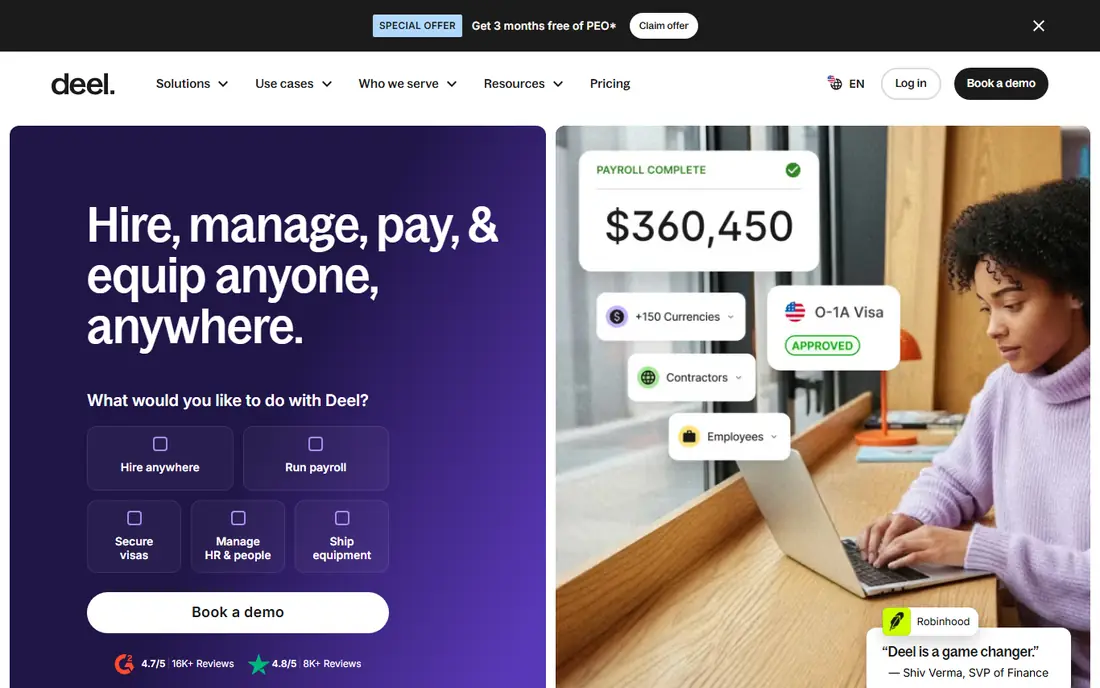
Deel is the broadest starting point for a company hiring across borders. Global payroll starts at a published rate, and the same platform also handles contractors and employer-of-record hiring for countries where the company has no entity. That range means a team can start with payroll and add EOR hiring later without moving systems.
The headline payroll price is not the whole story. EOR hiring costs far more per employee per month, and entity setup can add fees that do not appear in the payroll rate. Deel still suits fast-growing teams because coverage is wide and the HRIS tools help small HR teams stay organised. Get EOR and payroll quotes separately before budgeting.
- Wide country coverage
- Contractor and EOR options in one place
- Free HRIS tier
- EOR pricing is far higher than payroll pricing
- Setup fees can apply for entities
Remote stands out for owning its local entities in many of the countries it serves, rather than relying only on partners. That model can give HR a clearer line of responsibility when a payroll question arises. Public pricing is also clearer than in much of this category, which helps finance teams plan.
As with Deel, payroll and EOR prices are very different products. EOR hiring is priced per employee per month at a premium rate, while payroll for staff employed by the company itself starts lower. Off-cycle runs and year-end processing can also add cost. Remote suits teams that value entity ownership and price transparency over the lowest possible EOR fee.
- Owned entities in many markets
- No setup or onboarding fee stated
- Clear public pricing
- EOR rate is far higher than payroll rate
- Off-cycle and year-end work can cost extra

Papaya Global suits larger firms that already run payroll in many countries and need one view of it all. Its platform consolidates data from local providers, tracks payroll cycles, and supports payments in a wide set of currencies. For finance teams, that consolidation and reporting view is often worth more than a low per-employee rate.
Buyers should ask for the full fee list. Setup, payroll cycle, and year-end fees can sit on top of the per-employee rate, and a refundable deposit may apply. EOR hiring is priced separately at a premium. Papaya is an enterprise consolidation pick, not a cheap entry point for a first international hire.
- Wide payroll coverage
- Consolidation across local providers
- Same-day payments in many currencies
- Setup, cycle, and year-end fees can apply
- EOR pricing is far higher
Multiplier is worth a look for mid-size teams that want EOR hiring at a lower entry price than Deel or Remote. Its EOR rate on annual billing undercuts the premium rivals, and coverage spans a wide set of countries, with strength in Asia-Pacific hiring. Contractor management sits alongside EOR in the same platform.
Payroll pricing is less clear than the EOR rate, and setup, implementation, and statutory fees can apply on top. Teams should ask for a total quote for their exact countries before comparing Multiplier with a payroll-first tool. For EOR-led hiring on a budget, it is a strong contender.
- Lower EOR entry price on annual billing
- Broad EOR coverage
- Contractor support
- Payroll pricing is less transparent
- Setup and statutory fees can apply
Oyster is an EOR-first platform, not a standalone payroll tool, and that distinction matters for this topic. It suits teams hiring full-time staff in countries where they have no entity, and it puts weight on human HR support during onboarding and employment. Contractor hiring is available at a much lower monthly rate.
The EOR price sits at the premium end of this list, so Oyster is a poor fit for teams that only need payroll for their own entities. It makes sense when a company wants guided EOR hiring and is willing to pay for support. Teams that need payroll only should shortlist Deel, Remote, or Papaya instead.
- Human HR support focus
- Contractor option from $29 per month
- EOR in many countries
- No standalone payroll product
- Premium EOR price
Rippling suits companies that already want HR, IT, and finance in one system and need global payroll as part of that stack. US HR and payroll are its home ground, and global EOR and payroll modules extend that system to international hires. For a US-centric company scaling abroad, keeping one system has real appeal.
The drawback is price transparency. Rippling does not publish a starting price for global payroll, so budgeting needs a demo and a quote. Global payroll depth also varies by country, so HR should confirm coverage and local compliance support for each country on the hiring plan. Rippling is a platform pick, not a quick price comparison.
- HR, IT, finance, and payroll in one platform
- Strong US base
- Modular global tools
- No published starting price for global payroll
- Global payroll depth varies by country
Safeguard Global suits larger, compliance-heavy employers that want managed global payroll rather than a self-serve tool. Its model leans on advisory support and local expertise across many countries, which helps firms in regulated industries or with complex employment rules. Reporting and payroll operations are handled with that support in mind.
Small teams will find it heavy. Pricing is quote-only, and the service model is built for enterprise scale rather than a first handful of international hires. Firms with complex compliance needs and a large international workforce should include it in a shortlist. Smaller firms should start with a published-price tool.
- Deep compliance and advisory focus
- Wide country coverage
- Managed payroll services
- Quote-only pricing
- Enterprise focus makes it heavy for small teams
CloudPay suits finance-led teams that treat global payroll as part of treasury and reporting, not just an HR task. It covers payroll in many countries, unifies payroll data for reporting, and connects payroll to finance systems. That focus helps controllers who need clean, auditable payroll figures across entities.
At enterprise scale, pricing moves to quotes, so the entry rate is only a starting point for mid-market teams. CloudPay also does not offer its own EOR product, so firms that need EOR hiring must pair it with another provider. For payroll-first, finance-led buyers, it is a credible alternative to Papaya.
- Finance and treasury integration
- Wide payroll coverage
- Unified payroll data
- Enterprise pricing is quote-based at scale
- No EOR product of its own
How we picked these
We compared vendor pricing pages and recent global payroll comparisons that cite vendor prices from October 2026. A tool made the list only if it is actively sold for international employment or payroll work and serves real multi-country payroll or EOR needs. Where a vendor publishes no payroll price, we wrote See website rather than guessing from EOR rates.
What to check before you buy
Start with the hiring plan, not the vendor list. Write down each country, the number of hires, and whether each person will be employed by your entity or through an EOR. That split decides which price applies, and it changes the total far more than small rate differences.
Confirm who is the legal employer
Ask whether the vendor owns the local entity, works through a partner, or only provides software over your existing providers. Ownership affects who answers when a payment or filing goes wrong. Get the answer in writing for each country that matters.
Ask for every fee
Request setup, payroll cycle, off-cycle, year-end, payment, and deposit fees in one quote. Compare the full first-year total, not the monthly per-employee rate alone. A low rate with high cycle fees can cost more than a higher rate with fees included.
Test reporting and integrations
Check that payroll data flows into your HRIS, finance system, and time tools without manual re-entry. Ask for a sample payroll report and a sample variance report. If finance cannot reconcile payroll to the ledger easily, the tool will create monthly work.
Frequently asked questions
Which HR software is best for global payroll for a small team?
Deel and Remote are strong starting points because both publish global payroll from $29 per employee per month and cover many countries. Papaya Global suits larger firms that need consolidation. Start with the countries you actually hire in, not the total country count.
What is the difference between global payroll and EOR?
Global payroll pays employees who work for your own legal entity in another country. EOR means the vendor is the legal employer in that country, and you direct the daily work. EOR costs far more per employee, so use it only where you have no entity.
Is Deel or Remote better for global payroll?
Both publish the same payroll starting price and wide coverage. Remote puts weight on owned entities, while Deel offers a broader mix of payroll, EOR, and contractor tools in one place. Choose Remote for entity ownership, and Deel for range in one platform.
How much does global payroll software cost?
Published payroll rates here start from $12 to $29 per employee per month, but setup, cycle, and year-end fees can add to the total. EOR hiring is a separate, premium product, often from $459 to $699 per employee per month. Always compare a full first-year quote.
Do I need global payroll software if I only hire contractors?
No, in most cases. Contractor management tools from Deel, Remote, Oyster, and Multiplier handle contractor payments at a lower rate. Global payroll software is for employees, where local tax, benefits, and filings apply.
Sources
See where you really rank - block by block
ProMapRanker scans Google Maps across a grid of your service area. Simple monthly plans from $19, white-label on every plan.
Start freeKeep reading
 zscaler alternatives
Best Zscaler Alternatives in 2026
Looking for zscaler alternatives? We compare 9 SASE and zero trust platforms on architecture, data protection, pricing, and fit for your network and team.
Read → zapier alternatives free
Best Zapier Alternatives Free in 2026
Nine automation tools for zapier alternatives free in 2026, all with genuinely free tiers, plus free plan limits, starting prices and upgrade paths explained.
Read → which platform is best for online reputation
Which Platform Is Best for Online Reputation in 2026
Wondering which platform is best for online reputation? We compare 8 review, listing, and response tools for small and multi-location businesses and agencies.
Read →