 ProMapRanker
Which Data Movement Tool Is Best for Business in 2026

Key takeaways
- Fivetran suits businesses that want managed, hands-off pipelines with a broad connector catalog, if the usage-based bill fits the budget.
- Airbyte suits engineering teams that want open source control and a low entry price, with self-hosting as an option.
- Hevo Data and Stitch suit smaller teams that want simpler, tiered pricing and no-code setup.
- Pricing models differ by rows changed, events, volume, or credits, so estimate your change rate before you compare totals.
Quick comparison
| Pick | Great for | Pricing starts at | Free tier | |
|---|---|---|---|---|
 Fivetran | Managed ELT with broad connectors | Free | Yes | Visit |
 Airbyte | Open source ELT with control | $20 per month | Yes | Visit |
 Hevo Data | No-code ELT for small and mid-size teams | $265 per month | Yes | Visit |
 Stitch | Simple, low-cost replication | $100 per month | Free trial | Visit |
 Matillion | Warehouse-native ELT and transformation | See website | No | Visit |
 Integrate.io | Fixed-fee ETL and reverse ETL | $1,999 per month | Free trial | Visit |
 AWS Glue | Serverless ETL inside AWS | $0.44 per DPU-hour | No | Visit |
 Azure Data Factory | ETL inside Azure and hybrid data | See website | Free trial | Visit |
 Qlik Talend Cloud | Enterprise integration and governance | See website | No | Visit |
 Estuary Flow | Streaming CDC with low latency | Free | Yes | Visit |
The best data movement tools for business
Data movement tools copy data from apps, databases, and files into a warehouse, lake, or another system, so teams can report, analyze, and act on it. The right tool depends on your sources, your data volume, your warehouse, and how much engineering time you have.

Fivetran is the managed ELT pick for businesses that want pipelines to run without constant care. It offers hundreds of connectors for SaaS apps, databases, and files, handles schema changes automatically, and loads data into major warehouses with little setup. A free tier covers up to 500,000 monthly active rows, which lets small teams test a few connectors before paying.
Pricing is usage based on monthly active rows per connection, plus a small base charge per connection, so the bill moves with your change rate and source count. Teams with many connectors or fast-changing data should estimate MAR carefully and monitor it monthly. If hands-off reliability matters more than the lowest price, Fivetran is often worth that premium.
- Broad connector catalog
- Automated schema handling
- Managed reliability and governance
- Usage-based MAR pricing can be hard to forecast
- Per-connection billing adds up with many sources
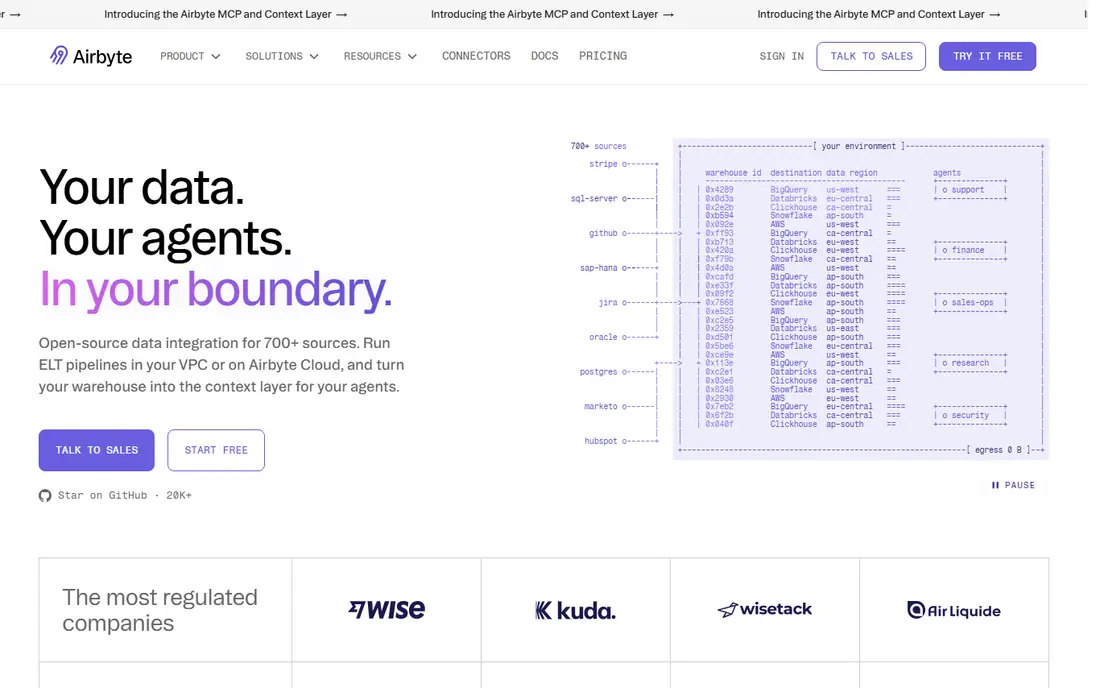
Airbyte offers an open source ELT platform with a large community connector catalog, plus a managed cloud service. Self-hosting is free in software terms, though you pay for infrastructure and engineering time, while Airbyte Cloud starts at $20 per month for the Standard tier. It supports change data capture for major databases and works with dbt for transformations.
The trade-off is the gap between self-serve cloud and contract tiers, and the work needed to run self-hosted pipelines reliably. For an engineering team that wants control, no vendor lock-in, and a low entry price, Airbyte is a strong pick. For a business team with no data engineers, a managed tool such as Fivetran or Hevo may be easier.
- Open source self-hosting option
- Large connector catalog
- Low cloud entry price
- Self-hosting needs engineering time
- Cloud pricing jumps between self-serve and contract tiers
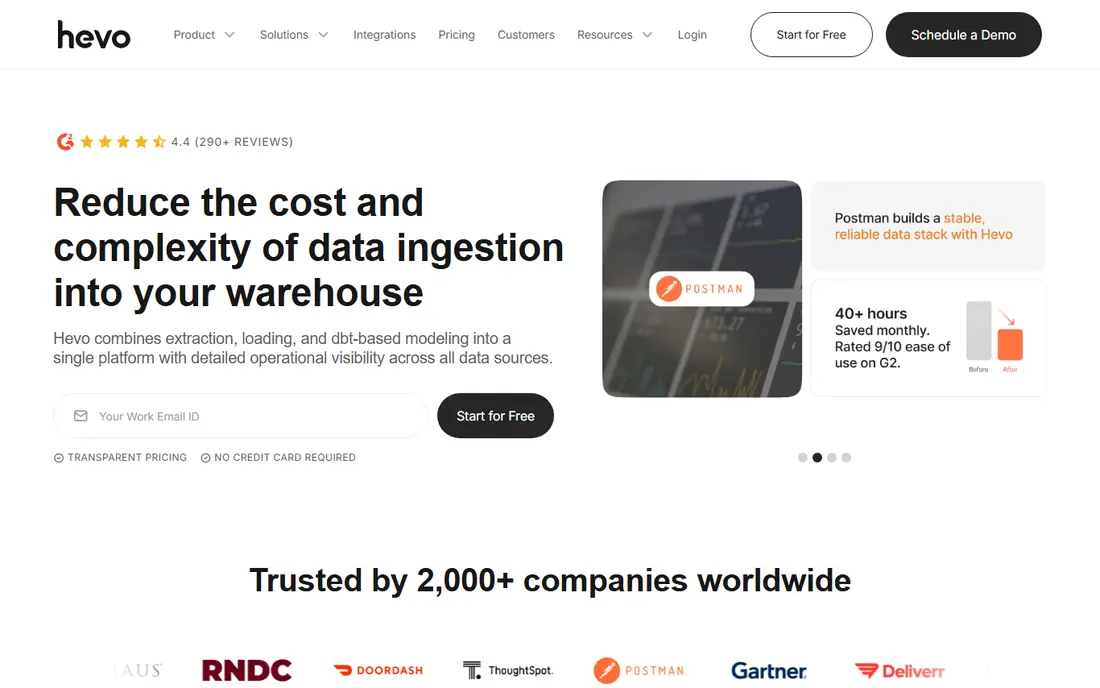
Hevo Data is a no-code ELT platform for small and mid-size teams that want to move data from apps and databases into a warehouse without writing pipelines. It offers more than 150 connectors, change data capture for major databases, and drag-and-drop plus Python transformations, with dbt on paid plans. A free tier covers up to 1 million events, while the Starter plan is $265 per month billed annually.
Event-based pricing is easier to forecast than MAR in some ways, but every insert, update, and delete counts, so high-frequency sources can use events quickly. For a team with steady, moderate volumes and no data engineers, Hevo is one of the most approachable managed options. For very high-change data, compare it with Airbyte or Fivetran on real volumes.
- No-code pipeline setup
- Event-based tiers
- Drag-and-drop and Python transformations
- Every record change counts as an event
- High-frequency updates multiply costs
Stitch is a lightweight extract-and-load tool for teams that need simple replication from apps and databases into a warehouse. It offers more than 130 connectors, row-based tiers starting at $100 per month for 5 million rows, and a 14-day trial. Setup is quick, and the pricing model is easy to understand compared with MAR or credit models.
Stitch offers little in-platform transformation, so teams that need heavy modeling should use dbt in the warehouse or choose a fuller platform. Its future inside Qlik Talend Cloud also matters: new buyers should confirm the roadmap and support terms before committing. For simple, steady replication on a tight budget, Stitch remains a practical choice.
- Simple row-tier pricing
- Easy setup for basic replication
- Part of Qlik ecosystem
- Fewer transformation features
- Product is being absorbed into Qlik Talend Cloud
Matillion runs ELT and transformation inside your warehouse, using push-down SQL and Python so heavy work stays close to the data. It suits data teams that already use Snowflake, BigQuery, or Redshift and want visual pipeline building plus transformation in one place. Streaming change data capture on higher tiers helps teams that need fresher data than batch loads provide.
Pricing is credit based and not publicly listed, so you need a quote based on task hours and volume. That opacity makes budgeting harder than with Hevo or Stitch. For a warehouse-centric team that values transformation power, Matillion is a strong pick. For a team that only needs simple replication, it is more tool than you need.
- Warehouse-native transformations
- Push-down SQL and Python
- Streaming CDC on higher tiers
- Credit-based pricing is not publicly listed
- Best value inside a supported warehouse
Integrate.io offers ETL, ELT, change data capture, and reverse ETL in one platform, with a low-code pipeline designer and SQL and Python steps. The Core plan is listed at $1,999 per month with a fixed fee and unlimited volume, which suits businesses with large or spiky volumes that want a predictable bill. Reverse ETL, which sends warehouse data back to apps such as a CRM, is a useful extra for operational teams.
The entry price puts it out of reach for small teams, and its connector catalog is smaller than Fivetran or Airbyte. For a mid-market business with high volumes and a need for reverse ETL, the fixed fee can be cheaper than usage-based rivals. For a small team, start with Airbyte, Hevo, or Stitch instead.
- Fixed fee with unlimited volume on Core plan
- ETL, ELT, CDC, and reverse ETL in one platform
- Low-code designer
- High entry price for small teams
- Connector count is smaller than Fivetran or Airbyte
AWS Glue is a serverless ETL service for teams already running on AWS. It crawls data sources, builds catalogs, and runs Spark or Python jobs to move and transform data into warehouses, lakes, and other AWS services, with visual ETL for simpler jobs. Pricing is $0.44 per DPU-hour, so you pay for compute time, not for a fixed tier.
That model suits variable, batch-style workloads, but costs can vary sharply if jobs are over-provisioned or run too often. Glue is also AWS-centric, so multi-cloud teams may prefer a neutral tool such as Fivetran or Airbyte. For an AWS shop with data engineers, Glue is a flexible and cost-effective building block.
- Serverless Spark ETL inside AWS
- Visual ETL plus Python
- No servers to manage
- Best inside AWS only
- Costs vary with job runtime and cluster size
- Learning curve for non-AWS teams
Azure Data Factory is Microsoft's cloud ETL service for moving data between Azure services, on-premises systems, and SaaS apps. It offers a visual designer, a broad connector set, and integration with Azure Synapse, Databricks, and other Microsoft data tools. That makes it a natural choice for businesses already standardized on Azure.
Pricing is usage based across pipeline runs, data movement, and compute, so forecasting needs a real workload test. Multi-cloud teams may find a neutral tool simpler to manage. For an Azure-heavy business, Data Factory gives you a managed, governed way to move data without adding a separate vendor for every pipeline.
- Strong Azure and hybrid integration
- Visual pipeline designer
- Broad connector set
- Pricing is usage based and complex
- Best value inside Azure
Qlik Talend Cloud combines Talend data integration with Qlik Replicate change data capture, plus data quality and governance features for enterprise teams. It suits businesses that need more than simple replication: complex transformations, data quality checks, and governance across many sources and teams. Capacity pricing is based on volume, executions, and duration, so a quote is needed.
Setup is heavier than Hevo or Stitch, and the platform is best for teams with data engineers or integration specialists. For an enterprise with strict governance and complex pipelines, that depth is the point. For a small team with a handful of sources, a simpler ELT tool will be faster and cheaper.
- Enterprise data integration, quality, and governance
- Broad transformation
- Qlik Replicate heritage for CDC
- Quote-based capacity pricing
- Heavier setup than simpler ELT tools
Estuary Flow is a streaming data movement platform built around change data capture, with sub-minute latency for supported databases. It charges $0.50 per GB plus $100 per connector per month on paid tiers, with a free developer tier up to 10 GB per month. Derivations in SQL and TypeScript let technical teams transform streams as they move, rather than waiting for a batch load.
That code-first style suits engineering teams that need fresh data for operational use, such as live dashboards or downstream apps. Business teams that want no-code pipelines may prefer Hevo or Fivetran. For a team where latency matters and engineers are on hand, Estuary Flow is a distinctive, low-cost streaming option.
- Streaming change data capture
- Low latency
- Free developer tier
- SQL and TypeScript derivations
- Code-first derivations suit technical teams
- Reverse ETL is limited
How we picked these
We compared official pricing pages, feature pages, and public product comparisons checked in October 2026 for data movement tools that move data into warehouses or other systems. We kept tools that are live and maintained, that support multiple sources, and that serve business teams, not just a single app integration. Where pricing is quote based, we wrote See website rather than repeating a third-party estimate.
How to choose a data movement tool for your business
Start with your sources, your warehouse, and your change rate. List every source, how often its data changes, and how fresh the warehouse data needs to be. A daily sales report needs different latency and pricing than a live operations dashboard, and a tool that is cheap for one can be costly for the other.
Estimate volume before you compare prices
Usage models differ: Fivetran bills monthly active rows per connection, Hevo bills events, Stitch bills rows, Airbyte bills credits or capacity, and Matillion bills credits for task hours. Run a one-month estimate on real change rates, including re-syncs and deletes, since those often surprise teams. A fixed-fee tool such as Integrate.io may win once volumes grow, even if its entry price looks high.
Check connectors and transformation needs
Confirm that your exact sources are supported, including the version and API your team uses, and check whether transformations happen before load, in the warehouse, or both. If you need reverse ETL to send data back to a CRM or support tool, check that feature explicitly, since many ELT tools do not include it.
Pilot on one critical pipeline
Build one real pipeline, such as orders from your store to your warehouse, and run it for a month. Check data freshness, schema change handling, error alerts, and the actual bill. That pilot tells you more than a connector count, because reliability and cost at your volume are what decide whether a tool fits your business.
Frequently asked questions
Which data movement tool is best for business overall?
Fivetran is the most common overall pick for businesses that want managed, hands-off pipelines with a broad connector catalog. Airbyte is best for engineering teams that want open source control, while Hevo Data is best for smaller teams that want no-code setup and tiered pricing.
What are the best data movement tools for business on a budget?
Airbyte Cloud from $20 per month, Stitch from $100 per month, and Hevo Data with a free tier are the budget picks in this list. Estuary Flow also offers a free developer tier. Compare them on your actual change rate, since usage pricing can outweigh a low entry price.
Is Fivetran better than Airbyte?
Fivetran is better for businesses that want managed reliability and broad connectors without engineering work. Airbyte is better for teams that want open source control, self-hosting, and a lower entry price, and that can handle engineering overhead. Choose based on team skill and volume, not on connector counts alone.
What is the difference between ETL and ELT?
ETL transforms data before loading it into a warehouse, while ELT loads raw data first and transforms it inside the warehouse. ELT suits modern cloud warehouses with strong compute, since it keeps raw data available for new models. ETL suits cases where data must be cleaned or joined before it reaches the warehouse.
How do I keep data movement costs under control?
Select only the tables and columns you need, avoid full re-syncs, and monitor change rates monthly. Use incremental loads and change data capture where supported, and set alerts for volume spikes. Review connectors each quarter and remove sources that no longer feed a report or decision.
Sources
- https://www.fivetran.com/pricing
- https://www.airbyte.com/pricing
- https://www.hevodata.com/pricing
- https://www.stitchdata.com/pricing
- https://www.matillion.com
- https://www.integrate.io/pricing
- https://aws.amazon.com/glue/pricing
- https://azure.microsoft.com/pricing/details/data-factory
- https://www.qlik.com
- https://www.estuary.dev/pricing
See where you really rank - block by block
ProMapRanker scans Google Maps across a grid of your service area. Simple monthly plans from $19, white-label on every plan.
Start freeKeep reading
 zscaler alternatives
Best Zscaler Alternatives in 2026
Looking for zscaler alternatives? We compare 9 SASE and zero trust platforms on architecture, data protection, pricing, and fit for your network and team.
Read → zapier alternatives free
Best Zapier Alternatives Free in 2026
Nine automation tools for zapier alternatives free in 2026, all with genuinely free tiers, plus free plan limits, starting prices and upgrade paths explained.
Read → which platform is best for online reputation
Which Platform Is Best for Online Reputation in 2026
Wondering which platform is best for online reputation? We compare 8 review, listing, and response tools for small and multi-location businesses and agencies.
Read →