 ProMapRanker
Which DAST Tool Is Best for Cloud Platforms in 2026

Key takeaways
- For cloud platforms, the best DAST tool depends on whether you scan web apps, APIs, or both, and whether scans run in CI or on a schedule.
- OWASP ZAP is the strongest free starting point, while Burp Suite suits hands-on testing by skilled security staff.
- Invicti, Qualys, Rapid7, and Tenable suit teams that must scan many cloud apps from one console with reporting for audits.
- StackHawk and Detectify suit developer-led and external attack-surface use cases, with clearer published pricing than many rivals.
- DAST tests a running app, so it does not replace code review, manual penetration testing, or checks for business logic flaws.
Quick comparison
| Pick | Great for | Pricing starts at | Free tier | |
|---|---|---|---|---|
 OWASP ZAP | Free DAST for CI and learning | Free | Yes | Visit |
 Burp Suite | Hands-on web testing | See website | Free trial | Visit |
 Invicti | Proof-based scanning at scale | See website | No | Visit |
 Checkmarx DAST | Enterprise application security programs | See website | No | Visit |
 Veracode DAST | Governed cloud scanning and compliance | See website | No | Visit |
 Qualys Web Application Scanning | Teams already using Qualys | See website | No | Visit |
 Rapid7 InsightAppSec | Insight platform users | See website | No | Visit |
 Tenable Web App Scanning | Tenable platform users | See website | No | Visit |
 StackHawk | Developer-led API and app scanning | $10 per person per month | Free trial | Visit |
 Detectify | External attack surface and web scanning | See website | Free trial | Visit |
The best DAST tools for cloud platforms
Dynamic application security testing, or DAST, probes a running application from the outside, much like an attacker would. For cloud platforms, that means the tool must handle hosted web apps, single-page apps, and APIs, plus login flows, containers, and CI pipelines. We compared tools on those points, not only on price.

OWASP ZAP is the tool we suggest first when budget is zero and your team can tune a scanner. It runs locally, in Docker, or in CI, and it can crawl web apps and APIs, test common vulnerability classes, and produce reports in common formats. For a cloud team that wants a scan on every pull request, ZAP gives a real starting point without a contract.
The cost is time. ZAP needs configuration for login, session handling, and modern single-page apps, and its default results need triage. A team without security experience may chase false positives or miss authenticated pages. Use ZAP with a small set of target apps first, tune the rules, and add it to CI only after the results are stable.
- Free and open source
- Docker images and CI scripts
- Broad community extensions
- Needs tuning and expertise
- Authenticated scans for complex apps take setup work
Burp Suite is the practitioner standard for manual web testing, and it remains relevant for cloud apps because its proxy lets a tester inspect and change live traffic. Paid editions add an automated scanner, enterprise scheduling, and CI integration, which suit teams that need both manual depth and repeat scans. Its extension library adds checks for many frameworks and APIs.
Burp is not a set-and-forget scanner. The Community Edition is free but limited, and the paid editions reward testers who know how to drive them. If your team has a penetration tester or a strong AppSec engineer, Burp is a strong core tool. If you need fully automated fleet scanning with little human input, Invicti or Qualys may fit better.
- Industry-standard proxy for manual testing
- Large extension library
- Automated scanner in paid editions
- Full value depends on skilled testers
- Community Edition lacks the automated scanner and saved state
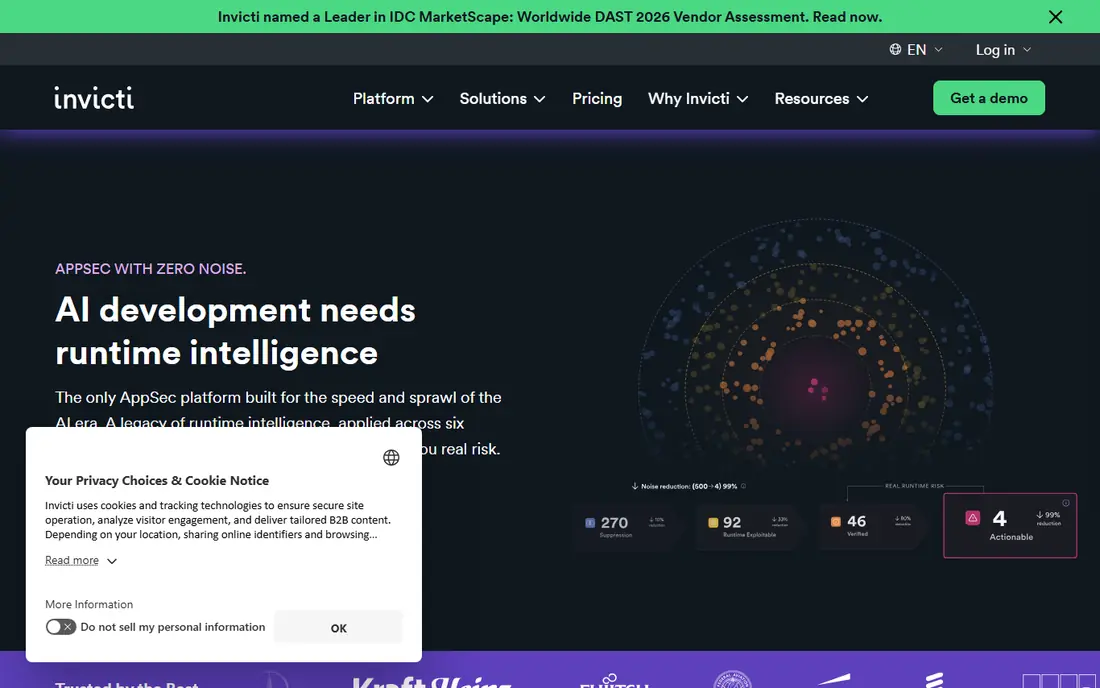
Invicti, which unified the former Netsparker and Acunetix products, suits teams that run many cloud apps and need defensible results. Its proof-based approach safely confirms many vulnerabilities, which reduces the time spent chasing false positives. Scheduling, role-based access, and compliance reporting help larger security teams manage a fleet of targets.
Pricing is the main barrier. Invicti is quote-based and sits at the enterprise end, so small teams should request a quote for their exact app count before assuming it fits. For a central AppSec team that must report to auditors and developers alike, Invicti is one of the strongest automated choices in this list.
- Proof-based checks that confirm many findings
- Scheduling and reporting for many apps
- Web and API coverage
- Quote-based enterprise pricing
- Triage still needs human review for complex logic
Checkmarx DAST fits enterprises that already use Checkmarx for static analysis or software composition analysis. Running DAST in the same platform lets teams see web findings alongside code findings, prioritize in one place, and track fixes across releases. That consolidation can save time for large AppSec programs.
For a team that only needs DAST, Checkmarx may feel heavy and expensive. Its pricing is quoted, and its strength shows when you use several Checkmarx products together. If your cloud program is large and you want one AppSec console, Checkmarx deserves a trial. If you need a single-purpose scanner, a smaller tool may be simpler.
- Part of a broad AppSec platform
- One queue for findings across testing types
- Enterprise controls
- Quote-based pricing
- Value depends on using the wider Checkmarx platform
Veracode DAST suits regulated teams that need cloud scanning with clear policies and audit-ready reports. Its platform covers web apps and APIs, and it fits programs that must show scan coverage, remediation progress, and policy compliance to auditors. For a cloud team in finance or healthcare, that governance layer matters.
The trade-off is process. Veracode works best when you define scan policies, target inventories, and remediation timelines up front. A small team that wants a quick scan may find the setup heavier than ZAP or StackHawk. For an enterprise that must prove coverage, Veracode is a strong, steady choice.
- Cloud-based scanning
- Compliance reporting
- Fits governed enterprise programs
- Quote-based pricing
- Setup and policy work take time
Qualys Web Application Scanning, often called Qualys WAS, is a natural pick for teams that already use Qualys for infrastructure scanning. It lets you manage web findings alongside host findings, reuse asset data, and report from one platform. For a cloud team that already pays for Qualys, adding WAS avoids another console and another vendor contract.
Outside that ecosystem, Qualys WAS is harder to judge on price alone, because pricing is quoted. Its web coverage is solid, but a team with no Qualys footprint may prefer a standalone DAST vendor with clearer published pricing. If Qualys is already your system of record, WAS is the low-friction choice.
- Integrates with Qualys vulnerability management
- Cloud delivery
- Broad web and API checks
- Quote-based pricing
- Best value comes inside the wider Qualys platform
Rapid7 InsightAppSec suits teams that already use Rapid7 for vulnerability management or detection. It scans web apps and APIs, maps findings to compliance frameworks, and shares data with the wider Insight platform. That link helps a security operations team see app risk next to infrastructure risk.
Cost control needs care. InsightAppSec has been priced per application in past comparisons, so a microservices estate with hundreds of targets can become expensive. Model your target count, including staging and API services, before you sign. For a focused app portfolio inside Rapid7, it is a practical choice.
- Ties into Rapid7 Insight platform
- Compliance templates
- Cloud and on-prem options
- Quote-based pricing
- Per-app costs can rise with many cloud targets
Tenable Web App Scanning fits teams that already use Tenable for vulnerability and exposure management. It adds web app and API scanning to the same workflow, so app findings sit next to host and cloud findings. That unified view helps a team prioritize the exposures that matter most, rather than treating web apps as a separate silo.
As with Qualys and Rapid7, the case is weaker if you have no Tenable footprint. Pricing is quoted, and a standalone DAST tool may offer clearer terms for a small portfolio. If Tenable is already your exposure platform, its web scanning is a sensible extension rather than a new tool to learn.
- Integrates with Tenable exposure management
- Cloud delivery
- Scheduled scanning
- Quote-based pricing
- Value is strongest inside the Tenable platform
StackHawk is our pick for developer-led cloud teams. It runs in CI, scans running apps and APIs, and returns findings where developers already work. Its per-person pricing, including a Wingman tier at $10 per person per month in recent comparisons, is clearer than many enterprise DAST quotes. That model suits teams that scan often and want costs tied to people, not to app count.
StackHawk does not replace manual testing for authorization logic or multi-step business flows. It catches known vulnerability classes in code that ships, which is exactly what a CI scanner should do. Pair it with periodic manual testing for high-risk releases, and StackHawk can anchor a cloud DAST program without a large AppSec team.
- Built for CI pipelines
- Covers REST, GraphQL, SOAP, and gRPC
- Per-person pricing
- Depth for complex business logic is limited
- Enterprise features sit on higher tiers
Detectify suits teams that care about what an outsider can find. Its platform scans web apps from the outside and adds attack surface discovery, so forgotten subdomains and exposed services show up alongside app findings. Its crowdsourced research model, which draws on external security researchers, gives it a different detection source than vendor-only rule sets.
Read the pricing page carefully. Detectify publishes a platform fee ladder, but API scanning and other features can add per-target costs, and PCI scanning is a separate item in past comparisons. For a cloud team that wants external visibility and a published price starting point, Detectify is a strong option. For deep internal API logic testing, pair it with StackHawk or Burp.
- Published pricing ladder in euros
- Crowdsourced detection research
- External attack surface coverage
- API scanning and some features carry extra per-target costs
- Pricing is in euros, not dollars
How we picked these
We compared official vendor pages, product docs, and public pricing comparisons, and we favored tools that clearly support cloud-hosted web apps, single-page apps, and APIs, plus CI integration or scheduled scanning. We did not claim hands-on testing, and we did not invent prices. Where pricing was quoted or conflicting across sources, we wrote See website and urged readers to confirm the current price for their target count.
How to choose a DAST tool for cloud platforms
Start with your target list. Count web apps, single-page apps, and APIs separately, and note which ones need login, multi-factor authentication, or role-based testing. A tool that cannot authenticate like a real user will only scan your login page, which is a common failure in cloud programs.
Next, decide where scans run. CI-integrated tools suit developer teams that ship often, while scheduled fleet scanners suit central AppSec teams that report to auditors. Check data residency, scan windows, and rate limits for production targets, and always scan staging first. Finally, plan triage. Assign owners for findings, set fix timelines by severity, and schedule manual testing for high-risk flows that automation cannot judge.
Frequently asked questions
Which DAST tool is best for cloud platforms?
There is no single winner. StackHawk suits developer-led CI scanning, Invicti suits large fleets that need proof-based results, and ZAP suits teams with no budget and strong tuning skills. Match the tool to your app count, API mix, and who will own triage.
What is the best DAST tool for cloud applications?
For cloud applications with many APIs, StackHawk and Invicti are strong starting points, because both cover REST and GraphQL alongside web apps. Detectify adds external attack surface coverage, which helps when cloud assets sprawl. Test login flows on your own apps before you buy.
Is DAST enough for cloud security?
No. DAST tests a running app from the outside, but it does not see source code, infrastructure settings, or business logic in full. Pair DAST with static analysis, cloud posture checks, dependency scanning, and periodic manual penetration testing for high-risk systems.
Can I run DAST in CI for cloud apps?
Yes, if the tool supports pipeline integration and your staging environment can handle scan traffic. ZAP and StackHawk are built for this use case. Start with a small set of checks on every build, then expand coverage as false positives fall and developers trust the results.
How much does DAST cost?
Costs range from free for ZAP to quote-based enterprise pricing for Invicti, Checkmarx, Veracode, Qualys, Rapid7, and Tenable. Per-app, per-user, and per-scan models all exist, so model your total from your target count and scan frequency, not only from a headline price.
Sources
See where you really rank - block by block
ProMapRanker scans Google Maps across a grid of your service area. Simple monthly plans from $19, white-label on every plan.
Start freeKeep reading
 zscaler alternatives
Best Zscaler Alternatives in 2026
Looking for zscaler alternatives? We compare 9 SASE and zero trust platforms on architecture, data protection, pricing, and fit for your network and team.
Read → zapier alternatives free
Best Zapier Alternatives Free in 2026
Nine automation tools for zapier alternatives free in 2026, all with genuinely free tiers, plus free plan limits, starting prices and upgrade paths explained.
Read → which platform is best for online reputation
Which Platform Is Best for Online Reputation in 2026
Wondering which platform is best for online reputation? We compare 8 review, listing, and response tools for small and multi-location businesses and agencies.
Read →