 ProMapRanker
Which CSPM Tool Is Best for Cloud Security in 2026

Key takeaways
- There is no single best CSPM tool for every team: Wiz suits broad multi-cloud visibility, while Microsoft Defender for Cloud suits Azure-heavy teams.
- Orca Security and Cortex Cloud suit teams that want agentless scanning plus deeper runtime coverage as they grow.
- Smaller teams should start with a free or usage-based option such as Defender foundational CSPM or Prowler, then move to a paid platform when alerts need prioritization.
- Pricing is mostly quote based, so compare tools on the same cloud inventory and ask how findings are prioritized, not just how many are found.
Quick comparison
| Pick | Great for | Pricing starts at | Free tier | |
|---|---|---|---|---|
 Wiz | Broad multi-cloud posture and attack paths | See website | No | Visit |
 Orca Security | Agentless multi-cloud scanning | See website | No | Visit |
 Cortex Cloud | Palo Alto customers and unified cloud security | See website | No | Visit |
 Microsoft Defender for Cloud | Azure and multi-cloud posture | Free | Yes | Visit |
 Lacework by Fortinet | Cloud security with anomaly detection | See website | No | Visit |
 Sysdig Secure | Container and cloud runtime security | See website | Free trial | Visit |
 CrowdStrike Falcon Cloud Security | Endpoint-led teams moving to cloud | See website | Free trial | Visit |
 Tenable Cloud Security | Vulnerability-led cloud posture | See website | Free trial | Visit |
 Prowler | Open source cloud security checks | Free | Yes | Visit |
The best CSPM tools for cloud security
Cloud security posture management tools check your cloud accounts for misconfigurations, exposed resources, weak identity settings, and vulnerabilities, then rank what to fix first. The best tool for you depends on your clouds, your team size, and whether you also need runtime protection for containers and servers.
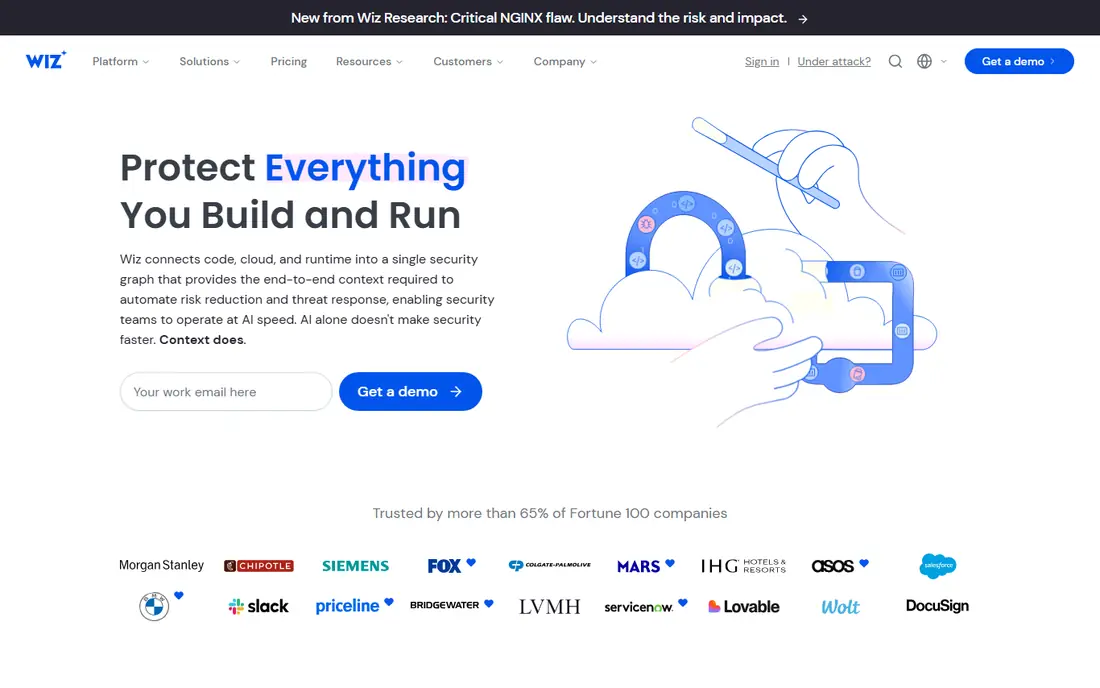
Wiz connects to AWS, Azure, and Google Cloud without agents and builds a graph of resources, identities, and risks, so it can show attack paths rather than isolated alerts. That context helps teams fix the issues that actually lead to a breach, such as a public storage bucket linked to sensitive data, before they fix low-risk misconfigurations. Wiz also covers code, containers, and AI assets through added modules.
Pricing is quote based and tied to cloud resource counts and modules, so two companies with the same footprint can pay different amounts. Smaller teams may find the entry cost high. For a multi-cloud team that wants one posture view and clear prioritization, Wiz is the most common first pick in this category.
- Agentless multi-cloud visibility
- Attack path analysis
- Broad module coverage
- Quote-based pricing
- Costs can rise with modules and cloud resource count
Orca Security scans cloud workloads from outside the workload, a method often called side-scanning, which gives context on vulnerabilities, misconfigurations, and data risks without installing agents on every server. That approach speeds up deployment and avoids agent conflicts, while still showing which risks are actually reachable or exploitable. It covers AWS, Azure, Google Cloud, and other platforms.
Pricing is quote based and tied to workload counts, so you need a full inventory before a quote means much. Orca is a strong alternative to Wiz for teams that want agentless coverage with less module complexity. Ask for a trial on your own accounts to compare alert volume and prioritization with Wiz before you choose.
- Agentless scanning across clouds
- Side-scanning for context
- Strong prioritization
- Quote-based pricing
- Full value needs a complete cloud inventory first

Cortex Cloud, from Palo Alto Networks, brings together the former Prisma Cloud posture and cloud workload features with Cortex detection and response. It offers agentless scanning plus optional agents for deeper runtime and Kubernetes protection, and it fits teams already using Palo Alto firewalls, Cortex XSIAM, or other Palo Alto products. That integration can shorten incident response when a posture finding turns into an active threat.
Licensing is credit based, with credits mapping to different resource types by module, which makes forecasting harder than a simple per-resource price. Setup can also be more involved than a pure CSPM tool. For a Palo Alto shop, the unified platform is a clear advantage. For a team with no Palo Alto stack, compare it carefully with Wiz and Orca on price clarity.
- Combines posture with detection and response
- Agentless plus agent options
- Broad Palo Alto integration
- Credit-based pricing can be hard to forecast
- Setup can be complex
Microsoft Defender for Cloud offers foundational CSPM for free, with continuous assessments, Secure Score, and the Microsoft cloud security benchmark across Azure, AWS, and Google Cloud. The advanced Defender CSPM plan adds agentless vulnerability scanning, attack path analysis, data-aware posture, and code-to-cloud context, priced at $5.11 per billable resource per month.
That published price makes budgeting easier than quote-based rivals, and Azure teams get deep integration with Microsoft Sentinel and other Microsoft tools. Multi-cloud teams should still test AWS and Google Cloud coverage on their own accounts, since the Azure experience is the strongest. For an Azure-heavy team, Defender for Cloud is often the most practical first step.
- Free foundational CSPM
- Clear per-resource pricing for advanced CSPM
- Strong Azure integration
- Advanced features cost per billable resource
- Best experience is inside Azure
Lacework, now part of Fortinet, combines cloud posture checks with anomaly detection based on normal behavior in your cloud accounts. That approach can catch threats that signature-based checks miss, such as unusual access patterns or new network behavior. It covers AWS, Azure, and Google Cloud, with workload and container protection alongside posture management.
Pricing is quote based and tied to workloads and data volume, so get a quote based on your actual footprint. Behavior models also need time to learn what normal looks like, so early alerts may need tuning. For teams that want posture plus behavioral detection in one platform, Lacework is a credible alternative to the larger CNAPP suites.
- Anomaly detection from behavior baselines
- Multi-cloud posture and workload coverage
- Fortinet integration
- Quote-based pricing
- Behavior models need time to learn normal activity
Sysdig Secure is built for teams that run containers and Kubernetes at scale, with runtime detection alongside cloud posture checks. It can trace activity inside containers, show which processes and network calls are unusual, and link runtime findings back to posture issues such as a vulnerable image or an exposed service. That runtime view matters when a posture alert alone does not tell you if an issue is being exploited.
Teams that run few containers may not use its strongest features, and full pricing is quote based. For a container-first team, Sysdig Secure is a strong pick that goes beyond a posture-only tool. For a team with mainly virtual machines and managed services, a posture-first tool such as Wiz or Defender may fit better.
- Strong container and Kubernetes runtime visibility
- Posture plus runtime in one platform
- Open source roots
- Best value for container-heavy teams
- Quote-based pricing for full platform
CrowdStrike Falcon Cloud Security
Great for: Endpoint-led teams moving to cloud
CrowdStrike Falcon Cloud Security extends the Falcon platform into cloud posture, workload, container, and identity protection. Teams that already use Falcon for endpoint security get a unified console, shared threat intelligence, and consistent policies across endpoints and cloud workloads. It covers AWS, Azure, and Google Cloud, with both agentless scanning and agent-based runtime protection.
Pricing is quote based, and the full value is clearest for existing Falcon customers. A team with no CrowdStrike stack should compare posture depth and alert quality with Wiz and Orca before choosing. For an endpoint-led security team, the unified platform can reduce tool sprawl and speed up response.
- Agentless and agent-based cloud coverage
- Strong threat intelligence
- Unified Falcon platform
- Quote-based pricing
- Best value if you already use Falcon for endpoints
Tenable Cloud Security builds on Tenable vulnerability management experience, adding cloud posture checks, exposure analysis, and asset coverage across AWS, Azure, and Google Cloud. It suits teams that already think in terms of vulnerabilities and exposure, and that want cloud findings in the same workflow as their existing Tenable program. Exposure analysis helps prioritize issues that are internet-facing or linked to sensitive data.
Pricing is quote based, and the full feature set depends on the tier and modules you choose. Teams that want a pure posture tool with attack path analysis may prefer Wiz or Orca. Teams that want cloud posture inside a wider vulnerability program will find Tenable a natural fit.
- Strong vulnerability management heritage
- Cloud posture with exposure analysis
- Broad asset coverage
- Quote-based pricing
- Posture depth varies by module and tier
Prowler is an open source cloud security tool that runs checks against AWS, Azure, Google Cloud, and other platforms, reporting misconfigurations and compliance gaps. It is free to use, its rules are open for review, and it suits small teams, auditors, and engineers who want a quick posture check without a sales process. A commercial Prowler Cloud offering adds a managed dashboard and reporting.
The trade-off is operational work: you set up runs, manage reports, and triage findings yourself, with no managed prioritization engine by default. For a small team with a modest cloud footprint, that is a fair trade. For a large team with hundreds of accounts, a managed platform will save more time than the license fee costs.
- Free open source checks for AWS, Azure, and Google Cloud
- Transparent rules
- Good for small teams and audits
- You handle setup, reporting, and triage
- No managed prioritization or support by default
How we picked these
We compared official product pages, pricing pages, and public product comparisons for tools that offer CSPM as a core function in October 2026. We kept tools that cover at least two major clouds, that are live and maintained, and that check configurations, identities, or vulnerabilities, not just billing or monitoring. Where pricing is quote based, we wrote See website rather than presenting third-party estimates as list prices.
How to choose a CSPM tool
Start with your cloud inventory: how many accounts, resources, and workloads you have, and which clouds matter most. Run a trial on the same inventory in two tools and compare alert counts, false positives, and the time it takes to fix the top ten findings. A tool that finds more issues is not better if your team cannot act on them.
Prioritization beats raw findings
Ask how each tool ranks findings: does it consider internet exposure, sensitive data, identity privilege, and whether a vulnerable package is actually reachable? Attack path analysis and exposure context cut triage time far more than a longer checklist. Also check remediation guidance: clear steps, code fixes, and automation links help small teams close issues faster.
Check identity and data coverage
Modern cloud risk often comes from over-privileged identities and exposed data, not just open ports. Check whether a tool covers cloud identity entitlements, data stores, and secrets, and whether it maps findings to compliance frameworks you must meet. A posture tool that only checks network settings will miss a large share of real risk.
Plan the operating cost
Quote-based pricing means you should get a written quote based on your actual resource counts, and ask how costs change as you add accounts or modules. Also count staff time: a tool that needs heavy tuning, professional services, or a dedicated admin costs more than its license fee. For small teams, a free or usage-based start is often the right first step.
Frequently asked questions
Which CSPM tool is best for cloud security overall?
Wiz is the most common overall pick for multi-cloud teams, thanks to broad visibility and attack path analysis. Microsoft Defender for Cloud is often best for Azure-heavy teams, while Orca Security is a strong agentless alternative. The best choice depends on your clouds, team size, and budget.
What are the best CSPM tools for cloud security on a budget?
Microsoft Defender for Cloud foundational CSPM is free, and Prowler is free open source software. Both give you a solid posture check without a contract. Move to a paid platform when you need prioritization, runtime coverage, or managed reporting at scale.
Is CSPM the same as CNAPP?
No, CSPM is one part of a wider cloud native application protection platform, known as CNAPP. CSPM checks cloud configurations and posture. CNAPP adds workload protection, container security, code security, and runtime detection. Many tools in this list, including Wiz, Cortex Cloud, and CrowdStrike, now offer CNAPP breadth beyond basic CSPM.
Do I need agents for CSPM?
Not always. Wiz, Orca, and Defender CSPM offer agentless scanning for posture and many vulnerability checks. Agents add deeper runtime visibility for containers and servers, but they also add deployment work. Start agentless for posture, then add agents where runtime protection matters.
How do I compare CSPM pricing?
Compare tools on the same inventory: same accounts, resources, and workloads. Ask each vendor for a written quote, clarify the billing unit, and ask how modules, overages, and multi-year terms affect the total. Avoid comparing a per-resource price with a credit price without converting both to your actual footprint.
Sources
See where you really rank - block by block
ProMapRanker scans Google Maps across a grid of your service area. Simple monthly plans from $19, white-label on every plan.
Start freeKeep reading
 zscaler alternatives
Best Zscaler Alternatives in 2026
Looking for zscaler alternatives? We compare 9 SASE and zero trust platforms on architecture, data protection, pricing, and fit for your network and team.
Read → zapier alternatives free
Best Zapier Alternatives Free in 2026
Nine automation tools for zapier alternatives free in 2026, all with genuinely free tiers, plus free plan limits, starting prices and upgrade paths explained.
Read → which platform is best for online reputation
Which Platform Is Best for Online Reputation in 2026
Wondering which platform is best for online reputation? We compare 8 review, listing, and response tools for small and multi-location businesses and agencies.
Read →