 ProMapRanker
Which Companies Are the Best Free RPC Providers in 2026

Key takeaways
- Alchemy and Infura lead on ecosystem depth, with large chain coverage, enhanced APIs, and broad developer tooling on free tiers.
- Chainstack, dRPC, and Dwellir offer clearer unit pricing, with Chainstack at 3 million request units per month and dRPC at a large free compute unit pool.
- Ankr and Blast suit multi chain builders, with Ankr covering many chains and Blast offering public and premium endpoints.
- Tenderly suits developers who also need simulation, debugging, and transaction tooling alongside RPC access.
- Free tiers carry rate limits and no service level agreement, so they are not production guarantees for live user facing apps.
Quick comparison
| Pick | Great for | Pricing starts at | Free tier | |
|---|---|---|---|---|
 Alchemy | Ecosystem depth and enhanced APIs | Free | Yes | Visit |
 Infura | Daily credit quota and long running reliability | Free | Yes | Visit |
 Chainstack | Clear request unit pricing | Free | Yes | Visit |
 dRPC | Large free compute unit pool | Free | Yes | Visit |
 Ankr | Multi chain free access | Free | Yes | Visit |
 Dwellir | Simple per response pricing | Free | Yes | Visit |
 Blast | Public endpoints and premium scaling | Free | Yes | Visit |
 Tenderly | Simulation, debugging, and RPC in one platform | Free | Yes | Visit |
The best free rpc providers
A remote procedure call, or RPC, endpoint lets an app read blockchain data and send transactions without running its own node. Free tiers from the companies below are real, but they are limited by design. Rate limits, daily or monthly quotas, method restrictions, and lack of a service level agreement mean free tiers suit development, testing, hackathons, and small apps, not guaranteed production traffic. We compared official pricing pages, free tier quotas, rate limits, archive support, and chain coverage. Free here means a permanent free tier, not a time limited trial, which is why QuickNode is excluded, since its free offer is a one month trial.
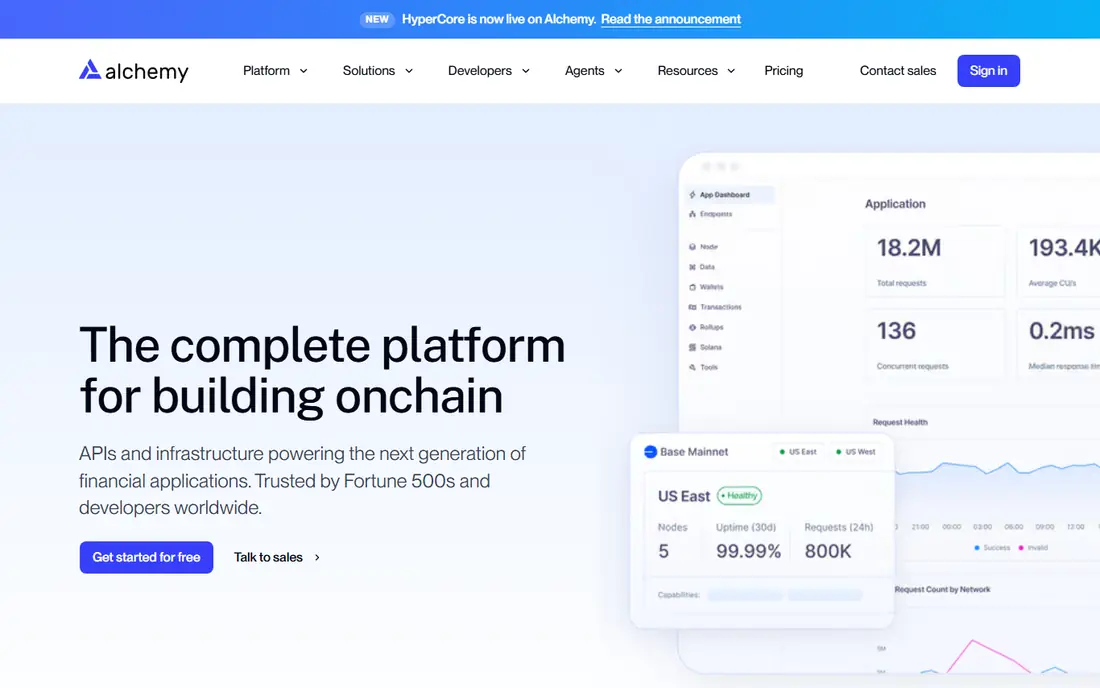
Alchemy is the most established name for Ethereum developers, and its free tier reflects that scale. The free plan offers around 30 million compute units per month, which translates to roughly one million typical requests depending on method mix, with private endpoints and WebSocket support. Enhanced APIs for token data, transaction simulation, and webhooks let developers build features without separate services. Broad chain coverage also helps teams that start on Ethereum and expand to other networks later.
The honest catch is compute unit math. Heavier methods cost many more units than a simple block number call, so actual request counts vary sharply with method mix. Throughput on the free tier is also limited, and there is no production SLA, so a traffic spike can throttle an app. For development, prototyping, and small apps that value enhanced APIs, Alchemy is a strong first endpoint. For high volume production, a paid plan or a second provider is needed.
- Free tier around 30 million compute units per month
- Enhanced APIs for tokens and transactions
- Broad chain coverage
- Compute unit pricing makes heavy calls costly
- Free tier has throughput limits and no SLA
Infura, from ConsenSys, has run Ethereum RPC access since the early years of the network, and its free Core tier gives 3 million credits per day. That daily reset suits apps with steady daily traffic, since unused credits do not carry to the next day, but a consistent app can rely on a fresh quota each morning. Archive data is included, WebSocket support is available, and Infura integrates closely with MetaMask and ConsenSys tooling, which reduces setup friction for many teams.
The limit is credit weighting. Methods such as eth_getLogs cost far more credits than a simple call, so an app that scans logs heavily will exhaust a daily quota faster than the headline number suggests. Free tier support is standard, with no SLA, so production apps need a paid plan for guarantees. For steady, moderate traffic and teams already in the ConsenSys ecosystem, Infura free tier is a dependable development and small production starting point.
- Free Core tier with 3 million credits per day
- Long operating history
- Archive data included
- Daily quota does not roll over unused credits
- Heavier methods consume credits faster
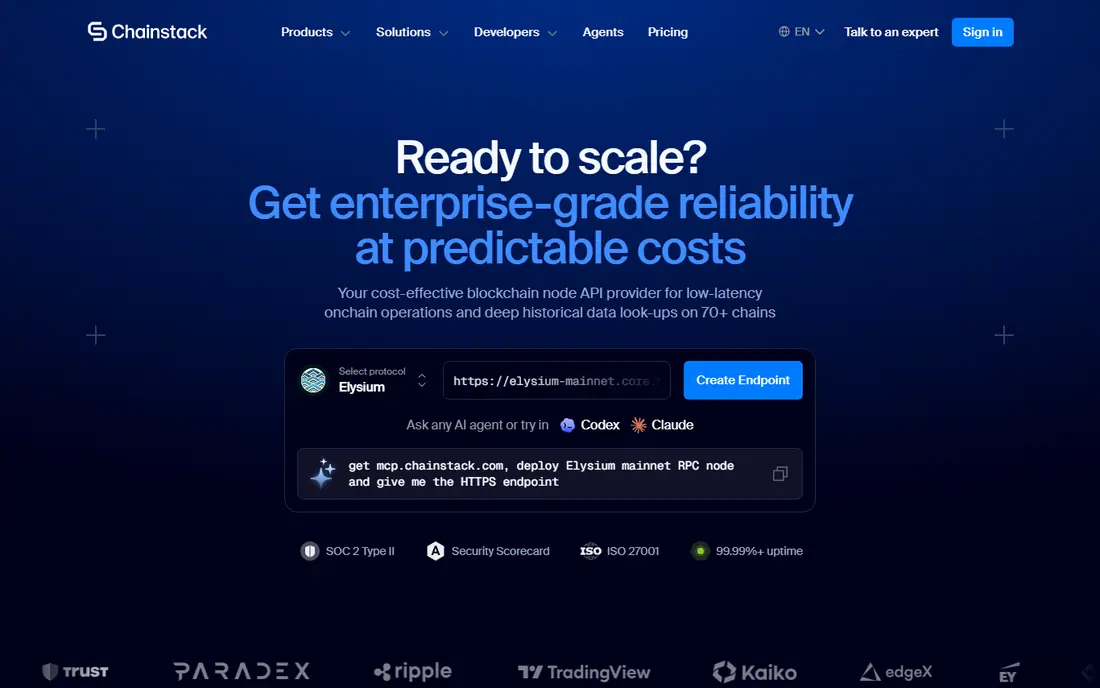
Chainstack appeals to developers who want pricing they can reason about. The free Developer tier offers 3 million request units per month, with most calls costing one unit and archive or debug calls costing two, plus a rate limit around 25 requests per second. That simple model makes it easier to forecast usage than credit systems with wide method multipliers. Chainstack also supports many networks, offers private endpoints, and includes WebSocket access, which covers most development needs in one plan.
The drawback is scope on the free tier. Archive and debug work consumes units faster, and support is limited compared with paid plans, with no SLA on free access. Teams that need heavy archive scanning should budget units carefully or compare dRPC and Dwellir. For a developer who wants a clean free quota, clear unit rules, and broad chain coverage, Chainstack is one of the easiest free tiers to use well.
- Free Developer tier with 3 million request units per month
- 25 requests per second limit described on its site
- Many supported networks
- Archive and debug calls cost extra units
- Free tier support is limited
dRPC stands out for the size of its free pool. Published comparisons describe around 210 million compute units per month on the free tier, with a rate limit around 100 requests per second, which is generous for development and small apps. Multi chain coverage spans more than 100 networks, and the flat per request unit model is simpler to track than some rivals. That combination makes dRPC a strong choice for hackathons, testing across chains, and apps with bursty traffic that stays within method limits.
The honest limit is feature gating. Archive, trace, and WebSocket access are more restricted on the free tier than on paid plans in several published comparisons, so developers who need those features should verify current free tier terms before building around them. There is also no SLA on free access. For raw request volume and multi chain testing, dRPC free tier is hard to beat, provided the app method mix fits free tier rules.
- Large free monthly compute unit pool
- High free rate limit around 100 requests per second
- Multi chain coverage
- Archive, trace, and WebSocket access are limited on free tier in some comparisons
- Unit math still needs care
Ankr suits builders who work across many chains and want one dashboard for them. The free tier offers a large monthly credit pool, described in comparisons as around 200 million credits per month, with a rate limit around 30 requests per second on the free tier. Coverage spans many EVM and non EVM networks, and Ankr premium endpoints add features such as archive access and higher throughput for teams that outgrow free limits. That breadth helps a team prototyping on several chains without managing many providers.
The catch is credit math. A basic call can cost around 200 credits in Ankr system, so the headline credit pool translates to roughly one million basic requests, not hundreds of millions. Premium features such as WebSocket and trace access also sit behind paid tiers in several comparisons. For multi chain development where breadth matters more than advanced features, Ankr free tier is useful. For heavy archive or trace work, compare Alchemy, Infura, or Chainstack paid options.
- Free tier with a large monthly credit pool
- Many supported chains
- Premium endpoints for heavier use
- Credit weighting means a simple call costs many credits
- Advanced features sit on premium tiers
Dwellir wins on pricing clarity. The free tier offers 100,000 responses per day, with one credit per response for most methods, which makes usage easy to forecast without a unit conversion table. Archive data is included on all plans, WebSocket support is available, and the rate limit around 20 responses per second suits development and small apps. Coverage spans more than 100 networks, so Dwellir can serve as a primary free endpoint, not just a backup.
The limit is method coverage on free tier. Published comparisons note that the free plan excludes eth_getLogs, which matters for apps that scan event logs. Support and ecosystem tooling are also smaller than Alchemy or Infura, so developers may need separate services for enhanced APIs. For an app that reads blocks, balances, and transactions without heavy log scanning, Dwellir free tier is one of the clearest and most predictable options.
- Free tier with 100,000 responses per day
- One credit per response model
- Archive data on all plans
- Free tier excludes some methods such as eth_getLogs
- Smaller brand than Alchemy or Infura
Blast, from Bware Labs, offers a useful two level model. Public endpoints let a developer test quickly without signup friction in some cases, while premium endpoints provide private access, higher limits, and better reliability for apps that grow. Multi chain coverage and dedicated node options on paid plans give Blast a path from prototype to production without switching providers entirely. That path matters for teams that want to start free and scale on the same platform.
The honest caveat is that public endpoints are shared, rate limited, and carry no SLA, so they should never serve live user traffic. Premium free tier terms also vary by network and method, so a developer should verify the current free allowance for each chain used. For quick testing and as a backup endpoint alongside Alchemy or Infura, Blast is a practical addition. For production, a paid plan or a second provider is still needed.
- Public endpoints for quick testing
- Premium endpoints with higher limits
- Multi chain coverage
- Public endpoints carry shared limits and no SLA
- Premium features require paid plans
Tenderly is different from the pure RPC providers above, because RPC access sits inside a broader developer platform. The free tier offers around 25 million Tenderly Units per month, with simulation, debugging, transaction monitoring, and alerting tools alongside node access. That combination helps developers test transactions before sending them, debug failed calls, and monitor contracts, all without stitching together many tools. EVM chain coverage is broad, which suits most Ethereum compatible app development.
The limit is focus. Tenderly is EVM focused, so non EVM chains need another provider, and RPC throughput on the free tier is lower than dRPC or Ankr for raw volume. Teams that only need raw RPC throughput may prefer a specialist. Teams that debug transactions often, simulate complex calls, or monitor contracts will find Tenderly free tier adds value beyond the endpoint itself.
- Free tier with around 25 million Tenderly Units per month
- Simulation and debugging tools
- EVM focused coverage
- EVM only focus
- RPC is part of a broader platform, not a pure RPC specialist
How we picked these
We compared official pricing pages and published free tier comparisons for RPC providers active in 2026, focusing on permanent free tiers, not time limited trials. We favored providers with a clear free quota, published rate limits, private endpoints, and multi chain or Ethereum coverage. We excluded QuickNode from the free list because its free offer is a one month trial, and we excluded providers with no published free tier terms.
How to use free RPC tiers without breaking a live app
Treat every free tier as development infrastructure first. Set a hard budget in your app for requests per minute, cache responses where possible, and batch calls to reduce method count. Add a second provider as a fallback, so a quota exhaustion or outage on one endpoint does not take the app down. Monitor usage daily during launch, since a traffic spike can exhaust a daily quota such as Infura 3 million credits far faster than a monthly quota.
Next, plan the paid upgrade before you need it. Identify which methods cost the most units or credits, such as log scans and archive calls, and move those to a paid plan or a dedicated node early. Read the terms for rate limits, method restrictions, and data retention, and confirm whether the free tier includes an SLA, since most do not. Finally, never hard code a single free endpoint into a production app without a fallback and an upgrade path, because free tiers can change terms with notice.
Frequently asked questions
What does free mean for an RPC provider?
Free usually means a permanent free tier with a monthly or daily quota, a rate limit, and no SLA, not unlimited production access. Quotas vary by unit system, so compare effective requests, not just headline credits or compute units, before choosing.
Can I run a production app on a free RPC tier?
A very small app with low, steady traffic can run on a free tier, but it carries risk. Rate limits, quota exhaustion, method restrictions, and lack of an SLA mean a traffic spike or provider change can break the app. Production apps with real users should use a paid plan, a fallback provider, or both.
Why do free RPC quotas look so different between providers?
Providers bill in different units, such as compute units, credits, request units, or responses, and each method costs a different number of units. A 200 million credit pool can equal about one million basic calls, while a 3 million request unit pool can equal about three million simple calls. Always convert to your own method mix.
Do free RPC tiers include archive data?
Some do, including Alchemy, Infura, Chainstack, and Dwellir on their free tiers, subject to unit costs and limits. Others restrict archive, trace, or WebSocket access to paid plans, so check method support for each chain before building features that depend on history.
What happens when I exceed a free RPC quota?
Most providers throttle requests, return rate limit errors, or block further calls until the quota resets, daily or monthly depending on the provider. Design your app to handle those errors gracefully, with caching, retries with backoff, and a fallback endpoint.
Should I use one RPC provider or several?
Use at least two providers for any app with real users, even if one is free and the other is paid. A fallback endpoint protects against outages, quota exhaustion, and provider term changes, and it gives you negotiating strength when discussing a paid plan.
Sources
See where you really rank - block by block
ProMapRanker scans Google Maps across a grid of your service area. Simple monthly plans from $19, white-label on every plan.
Start freeKeep reading
 worlds best local seo company
8 Worlds Best Local SEO Companies for Map Pack Growth in 2026
Compare the worlds best local seo company options for Google Business Profile work, citations, reviews, and multi-location rankings and reporting in 2026.
Read → world's best web hosting company
World's Best Web Hosting Company in 2026
Searching for the world's best web hosting company? We compared 10 hosts on price, renewal rates, speed, and support to help you choose well today in 2026.
Read → who's got the best nanny tax services
Who's Got the Best Nanny Tax Services in 2026
We answer who's got the best nanny tax services, comparing full filing, back taxes, software, and pricing so families can handle nanny taxes correctly.
Read →