 ProMapRanker
Which Auto Marketplace App Is Best in 2026


Detailed search across dealers and private sellers · Pricing starts at: Free
Key takeaways
- For most buyers, CarGurus and Autotrader give the strongest mix of inventory depth and price context, while Carvana and CarMax suit buyers who want a fixed price and delivery.
- Buying through a dealer marketplace and buying from a local private seller are different jobs, so we kept both kinds of app in this list and marked the difference clearly.
- Free browsing is standard, but seller fees, delivery fees and return terms vary a lot, so check those three items before you commit to any listing.
- A vehicle history report and an independent inspection matter more than any deal label, especially on private-party listings.
Quick comparison
| Pick | Great for | Pricing starts at | Free tier | |
|---|---|---|---|---|
| Autotrader | Detailed search across dealers and private sellers | Free | Yes | Visit |
 Cars.com | Local dealer shopping with reviews | Free | Yes | Visit |
 CarGurus | Checking whether a price is fair | Free | Yes | Visit |
 Carvana | Fully online buying with home delivery | Free | Yes | Visit |
 CarMax | Fixed pricing with a return window | Free | Yes | Visit |
 Edmunds | Research before you buy | Free | Yes | Visit |
 TrueCar | Seeing upfront dealer pricing | Free | Yes | Visit |
 Facebook Marketplace | Local private-party bargains | Free | Yes | Visit |
The best auto marketplace apps
We compared official feature pages, pricing pages, app store listings and public help pages for the apps below. Our pick for most people is CarGurus for price context, with Autotrader close behind for search depth.
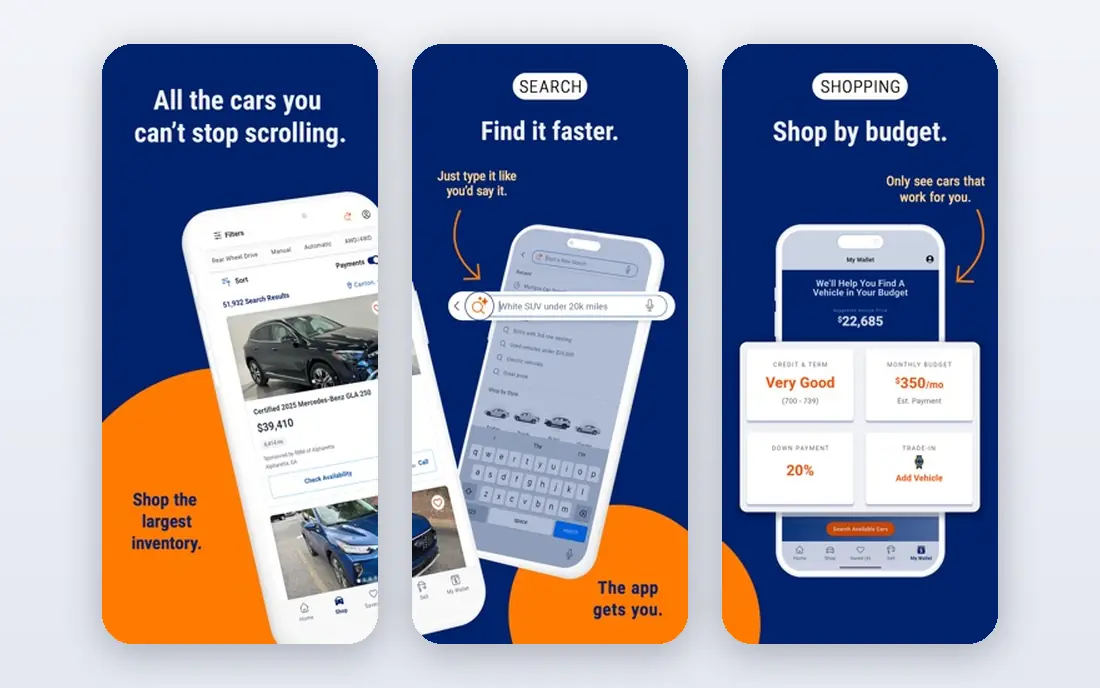
Autotrader suits a buyer who already knows the model, trim and budget and wants to narrow a large pool fast. Its filters cover price, mileage, body style, drivetrain and seller type, which helps when two similar cars sit at very different prices. The site also pairs listings with financing calculators and trade-in estimates, so a buyer can test a monthly payment before contacting a dealer.
The honest catch is that Autotrader is mainly a meeting place, not the seller. That means inspection, history and return terms sit with the dealer or private seller behind each listing. We would still start here for research, then verify the car itself with a history report and, for a private sale, an independent inspection.
- Wide search filters
- Dealer and private listings in one place
- Financing and trade-in tools
- Seller listing fees apply
- Return terms depend on the seller, not Autotrader
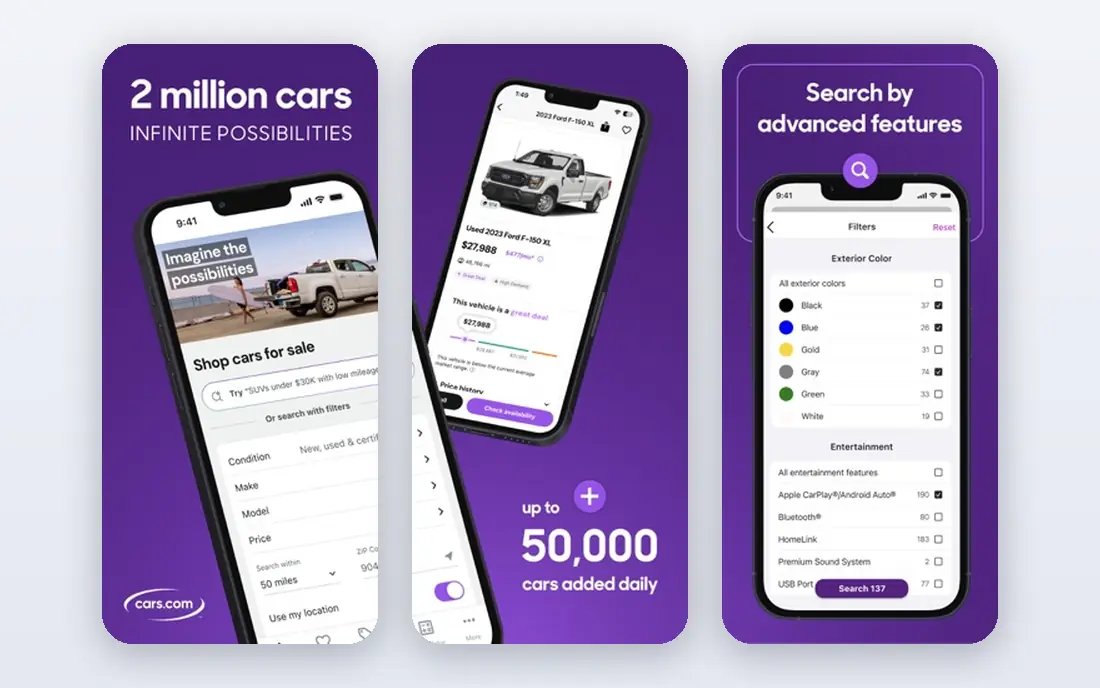
Cars.com works best for a buyer who wants to shop local dealers first and read what other buyers said about those dealers. Dealer reviews add context that a price alone cannot give, especially on service after the sale. Its search also makes it easy to compare the same model across nearby dealers, which can surface a better equipped car at a similar price.
The trade-off is coverage. Private-party cars exist here, but the depth is dealer led, so a bargain hunter chasing a private sale may need a second app. Delivery is also dealer by dealer rather than a single national promise, so confirm transport and pickup terms in writing before paying a deposit.
- Large dealer inventory
- Dealer reviews and ratings
- Price comparison tools
- Private listings are thinner than dealer stock
- Delivery depends on the dealer
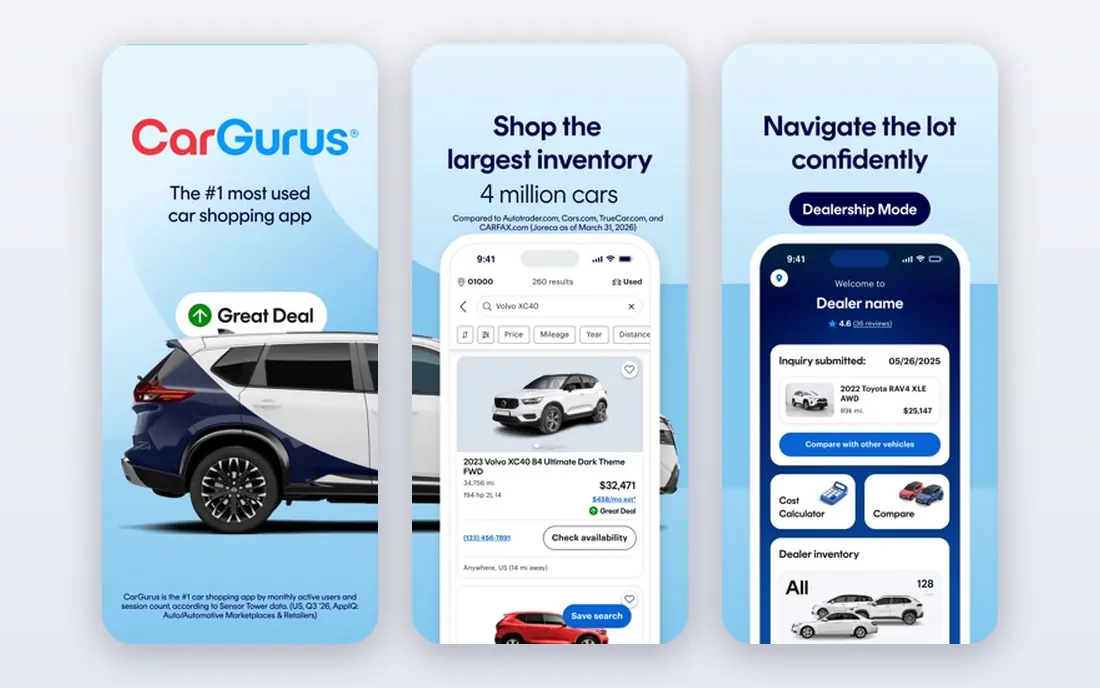
CarGurus earns its place for one reason: it puts a price judgment next to the car. A listing labelled as a good deal or overpriced gives a first-time buyer a quick way to spot an outlier, and the underlying market data helps in a negotiation. The app also covers a broad dealer pool, so a buyer is less likely to miss a nearby car.
We would still treat a deal rating as a starting point, not a verdict. Ratings reflect listed prices and market data at a point in time, and they do not cover condition, accident history or dealer add-ons. Use the rating to shortlist, then check the history report and the out-the-door price.
- Deal ratings on many listings
- Instant market price context
- Large dealer inventory
- Ratings are estimates, not guarantees
- Some listings lead to dealer fees or add-ons
Carvana suits a buyer who wants to skip the lot entirely. The price shown is the price, the car can be delivered to a home address in service areas, and buyers get a short period after delivery to decide whether the car fits daily life. That structure removes much of the back-and-forth that puts people off dealer shopping.
The limit is scope. Carvana sells its own stock, so it cannot match the combined inventory of every dealer and private seller in a city. Delivery fees, availability and return terms also vary by location, so read the delivery and return pages for your address before ordering.
- No-haggle listed prices
- Home delivery in service areas
- A return window after delivery
- Delivery fees can apply
- Inventory is Carvana owned, so choice is narrower than a marketplace
CarMax is the calm option in this list. Prices are fixed, cars are inspected by the company, and buyers get a return window that gives time to drive the car in normal use. For a buyer who values certainty over chasing the lowest possible price, that package is easy to understand.
The cost of that certainty is price. A private seller may list the same model for less, and a transfer from another store can add a fee. We would use CarMax as a benchmark: if a private or dealer car is only slightly cheaper, the return window and inspection may be worth the gap.
- No-haggle pricing
- Large company-owned inventory
- Transfer between stores in many cases
- Prices can run higher than a private sale
- Transfer fees can apply
Edmunds is best used at the start of a search, not the end. Its reviews explain how a car drives, what the trim differences mean and what a fair price looks like in the current market. That research helps a buyer avoid paying for a trim or option pack that adds little in daily use.
As a marketplace, Edmunds is narrower. It lists dealer cars and pairs them with pricing tools, but a buyer hunting private sales will need another app. We suggest pairing Edmunds research with a marketplace search, so the price target comes from data and the car comes from the widest pool.
- Detailed reviews and pricing data
- True Market Value estimates
- Clear buying guides
- Listings are dealer led
- It is weaker as a private-party marketplace
TrueCar suits a buyer who wants a dealer price without a long negotiation. Participating dealers show upfront pricing, and the site gives context on what other buyers paid for similar cars. That transparency can cut the time spent haggling and make the first dealer visit less stressful.
The catch is that the network sets the boundary. A dealer outside the network may have the exact car, and the final out-the-door figure can still include taxes and dealer fees that are not in the headline price. Ask for the full breakdown before signing, and compare it with a marketplace listing for the same model.
- Upfront pricing from participating dealers
- Shows what others paid
- Simple buying flow
- Choice is limited to participating dealers
- Final fees can still vary
Facebook Marketplace is where many of the lowest asking prices live, because private sellers list directly and skip dealer overhead. It is also the most hands-on option: the buyer arranges viewing, checks paperwork, and handles payment. For a buyer with mechanical knowledge and patience, that can pay off.
The risks are real and worth stating plainly. There is no standard return policy, title and lien checks fall on the buyer, and scam listings do appear. Meet in a public place, never pay in advance for a car you have not seen, check the title matches the seller, and get a history report and inspection on any car that costs more than you can afford to lose.
- Large local private inventory
- Direct seller contact
- Often the lowest asking prices
- No standard inspection or return protection
- Scam and title risks are higher
How we picked these
We compared official feature pages, pricing and help pages, and app store listings for each app, and we kept only apps that are live and working in the United States in October 2026. We favoured apps that cover a distinct buyer need, such as price context, fixed-price delivery, dealer reviews or private-party reach, rather than listing near-duplicates. Where a price or fee could not be verified on the vendor site, we left the field as free browsing for buyers and noted that seller and delivery fees vary.
What to check before you buy
A good app makes the search easier, but it does not replace checks on the car itself. Use the points below in order, and walk away if a seller resists any of them.
Price the car three ways
Compare the asking price with a deal rating, a market value estimate and a similar listing in another app. If all three point the same way, the price is probably fair. If one source looks far out of line, find out why before you negotiate.
Verify history and condition
Ask for a vehicle history report, check for accident, title and odometer notes, and arrange an independent inspection for a used car, especially a private sale. A clean listing photo set is not a substitute for a mechanic looking under the car.
Read the full cost and return terms
Confirm taxes, dealer fees, delivery fees and any transfer fee in writing, and note the return window in days and miles where one exists. A low headline price can lose its edge once fees are added.
Protect the payment
Pay through a traceable method, keep the title transfer and bill of sale in your own name, and avoid wire transfers or gift payments to a stranger. For a private sale, complete the exchange at a bank or a public safe-exchange location where possible.
Frequently asked questions
What is the best auto marketplace app?
For most buyers, CarGurus gives the best price context and Autotrader gives the deepest search, so using both covers research and inventory. Buyers who want a fixed price and delivery should look at Carvana or CarMax instead, and bargain hunters should add Facebook Marketplace with extra checks.
Is the best auto marketplace app free for buyers?
Yes, browsing and searching are free on every app in this list for buyers. Sellers may pay listing fees, and delivery, transfer or dealer fees can apply on top of the car price, so the cost to check is in those fees, not in downloading the app.
Which app is best for selling a car?
Autotrader and Cars.com reach large dealer and private audiences, while Carvana and CarMax give fast company offers for sellers who want speed over top price. Facebook Marketplace can reach local buyers at no listing cost, but the seller handles viewing, paperwork and payment safety.
Should I trust a deal rating?
Treat it as a helpful signal, not a guarantee. Deal ratings compare listed prices with market data, but they do not inspect the car, so always pair a rating with a history report, an inspection and an out-the-door price.
Is Facebook Marketplace safe for buying a car?
It can be, with care. Meet in public, verify the title and seller identity, avoid advance payments, and get a history report and inspection. If a deal feels rushed or the price looks far below market for no clear reason, walk away.
Sources
See where you really rank - block by block
ProMapRanker scans Google Maps across a grid of your service area. Simple monthly plans from $19, white-label on every plan.
Start freeKeep reading
 zscaler alternatives
Best Zscaler Alternatives in 2026
Looking for zscaler alternatives? We compare 9 SASE and zero trust platforms on architecture, data protection, pricing, and fit for your network and team.
Read → zapier alternatives free
Best Zapier Alternatives Free in 2026
Nine automation tools for zapier alternatives free in 2026, all with genuinely free tiers, plus free plan limits, starting prices and upgrade paths explained.
Read → which platform is best for online reputation
Which Platform Is Best for Online Reputation in 2026
Wondering which platform is best for online reputation? We compare 8 review, listing, and response tools for small and multi-location businesses and agencies.
Read →