 ProMapRanker
What Is the Best Platform for AI Inference in 2026

Key takeaways
- Speed leaders such as Groq and Cerebras suit real-time work, while catalog providers suit teams that need many models.
- Usage-based pricing varies by model, so price your exact model and prompt mix, not a headline rate.
- Serverless token billing suits bursty traffic; dedicated GPUs suit steady, high volume.
- No provider guarantees the same speed or availability for every model, prompt, and traffic spike.
Quick comparison
| Pick | Great for | Pricing starts at | Free tier | |
|---|---|---|---|---|
 Together AI | Open-weight models at scale | Pay as you go | Yes | Visit |
 Groq | Low-latency, real-time responses | Pay as you go | Yes | Visit |
 Fireworks AI | Fast open-model inference and fine-tuning | Pay as you go | Yes | Visit |
 Replicate | Custom and creative models, fast prototypes | Pay as you go | Yes | Visit |
 Modal | Python teams running custom GPU workloads | Pay as you go | Yes | Visit |
 Baseten | Custom and fine-tuned model deployment | Pay as you go | Yes | Visit |
 DeepInfra | Budget-conscious open-model inference | Pay as you go | Yes | Visit |
 Cerebras | Highest-speed inference for demanding apps | See website | No | Visit |
 OpenRouter | Routing across many providers | Pay as you go | Yes | Visit |
The best platforms for AI inference
We compared official pricing pages, model lists, documentation, and public reviews for nine inference providers live in October 2026. Our focus was model range, speed profile, billing unit, scaling behavior, and how easily a team can start, test, and move as volume grows.
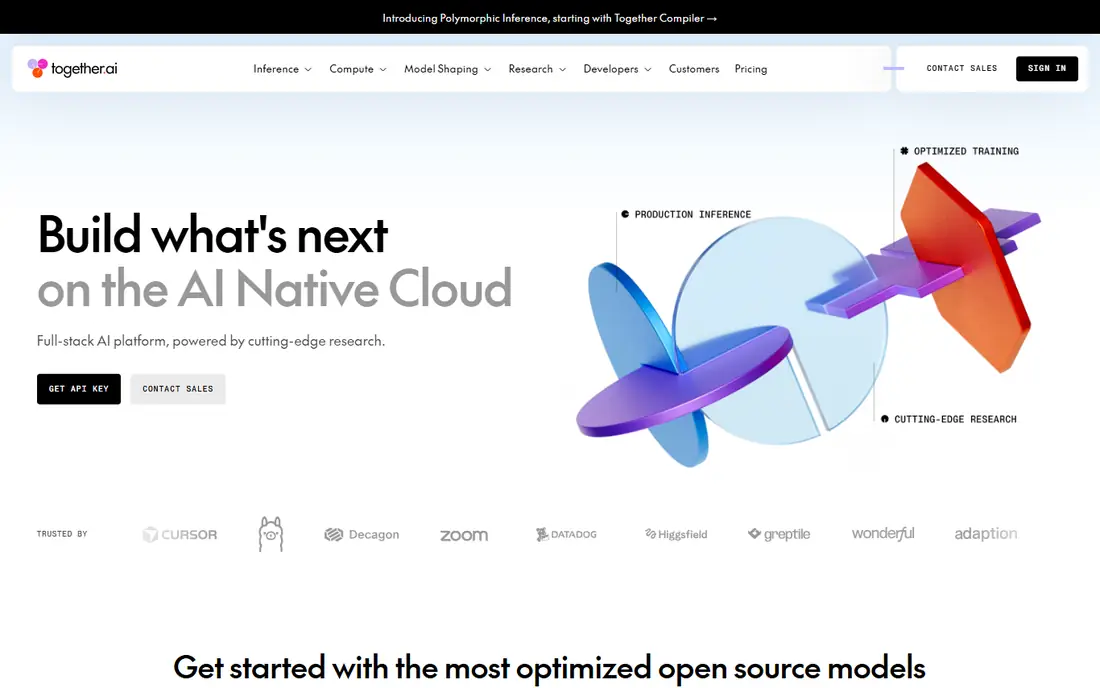
Together AI suits teams that want many open-weight models behind one API. It offers serverless endpoints for quick starts and dedicated GPUs for steady production work, plus fine-tuning for teams that need a model shaped to their own data. That range helps a prototype grow without an early vendor switch.
Pricing is usage-based and varies by model, so a budget built on one model does not transfer to a larger one. Teams should price their exact model, check batch options for non-urgent work, and watch output tokens, which often cost more than input tokens on long answers.
- Broad open model catalog
- Serverless and dedicated options
- Fine-tuning support
- Per-token costs vary by model
- Dedicated capacity needs planning
Groq is built around speed. Its custom hardware aims for fast first tokens and high throughput, which matters for voice agents, live chat, and multi-step agent work where each pause adds up. An OpenAI-compatible API also keeps integration work modest for many teams.
The catalog is focused rather than endless, so teams should confirm their chosen model is offered before designing around Groq. Pricing is usage-based and varies by model, and no provider can promise the same speed for every prompt, load level, and model size. Test with real prompts before committing.
- Very fast token output on supported models
- OpenAI-compatible API
- Strong for chat and agents
- Model catalog is narrower than general clouds
- Speed gains depend on the model
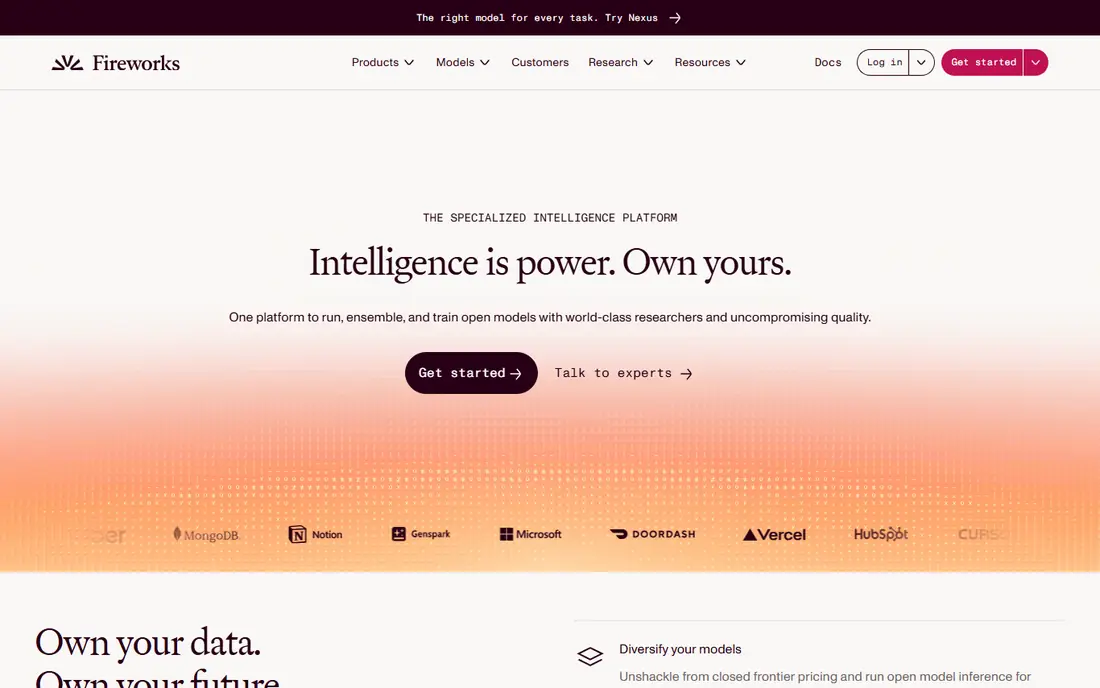
Fireworks AI appeals to teams that need open models to answer quickly and follow a strict output format. It pairs serverless endpoints with dedicated GPU options and fine-tuning, so a team can start cheaply and move to reserved capacity as volume steadies. Framework integrations also shorten setup for agent builders.
Published per-token rates cover a wide range, so quoting a single price for Fireworks AI would mislead. Dedicated H100 time starts at a higher hourly figure, and the best value depends on traffic pattern. Teams should compare serverless cost at their volume against a dedicated GPU before scaling.
- Fast serverless inference
- Structured output support
- Fine-tuning and dedicated GPUs
- Costs vary sharply by model and GPU choice
- Enterprise features need sales talks
Replicate is the easiest place to try an unusual model. Its catalog covers text, image, audio, and video models from many creators, and a prediction API turns a model into a callable endpoint with little setup. For prototypes and creative tools, that breadth beats a narrow catalog.
The trade-off is billing and integration style. Many models bill by GPU seconds, so a slow model costs more than a fast one even for the same output. The API is its own design, not a drop-in OpenAI replacement, so teams planning a later move should keep that wrapper code isolated.
- Huge community model range
- Simple prediction API
- Per-second GPU billing
- API differs from OpenAI-style calls
- Costs depend on model runtime
Modal fits developers who think in Python functions rather than model catalogs. It runs GPU code on demand, scales to zero when idle, and bills per second, which suits bursty jobs and custom pipelines. Teams with their own serving code get control without managing servers.
Modal does not offer a ready catalog of hosted chat models in the way Together AI or Groq do, so teams bring their own code and models. Cold starts and scaling behavior need testing for user-facing work. For batch jobs and internal tools, the model is strong; for a quick chat API, a catalog provider is simpler.
- Python-first GPU functions
- Scale to zero
- Per-second billing
- Custom code only, no ready model catalog
- Cold starts need design care
Baseten suits teams with a custom or fine-tuned model that must run as a production API. It supports autoscaling deployments, dedicated GPUs, and model APIs, with tooling for packaging models for serving. That focus helps when an off-the-shelf model is not the right answer.
The price of a dedicated GPU, billed per minute, can exceed a serverless token bill at low use and beat it at high, steady use. Teams should forecast traffic, test autoscaling under spikes, and confirm which models are offered as ready APIs versus models they must deploy themselves.
- Autoscaling custom deployments
- Model APIs
- Dedicated GPU options
- Setup takes more effort than a catalog API
- Dedicated cost needs forecasting
DeepInfra draws cost-conscious teams with low per-token rates across a broad open-model list and an OpenAI-compatible API. For a team running many small requests or testing several models, the entry cost stays low and switching models takes little code change.
Low headline rates belong to smaller models, while large models cost more, as they do everywhere. Teams should price the exact model they plan to ship, not the cheapest one on the page. Throughput and availability can also vary, so load testing matters before a public launch.
- Low per-token rates on many models
- OpenAI-compatible API
- Dedicated GPUs
- Cheapest models are not the largest ones
- Support depth varies by plan
Cerebras targets teams where speed is the product, such as real-time agents and interactive tools that cannot tolerate slow token streams. Its wafer-scale hardware reports very high throughput on supported models, and the platform is aimed at production workloads rather than casual trials.
That speed comes with a focused model range and sales-led pricing for many deployments, so small teams may find the entry path less clear than a self-serve token API. Teams should confirm model availability, contract terms, and expected throughput on their own prompts before judging value.
- Very high throughput on supported models
- Wafer-scale hardware
- Enterprise support
- Pricing is sales-led for many workloads
- Model range is focused
OpenRouter helps teams that do not want to bet on one provider. It routes requests across many models and providers through one API, with fallback options when a provider is slow or unavailable. That flexibility suits tools that offer users a choice of models.
OpenRouter adds a platform fee to provider rates, so the same model can cost slightly more than buying direct. It also does not give the dedicated GPU control that a specialist deployment offers. Use it for flexibility and fallback, and compare the all-in cost per model before scaling.
- Access to many models and providers in one API
- Fallback routing options
- Platform fee on top of provider rates
- No dedicated GPU control
How we picked these
We compared official feature pages, pricing pages, and documentation, plus public reviews, and we did not claim hands-on testing. We checked which models each provider actually hosts, how it bills, and whether it offers serverless, dedicated, or custom deployment paths. Pricing is usage-based and varies by model and load, so we avoided any guaranteed performance claim.
How to choose without overpaying
Start from the workload, not the brand. A real-time chat agent needs low first-token time and steady throughput, while a nightly batch job needs low cost per million tokens and can accept slower delivery. A custom model needs a deployment platform such as Baseten or Modal, while a standard open model often fits a catalog API.
Price the real prompt
Build a test set from real user prompts, including long inputs and long outputs, then price input and output tokens separately. Add retries, fallback calls, and any agent steps that call the model more than once. That total, not a single token rate, is the budget number.
Plan for spikes and failure
Check rate limits, fallback routing, and what happens when a provider is slow. Keep the model call behind a thin wrapper so you can change providers or models without rewriting the app. For steady production volume, compare a dedicated GPU quote against serverless cost at the same volume before signing.
Frequently asked questions
Is per-token pricing always cheapest?
Not always. Per-token serverless pricing is cheap at low or bursty volume, but a dedicated GPU can cost less at high, steady volume because idle time is already paid for. Compare both at your actual monthly token count and traffic pattern.
What affects inference speed?
Model size, prompt length, hardware type, current load, and output length all affect speed. A provider that is fast on a small model may be slower on a large one, so test with the exact model and prompts you plan to ship.
Can I switch providers later?
Often, yes, especially when providers offer an OpenAI-compatible API. Keep provider-specific code in one wrapper, store prompts and settings separately, and retest output quality after any switch, since the same model name can behave differently across providers.
Do I need a dedicated GPU?
You need one when volume is steady and high, when you run a custom model, or when you need predictable capacity. For prototypes and variable traffic, serverless endpoints usually cost less and need less planning.
What is the difference between inference and training?
Training teaches a model from data, while inference runs a trained model to answer new prompts. Inference platforms in this list focus on serving answers quickly and at scale, not on the long, costly training runs that create a model.
Sources
See where you really rank - block by block
ProMapRanker scans Google Maps across a grid of your service area. Simple monthly plans from $19, white-label on every plan.
Start freeKeep reading
 worlds best local seo company
8 Worlds Best Local SEO Companies for Map Pack Growth in 2026
Compare the worlds best local seo company options for Google Business Profile work, citations, reviews, and multi-location rankings and reporting in 2026.
Read → world's best web hosting company
World's Best Web Hosting Company in 2026
Searching for the world's best web hosting company? We compared 10 hosts on price, renewal rates, speed, and support to help you choose well today in 2026.
Read → who's got the best nanny tax services
Who's Got the Best Nanny Tax Services in 2026
We answer who's got the best nanny tax services, comparing full filing, back taxes, software, and pricing so families can handle nanny taxes correctly.
Read →