 ProMapRanker
What is the Best PIM Tool for Service Industry in 2026


Mid-market and enterprise teams with complex catalogs · Pricing starts at: See website
Key takeaways
- PIM stands for product information management: one central place for product names, specs, prices, images, and channel-ready descriptions.
- Service firms use PIM differently from retailers, often to manage service packages, spare parts, add-ons, and the documents that go with them.
- Plytix and Pimcore offer lower-cost starting points, while Akeneo, Salsify, and inRiver suit larger catalogs and retailer syndication.
- Most enterprise PIM pricing is quoted, so budget for implementation and data cleanup as well as the subscription itself.
Quick comparison
| Pick | Great for | Pricing starts at | Free tier | |
|---|---|---|---|---|
| Akeneo | Mid-market and enterprise teams with complex catalogs | See website | Yes | Visit |
 Pimcore | Developer-led teams that want open, customizable control | See website | Yes | Visit |
 Salsify | Brands that sell through many retailers and marketplaces | See website | No | Visit |
 inRiver | B2B service and manufacturing catalogs with syndication needs | See website | No | Visit |
 Plytix | Smaller teams that want a simple PIM with built-in asset storage | See website | Yes | Visit |
 Sales Layer | Product teams that want an easy-to-use PIM for B2B catalogs | See website | No | Visit |
 Catsy | Distributors that need PIM plus digital asset management | See website | No | Visit |
 Syndigo | Firms that need retailer content syndication at scale | See website | No | Visit |
The best PIM tools for the service industry
PIM stands for product information management. A PIM tool stores product data in one place, checks it for gaps, and sends clean, channel-ready versions to a website, a marketplace, a retailer portal, or a sales team. For service firms, that catalog may include service packages, maintenance plans, spare parts, consumables, and the manuals and safety sheets that support them. We compared official feature pages, pricing notes, integration lists, and public reviews to see which tools fit that mix.
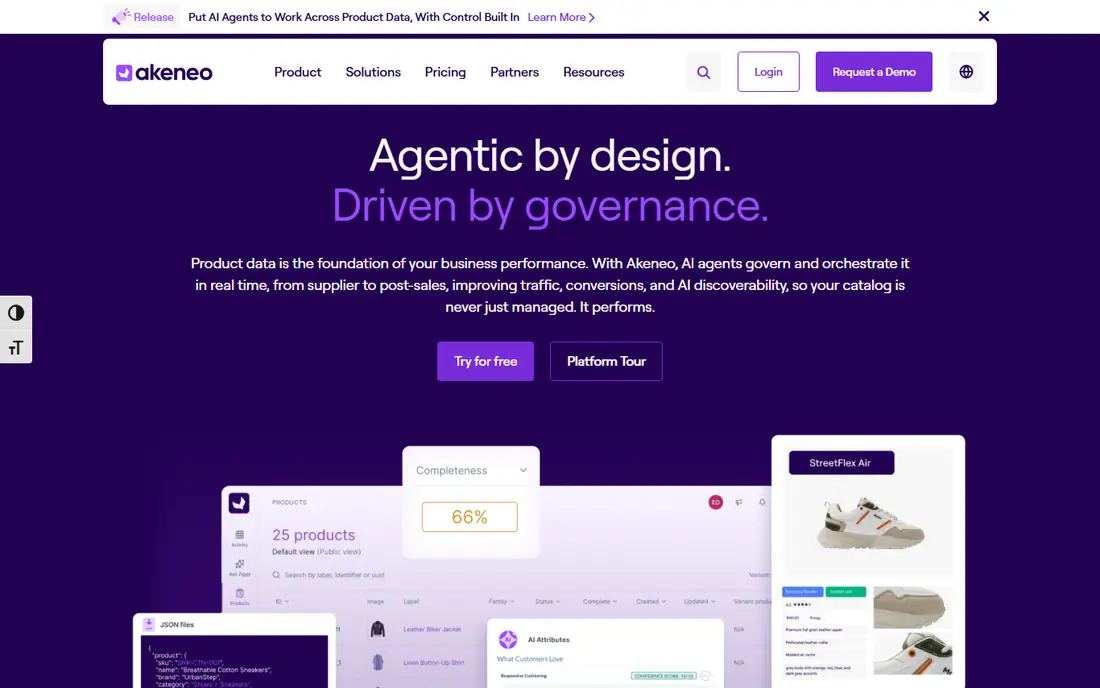
Akeneo suits service firms whose catalog has grown messy across spreadsheets, supplier files, and a website. The platform centralizes attributes, images, and translations, then uses workflows and quality checks to flag incomplete records before they reach a channel. That control matters when a service package, a part, and a price list must stay consistent across a quote, a portal, and a marketplace listing.
The community edition gives smaller teams a free starting point, but hosted and enterprise packages are quoted and implementation adds cost. A service firm with a simple catalog may not need this depth. A firm with thousands of parts, variants, and channel rules will find the structure worth the effort.
- Strong data quality and workflow tools
- Open-source community edition
- Channel publishing for many outputs
- Enterprise pricing is quoted
- Implementation can be a large project for small teams

Pimcore appeals to service firms that already have developers or a strong IT partner and want to shape the system around their own processes. It combines product information, digital assets, and master data in one open platform, so a service catalog, its images, and its customer data rules can live under one roof. The data model is flexible enough for unusual service attributes, such as coverage areas, response times, or included parts.
That flexibility is also the cost. Pimcore is not a quick sign-up tool for a non-technical team, and hosting, upgrades, and support need ongoing attention. If your firm values control and has the skills to use it, Pimcore offers more freedom than most closed PIM tools.
- Open-source platform combining PIM, asset management, and master data
- API-first design
- Flexible data models
- Needs developer time to set up and maintain
- Hosted and support pricing is quoted

Salsify is built for brands that must keep product content correct across dozens of retailer sites and marketplaces at once. Its syndication network and digital shelf tools show where content is missing or out of date, which helps a service firm that also sells parts or consumables through retail channels. Supplier collaboration features also help when product data arrives from many sources.
Pricing is enterprise level and quoted, so Salsify fits larger firms better than small service teams. A local service company with a website and one sales channel will not use most of this network. A national service brand with retail partners will benefit from the scale.
- Broad retailer syndication network
- Digital shelf analytics
- Supplier collaboration tools
- Enterprise pricing is quoted
- More than a small service firm usually needs
inRiver works well for complex B2B catalogs where products relate to each other in structured ways. A service firm can link a maintenance plan to its included parts, link parts to compatible models, and publish those relationships consistently. Supplier portals help collect data from vendors, while syndication tools push clean content to sales channels.
The platform is priced for mid-market and enterprise use, and smaller teams may find the setup heavy. For a distributor or a large service provider with deep catalogs and channel partners, that structure pays off. For a small firm with a short price list, a simpler tool will move faster.
- Strong product relationship modeling
- Built-in syndication
- Supplier portals for data collection
- Pricing is quoted
- Setup suits larger B2B teams rather than small firms
Plytix is the friendliest entry point on this list for a service firm that wants to stop managing products in spreadsheets. Product sheets, images, and brand portals sit in one place, and the interface is clear enough for marketing and operations staff to use without developer help. A free tier for small catalogs lets a team test the workflow before paying.
Scale is the limit. Very large catalogs with complex governance may outgrow Plytix, and some advanced channel needs may require extra steps. For a growing service firm with a manageable catalog, that simplicity is a strength, not a weakness.
- Easy interface for non-technical teams
- Built-in digital asset management
- Free tier for small catalogs
- Less suited to very large enterprise catalogs
- Advanced syndication may need workarounds
Sales Layer
Great for: Product teams that want an easy-to-use PIM for B2B catalogs
Sales Layer focuses on making product data usable for the people who write and approve it, not just for developers. Its interface suits manufacturers and B2B distributors, which maps well to service firms that sell parts and packages to business customers. AI-assisted enrichment and quality scoring help teams fill gaps in descriptions and specs faster.
Pricing is quoted, so small firms should request a quote early and compare total cost with Plytix or Pimcore. The community and connector range is also smaller than the largest platforms. For a product team that wants speed without a heavy IT project, Sales Layer is a strong middle option.
- Clean interface for marketers and product teams
- AI-assisted enrichment
- Connector library for channels
- Pricing is quoted
- Smaller community than Akeneo or Pimcore
Catsy combines product information and digital assets in one system, which helps service distributors that handle many images, manuals, and spec sheets alongside product records. Bulk editing speeds up price and description changes, and export templates prepare data for retailer and marketplace requirements. That mix suits firms that publish the same catalog in several formats.
Catsy is priced by quote, and the tool is built for catalog teams rather than occasional users. A small service firm may find it more than it needs. A distributor with a large, image-heavy catalog will use its combined PIM and asset features daily.
- Combined PIM and asset management
- Bulk editing
- Retailer-ready export templates
- Pricing is quoted
- Interface suits catalog teams more than casual users
Syndigo suits firms whose main problem is distribution rather than internal catalog editing. Its network carries product content to retailers and marketplaces, and its monitoring tools flag quality gaps that could hurt listings. For a service firm that also sells a product range through retail partners, that distribution strength matters more than a simple internal database.
Pricing is quoted and can depend on item volume, so costs rise with catalog size. Teams that only need an internal PIM may find Syndigo broader than necessary. Teams that live or die by retailer listings will value the network effect.
- Large retailer and marketplace content network
- Data quality monitoring
- Content syndication at scale
- Pricing is quoted and can be item-based
- PIM features are part of a broader syndication platform
How we picked these
We compared official feature pages, pricing and plan notes, integration and syndication lists, and public reviews for PIM platforms available in October 2026. We favored tools with clear product data modeling, quality checks, asset handling, and channel publishing, and we weighted service-industry use cases such as service packages, parts, and B2B catalogs. We left out single-purpose spreadsheet add-ons and tools that could not be verified as live PIM products.
How to choose a PIM for a service firm
Start by listing what you actually sell. A service catalog may include packages, plans, parts, and documents, and each type needs different attributes. Map those attributes before you demo any tool, or you will compare interfaces instead of fit. Then check your channels: a website only needs clean web publishing, while retailer and marketplace sales need syndication and quality monitoring.
Next, count the people who will maintain the data. A developer-led team can use Pimcore well, while a marketing-led team will move faster in Plytix or Sales Layer. Ask vendors for total first-year cost, including implementation, data cleanup, and training, since quoted enterprise pricing hides those items. Run a pilot with a real slice of your catalog, including a messy supplier file, before you sign a long contract.
Frequently asked questions
What does PIM mean?
PIM means product information management. It is software that stores product data in one central place, checks it for completeness, and publishes it to sales channels. For service firms, it can also manage service packages, parts, and supporting documents.
Does a service firm need a PIM if it does not sell products?
It may still help if it sells packages, plans, parts, or add-ons that appear on a website, in quotes, or through partners. If the offer list is short and stable, a spreadsheet may be enough. If prices, specs, or channels change often, a PIM saves time and errors.
How much does PIM software cost?
Costs range from free tiers for small catalogs to quoted enterprise contracts that can reach five or six figures a year. Implementation, data cleanup, and training add to the subscription. Always ask for a first-year total before comparing vendors.
How long does PIM implementation take?
Simple tools can go live in weeks with a clean catalog, while enterprise platforms can take months. Data cleanup is usually the slowest part, especially when supplier files use different names and formats. A pilot with real data gives a better timeline than a sales estimate.
Can a PIM replace a website or an ERP system?
No. A PIM manages product content and sends it to other systems, but it does not replace a storefront, a booking system, or an ERP. It works best when it feeds those systems with clean, consistent data.
Sources
See where you really rank - block by block
ProMapRanker scans Google Maps across a grid of your service area. Simple monthly plans from $19, white-label on every plan.
Start freeKeep reading
 worlds best local seo company
8 Worlds Best Local SEO Companies for Map Pack Growth in 2026
Compare the worlds best local seo company options for Google Business Profile work, citations, reviews, and multi-location rankings and reporting in 2026.
Read → world's best web hosting company
World's Best Web Hosting Company in 2026
Searching for the world's best web hosting company? We compared 10 hosts on price, renewal rates, speed, and support to help you choose well today in 2026.
Read → who's got the best nanny tax services
Who's Got the Best Nanny Tax Services in 2026
We answer who's got the best nanny tax services, comparing full filing, back taxes, software, and pricing so families can handle nanny taxes correctly.
Read →