 ProMapRanker
What is the Best Digital Billboard Ad Service in 2026


Small-budget self-serve tests · Pricing starts at: See website
Key takeaways
- Self-serve platforms suit small budgets and short tests, while marketplaces and operators suit larger flights and specific locations.
- Blip charges per short display, so small advertisers can test billboards without a four-week contract.
- AdQuick and other marketplaces help you compare inventory across many owners, but final rates still depend on market and placement.
- Creative rules, approval times and proof of play vary, so ask how you will see where and when your ad ran.
Quick comparison
| Pick | Great for | Pricing starts at | Free tier | |
|---|---|---|---|---|
| Blip Billboards | Small-budget self-serve tests | See website | No | Visit |
 AdQuick | Marketplace buying across owners | See website | No | Visit |
 Lamar Advertising | Direct operator inventory | See website | No | Visit |
 Clear Channel Outdoor | Large national operator reach | See website | No | Visit |
 OUTFRONT Media | Urban and transit-adjacent digital boards | See website | No | Visit |
 Adomni | Programmatic self-serve buying | See website | No | Visit |
 Fliphound | Simple self-serve billboard buys | See website | No | Visit |
The best digital billboard ad services
We compared digital billboard services on buying model, inventory access, minimums, creative approval and reporting. The seven below cover self-serve platforms, marketplaces and direct operators active in the United States in October 2026.
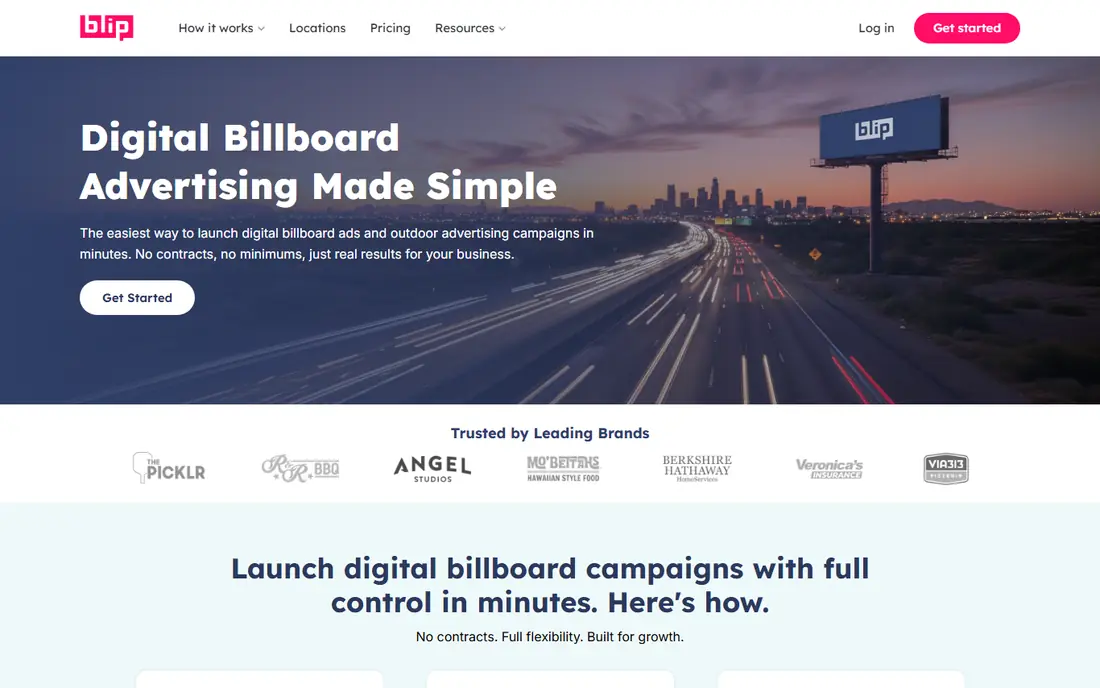
Blip fits a local business that wants to try billboards without committing to a four-week flight. You upload creative, set a daily budget and pay only for each short display, often seven to ten seconds, on a rotating digital board. That model makes it easy to test a message near your store, event or service area before spending more.
The trade-off is share of voice. Your ad rotates with other advertisers, so it will not show continuously, and busy times attract higher bids. Keep the message very short, use large text and one clear call to action, and check the play reports to see which boards and times delivered the most displays.
- Pay per short display with no long contract
- Daily budget controls
- Wide US digital board network
- Rotating displays mean shared attention
- Prime times cost more through bidding
AdQuick suits advertisers that want to compare digital billboards across cities and owners without contacting each operator separately. The platform brings planning tools, inventory search and attribution features together, which helps when a campaign spans several markets. Managed support can also help with media planning and creative specs.
Costs still depend on location, format, share of voice and flight length, so treat any range as a starting point rather than a quote. Ask for a media plan with specific units, estimated impressions and the measurement method before you approve a budget. That detail makes it easier to judge value across different markets.
- Inventory from many media owners in one place
- Planning and measurement tools
- Managed and self-serve options
- Final pricing varies by market and unit
- Larger flights may need sales support
Lamar is a direct operator, which means you buy space on boards Lamar itself owns and operates. That can simplify accountability, since one company controls the board, the schedule and the posting. Local teams can advise on which roads and neighborhoods fit a campaign, and digital boards allow creative changes during a flight.
The limit is coverage. An operator network is strong in its own markets and weaker where it owns fewer boards, so a national plan may still need other vendors. If your audience sits in one region, direct buying can be efficient. If you need many cities, compare Lamar alongside a marketplace that aggregates several owners.
- Large owned digital network
- Local sales teams
- Roadside and urban formats
- Direct buying can be slower for multi-market plans
- Pricing is quote-based
Clear Channel Outdoor fits brands that need scale across major US markets and formats beyond roadside boards. Its inventory includes digital bulletins and urban displays, and programmatic buying options suit advertisers that already plan media through digital platforms. Creative flexibility is a plus, since digital boards can rotate messages by time of day.
Smaller advertisers should ask early about minimums and market availability, because national operator pricing is usually quoted per unit and flight. A local test may be cheaper through a self-serve platform, while a larger brand campaign can benefit from the operator's reach and planning support.
- Broad US digital inventory
- Airport, roadside and urban placements
- Programmatic options
- Quote-based pricing
- Enterprise focus may suit larger budgets best
OUTFRONT suits advertisers targeting city audiences, commuters and neighborhoods around transit, retail and entertainment areas. Digital formats allow dayparting, so a lunch offer can run at midday and an event message can run in the evening. That timing control is one of the main advantages of digital over static boards.
The catch is geography. Premium urban inventory costs more and may be limited in smaller markets, so rural or small-town campaigns need a different mix. Ask which specific units are available in your target area, and check whether the flight includes proof of play and impression estimates for those units.
- Strong urban and transit-adjacent inventory
- Digital creative flexibility
- National planning support
- Pricing is quote-based
- Best inventory concentrates in larger markets
Adomni fits advertisers comfortable with digital ad platforms who want more control over audience, geography and timing. You can plan buys around places and audience traits rather than picking single boards one by one, and reporting helps you see delivery across screens. That approach suits multi-location businesses that already think in terms of audiences.
Programmatic buying is not the same as buying a single famous board for a month, so expectations matter. Delivery depends on auction conditions and available inventory, and results improve when creative is simple and the target area is clear. New buyers should start with a defined test area and a modest budget before scaling.
- Self-serve programmatic buying
- Audience and location targeting
- Campaign reporting
- Programmatic buying has a learning curve
- Minimums and fees vary by campaign
Fliphound works for advertisers that want a straightforward way to buy digital billboards without learning a full programmatic platform. You set a budget, choose locations and launch creative, which keeps the process close to other self-serve ad tools. That simplicity is helpful for a first billboard test or a short local promotion.
The trade-off is depth. You may get fewer planning, attribution and targeting tools than a larger marketplace offers, and inventory will be thinner in some markets. Check board availability in your exact area before building a campaign around a specific road or neighborhood, and keep creative to a few words for roadside readability.
- Simple self-serve setup
- Budget-based buying
- US digital board access
- Smaller feature set than full marketplaces
- Inventory varies by market
How we picked these
We compared official product pages, marketplace descriptions, operator inventory pages and public pricing guides for digital billboard services active in October 2026. We favored services that clearly sell digital billboard access in the United States, explain their buying model and offer reporting or proof of play. We excluded static-only brokers and general ad agencies that do not operate a billboard buying platform or network.
We did not claim hands-on testing. Our comparison rests on vendor feature pages, pricing and FAQ pages, inventory descriptions and public reviews, with prices shown as quoted where vendors do not publish a fixed starting rate.
What to check before you buy
Start with the goal and the geography. A store opening needs boards near the store, while a brand campaign needs reach across a city or several cities. Write down the roads, neighborhoods and times that matter, then ask each service which specific units cover them. A low national average means little if no board sits on your target route.
Next, simplify the creative. Drivers have seconds to read a billboard, so use a short headline, large type, high contrast and one action, such as a short web address or a simple offer. Confirm file specs, approval times and whether you can swap creative mid-flight, because digital boards make changes possible but operators still review content. Ask for proof of play, impression estimates and the reporting cadence, and keep a record of where and when your ad ran.
Finally, set a test budget and a way to judge it. Track store visits, calls, searches or promo-code use during the flight, and compare those signals with a period before the campaign. Billboards build awareness over time, so a very short test may show reach but not sales. If the first test works, scale the boards and times that performed best rather than spreading the same budget thinner.
Frequently asked questions
What is the best digital billboard ad service for a small business?
For most small businesses, a self-serve option such as Blip or Fliphound is the easiest first test, because you control the daily budget and avoid a long contract. If you need specific premium boards or several markets, a marketplace such as AdQuick may find inventory that self-serve networks do not cover. Match the buying model to your budget and geography first.
How much does digital billboard advertising cost?
Costs vary widely by market, board location, share of voice and flight length, and most operators quote per unit. Self-serve per-display buying can start with a small daily budget, while traditional digital flights often run for four weeks and cost more in large metros. Ask for a quote tied to specific boards before you compare prices.
How long does it take to launch a campaign?
Self-serve campaigns can launch quickly once creative is approved, often within days, while managed and operator flights may take longer for planning and approvals. Creative specs, operator review and inventory availability are the usual delays. Submit final creative early and confirm approval timelines in writing.
Do digital billboards allow creative changes during a flight?
Yes, in most cases digital boards allow creative swaps, subject to operator approval and file specs. That flexibility suits time-sensitive offers, events and dayparted messages. Confirm any swap fees and turnaround times before the flight starts, since policies differ by vendor.
How do I know my ad actually ran?
Ask for proof of play, delivery reports and impression estimates tied to specific boards and times. Self-serve platforms usually show plays in a dashboard, while marketplaces and operators may provide scheduled reports. Keep those reports with your invoices so you can compare delivery against what was booked.
Sources
See where you really rank - block by block
ProMapRanker scans Google Maps across a grid of your service area. Simple monthly plans from $19, white-label on every plan.
Start freeKeep reading
 worlds best local seo company
8 Worlds Best Local SEO Companies for Map Pack Growth in 2026
Compare the worlds best local seo company options for Google Business Profile work, citations, reviews, and multi-location rankings and reporting in 2026.
Read → world's best web hosting company
World's Best Web Hosting Company in 2026
Searching for the world's best web hosting company? We compared 10 hosts on price, renewal rates, speed, and support to help you choose well today in 2026.
Read → who's got the best nanny tax services
Who's Got the Best Nanny Tax Services in 2026
We answer who's got the best nanny tax services, comparing full filing, back taxes, software, and pricing so families can handle nanny taxes correctly.
Read →