 ProMapRanker
What Is the Best Blockchain Service for Web3 in 2026

Key takeaways
- Alchemy and Infura suit most app teams, but their unit and credit models price very differently at scale.
- Moralis and Thirdweb speed up building, while Tenderly helps teams test and debug transactions before launch.
- Chainstack and Besu suit teams that want control over deployment, with Besu shifting operations work to your own team.
- QuickNode is excluded here because a one-month trial is not a free tier, and archived clients should not be chosen for new work.
- No service here can promise returns, token prices, or uptime for a specific app, so test with your real call mix.
Quick comparison
| Pick | Great for | Pricing starts at | Free tier | |
|---|---|---|---|---|
 Alchemy | Full-stack Web3 apps | See website | Yes | Visit |
 Infura | Ethereum-focused projects | See website | Yes | Visit |
 Moralis | Fast prototyping with indexed data | See website | Yes | Visit |
 Ankr | Budget multi-chain access | See website | Yes | Visit |
 Chainstack | Enterprise and hybrid deployments | See website | Yes | Visit |
 Tenderly | Simulation and debugging | See website | Yes | Visit |
 Thirdweb | App builders using SDKs | See website | Yes | Visit |
 Hyperledger Besu | Enterprise Ethereum nodes | Free | Yes | Visit |
 Blockdaemon | Dedicated enterprise nodes | See website | No | Visit |
The best blockchain services for Web3
This is general information only, not financial advice, and nothing here promises returns or token prices. A blockchain service in this guide is the infrastructure an app uses to read chain data, send transactions, or run a node, not an investment product. The right choice depends on chain coverage, call mix, throughput, and how much operations work your team wants to own. We compared official feature pages, pricing pages, app store listings, privacy policies, and public reviews, and we left out QuickNode entirely, because its current offer is a one-month trial rather than a genuine free tier, and we left out ConsenSys Quorum and GoQuorum, which are archived.
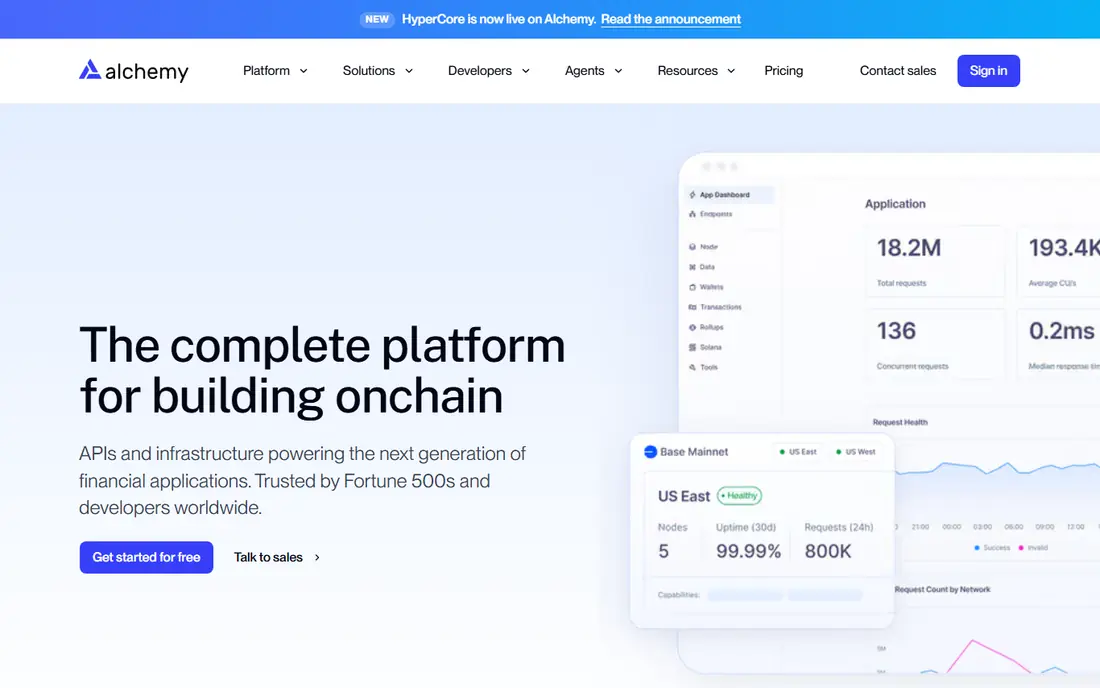
Alchemy is a natural starting point for teams building a complete app, not just a single contract call. Its node access sits beside enhanced APIs, webhooks, and monitoring tools, so a team can read chain data, simulate a transaction, and watch for events without stitching several vendors together. That breadth helps product teams that need token balances, NFT data, and transaction history in one place.
The weakness is pricing clarity: compute units weight different methods differently, so a shift in call mix can move the bill even when request counts stay flat. Model the bill on your actual method mix, and watch the first invoice before committing to a large allowance. For a tree crew or a web team, the test is simple: run one small campaign or project first, watch the real cost per result, and only then scale the budget.
- Wide chain coverage and enhanced APIs
- Developer tools for simulation and monitoring
- Clear documentation for common stacks
- Compute-unit pricing can be hard to forecast
- Heavier calls cost more
- Advanced features sit on paid tiers
Infura has been part of Ethereum tooling for years, and that history still counts for teams that want a steady, familiar endpoint. Its daily credit quota gives a predictable rhythm for apps with steady traffic, and its documentation and client libraries cover the common Ethereum workflows without extra setup. For a team already using MetaMask-related tooling, the shared ecosystem can shorten the first integration.
The catch is the daily reset: unused credits do not carry forward, so a quiet day does not bank capacity for a busy launch day. Check your peak-day usage, not your average, before choosing a tier. Start small, measure what actually happens in the first month, and keep the plan only if the numbers and the daily workflow both hold up.
- Long-running Ethereum infrastructure
- Daily credit model suits steady apps
- Broad tooling and MetaMask familiarity
- Daily credits do not roll over unused capacity
- Some advanced APIs need paid tiers
- Chain list is narrower than some rivals
Moralis suits builders who need answers about wallets and tokens quickly, rather than raw node access alone. Its indexed APIs return balances, transfers, and NFT holdings in a form an app can display at once, which speeds up a prototype or a dashboard. That data layer can save a small team from building its own indexer for common queries.
The trade-off is focus: if the core need is low-level node methods, trace data, or a dedicated node, another provider may fit better. Use it where indexed data is the bottleneck, and pair it with a dedicated node provider if raw access matters. The right test is a short, real trial with your own jobs, files, or contacts, not a demo account filled with sample data.
- Indexed wallet, token, and NFT APIs
- Quick start for prototypes
- Useful for apps that need rich user data
- Node access is not the main focus
- Rate limits and plan tiers need checking
- Costs rise with data volume
Ankr is worth a look when the budget is tight and the app must touch many chains at once. Its shared endpoints and credit model let a small team test across networks without a large monthly commitment, and the chain list is broad for the price. That breadth helps hackathon projects, side projects, and multi-chain wallets that cannot justify a premium tier for each network.
The weakness is the fine print: premium methods and higher throughput need paid access, and credit weights mean the headline allowance buys fewer calls than it first suggests. Test the exact methods your app uses, and price that mix rather than the headline number. Compare the total monthly cost, including add-ons and renewals, before you judge a headline price.
- Broad chain coverage at a low entry cost
- Public endpoints for testing
- Pay-as-you-go options for variable traffic
- Advanced methods sit on premium tiers
- Credit weighting makes headline allowances misleading
- Support depth varies by plan
Chainstack stands out for teams that want both managed endpoints and control over where nodes run. It offers managed nodes, dedicated nodes, and a self-hosted option, which gives a company a path from a simple shared endpoint to its own infrastructure without changing vendors. Compliance features and global deployment also help regulated or enterprise teams with data-location needs.
The downside is complexity and entry cost: the choice of deployment models takes more planning, and the paid tier starts above the cheapest shared options. Map the deployment model first, then price it, rather than starting from the cheapest tier. If the setup feels heavy for the size of your team, that friction usually stays, so weigh it as heavily as the feature list.
- Managed and self-hosted node options
- Enterprise compliance features
- Global node deployment choices
- Entry paid tier starts higher than some rivals
- Archive and debug costs need checking
- Setup choices can feel complex
Tenderly earns its place when the hardest problem is understanding what a transaction will do before it goes live. Simulation lets a developer test a contract call, inspect state changes, and catch a costly mistake while it is still reversible. Monitoring and alerts then help a team spot failed or unusual transactions after launch, which matters for finance-facing apps.
The limit is scope: it is a developer platform with node access, not the cheapest bulk RPC pipe for high-volume read traffic. Use it alongside a primary node provider if simulation and debugging are the real bottleneck. A short pilot with real work will tell you more than any feature page, so set a clear pass mark before you start.
- Transaction simulation before sending
- Debugging and monitoring for smart contracts
- Virtual test environments
- Not a general-purpose node replacement for every app
- Unit pricing needs care
- Advanced features need paid plans
Thirdweb fits teams that want to ship an app quickly using ready-made building blocks rather than wiring every contract call by hand. Its SDKs, dashboards, and contract tools cover deployment, wallet connection, and common app flows, which can cut weeks from an early build. For a small team with a clear product idea, that speed is the main reason to choose it.
The weakness is fit: a team with a custom architecture may fight the opinionated defaults, and costs and limits differ across its products. Prototype one full user flow first, and check what happens if you later move a piece of the stack elsewhere. Check the renewal price and the cancellation steps in writing, because those terms matter as much as the first month.
- SDKs and dashboards for contracts and apps
- Infrastructure for wallets and payments
- Faster build for common patterns
- Opinionated tooling may not fit custom stacks
- Pricing and limits vary by product
- Lock-in risk if SDKs spread widely
Besu is the enterprise Ethereum route for teams that want to run their own nodes rather than rent access. As an open-source client, it supports Ethereum mainnet and permissioned networks, which suits companies building private or consortium chains with known participants. Running the client yourself also removes per-call billing and vendor limits for internal traffic.
The honest cost is operations: someone must run, monitor, upgrade, and secure the nodes, and that work does not disappear because the software is free. Choose Besu when you have the operations capacity to own the infrastructure, and budget staff time as the real price. Keep one alternative ready during the trial, so you can walk away cleanly if the fit is wrong.
- Open-source Ethereum client for enterprise use
- Permissioned network support
- No vendor lock-in for the client itself
- Running nodes needs operations skill
- No managed support in the free client
- Upgrades and monitoring are your job
Blockdaemon is built for companies that need dedicated infrastructure and a support relationship, not a quick shared endpoint. Its dedicated nodes, staking services, and enterprise tooling suit exchanges, custodians, and large apps where downtime or shared-node limits carry real business risk. Protocol coverage is broad, and the managed model shifts node operations to the vendor.
The trade-off is access and cost: pricing is quote-based, there is no simple free tier for a weekend prototype, and onboarding is heavier than a self-serve signup. Talk to Blockdaemon when dedicated capacity and support matter more than a low starting price. Judge it on the jobs you run every week, not on the largest or most unusual job in your pipeline.
- Dedicated nodes and staking infrastructure
- Enterprise support and compliance focus
- Broad protocol coverage
- Quote-based pricing with no simple self-serve tier
- Overkill for small prototypes
- Onboarding takes longer
How we picked these
We compared official feature pages, pricing pages, app store listings, privacy policies, and public reviews, and we kept only services that are live and clearly fit the topic in October 2026. Where a price or a free tier could not be confirmed on the vendor site, we wrote See website rather than guessing, and we left out services that are retired, trial-only when a free plan was claimed, or a poor fit for the stated angle.
Each pick below gets one concrete strength and one honest weakness. That balance matters more than a long feature list, because the best choice for a solo operator is rarely the best choice for a larger team, and a low headline price can hide renewal fees, per-user charges, or limits that only show up at scale.
How to choose without overpaying for units
Price the method mix, not the headline allowance. One provider may bill a simple call at one unit and a log query at many times that amount, while another uses daily credits that reset each day. List the methods your app actually calls, estimate daily volume for each, and run the same workload through a free tier or trial on two providers before committing. Watch latency, error rates, and archive access during that test, because a cheap endpoint that fails under load costs more in lost users than it saves in fees.
Decide how much infrastructure you want to own. Managed endpoints suit most product teams, dedicated nodes suit high-volume or regulated apps, and running Besu suits teams with operations staff and a reason to control the node itself. Check data residency, support hours, and what happens when a provider has an outage, and keep a fallback endpoint ready for critical paths. A second provider for reads can be cheaper than a long outage, especially for wallets and payment flows.
Frequently asked questions
What is a blockchain service for Web3?
It is infrastructure that lets an app read blockchain data, send transactions, or run a node without building that layer from scratch. Examples include node APIs, indexed data APIs, simulation tools, and managed or self-run clients.
Is QuickNode free?
No, not as a free tier in this guide. Its current offer is a one-month trial, which ends, so we excluded it entirely rather than listing it as free. A trial can still be useful for testing, but it should not be budgeted as ongoing free access.
Should a beginner run their own node?
Usually no. A managed endpoint is faster to start, easier to monitor, and simpler to scale for a first app. Running a node yourself makes sense when you need control, privacy, or predictable internal costs and you have staff to operate it.
Do these services give financial advice?
No. They provide infrastructure and data, not investment advice, and none of them can promise returns or token prices. Treat any service that promises gains with caution and check its claims against independent sources.
How do I avoid surprise bills?
Set usage alerts, cap spending where the provider allows it, and test with your real method mix. Re-check the bill after the first busy week, because log queries, archive reads, and debug calls often cost far more than simple calls.
Sources
See where you really rank - block by block
ProMapRanker scans Google Maps across a grid of your service area. Simple monthly plans from $19, white-label on every plan.
Start freeKeep reading
 worlds best local seo company
8 Worlds Best Local SEO Companies for Map Pack Growth in 2026
Compare the worlds best local seo company options for Google Business Profile work, citations, reviews, and multi-location rankings and reporting in 2026.
Read → world's best web hosting company
World's Best Web Hosting Company in 2026
Searching for the world's best web hosting company? We compared 10 hosts on price, renewal rates, speed, and support to help you choose well today in 2026.
Read → who's got the best nanny tax services
Who's Got the Best Nanny Tax Services in 2026
We answer who's got the best nanny tax services, comparing full filing, back taxes, software, and pricing so families can handle nanny taxes correctly.
Read →