 ProMapRanker
What Does Customer Service Mean to You


Structured video curriculum · Pricing starts at: $39 per month
Key takeaways
- The strongest answer defines service in one sentence, gives a short real example, and ends with the result for the customer.
- A good customer service philosophy puts listening, ownership, and follow-through ahead of scripts and slogans.
- Prep tools help you practise delivery and structure, but they cannot invent experience you do not have.
- Never use a live AI helper during a real interview unless the employer clearly allows it, since that can breach hiring rules.
Quick comparison
| Pick | Great for | Pricing starts at | Free tier | |
|---|---|---|---|---|
| Big Interview | Structured video curriculum | $39 per month | No | Visit |
 Yoodli | Delivery and pacing feedback | $8 per month | Yes | Visit |
 Huru | Free AI video mock interviews | Free | Yes | Visit |
 Final Round AI | All-in-one prep platform | See website | Yes | Visit |
 LinkedIn Learning | Short workplace courses | See website | Free trial | Visit |
 Glassdoor | Real interview questions by company | Free | Yes | Visit |
 Indeed | Job search plus interview guides | Free | Yes | Visit |
 Coursera | Communication and service courses | See website | Yes | Visit |
The best tools for what does customer service mean to you best answer
There is no single best answer to this interview question, and any tool that sells you one script is selling a shortcut. Interviewers ask it to hear your philosophy, your judgment, and a real example. The tools below help you shape that answer, practise saying it out loud, and learn from questions other candidates faced at the same company.
Use them for practice only. Do not use a live AI copilot during a real interview unless the employer explicitly allows it. Practising with AI is fair preparation. Getting live answers during an interview can break hiring rules and cost you the role.
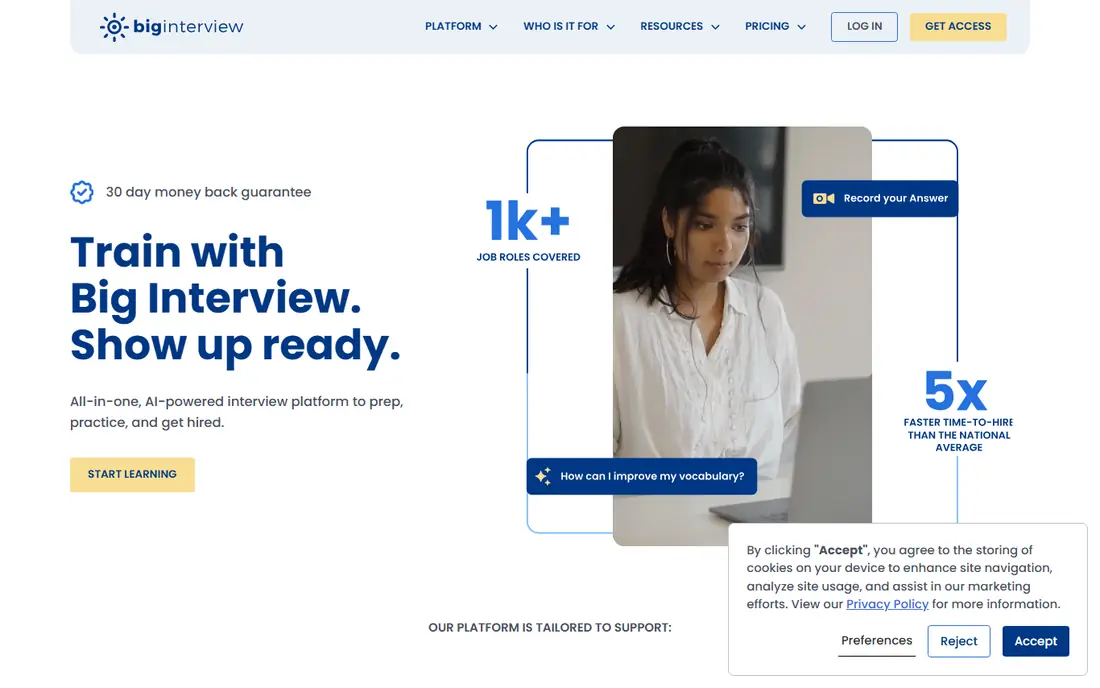
Big Interview is the classroom option in this list. It walks you through interview lessons, answer structures, and practice questions, rather than throwing you into open mock interviews at once. That structure helps if you know what good service looks like but struggle to say it in a clear order. You can record answers, review them, and rebuild weak parts before the real interview.
The price is the filter. At $39 for 30 days, it suits a focused prep period, not a year of casual browsing. It also works best for learners who follow a curriculum. If you only need one answer polished, a free mock tool plus a written draft may be enough.
- Lesson-by-lesson interview curriculum
- Practice questions with answer frameworks
- Video recording and review
- Costs $39 for 30 days in recent reports
- No free plan beyond a question preview
- Curriculum suits self-paced learners best
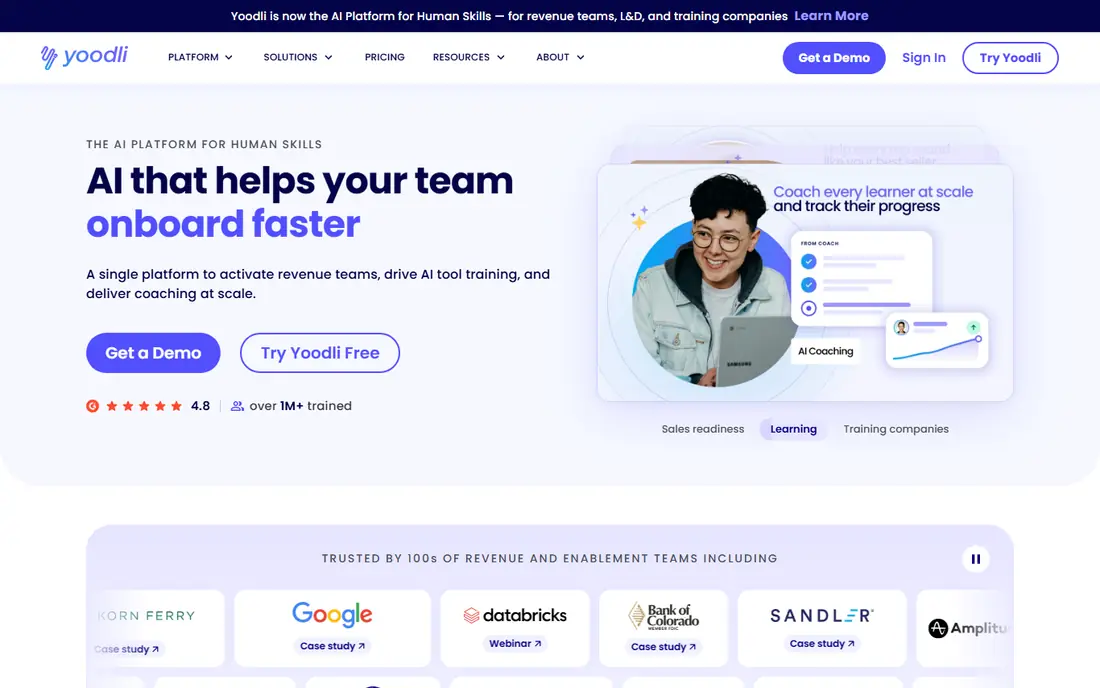
Yoodli coaches how you say an answer, not just what you say. It tracks filler words, pacing, and clarity across recorded practice sessions, so you can see whether you speed up under pressure or ramble past the point. The free tier offers a small number of lifetime sessions, while Pro costs about $8 per month on annual billing in recent reports. That makes it a cheap way to fix delivery.
The limit is content. Yoodli will not tell you whether your service example proves ownership or just describes a polite chat. Pair it with a content tool or a written draft, and use Yoodli last, to polish an answer you already trust. Delivery polish on a weak story still leaves a weak story.
- Measures filler words, pace, and clarity
- Free tier with limited lifetime sessions
- Progress tracking across sessions
- Judges delivery more than answer content
- Paid plan needed for fuller use
- Video feedback needs a quiet practice space

Huru offers AI video mock interviews that feel closer to a real interview than a text prompt. You answer on camera, get a score for each answer, and can re-record after rewriting weak parts. Recent reports describe it as free for job seekers, with organisations paying for enterprise plans, and note coverage of many career roles. For a service role, that video format is valuable, since tone and eye contact matter.
Treat the score as feedback, not a verdict. An AI score cannot know your full work history or the hiring manager's priorities. Use Huru to practise the customer service question in a realistic setting, then rewrite the answer in your own words and practise again.
- Free for job seekers in recent reports
- Video mocks with answer-by-answer scoring
- Covers many career roles
- Less suited to deep technical rounds
- Scoring is a guide, not a hiring decision
- Needs a camera and a stable connection
Final Round AI bundles mock interviews, a question bank, and resume help into one platform. That breadth suits a candidate preparing for several rounds at once, who wants one dashboard for practice. A free basic tier lets you test the layout before you pay, though paid pricing differs across recent reports, from about $25 per month on annual billing to $150 per month for fuller plans, so check the current page carefully.
The important warning is about live use. Final Round AI also offers a live Interview Copilot, and using live help during a real interview can breach employer rules, even if the tool allows it. Use this platform for preparation, with live help switched off. A strong prepared answer beats a risky live shortcut.
- Mock interviews, question bank, and resume tools in one place
- Useful for structured prep cycles
- Free basic tier to test
- Pricing varies widely across reports
- Live copilot use during interviews raises ethical and policy risks
- Billing complaints appear in reviews
LinkedIn Learning helps when your service philosophy needs vocabulary and structure. Short courses cover listening, empathy, de-escalation, and handling difficult customers, with examples you can adapt to your own experience. A trial lets you test a course before you commit to a subscription, and completed courses can appear on your profile.
The limit is honesty. A certificate does not prove you handled a hard customer well, and interviewers will probe for a real story behind any claim. Use LinkedIn Learning to learn frameworks, then translate them into your own example. Borrow the language, not someone else's story.
- Short courses on communication and service
- Taught by working professionals
- Certificates to show on a profile
- Pricing is subscription-based
- Course depth varies
- Certificates do not replace real experience
Glassdoor is the research tool for a specific employer. Search the company, read interview questions other candidates report, and note how often the customer service question appears and what follow-ups it draws. That context helps you tailor an answer to the company's values, whether it stresses speed, empathy, or problem ownership. Salary and culture pages add useful background for your own questions at the end.
Reports are uneven. Some are detailed and recent, while others are vague or old. Use Glassdoor to find patterns across several reports, not to memorise one answer. If five candidates describe a focus on resolving issues without passing the customer around, shape your example around ownership, in your own words.
- Interview questions shared by past candidates
- Salary and culture context by employer
- Free to browse with an account
- Reports vary in detail and date
- Some content needs a contribution to open
- Reviews can be biased
Indeed pairs job search with free interview guides, including sample answers for common questions. Its guides explain why interviewers ask about customer service, what a strong structure looks like, and how to avoid vague slogans. That free guidance is a good starting point if you have no prep budget. You can also check the employer's job page and reviews from the same site.
General guides need personalising. An Indeed example about a retail return will sound hollow if you apply for a support desk role and never mention tickets, follow-up, or system notes. Take the structure, keep your own story, and cut any line that does not match your real experience.
- Free interview guides and example answers
- Job listings and company pages in one place
- Career advice for many roles
- Guides are general, not tailored to one employer
- Example answers need adapting
- Advice quality varies by article
Coursera suits candidates who want deeper learning behind the interview answer. Courses on communication, customer experience, and service management explain listening, expectation setting, and recovery after a failure. Many courses offer a free audit route, while certificates and graded assignments sit on paid enrolment. That depth helps if you are changing careers and need a stronger service foundation.
Coursera is not a quick mock tool. A multi-week course will not polish one answer the night before an interview. Use it when you have weeks to prepare and want your philosophy to rest on real concepts, then practise the short answer with a mock tool. The course gives you ideas, while practice gives you delivery.
- University and industry courses on communication
- Free audit options on many courses
- Structured learning with assignments
- Full certificates cost extra
- Courses take longer than a quick prep tool
- Not tailored to one interview question
How we picked these
We compared official product pages and recent October 2026 pricing and feature reports, and we kept only tools that exist and work now for interview preparation. We favoured tools that help with structure, delivery, or employer research, rather than tools that promise a single scripted answer. We flagged live copilot use as a risk, and we left out retired tools such as Google Interview Warmup, which redirected to general interview tips in 2026.
Example answers and a philosophy you can adapt
A strong answer has three parts: a definition, a short example, and a result. Keep it under a minute when spoken, and use your own experience. Interviewers remember a clear story far longer than a slogan.
A short philosophy you can say
Try a version of this in your own words: customer service means taking ownership of a problem until the customer has a clear next step, even if you cannot fix everything at once. It means listening first, explaining honestly what you can do, and following through on what you promised. Good service is not being nice for a minute. It is making the customer's next step easier.
Example answer for a support role
Say something like this, adapted to your history: to me, customer service means solving the real problem, not just closing the ticket. In my last role, a customer contacted us twice about the same billing error, so I checked the full history instead of repeating the last reply. I found the duplicate charge, corrected it, and confirmed the fix in writing. The customer replied that it was the first time someone had explained the full picture, and the case did not come back.
Example answer for a retail or hospitality role
Say something like this, adapted to your history: customer service means making people feel heard and respected, even when the answer is no. When a guest was upset about a sold-out item, I listened without interrupting, checked nearby stock honestly, and offered a clear alternative with the same value. The guest left with a plan, not just an apology. That balance of honesty and help is what I aim for in every interaction.
What to avoid in your answer
Avoid vague lines such as saying you love helping people, with no example. Avoid claiming you always satisfy every customer, since interviewers know that is not possible. Avoid blaming customers, past employers, or systems for every problem. Name what you did, what you learned, and what changed for the customer, and keep the focus on your actions.
Frequently asked questions
What is the best answer for what does customer service mean to you?
The best answer defines service in one sentence, gives a short real example, and ends with a result for the customer. For example, say service means owning a problem until the customer has a clear next step, then describe a time you did that. Keep it honest, specific, and under a minute when spoken.
What does good customer service mean to you best answer for a beginner?
If you have little work experience, use a school, volunteer, or part-time example where you helped someone solve a problem. Focus on listening, clear communication, and follow-through, rather than claiming years of service experience. Interviewers value a genuine small example over a polished story that does not fit your history.
What is the best customer service philosophy for an interview?
A strong philosophy puts listening, ownership, and follow-through first. Say you listen before you act, take responsibility for the next step, and confirm the outcome with the customer. Add one example that shows that philosophy in action, so it sounds like a working belief rather than a slogan.
Should I memorise an example answer word for word?
No. Memorised answers sound flat and fall apart when the interviewer asks a follow-up. Learn your structure: definition, example, result. Practise it several ways with a mock tool, so you can adapt the wording while keeping the story and the result clear.
How long should my answer be?
Aim for 45 to 75 seconds when spoken, which is roughly 120 to 180 words. That length gives room for a definition, a short example, and a result, without turning into a monologue. Practise with a timer, and cut any detail that does not support the point.
Sources
See where you really rank - block by block
ProMapRanker scans Google Maps across a grid of your service area. Simple monthly plans from $19, white-label on every plan.
Start freeKeep reading
 zoho inventory alternatives
6 Alternatives to Zoho Inventory, Compared on Price and Fit
Zoho Inventory alternatives: 6 tools compared on price, free plans and fit. Katana leads the list for manufacturers. Fit and flaws are laid out for each entry.
Read → zoho crm alternatives
Best Zoho CRM Alternatives (2026)
Need Zoho CRM alternatives? We compare 7 tools on cost, free access and who each suits. Every pick gets a straight assessment. Built for quick decisions.
Read → zelle alternatives
Best Zelle Alternatives in 2026
Compare the best Zelle alternatives for sending money to friends, paying sellers and moving funds abroad, with honest notes on fees, speed and safety in 2026.
Read →