 ProMapRanker
Best Webull Alternatives in 2026

Key takeaways
- Stock and ETF trades are $0 at most brokers here, so tools, account types and options fees matter more than headline commissions.
- Fidelity and Charles Schwab are our picks for most investors who want research, retirement accounts and long term investing in one place.
- Robinhood and Moomoo suit mobile-first traders, while Interactive Brokers and tastytrade suit active and international traders.
- Options fees differ: some brokers charge $0 per contract and others charge $0.65 per contract, so frequent options traders should check that line closely.
- This is not financial advice. Trading carries risk, and you can lose money, including money you invest in stocks, ETFs, options and crypto.
Quick comparison
| Pick | Great for | Pricing starts at | Free tier | |
|---|---|---|---|---|
 Robinhood | Simple mobile trading | Free | No | Visit |
 Fidelity | Most investors overall | Free | No | Visit |
 Charles Schwab | Full-service investing | Free | No | Visit |
 E*TRADE | Education and active trading | Free | No | Visit |
 SoFi Invest | Beginners who want one app | Free | No | Visit |
 Moomoo | Active traders and market data | Free | No | Visit |
 Interactive Brokers | Serious and global traders | See website | No | Visit |
 Public | Social and fractional investing | Free | No | Visit |
 tastytrade | Options and futures traders | Free | No | Visit |
The best Webull alternatives
We compared fees, trading tools, account types, mobile apps and research, using official pricing pages and public broker documentation. Webull itself is not listed here, since this guide covers alternatives only.

Robinhood is the easiest starting point in this list for a new investor who wants to place a first stock or ETF trade without learning a dense desktop platform. The app keeps orders, positions and watchlists close at hand, and fractional shares let a small budget spread across several holdings. That simplicity is a real strength for someone who trades a few times a month.
The trade-off is depth. Research, screeners and retirement planning tools are thinner than at Fidelity or Schwab, and investors who want mutual funds or detailed analyst reports may feel boxed in. Robinhood Gold, a paid subscription, adds margin and extra data, but the free account alone covers the basics well. Check fees for options, crypto spreads and account transfers before you move money.
- $0 stock and ETF trades
- Fractional shares from small amounts
- Clean mobile app
- Fewer research tools than full-service brokers
- No mutual funds
- Customer support can feel limited for complex cases
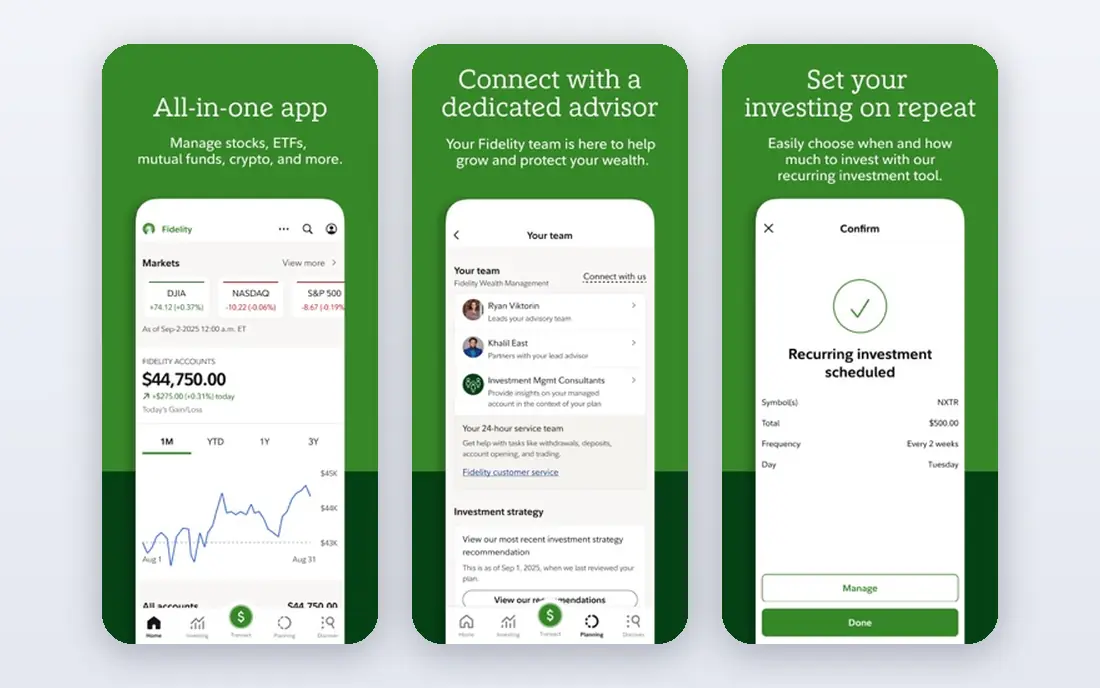
Fidelity is our pick for most people in this comparison because it covers so much ground without charging for stock and ETF trades. Investors get research, screeners, fractional shares, retirement accounts and a large fund range in one account. That breadth helps a beginner grow into more advanced tools without switching brokers later.
Active Trader Pro, the desktop platform, adds charting and order tools for traders who want more control, but new users can ignore it at first and use the standard app or website. The main costs to watch are options contracts at $0.65 each and any fund expense ratios, which vary by fund. Support and education are stronger here than at most mobile-only brokers.
- $0 stock and ETF trades
- Strong research and screeners
- Wide retirement account choice
- Mobile app feels busier than Robinhood
- Advanced platform takes time to learn
- Options cost $0.65 per contract
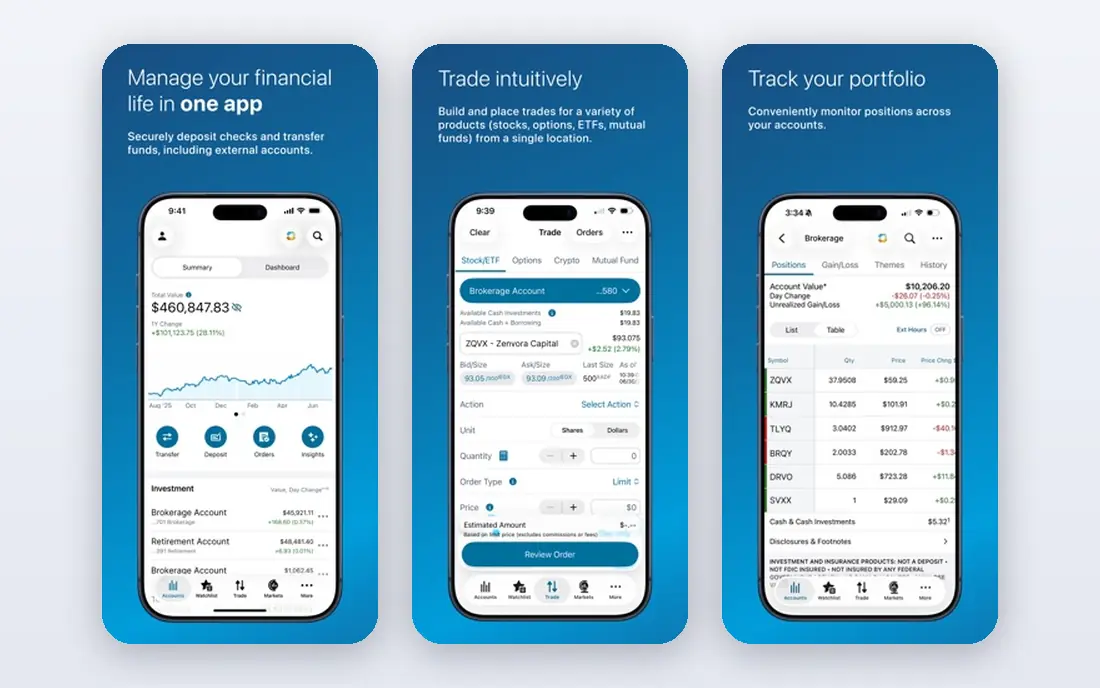
Schwab suits investors who want a full-service broker with branches, banking options and a serious trading platform under one roof. The thinkorswim platform, brought over from TD Ameritrade, gives active traders charting, paper trading and complex order types. Long term investors, by contrast, can stick with the standard website and app and never open thinkorswim.
That range is both the strength and the weakness. New investors may need time to find the right tool for their goal, and the number of account and platform choices can feel heavy at first. Once set up, though, Schwab covers retirement accounts, education savings and managed portfolios in a way that mobile-only apps do not. Options traders should factor in the $0.65 per contract fee.
- $0 stock and ETF trades
- Thinkorswim trading platform
- Broad retirement and banking options
- Options cost $0.65 per contract
- Platform choice can confuse beginners
- Some features sit behind separate logins
ETRADE, part of Morgan Stanley, works well for investors who want to learn while they trade. The education library covers stocks, options and retirement topics in plain language, and Power ETRADE gives active traders a cleaner charting workspace than the standard site. Paper trading lets beginners practise order types without risking real money.
The catch is consistency. Moving between the main site, the mobile app and Power ETRADE can feel like using three related but different products. Options cost $0.65 per contract, with discounts for high-volume traders, so heavy options users should compare that against $0 contract brokers. For most stock and ETF investors, the $0 trades and education make ETRADE a solid middle ground.
- $0 stock and ETF trades
- Power E*TRADE for active traders
- Strong learning library
- Options cost $0.65 per contract
- Account transfer fees can apply
- Interface varies across web, app and Power E*TRADE
SoFi Invest fits people who already use SoFi for banking or lending and want investing in the same app. The investing side stays simple: stocks, ETFs and fractional shares, with automated investing available for hands-off savers. That single-app setup reduces friction for someone who checks balances, moves money and invests in short sessions.
Serious chart traders will find the toolset thin next to Moomoo, tastytrade or thinkorswim. Research is basic, and the product range is narrower than at Fidelity or Schwab. SoFi still earns a place here for beginners who value simplicity and a linked bank account over advanced order types. Confirm which assets are offered in your state before opening an account.
- $0 stock and ETF trades
- Fractional shares
- Banking, lending and investing in one app
- Fewer advanced trading tools
- Limited research depth
- Crypto availability varies by state and product
Moomoo is the closest match in this list for traders who liked Webull for data and charting. The platform puts Level 2 quotes, screeners, earnings calendars and order book detail in front of the trader without a separate data subscription. Mobile, web and desktop apps share a similar layout, so a trader can move between devices without relearning the tools.
The app rewards study. New investors may find the density of indicators, news feeds and community posts distracting, and there are no mutual funds for fund-only investors. Margin rates and other fees should be checked on the pricing page, since they change over time. For active stock and ETF traders who want data depth at $0 commissions, Moomoo is a strong pick.
- $0 stock, ETF and options trades
- Free Level 2 market data
- Strong screener and charting
- No mutual funds
- No futures in the US offering
- Interface can overwhelm new investors
Interactive Brokers suits traders and investors who need more than US stocks and ETFs. The platform covers many global markets, asset types and order types, and its margin rates are often lower than at retail brokers. GlobalTrader, the simpler mobile app, helps newer users, while Trader Workstation serves professionals who want full control.
Beginners should expect a learning curve. Pricing has Lite and Pro tiers with different commission structures, so the right choice depends on trading volume and markets. The account opening process also asks more questions than a mobile-only broker. For investors who trade across borders or in size, that complexity buys real breadth that the simpler brokers here cannot match.
- Very wide market and asset range
- Low margin rates for many traders
- Strong order tools
- Platform can feel complex for beginners
- Pricing tiers need careful reading
- Support is geared to experienced users
Public takes a different angle from the data-heavy brokers in this list. It pairs $0 stock and ETF trades and fractional shares with a community feed where members discuss companies and share context around their holdings. That social layer can help a new investor learn what other holders are watching, without the noise of a general social network.
The platform is not built for heavy charting or complex options strategies. Research tools are lighter than at Fidelity or Schwab, and mutual fund investors will need another broker. Public fits best as a first or second account for long term stock and ETF investing, especially for people who like learning from other investors. Check current fees for options and crypto before trading those assets.
- $0 stock and ETF trades
- Fractional shares
- Community discussion tied to holdings
- Fewer advanced trading tools
- No mutual funds
- Research is lighter than full-service brokers
tastytrade is built around options traders, and that focus shows in its pricing and education. Stock and ETF trades are $0, and options pricing is structured per contract to open with a cap per leg and $0 to close in the standard structure, which helps traders who trade in size. The learning content explains options mechanics in a direct way that many brokers skip.
Investors who mainly buy index funds or mutual funds will find less here than at Fidelity or Schwab. The platform language also assumes some comfort with options terms, so complete beginners should use the education section first. For traders who want options as their main activity, tastytrade is one of the most focused alternatives to Webull in this guide.
- $0 stock and ETF trades
- Clear options pricing with a cap per leg
- Strong options education
- Less suited to mutual fund investors
- Platform assumes options knowledge
- Futures fees vary by contract
How we picked these
We compared official pricing pages, account types, trading platforms, mobile apps and public documentation for brokers that serve US investors in October 2026. We kept only brokers that offer stock and ETF trading, are open to new US accounts, and fit the same general use as Webull, which is active stock, ETF and options trading with a strong mobile and desktop experience. We left out brokers that are closed to new accounts, brokers focused only on crypto, and Webull itself.
We gave weight to $0 stock and ETF commissions, options pricing, charting and data, retirement accounts, research and the clarity of fees. No broker paid for placement, and we did not claim hands-on account testing. Prices and fees change, so confirm the current schedule on the broker site before you fund an account.
What to check before you switch brokers
Fees beyond commissions
Stock and ETF commissions are $0 at most brokers here, but options contracts, margin interest, account transfers and crypto spreads still vary. Read the full fee schedule, not just the headline commission, and add up the costs for the trades you actually make each month.
Tools and account types
Match the platform to your habits. A long term investor needs retirement accounts, fractional shares and fund choice more than Level 2 data. An active trader needs charting, order types and fast execution. If you hold mutual funds, check that the new broker offers them, since several mobile brokers do not.
Moving your holdings
Ask about transfer fees and transfer time before you close an old account. Some brokers charge for a full account transfer out, and fractional shares often cannot transfer, so they may need to be sold. Keep records of your cost basis, and confirm it appears correctly after the move.
Frequently asked questions
Are Webull alternatives really commission-free?
Most brokers here charge $0 for online stock and ETF trades, but that does not mean every trade is free. Options contracts, margin borrowing, crypto spreads and account transfers can still cost money, so read the fee schedule for the trades you plan to make.
Which Webull alternative is best for beginners?
Fidelity and Schwab suit most beginners because they pair $0 trades with research, retirement accounts and support. Robinhood and SoFi Invest are simpler starting points, but they offer less depth if you later want funds, detailed research or managed portfolios.
Which alternative is best for options trading?
Moomoo and tastytrade stand out for options traders, with Moomoo offering $0 options trades and tastytrade offering a capped per-leg structure. Interactive Brokers also suits high-volume and international options traders, while Fidelity, Schwab and E*TRADE charge $0.65 per contract.
Can I transfer my stocks from Webull to another broker?
In most cases, yes, through an ACATS transfer, but fractional shares usually cannot transfer and may need to be sold. Check transfer-out fees at Webull and transfer-in terms at the new broker, and confirm your cost basis after the move.
Do these brokers offer retirement accounts?
Fidelity, Schwab, E*TRADE, SoFi Invest and Interactive Brokers offer retirement accounts such as IRAs, while mobile-first brokers vary. Check the account list on the broker site if an IRA or Roth IRA is a priority for you.
Is trading on these apps safe?
Brokers in the US are regulated, and cash and securities in brokerage accounts are generally covered by SIPC protection up to set limits, which does not protect against market losses. Use strong passwords, two-factor authentication and official apps only, and remember that trading carries risk and past returns do not promise future returns.
Sources
See where you really rank - block by block
ProMapRanker scans Google Maps across a grid of your service area. Simple monthly plans from $19, white-label on every plan.
Start freeKeep reading
 zyte alternatives
Best Zyte Alternatives in 2026
These zyte alternatives cover managed scraping APIs, proxy networks and no code tools for lawful collection from your own or consented sources only in 2026.
Read → zerto alternatives
Best Zerto Alternatives in 2026
Compare the best zerto alternatives for disaster recovery and replication, with recovery targets, cloud options and honest trade-offs for teams in 2026.
Read → zerofox alternatives
Best ZeroFox Alternatives in 2026
We compared 9 zerofox alternatives for brand protection, phishing takedowns, dark web monitoring, and social impersonation, with clear coverage notes.
Read →