 ProMapRanker
Best Vena Alternatives in 2026

Key takeaways
- Vena keeps finance teams inside Excel while adding a central database and audit trail, so the closest alternatives are the other Excel-native tools: Cube, Datarails and Aleph.
- Most FP&A vendors do not publish prices, so budget for a quote-based purchase plus implementation, which often costs as much as the first year of licences.
- Small and midsize teams should start with Jirav, Mosaic or Cube, while large enterprises with complex structures belong on Anaplan, Workday Adaptive Planning or Planful.
- This is not financial advice; these are planning tools, and the right choice depends on your company size, data sources and reporting needs.
Quick comparison
| Pick | Great for | Pricing starts at | Free tier | |
|---|---|---|---|---|
 Anaplan | Complex enterprise modelling | See website | Free trial | Visit |
 Workday Adaptive Planning | Workday ecosystem enterprises | See website | Free trial | Visit |
 Cube | Spreadsheet-native planning | See website | Free trial | Visit |
 Pigment | Fast-growing collaborative teams | See website | Free trial | Visit |
 Datarails | Excel-centric finance teams | See website | Free trial | Visit |
 Planful | Continuous planning at scale | See website | Free trial | Visit |
 Prophix | Mid-market consolidation | $3,000 per month | Free trial | Visit |
 Mosaic | SaaS metrics and reporting | See website | Free trial | Visit |
 Jirav | Growth-stage forecasting | See website | Free trial | Visit |
 Aleph | Live data in spreadsheets | See website | Free trial | Visit |
The best Vena alternatives
Vena is known for one idea: keep Excel as the front end and add a governed database, workflow and audit trail underneath. That approach suits finance teams that refuse to give up spreadsheets. The alternatives below range from other Excel-native tools to full planning platforms, so you can match the tool to how your team actually works.
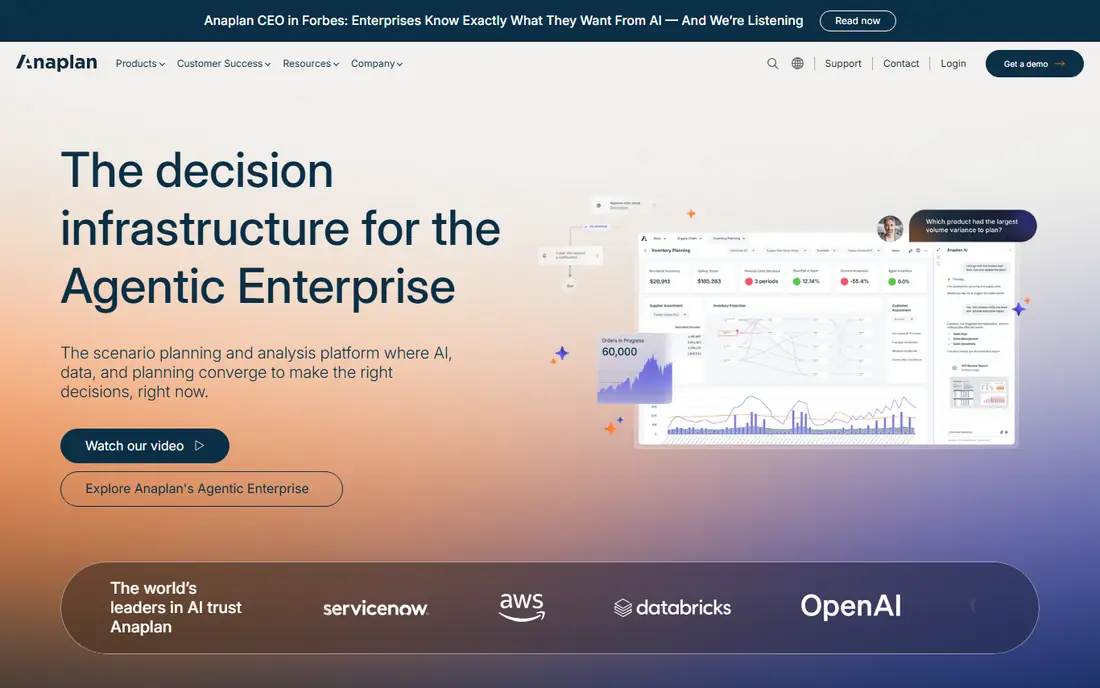
Anaplan is the enterprise heavyweight for connected planning. It models finance, sales, workforce and operations in one multi-dimensional engine, so a change to a sales assumption flows through headcount, revenue and cash in the same model. Large companies with many entities and complex structures use it precisely because spreadsheets break at that scale.
The price of that power is a long implementation and a quote-based contract that typically runs into six figures a year. Small teams should not start here. If your planning spans departments and countries, and you need one model everyone trusts, Anaplan is the benchmark other enterprise tools are measured against.
- Multi-dimensional modelling at scale
- Connected planning across departments
- Strong enterprise track record
- Quote-based pricing
- Implementation often takes months
Workday Adaptive Planning, formerly Adaptive Insights, is one of the most established cloud FP&A platforms. It covers financial, workforce and sales planning with support for complex organisational structures and multi-entity consolidation, plus machine learning forecasting with anomaly detection. Companies already running Workday HCM or Financials get the most value, because the data connections are native.
Like Anaplan, it is quote-based and carries real implementation cost, with enterprise deployments typically starting above $25,000 a year. The learning curve is also steeper than a spreadsheet-native tool. For Workday customers planning at enterprise scale, it is the natural first call.
- Deep Workday HCM and Financials integration
- Machine learning forecasting
- Enterprise-grade structure
- Quote-based pricing
- Heavy implementation overhead

Cube is the closest rival to Vena in spirit. Finance teams keep working in Excel or Google Sheets while Cube adds a central database, version control and automated actuals behind the scenes. Multi-scenario modelling, benchmarking and driver-based planning are built in, and implementation typically takes weeks rather than months.
The annoyance is pricing transparency: Cube does not publish plan prices, so the real number comes from sales, with published reports putting entry points around $2,000 a month. For mid-market teams that love spreadsheets but need governance, Cube is one of the strongest options on this list, and reviewers consistently rate it highly for ease of use.
- Works inside Excel and Google Sheets
- Fast implementation
- Multi-scenario modelling
- Pricing not published
- Less suited to the largest enterprises
Pigment is built for fast-growing companies where planning is a team sport. Its visual interface lets finance, HR and operations build budget, forecast and headcount plans together, with scenario planning and AI assistance woven in. It feels more modern than legacy enterprise tools, and collaboration is genuinely central rather than bolted on.
Pricing is quote-based and scales quickly, with larger deployments reported in the mid-five to low-six figures a year. That puts Pigment out of reach for very small teams. For a scaling company where headcount planning drives the whole forecast, Pigment is a strong, modern alternative to Vena.
- Visual, collaborative planning
- Strong headcount planning
- AI-assisted modelling
- Quote-based pricing
- Mid-five to low-six figure annual cost at scale
Datarails takes the Excel-native idea and leans into reporting. Finance teams build consolidated reports, budgets and forecasts in Excel while Datarails automates data consolidation, version control and collaboration underneath. An AI assistant helps with analysis and narrative, and the platform suits companies that produce board-ready reports every month.
Pricing is not publicly disclosed, with mid-market deployments typically running into five figures a year. Teams that dislike Excel will not enjoy Datarails, since the spreadsheet is the point. For Excel-centric finance teams that want faster closes and cleaner reporting, it is a direct Vena rival worth a demo.
- Excel-native reporting and consolidation
- AI assistant
- Strong automation
- Pricing not published
- Excel dependence can limit non-finance users
Planful is built around continuous planning: replacing the annual budget cycle with rolling forecasts, automated actuals and always-on reporting. It covers structured and dynamic planning, financial consolidation, multi-dimensional modelling and management reporting, with a web platform plus Excel add-ins for analysts who prefer spreadsheets.
Pricing is not published, with mid-market to enterprise deployments typically reported between $25,000 and $100,000 a year. Implementation usually takes one to three months including data connections and training. For mid-market companies that want to move past annual budgeting, Planful is a mature, well-supported choice.
- Rolling forecasts and continuous planning
- Multi-entity consolidation
- Excel add-ins
- Pricing not published
- Implementation takes one to three months
Prophix serves mid-market finance teams that need budgeting, forecasting, consolidation and reporting without enterprise complexity. It handles multi-entity consolidation and reconciliation well, and its workflow tools suit teams that close and report on a fixed monthly cycle. Published comparisons put its starting price around $3,000 per month.
That entry point is well above lightweight tools such as Jirav, so small companies should look elsewhere. For a mid-market company with several entities that needs reliable consolidation, Prophix offers depth without the six-figure enterprise commitment, and its support record is a genuine selling point.
- Strong consolidation and reconciliation
- Budgeting and forecasting in one platform
- Long mid-market track record
- Higher starting price than lightweight tools
- Implementation needs planning
Mosaic is a strategic finance platform built specifically for software companies. It combines planning with real-time analytics on the metrics SaaS boards care about, such as ARR, MRR, retention and burn, and produces investor-ready reporting without a separate business intelligence tool. AI assistance helps surface trends and explain variances.
Pricing is quote-based, with deployments typically in the mid-five figures a year. Non-SaaS companies will find the metric library less relevant, and very small startups may find it more than they need. For a Series A and beyond SaaS company, Mosaic is one of the best fits on this list.
- Real-time SaaS metrics
- Investor-ready reporting
- AI-powered insights
- Quote-based pricing
- SaaS focus limits fit for other industries
Jirav gets small and midsize companies from accounting data to a dynamic forecast quickly. It models profit and loss, balance sheet and cash flow together, with driver-based planning, rolling forecasts and what-if scenarios, plus industry templates for KPIs and board reporting. Connections to QuickBooks, Xero, NetSuite and Sage Intacct keep actuals fresh.
Published reports put pricing from around $10,000 a year, though Jirav does not publish plan tiers, so confirm the number with sales. Setup takes days to weeks rather than months, which is a real advantage over enterprise tools. For growth-stage companies and accounting firms offering FP&A advisory, Jirav hits a practical middle ground.
- Driver-based three-statement forecasting
- Fast setup
- Industry templates
- Exact plan pricing requires a sales conversation
- Premium for very small teams
Aleph lets finance teams plan in Excel and Google Sheets with live data connected from ERP and accounting systems, so actuals update without manual imports. Variance detection flags where results diverge from plan, and the platform adds version control and collaboration on top of the spreadsheet interface teams already know.
Pricing is quote-based, and Aleph is a younger company than Anaplan or Workday, so its partner ecosystem is smaller. Setup is typically measured in weeks. For teams that want to keep spreadsheets but kill the monthly copy-and-paste consolidation, Aleph is a modern, focused alternative to Vena.
- Spreadsheet-first with live ERP data
- Variance detection
- Fast setup
- Quote-based pricing
- Newer ecosystem than legacy rivals
How we picked these
We compared official product pages, pricing pages and public documentation for FP&A tools that cover budgeting, forecasting, consolidation or reporting in the same space as Vena. We included Excel-native tools, mid-market platforms and enterprise suites, and we favoured tools that are live and supported in October 2026. Where a vendor does not publish a price, we wrote See website rather than repeating an unverified estimate as fact.
What to check before you buy
Start with how your team actually plans. If analysts refuse to leave Excel, shortlist Cube, Datarails and Aleph first, because adoption will decide whether the purchase works. If planning spans many departments and entities, look at Anaplan, Workday Adaptive Planning and Planful, and budget for a longer implementation. Map your data sources early: accounting, HR and CRM connections are where rollouts stall, not in the modelling itself.
Budget the full cost
Licence fees are only part of the bill. Ask each vendor for implementation cost, training cost and the renewal price, and model the total at your headcount in two years, not today. Quote-based vendors will negotiate, especially against a rival quote, so run at least two demos before you sign. A paid pilot on one real forecast cycle is worth more than a polished sales demo.
Pick by company stage
Startups and small companies should start with Jirav or Mosaic, mid-market teams with Cube, Datarails, Prophix or Planful, and enterprises with Anaplan or Workday Adaptive Planning. Pigment suits fast-growing companies where headcount planning leads the forecast, and Aleph suits teams that want live data without leaving spreadsheets.
Frequently asked questions
Is Vena only for Excel users?
Mostly, yes. Vena is designed around Excel as the front end, with a governed database underneath. Teams that want to move away from spreadsheets entirely should look at Planful, Pigment or Anaplan instead, which are built around their own web interfaces.
Why do most FP&A tools hide their prices?
FP&A pricing depends on users, entities, data volume and modules, so vendors prefer quotes. Mid-market tools often run $20,000 to $60,000 a year, while enterprise platforms cost considerably more, plus implementation. Always ask for the full first-year cost before comparing.
How long does FP&A implementation take?
Lightweight tools can run in days to weeks, mid-market platforms typically take one to three months, and enterprise suites often take three to nine months with consulting support. The state of your source data is usually the biggest variable, not the software itself.
Do I need to abandon Excel to use FP&A software?
No. Cube, Datarails, Aleph and Vena itself are designed to work inside Excel, adding a connected database, version control and automated actuals behind the familiar interface. If your team resists leaving spreadsheets, shortlist the Excel-native options first.
What is the difference between FP&A software and a business intelligence tool?
FP&A software plans the future: budgets, forecasts, scenarios and consolidations. Business intelligence tools analyse the past and present through dashboards and reports. Many teams use both, with FP&A feeding plans into dashboards for tracking.
Sources
- https://www.anaplan.com
- https://www.workday.com/en-us/products/adaptive-planning.html
- https://www.cube.com
- https://www.pigment.com
- https://www.datarails.com
- https://planful.com
- https://www.prophix.com
- https://www.mosaic.tech
- https://www.jirav.com
- https://www.alephhq.com
- https://www.g2.com/compare/cube-2025-12-17-vs-planful
- https://www.selecthub.com/c/fp-and-a-software/
See where you really rank - block by block
ProMapRanker scans Google Maps across a grid of your service area. Simple monthly plans from $19, white-label on every plan.
Start freeKeep reading
 zoro.to alternatives
Best Zoro.to Alternatives in 2026
We compare the best zoro.to alternatives in 2026, listing only legal licensed anime streaming services, from Crunchyroll to free options for fans today.
Read → zip alternatives
Best Zip Alternatives in 2026
We compare the best zip alternatives for buy now, pay later in 2026, covering pay-in-4 plans, fees, spending limits, and credit reporting options today.
Read → yesware alternatives
Best Yesware Alternatives in 2026
Compare the best yesware alternatives for sales email tracking, templates, and sequences, with current pricing and honest tradeoffs for small sales teams.
Read →