 ProMapRanker
Best Upstash Alternatives in 2026

Key takeaways
- Upstash covers serverless Redis and, in past versions, Kafka, so the best alternative depends on whether you need caching, queues, streaming or a database.
- Redis Cloud is the closest managed Redis replacement, while Momento and Dragonfly Cloud suit usage based caching and high throughput workloads.
- Confluent Cloud, Redpanda Cloud and Aiven cover Kafka streaming, with Aiven offering a free plan for a small Kafka service.
- Cloudflare Workers KV and Turso suit edge and serverless apps, but they do not replace a full Redis or Kafka setup on their own.
- Check protocol support first. A tool that lacks your Redis commands or Kafka protocol features will cost more in code changes than it saves in hosting.
Quick comparison
| Pick | Great for | Pricing starts at | Free tier | |
|---|---|---|---|---|
 Redis Cloud | Managed Redis replacement | See website | Yes | Visit |
 Momento | Usage based caching | See website | Free trial | Visit |
 Dragonfly Cloud | High throughput Redis compatible cache | See website | Free trial | Visit |
 Confluent Cloud | Managed Kafka streaming | See website | Free trial | Visit |
 Redpanda Cloud | Kafka compatible streaming | See website | Free trial | Visit |
 Aiven | Managed Kafka with free plan | Free | Yes | Visit |
 Amazon ElastiCache Serverless | AWS native caching | See website | No | Visit |
 Cloudflare Workers KV | Edge key value storage | See website | Yes | Visit |
 Turso | Serverless edge database | See website | Yes | Visit |
The best Upstash alternatives
Upstash is a serverless data platform best known for Redis with a REST API, plus rate limiting, queues and search features for edge and serverless apps. These alternatives cover its main jobs from different angles. We compared pricing models, protocol support and free tiers, and kept only services that are still sold for caching, streaming or serverless data.

Redis Cloud is the most direct replacement for Upstash Redis. It runs managed Redis with the full range of data structures, persistence, replication and modules such as search and JSON, without requiring a team to run clusters. Teams moving from Upstash will find the protocol familiar and the feature set broader.
Cost is the trade off. Published listings show tiered pricing that rises with memory, throughput and availability needs, and the free tier is small, with low operation limits. For a production cache with steady traffic, Redis Cloud is a safe, well supported pick. For a tiny edge project, a usage based tool may be cheaper.
- Full Redis data structures and modules
- Managed failover and backups
- Multi cloud and multi region options
- Pricing scales with memory and throughput
- Free tier is small and capped
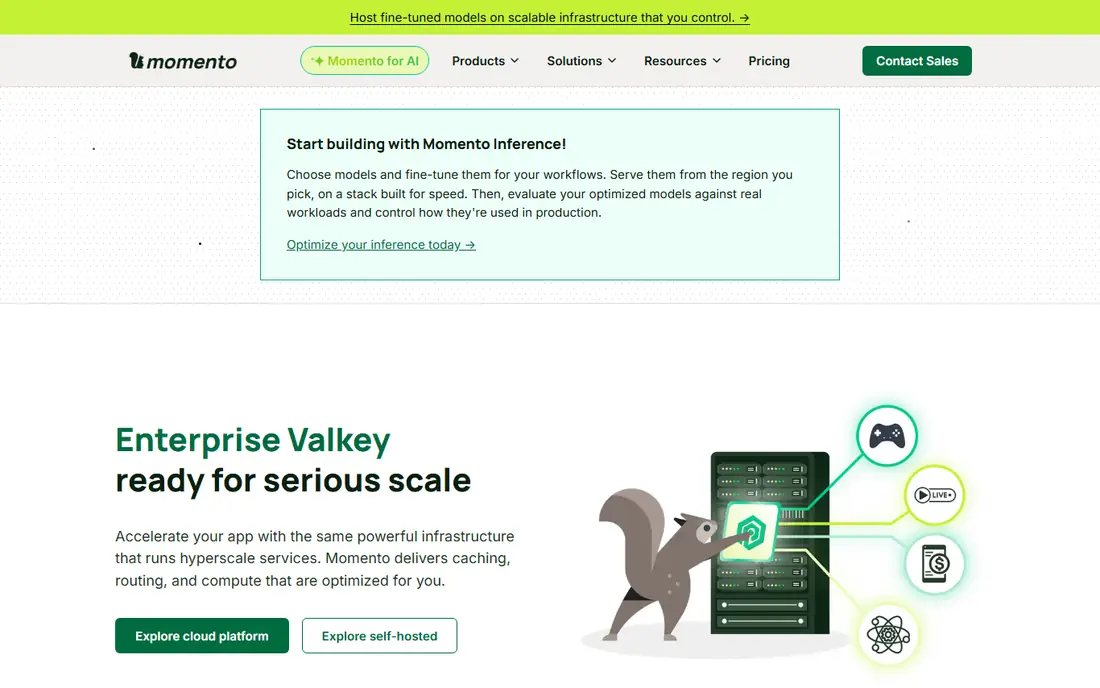
Momento suits teams that want caching without sizing a cluster. It scales automatically, bills by usage, and covers caching plus pub and sub topics, which maps well to real time features and rate limiting patterns that Upstash users often build. The serverless model fits variable workloads where traffic spikes are hard to predict.
The limit is breadth. Momento does not offer the full Redis data structure set in one store, and its vector index is a separate service rather than part of a single multi model database. Teams that rely on Redis JSON, time series or probabilistic structures should check command coverage before migrating. Teams that mainly need fast caching and topics will like the simplicity.
- Serverless caching with no capacity planning
- Pub and sub topics
- Vector index as a separate service
- Data structure range is narrower than Redis
- Caching, topics and vector search are separate services

Dragonfly is a Redis compatible in memory store designed for high throughput, and its cloud service gives teams a managed path without self hosting. Because it speaks the Redis protocol, many existing clients and code paths can move with little change. That compatibility is the main reason to consider it over a non Redis cache.
Maturity is the caution. Dragonfly Cloud is newer than Redis Cloud, so buyers should test persistence, failover and the specific commands their app uses before committing production traffic. For a cache heavy workload where throughput matters and Redis compatibility is required, it is a credible alternative.
- Redis compatible API
- High throughput design
- Managed cloud option for teams that want less operations
- Newer managed cloud than Redis Cloud
- Check module and persistence coverage for your workload
Confluent Cloud is the leading managed Kafka choice for teams that need streaming at scale. It runs Kafka clusters, connectors and stream processing, with tooling for schemas, governance and analytics on top of event streams. Teams that used Upstash for Kafka style messaging, or that need a stronger streaming platform, should start here.
Pricing needs careful modeling. Costs depend on throughput, storage, retention and processing, and the free trial uses credit that expires after a set period rather than a permanent free tier. Small experiments can still start cheaply, but production streaming bills should be modeled from real event volumes, not from the trial credit alone.
- Fully managed Kafka
- Stream processing with Flink SQL
- Broad connector ecosystem
- Costs scale with throughput and retention
- Trial credit expires after a set period
Redpanda offers a Kafka compatible streaming platform with a simpler architecture and strong performance claims. Its cloud service includes a serverless option, which suits teams that want Kafka protocol support without managing brokers. Existing Kafka clients can often connect with little change, which lowers migration effort.
The trade off is ecosystem. Confluent offers a broader connector and stream processing set, while Redpanda focuses on core streaming performance and simplicity. Trial credit also expires, so buyers should plan a paid pilot once the trial ends. For a team that wants fast Kafka compatible streaming with less operational weight, Redpanda is a strong pick.
- Kafka compatible API without ZooKeeper complexity
- Serverless option
- Strong throughput per node
- Trial credit is time limited
- Ecosystem differs from Confluent in connectors and tooling
Aiven stands out for learning and small projects because it offers a free plan for a small Kafka service with no card at signup in recent listings. The service powers off when idle and has limits on throughput, topics and retention, but it gives a real managed Kafka to test against. Aiven also hosts PostgreSQL, OpenSearch and other data services, so teams can keep several managed stores in one account.
Production use needs a paid tier. The free plan is not a substitute for a production cluster, and costs rise with service size and cloud region. For a team that wants a low risk way to try managed Kafka, or that already uses Aiven for other data services, it is the best starting point on this list.
- Free plan for a small Kafka service
- Managed Kafka, PostgreSQL and other data services
- Multi cloud hosting
- Free plan is small and powers off when idle
- Paid tiers scale with service size
ElastiCache Serverless suits teams that already run on AWS. It provides serverless caching with pay for stored data and request usage, without capacity planning, and it integrates with VPC networking, IAM permissions and CloudWatch monitoring. Redis and Valkey protocol support keeps client code familiar.
The limit is cloud lock in. A multi cloud or edge app that runs outside AWS will not benefit from ElastiCache, and pricing has no single flat rate, so teams need the AWS calculator to model cost. For an AWS native app that needs a managed cache close to its workloads, ElastiCache Serverless is a natural Upstash alternative.
- Serverless caching inside AWS
- Redis and Valkey support
- VPC and IAM integration
- AWS only, so it does not fit multi cloud apps
- Pricing needs the AWS calculator for an exact figure
Cloudflare Workers KV fits edge apps that need fast reads close to users. It stores key value pairs across Cloudflare's network and pairs naturally with Workers for serverless functions. A free tier makes it easy to test, and the global distribution suits configuration, session hints and cached content.
Consistency and data model are the limits. KV is eventually consistent and lacks Redis data structures, pub and sub, and rich commands, so it cannot replace Redis for queues, leaderboards or complex caching patterns. Use it for edge key value needs alongside a Redis or streaming tool, not as a drop in Redis replacement.
- Global edge key value storage
- Works with Workers
- Free tier for small projects
- Eventually consistent reads
- Not a full Redis replacement for complex data structures
Turso covers a different Upstash use case: a serverless database for apps that need relational data close to users. Built on libSQL, a SQLite fork, it replicates databases to the edge and offers a free tier for small projects. That model suits apps that need structured data, queries and transactions rather than a cache or event stream.
It is not a Redis or Kafka replacement. Teams that need caching, pub and sub or event streaming should pair Turso with Redis Cloud, Momento or a Kafka service. Teams that used Upstash mainly for small app data and want a serverless database at the edge will find Turso a good fit.
- Serverless SQLite at the edge
- LibSQL compatibility
- Free tier for small projects
- Relational model, not Redis or Kafka
- Check write scaling for high write workloads
How we picked these
We compared official pricing pages, protocol support, free tiers and serverless models for data services that overlap with Upstash. We left out Upstash itself and kept services that are still sold for caching, streaming or serverless data. Where pricing was usage based or differed across sources, we used See website rather than guessing a flat figure.
How to migrate without breaking your app
Start by listing every Upstash feature your app actually uses: Redis commands, REST API access, rate limiting, queues, topics or Kafka style streaming. That list decides the replacement, since no single tool on this page covers every Upstash feature in one product. Test protocol coverage next, especially for Redis commands and Kafka client compatibility, and run load tests at realistic traffic levels.
Next, compare billing units, not headline prices. Usage based tools bill by commands, operations or data transfer, while tiered tools bill by memory and throughput. Model both at your current traffic and at twice that traffic, since serverless costs can jump under spikes. Finally, migrate one workload at a time, keep the old store running during the cutover, and confirm latency and error rates before moving the next workload.
Frequently asked questions
What is Upstash used for?
Upstash is a serverless data platform best known for Redis with a REST API, plus rate limiting, queues and search features for edge and serverless apps. It suits developers who want data services without managing servers or clusters.
Which Upstash alternative is best for Redis?
Redis Cloud is the closest managed Redis replacement, with full data structures, persistence and multi region options. Momento and Dragonfly Cloud are strong usage based and high throughput alternatives, depending on whether you need simplicity or Redis compatibility at scale.
Does Upstash still offer Kafka?
Upstash Kafka was discontinued in March 2025 according to third party listings, so teams that need Kafka style streaming should choose Confluent Cloud, Redpanda Cloud or Aiven instead. Check the current Upstash docs for the latest product list before planning a migration.
Is there a free Upstash alternative?
Yes. Aiven offers a free plan for a small Kafka service, Redis Cloud offers a small free tier, and Cloudflare Workers KV and Turso offer free tiers for small projects. Free tiers are best for testing and small apps, not for production traffic at scale.
Can Cloudflare Workers KV replace Redis?
No, not for most Redis workloads. Workers KV is a globally distributed key value store with eventual consistency, while Redis offers rich data structures, pub and sub and stronger consistency options. Use KV for edge key value reads and Redis for caching, queues and real time features.
How do serverless data costs scale?
Serverless tools bill by usage, such as commands, operations, storage or throughput, rather than by reserved servers. That can be cheap for variable workloads and costly for steady high volume workloads, so model costs at current and doubled traffic before committing.
Sources
See where you really rank - block by block
ProMapRanker scans Google Maps across a grid of your service area. Simple monthly plans from $19, white-label on every plan.
Start freeKeep reading
 zyte alternatives
Best Zyte Alternatives in 2026
These zyte alternatives cover managed scraping APIs, proxy networks and no code tools for lawful collection from your own or consented sources only in 2026.
Read → zerto alternatives
Best Zerto Alternatives in 2026
Compare the best zerto alternatives for disaster recovery and replication, with recovery targets, cloud options and honest trade-offs for teams in 2026.
Read → zerofox alternatives
Best ZeroFox Alternatives in 2026
We compared 9 zerofox alternatives for brand protection, phishing takedowns, dark web monitoring, and social impersonation, with clear coverage notes.
Read →