 ProMapRanker
Top RFP Software in 2026: 9 Tools Compared

Key takeaways
- Responsive leads for large teams running complex RFP operations, while Loopio leads for teams that want a structured, governed content library.
- Qvidian and RocketDocs fit regulated and document heavy teams, with Qvidian favoring Microsoft Office workflows and RocketDocs favoring private AI.
- AutoRFP.ai and 1up offer faster, AI led routes for teams that want drafting without a large enterprise rollout.
- PandaDoc, Proposify and Better Proposals fit smaller teams that need proposals and RFP responses in one affordable tool, with e signatures included.
- The library is the long term asset, so test content reuse, freshness controls and export quality before choosing on AI features alone.
Quick comparison
| Pick | Great for | Pricing starts at | Free tier | |
|---|---|---|---|---|
 Responsive | Large complex RFP operations | See website | No | Visit |
 Loopio | Structured content library | $20,000 per year | No | Visit |
 Qvidian | Regulated document heavy teams | See website | No | Visit |
 RocketDocs | Regulated teams needing private AI | See website | No | Visit |
 AutoRFP.ai | AI drafting without per seat fees | $899 per month | Free trial | Visit |
 1up | Answering questions inside Slack | $250 per month | Yes | Visit |
 PandaDoc | Proposals with e signatures | $19 per user per month | Yes | Visit |
 Proposify | Branded proposals for agencies | $19 per user per month | Free trial | Visit |
 Better Proposals | Budget proposals for small teams | $13 per user per month | Free trial | Visit |
The best RFP software
RFP software helps teams answer requests for proposal, security questionnaires, due diligence questionnaires and RFIs faster and more consistently, by reusing approved content, assigning work to experts, and tracking every response to deadline. The tools below range from enterprise response platforms to affordable proposal tools that also handle RFP work.
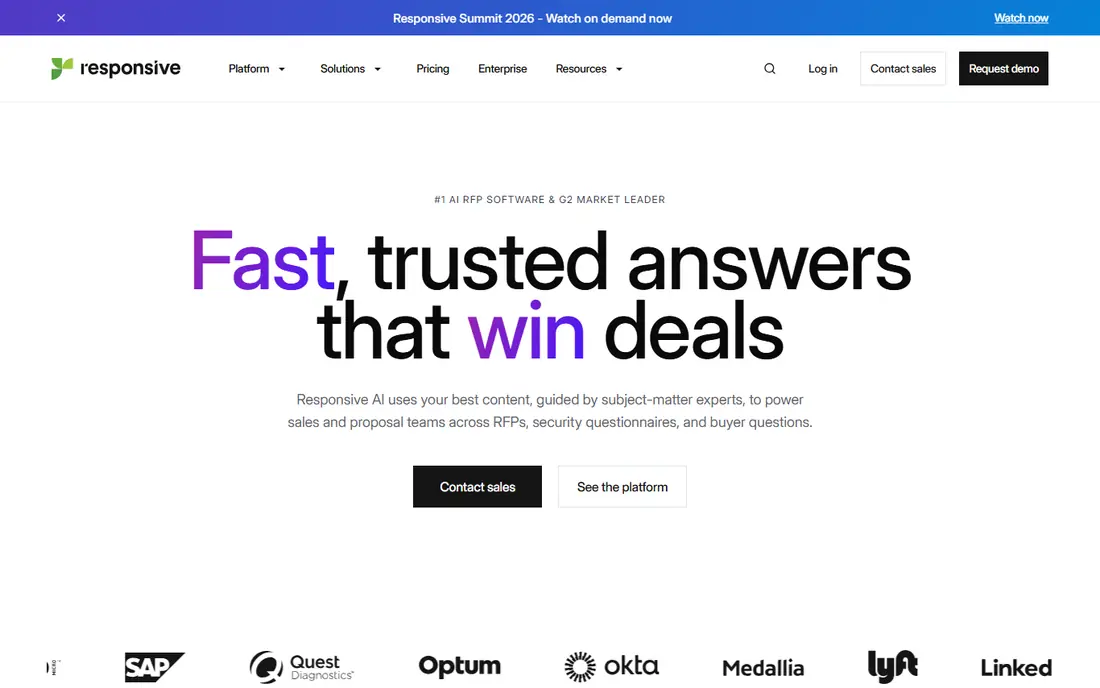
Responsive, formerly RFPIO, is the enterprise standard for response management. It handles intake, content library management, project assignments, collaboration, review cycles, reporting and analytics for RFPs, proposals, security questionnaires, DDQs and RFIs. Large teams can run hundreds of responses a year across departments, with governance controls that keep answers consistent and auditable.
Responsive AI adds first drafts and knowledge search inside the content library and project workflows, so teams can start from approved content rather than a blank page. The platform also offers trust center capabilities and program level reporting, which help leaders see volume, win rates and content gaps. The main drawback is access. Pricing is custom and sales led, and implementation takes time, so smaller teams may find the platform heavier than they need.
Responsive fits dedicated proposal departments, large sales organizations and regulated companies with complex response programs. If volume, governance and reporting matter most, Responsive is the platform to beat.
- Full RFP lifecycle and program controls
- Deep reporting
- Strong enterprise governance
- Quote based pricing
- Heavier setup than smaller tools

Loopio is built around a governed Library of approved responses, which is its core strength. Teams store, review and update answers in one place, then reuse them across RFPs, security questionnaires, DDQs and proposals, with confidence indicators and review dates to flag stale content. Projects support assignments, deadlines, expert collaboration, document handling and portal responses, keeping work visible from intake to submission.
Loopio AI adds assisted answers, tone adjustments, source citations, entry history and semantic search, so teams can draft faster without losing the link to approved source content. The Foundations package starts at $20,000 per year for ten seats, with unlimited projects and library entries, which sets a clear entry point for mid sized and enterprise teams. The ongoing cost is maintenance. A library only stays useful if owners review entries, retire duplicates and update claims, and that work needs a named owner.
Loopio fits teams with a dedicated content manager and a mature proposal process. If answer consistency and library governance are your priorities, Loopio is a strong, focused choice.
- Governed Library with review controls
- AI assisted answers
- Clear project workflows
- High entry package
- Library needs ongoing maintenance to stay current
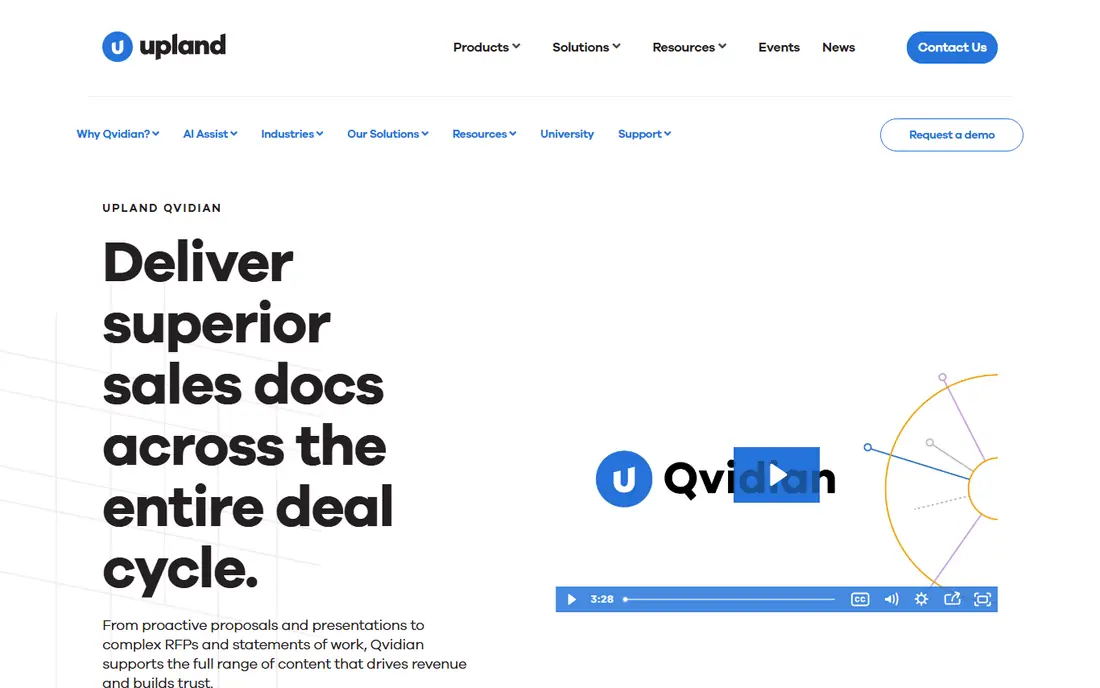
Qvidian, part of Upland Software, focuses on document heavy RFP and proposal work, especially for teams that live in Microsoft Word. It offers a content library, proposal automation, multi stage approvals and governance controls that help regulated enterprises in finance, healthcare and other sectors produce consistent, compliant documents. The Word centric approach matters for teams whose final deliverable is a formatted Word document that must match exact templates.
Qvidian handles complex documents, reusable content and approval chains well, although its workflow feels more traditional than browser first platforms such as Loopio or Responsive. Pricing is quote based, so buyers should expect a sales led process and should ask for pricing tied to user count and document volume. The platform rewards teams with a clear document process and a need for control.
Qvidian fits banks, insurers, healthcare organizations and other regulated teams that produce long, formatted proposal documents. If Word output quality and approval governance matter most, Qvidian deserves a place on the shortlist.
- Word centric document automation
- Multi stage approvals
- Governance controls
- Quote based pricing
- Office centered workflow may feel dated for browser first teams
RocketDocs is a response management platform for regulated industries, with a focus on private AI that drafts from a company's own approved content without sending that content to a public model in the same way a generic AI tool would. That privacy stance matters for finance, healthcare and other regulated teams that must control where sensitive content goes. The platform also offers a content library, project workflows, collaboration and reporting for RFPs and questionnaires.
RocketDocs positions itself as a modern alternative to legacy response tools, with AI drafting grounded in company sources. The trade off for conservative buyers is track record. RocketDocs is less established than Responsive or Loopio, so procurement teams should check references in their industry, confirm security and data handling in writing, and run a pilot on a real RFP before committing.
RocketDocs fits regulated teams that want AI speed without giving up data control. If private AI is a requirement, not just a preference, RocketDocs is a strong candidate to pilot.
- Private AI for response drafting
- Content library and workflows
- Regulated industry focus
- Quote based pricing
- Newer brand than Responsive or Loopio for some buyers
AutoRFP.ai is an accuracy first AI platform for RFPs, security questionnaires and DDQs. It generates source grounded answers with citations from approved company content, flags gaps where no source supports an answer, and assigns Trust Scores so reviewers can focus on the riskiest responses first. That evidence first design helps financial services and other regulated teams defend answers to investors, auditors and regulators.
The Scale plan starts at $899 per month on annual billing, without per seat fees, which changes the math for teams with many occasional contributors. A thirty day free trial lets teams test the workflow on real questionnaires. The main limit is that AI drafting, however well grounded, still needs human review and sign off, especially for high stakes claims about security, compliance or financials.
AutoRFP.ai fits asset managers, insurers, fintech companies and other regulated firms that answer many questionnaires and need defensible, citable responses. If accuracy and auditability matter more than a large enterprise suite, AutoRFP.ai is a focused choice.
- Source grounded answers with citations
- Trust Scores and gap flags
- No per seat pricing model
- Monthly price is high for very small teams
- AI output still needs human sign off
1up takes a different route to RFP work. Instead of asking sales teams to open a separate platform, it answers questions inside Slack, drawing on a company's knowledge base and past responses. A salesperson can ask a security, product or compliance question in Slack and get a sourced answer quickly, which speeds up RFP responses and day to day deal work alike. That Slack native design is why small and mid sized sales teams adopt it fast.
The Starter plan starts at $250 per month, with a free plan available, making 1up far more accessible than enterprise response platforms. The trade off is scope. 1up is stronger at answering questions than at managing a full RFP project with assignments, reviews and formatted document output, so teams with complex, document heavy RFPs may still need Loopio, Responsive or Qvidian for the final submission.
1up fits sales teams that live in Slack and answer many repeat questions across RFPs, security questionnaires and deal reviews. If speed inside Slack matters most, 1up is a practical, affordable pick.
- Slack native question answering
- Knowledge base reuse
- Fast for sales teams
- Narrower project management than full RFP platforms
- Needs a clean knowledge base
PandaDoc is best known for proposals, quotes and contracts with built in e signatures, but it also works for smaller RFP responses where the deliverable is a branded proposal document. Teams can use templates, a content library, approval workflows and analytics, then send the finished proposal for signature without a separate tool. That all in one path suits sales teams and agencies that need to move from response to signed deal quickly.
The Essentials plan starts at $19 per user per month on annual billing, with a free plan covering a limited number of documents per month. The main limit is RFP depth. PandaDoc does not offer the same questionnaire project management, AI drafting and governance controls as Responsive or Loopio, so large, complex RFP programs will outgrow it. For smaller, proposal shaped responses, that trade off is acceptable.
PandaDoc fits small and mid sized sales teams, agencies and freelancers who need branded proposals with signatures at an affordable price. If your RFP work ends in a proposal that needs signing, PandaDoc is a strong value choice.
- Proposal creation plus e signatures
- Templates and content library
- Affordable entry
- RFP project depth is lighter than dedicated response platforms
- Advanced features sit on higher plans
Proposify helps agencies, consultants and sales teams create polished, branded proposals with templates, a content library, interactive pricing and e signatures. Teams can control branding, track when a prospect opens a proposal, and follow up with data rather than guesswork. That presentation quality matters for agencies and professional services firms, where the proposal itself is part of the pitch.
The Basic plan starts at $19 per user per month on annual billing, with a fourteen day free trial. As with PandaDoc, Proposify is a proposal tool first, not a dedicated RFP response platform, so complex questionnaires with hundreds of questions and many expert contributors will need a tool such as Loopio or Responsive. For proposal led RFP responses, however, Proposify offers a clean, affordable workflow.
Proposify fits agencies, consultants and sales teams that win work with branded proposals. If presentation and ease of use matter more than questionnaire project depth, Proposify is a good fit.
- Polished branded proposals
- Templates and content library
- E signatures and analytics
- RFP questionnaire depth is limited
- Best for proposal documents, not complex RFP projects
Better Proposals is the budget option in this list, with a Starter plan at $13 per user per month on annual billing and a fourteen day free trial. It offers proposal templates, content reuse, e signatures and tracking in a simple interface that a freelancer or small team can learn quickly. That simplicity is the point. A small team does not need enterprise governance to send a professional proposal.
The trade off is depth. Better Proposals does not offer the content library governance, AI drafting or questionnaire project tools of the enterprise platforms, and larger teams will hit its limits as volume and complexity grow. It works best for small, proposal shaped work where speed and price matter more than program controls.
Better Proposals fits freelancers, startups and small agencies that need professional proposals on a tight budget. If you send a handful of proposals a month and want the lowest cost professional option, start here.
- Lowest entry price in this list
- Simple proposal creation
- Templates and signatures
- Fewer advanced features
- Limited RFP and questionnaire management
How we picked these
We compared official product pages, pricing pages and reputable comparisons for software that manages RFP responses, proposals or questionnaires, not general document editors with no response workflow. We kept only tools that exist and work in October 2026 and that offer content reuse, collaboration or proposal creation for RFP work. Where pricing was not published by the vendor, we wrote See website rather than repeating an estimate as a fact. We favored a mix of enterprise response platforms, AI led tools and affordable proposal tools so readers at different sizes can find a fit.
What to check before you pay
Start with your response volume and complexity. Count how many RFPs, security questionnaires and DDQs you answer each year, how many questions a typical response has, and how many people contribute. A team answering ten short proposals a year needs a different tool from a team answering two hundred complex questionnaires across departments. Match the tool to that volume, not to the longest feature list.
Next, test the library on a real RFP. Import a past response, search for three answers you know are hard to find, and check whether reuse is fast, whether stale answers are flagged, and whether export matches your template. A library that is hard to search will not be used, and an export that needs hours of cleanup will erase the time saved on drafting.
Finally, check AI grounding and review controls. Ask how AI drafts link to source content, how reviewers approve or reject answers, and how the system handles a question with no approved source. A tool that invents a confident answer is worse than a tool that flags a gap, especially for security and compliance questions.
Frequently asked questions
What is the best RFP software?
Responsive leads for large, complex RFP operations, Loopio leads for governed content libraries, and PandaDoc or Better Proposals lead for smaller proposal led teams. The best choice depends on volume, complexity and whether the deliverable is a questionnaire, a formatted document or a signed proposal.
What is the best RFP platform for small teams?
PandaDoc, Proposify and Better Proposals fit small teams, with entry prices from $13 to $19 per user per month and e signatures included. 1up also fits small sales teams that answer questions inside Slack, at $250 per month for the Starter plan.
How much does RFP software cost?
Prices in this list range from $13 per user per month for Better Proposals to $20,000 per year for Loopio Foundations, with AutoRFP.ai at $899 per month and 1up at $250 per month. Responsive, Qvidian and RocketDocs are quote based, so ask for pricing at your user count and response volume.
What is the difference between RFP software and proposal software?
RFP software focuses on answering questionnaires and managing response projects, with content libraries, assignments and reviews. Proposal software focuses on creating branded proposal documents with pricing and signatures. Many teams need both, and tools such as PandaDoc and Proposify bridge the gap for smaller programs.
Sources
See where you really rank - block by block
ProMapRanker scans Google Maps across a grid of your service area. Simple monthly plans from $19, white-label on every plan.
Start freeKeep reading
 zscaler alternatives
Best Zscaler Alternatives in 2026
Looking for zscaler alternatives? We compare 9 SASE and zero trust platforms on architecture, data protection, pricing, and fit for your network and team.
Read → zapier alternatives free
Best Zapier Alternatives Free in 2026
Nine automation tools for zapier alternatives free in 2026, all with genuinely free tiers, plus free plan limits, starting prices and upgrade paths explained.
Read → which platform is best for online reputation
Which Platform Is Best for Online Reputation in 2026
Wondering which platform is best for online reputation? We compare 8 review, listing, and response tools for small and multi-location businesses and agencies.
Read →