 ProMapRanker
Top Expense Management Software Comparison in 2026

Key takeaways
- Card-first tools such as Ramp and Brex bundle cards, expenses, and controls, while report-first tools such as Expensify work with cards you already have.
- Ramp and Brex offer free core tiers for qualifying US businesses, which makes them strong starts for startups.
- Navan suits companies that want travel booking and expenses in one flow, while SAP Concur suits large enterprises with complex policies.
- Zoho Expense and BILL Spend and Expense lead on low cost for small teams.
- Check card requirements, approval workflows, and accounting integrations before you move a whole team.
Quick comparison
| Pick | Great for | Pricing starts at | Free tier | |
|---|---|---|---|---|
 Ramp | Free card-first spend management | Free | Yes | Visit |
 Brex | Startups and scaling companies | Free | Yes | Visit |
 Expensify | Reporting with existing cards | $5 per month | Yes | Visit |
 Zoho Expense | Budget teams and Zoho users | Free | Yes | Visit |
 Navan | Travel plus expenses together | Free | Yes | Visit |
 BILL Spend & Expense | Free spend controls with BILL cards | Free | Yes | Visit |
 SAP Concur | Large enterprise travel and expense | See website | No | Visit |
 Airbase | Mid-market procure-to-pay control | See website | No | Visit |
The best expense management software comparison
We compared tools that capture receipts, enforce policy, approve spending, and sync to accounting. Our pick for most startups is Ramp, with Brex close behind, while Expensify is the pick for teams that want to keep their current cards.

Ramp gives startups and growth companies corporate cards, expense management, and spend controls in a free core tier. Receipt capture, policy flags, and accounting sync reduce the manual work that usually piles up at month end. Managers can set limits by team or vendor, and finance can see spending as it happens rather than after reports arrive.
The main condition is that you use Ramp cards, so teams that want to keep an existing card program should look at Expensify instead. Some businesses may not qualify for Ramp, and advanced features such as bill pay depth sit on Plus, commonly listed from $15 per user per month plus a platform fee. For qualifying US companies that want automation free, Ramp is a strong first choice.
- Free core tier with cards and expenses
- Strong automation and policy controls
- Bill pay on paid tiers
- Requires Ramp cards
- Some businesses may not qualify
- Advanced features need Plus or Enterprise

Brex combines corporate cards, spend management, and banking tools for startups and scaling companies. Its Essentials tier is free, while Premium is commonly listed from $12 per user per month and adds deeper controls and features. That stack suits venture-backed and fast-growing companies that want cards, travel, and expenses without stitching several vendors together.
Brex underwrites customers rather than selling a simple seat, so not every business qualifies on the same terms. Teams outside the startup profile may find Ramp or Expensify simpler to adopt. For a funded startup that wants a full finance stack in one place, Brex is a credible alternative to Ramp, and the choice often comes down to card terms and support.
- Free Essentials tier
- Cards, banking, and spend controls in one stack
- Global spend support
- Eligibility and underwriting apply
- Premium features cost extra
- Some features suit funded startups best
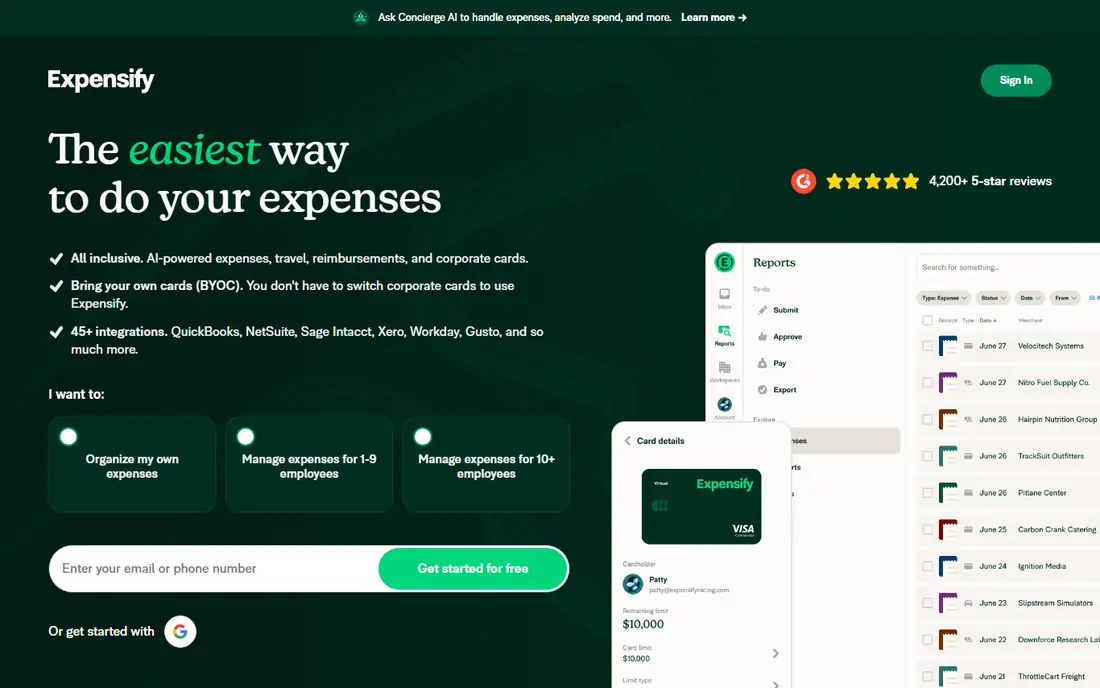
Expensify is the classic expense report tool, and its main advantage is flexibility. You do not need to switch cards to use it, which matters for companies with an existing bank or card program. Receipt scanning, mileage, reimbursements, and accounting integrations cover the core workflow for small and mid-size teams, and the Collect plan is commonly listed from $5 per member per month.
Advanced controls, such as multi-level approvals and deeper integrations, sit on higher plans, so the entry price does not tell the whole story. Plan names and details have changed over time, so check the current pricing page before you commit. If your team wants to keep its cards and simply fix reporting, Expensify remains the most flexible pick.
- Works with cards you already have
- Strong receipt scanning and reimbursements
- Flexible for many team sizes
- Advanced controls cost more
- Pricing and plan names change
- Per-member pricing adds up at scale
Zoho Expense is the budget pick in this comparison. A free version covers up to three users, and paid plans are commonly listed from around $3 to $4 per active user per month on annual billing. Receipt capture, approvals, mileage, and accounting sync cover the basics well, and integration with Zoho Books makes month-end work smoother for Zoho users.
Zoho Expense does not offer the same card-first controls as Ramp or Brex, since it works with expenses and reimbursements rather than issuing its own cards as the core product. Larger teams with complex procurement needs may need a heavier tool. For a small team that wants solid expense automation at a low price, Zoho Expense is hard to beat.
- Free version for up to three users
- Low paid pricing
- Strong fit with Zoho Books
- Card features are thinner than Ramp or Brex
- Advanced features need paid plans
- Best value inside Zoho
Navan suits companies where travel is a large share of spending. Booking a flight or hotel and capturing the expense happen in the same system, which reduces the usual gap between a trip and its report. For companies with up to 300 employees, the first five monthly expensing users are commonly free, with further users from $15 per user per month.
Teams that rarely travel may not need Navan's booking depth, and the price after the free users should be modeled for your whole team. Navan also competes with pure expense tools on reporting depth, so finance teams with complex approval chains should trial both. If travel and expenses belong together in your company, Navan is the natural pick.
- Travel booking and expenses in one flow
- First five expensing users free for smaller companies
- Policy controls for travel
- Full expense pricing applies after the free users
- Travel focus may be more than some teams need
- Enterprise pricing is quoted
BILL Spend and Expense, formerly Divvy, gives small teams free employee cards with built-in budgets and controls. Managers can set spending limits, employees can capture receipts in the app, and finance can track spending against budgets in real time. For teams already using BILL for bill pay, keeping spend in the same system simplifies reconciliation.
As with Ramp and Brex, the free spend features depend on using BILL cards, so report-only teams should look at Expensify or Zoho Expense. BILL's broader platform also includes paid bill pay and accounting features that may be more than a tiny team needs. For a small team that wants free cards and controls without a monthly seat fee, BILL is a strong option.
- Free plan with BILL corporate cards
- Budgets and controls built in
- Fits BILL bill pay users
- Requires BILL cards for the free spend features
- Less suited to report-only teams
- Enterprise pricing varies
SAP Concur is the enterprise standard for travel and expense in large organizations. It handles complex policies, multi-entity structures, audits, and global travel rules that smaller tools cannot match. Integrations with ERP and HR systems help large finance teams keep expense data consistent across many countries and business units.
Concur is quoted, implementation takes planning, and the product is far heavier than a small team needs. A startup that adopts Concur early will pay in setup time and cost for features it does not use. For a large enterprise with complex travel and expense policies, though, Concur's depth and audit support justify the investment.
- Deep policy, audit, and multi-entity support
- Global travel and expense coverage
- Strong enterprise integrations
- Quote-based pricing
- Implementation takes time
- Overkill for small teams
Airbase, now part of the Paylocity group, suits mid-market companies that want procurement control alongside cards and expenses. Purchase requests, approvals, cards, and bill pay sit in one workflow, which helps finance teams stop spending before it happens rather than catching it after. That procure-to-pay view is the main reason mid-market teams choose Airbase over a report-only tool.
Pricing is quoted, and the product needs a proper rollout, including approval chains and accounting mappings. Small teams with simple expenses will find it heavier than Ramp, Brex, or Zoho Expense. For a mid-market company where procurement discipline matters as much as receipt capture, Airbase is a serious shortlist pick.
- Procurement, cards, and expenses in one workflow
- Strong approval controls
- Good for mid-market finance teams
- Quote-based pricing
- Card-led model suits some teams better than others
- Implementation needs planning
How we picked these
We compared official pricing pages, product documentation, and public reviews for expense tools that serve US businesses in October 2026. We kept tools with distinct models, from free card-first platforms to report-first tools to enterprise suites, and we noted where pricing is free, where it is quoted, and where a card switch is required. We favored tools with receipt automation, policy controls, approvals, and accounting integrations.
How to choose from this comparison
Start with your card question. If you are willing to switch to a new corporate card, Ramp, Brex, and BILL offer free core tiers with strong controls. If you must keep your current cards, Expensify, Zoho Expense, and Navan fit better. That single choice narrows the list faster than any feature table.
Next, map your approval and accounting needs. A five-person team may only need one approval step and a QuickBooks sync. A 200-person company may need multi-level approvals, department budgets, and ERP integration. Trial the approval flow with a real expense, from receipt photo to reimbursement or card reconciliation, and check how cleanly it lands in your accounting system.
Finally, model the total cost. Free tiers can still carry card, foreign transaction, or add-on costs, and per-user pricing adds up as headcount grows. Quote-based tools need a written quote for your team size and volume. Choose the tool your team will actually use for every receipt, because an expense tool only works when capture happens on time.
Frequently asked questions
What is the best expense management software comparison for startups?
Ramp and Brex lead for startups because both offer free core tiers with cards and spend controls. Ramp suits automation-first teams, while Brex suits funded startups that want cards plus banking in one stack. Expensify suits startups that want to keep their existing cards.
How does this top expense management software comparison differ from a spend management list?
Expense management focuses on receipts, reports, approvals, and reimbursements. Spend management is broader and includes cards, procurement, and bill pay. Many tools here, such as Ramp, Brex, and Airbase, cover both, while Expensify and Zoho Expense focus more narrowly on expenses.
Is there a free expense management tool that actually works?
Yes. Ramp, Brex, BILL Spend and Expense, and Zoho Expense all offer free tiers, though card-first tools require their cards and Zoho Expense limits free users. Free tiers suit small teams well, but check limits on users, approvals, and integrations before rolling out company-wide.
Which expense tool is best for travel-heavy companies?
Navan is the strongest pick when travel booking and expenses should live together, while SAP Concur suits large enterprises with complex travel policies. For smaller travel-heavy teams, Navan's free first users make it easy to trial on real trips.
Do I need to switch corporate cards to use these tools?
It depends. Ramp, Brex, and BILL require their cards for their free card-first features. Expensify, Zoho Expense, and Navan work with expenses and reimbursements without forcing a card switch, though Navan also offers its own cards. Decide on cards first, then choose the tool.
How do expense tools handle accounting integration?
Most sync approved expenses, receipts, and card transactions to QuickBooks, Xero, NetSuite, or similar systems, with categories and departments mapped in advance. Test the sync with your chart of accounts during a trial, since a messy mapping creates more month-end work, not less.
Sources
See where you really rank - block by block
ProMapRanker scans Google Maps across a grid of your service area. Simple monthly plans from $19, white-label on every plan.
Start freeKeep reading
 zscaler alternatives
Best Zscaler Alternatives in 2026
Looking for zscaler alternatives? We compare 9 SASE and zero trust platforms on architecture, data protection, pricing, and fit for your network and team.
Read → zapier alternatives free
Best Zapier Alternatives Free in 2026
Nine automation tools for zapier alternatives free in 2026, all with genuinely free tiers, plus free plan limits, starting prices and upgrade paths explained.
Read → which platform is best for online reputation
Which Platform Is Best for Online Reputation in 2026
Wondering which platform is best for online reputation? We compare 8 review, listing, and response tools for small and multi-location businesses and agencies.
Read →