 ProMapRanker
Top ERM Software in 2026


No-code GRC for mid-market teams · Pricing starts at: See website
Key takeaways
- LogicGate and Onspring are the most flexible picks for mid-market teams that want to configure workflows without heavy IT help.
- MetricStream, Archer and ServiceNow suit large, regulated programs with complex controls and global scope.
- Riskonnect stands out when risk must connect to claims, insurance and operational risk in one system.
- Diligent and OneTrust add board governance and privacy or third-party risk alongside core ERM.
- Almost every ERM platform here is quote only, so budget for implementation as well as licences, and run demos with your real risk register.
Quick comparison
| Pick | Great for | Pricing starts at | Free tier | |
|---|---|---|---|---|
| LogicGate Risk Cloud | No-code GRC for mid-market teams | See website | No | Visit |
 Riskonnect | Integrated risk plus claims | See website | No | Visit |
 MetricStream | Large global GRC programs | See website | No | Visit |
 ServiceNow GRC | ServiceNow-centred enterprises | See website | No | Visit |
 Archer | Complex regulated frameworks | See website | No | Visit |
 Onspring | Lean teams needing flexibility | $20,000 per year | No | Visit |
 Resolver | Risk intelligence and reporting | $10,000 per year | No | Visit |
 Diligent One | Board governance plus risk | See website | No | Visit |
 OneTrust | Privacy and third-party risk | See website | No | Visit |
The top ERM software
Enterprise risk management software, often called ERM software, helps a company list risks, score them, link controls, track issues and report a clear picture to leaders and the board. These nine platforms cover that job at different scales, from lean mid-market teams to global regulated enterprises.
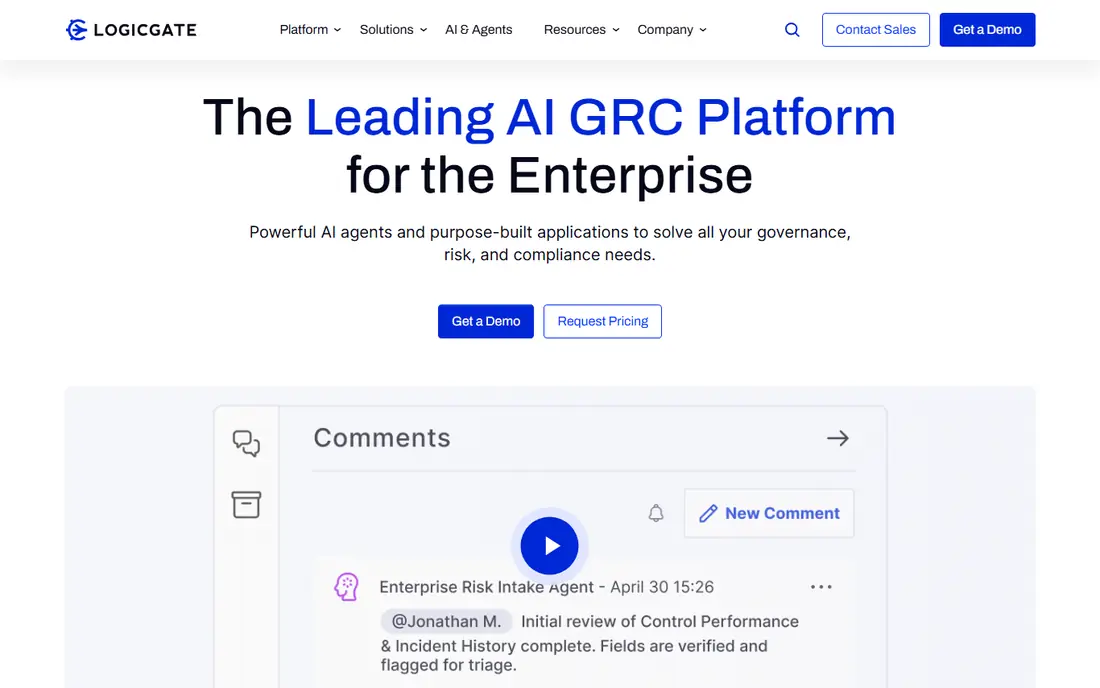
LogicGate Risk Cloud is our pick for a risk team that wants to build its own workflows without waiting on IT. Business users can shape forms, workflows and reports with a drag-and-drop builder, and prebuilt applications cover enterprise risk, third-party risk, audit and compliance. Standard and external user access is included without extra per-user fees on many plans, which helps when many staff only submit assessments.
The cost is quoted, not published, so budgeting needs a sales conversation and a scoped proposal. Reporting also draws some criticism for ad-hoc needs outside standard views, so test your board and committee reports during a demo. For a mid-market team that values speed and self-service, LogicGate is a strong first shortlist.
- No-code drag-and-drop workflows
- Prebuilt GRC applications
- Standard users included without extra per-user fees on many plans
- Pricing is custom and quoted
- Standalone reporting can feel thin
- Advanced features cost extra
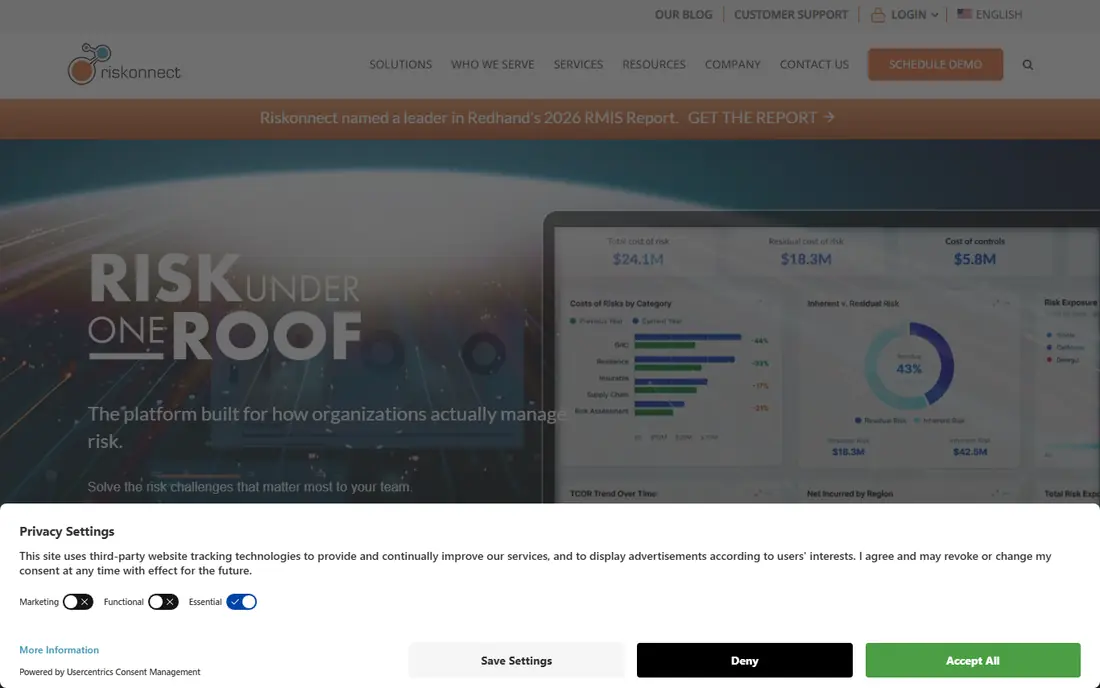
Riskonnect brings enterprise risk together with claims, safety and operational risk, which suits companies where insurance and incident data are part of the risk picture. A risk register that links to claims and incidents gives leaders a fuller view than a standalone register, and Riskonnect is built for that connected model across industries.
That breadth comes with setup effort and custom pricing. A small risk team with a simple register may not need claims and safety modules, and may prefer a leaner tool such as Onspring or LogicGate. Larger companies that already manage claims and operational risk alongside ERM will get the most from Riskonnect.
- Integrated risk, claims and safety in one platform
- Strong for insurance-linked risk
- Broad risk coverage
- Pricing is custom and quoted
- Breadth can mean longer setup
- Smaller teams may find it heavy

MetricStream is the large-program pick for governance, risk and compliance across many business units and countries. It covers risk registers, controls, audit, compliance and third-party risk in one platform, with AI features and a federated data model for connected risk programs. Regulated industries such as banking, energy and healthcare are core users.
The trade-off is weight. Configuration beyond standard setups can need specialist skills or consultants, and implementation timelines reflect that scale. If your program is global and complex, MetricStream earns its place. If your team is lean, a no-code platform will deliver value faster.
- Broad GRC coverage for global programs
- AI and analytics features
- Strong in banking, energy and healthcare
- Pricing is custom and quoted
- Deeper changes can need IT or consultants
- Rollout timelines are longer
ServiceNow GRC, also called Integrated Risk Management, suits companies that already run ServiceNow for IT service and security operations. Risk, compliance, privacy and vendor risk sit in the same platform as incidents and IT workflows, so risk data connects to the systems that fix issues. That link is the main reason to choose it over a standalone ERM tool.
Outside ServiceNow, the value drops sharply. Licensing is complex and quoted, the interface has a learning curve, and implementation often needs specialist help. Shortlist ServiceNow GRC only when ServiceNow is already a core platform, and price the full licence and implementation scope together.
- Ties risk to ITSM and SecOps
- One platform for IT and risk
- Scales across large programs
- Pricing is custom and complex
- Interface feels heavy outside ServiceNow
- Implementation often needs specialists
Archer, from RSA, is a mature GRC platform known for complex regulatory frameworks, control libraries and risk modelling in finance, healthcare and other regulated sectors. Teams that must map controls to many regulations, run detailed assessments and produce audit-ready evidence often pick Archer for that depth.
It is not a light tool. Setup is complex, pricing is quoted, and running Archer well usually needs a dedicated admin and a clear governance model. Smaller teams should look at LogicGate or Onspring first. Large regulated programs that need framework depth will find Archer hard to replace.
- Deep framework and control libraries
- Strong for finance and healthcare
- Mature GRC platform
- Pricing is custom and quoted
- Setup is complex
- Needs dedicated admin and governance
Onspring is a flexible GRC platform that lean teams can configure without heavy IT help. Its no-code builder lets non-technical staff create workflows, fields and reports, and ready-made products cover risk management, third-party risk, controls, audit and policy work. A central risk register with hierarchies helps teams track financial, operational and reputational risks together.
Third-party listings put its starting price around $20,000 per year, though the vendor quotes final pricing, so confirm that figure in a proposal. Reporting customisation also draws some criticism, so test your specific board reports in a demo. For a small risk team that wants control without consultants, Onspring is a strong pick.
- No-code setup for lean teams
- Central risk register with hierarchies
- Ready-made GRC products
- Starting price around $20,000 per year in third-party listings
- Reporting customisation can be limited
- Learning curve at first
Resolver positions itself as risk intelligence software: it gathers risk data, links risks to business impact, and automates workflows and reporting so risk work turns into action. That impact view helps leaders see not just a risk score, but what a risk could mean for operations, compliance or reputation, which makes board reporting clearer.
Third-party listings put its starting price around $10,000 per year, with final pricing quoted by the vendor. Integration depth varies by system, so check your core tools during evaluation. Resolver fits mid-market and large teams that want clear reporting and impact links without the weight of the largest GRC suites.
- Risk data linked to business impact
- Workflow automation and reporting
- Used by large organisations
- Starting price around $10,000 per year in third-party listings
- Final pricing is quoted
- Integration depth varies
Diligent One combines risk, audit, compliance and board governance in one platform, which suits public companies and governance-led buyers. Risk registers and controls sit next to board materials and reporting, so the same system serves risk teams, audit teams and directors. That breadth is useful when governance, not just risk scoring, drives the purchase.
A team that only needs a risk register may find Diligent heavier and pricier than a focused ERM tool, and pricing is quoted. Choose Diligent when board reporting and governance are central to the program, and when audit and risk must share one system.
- Board and governance tools alongside risk
- Audit and compliance coverage
- Strong for public companies
- Pricing is custom and quoted
- Breadth can be heavy for a simple register
- Best value for governance-led buyers
OneTrust is best known for privacy, but its platform also covers third-party risk, compliance and broader GRC, which makes it relevant for ERM buyers whose risk picture is driven by vendors and data handling. Its modular design lets a company buy the modules it needs, from privacy assessments to vendor risk workflows, rather than a single monolithic suite.
Modular pricing means the total depends heavily on module choice, and ERM depth varies with those choices, so scope carefully. If privacy and third-party risk dominate your risk register, OneTrust is a strong fit. If core ERM registers and controls are the whole job, compare LogicGate, Onspring and Resolver first.
- Strong privacy and third-party risk modules
- Broad compliance coverage
- Modular platform
- Pricing is per module and quoted
- ERM depth varies by module choice
- Setup needs scoping
How we picked these
We compared official product pages, GRC comparisons and public reviews for ERM and GRC platforms live in October 2026. We kept only platforms with a clear enterprise risk offer and a current product, and we mixed no-code mid-market tools with large regulated suites so buyers at different scales can compare. We used See website wherever a vendor quotes privately, and we flagged third-party starting figures for Onspring and Resolver as listings to confirm, rather than presenting them as vendor list prices.
How to choose ERM software
Start with your risk register, not the feature list. Bring a real, anonymised register to demos, with ten risks, their scores, controls and owners, and ask each vendor to load it, score it, link controls and produce a board report. That test reveals reporting and workflow gaps that a slide deck hides.
Price the whole program. Add licences, implementation, integrations, training and admin time, because ERM suites often cost as much to implement as to licence in year one. A cheaper licence with a long implementation can cost more than a pricier platform that goes live in weeks.
Check who will run it day to day. A no-code tool such as LogicGate or Onspring suits a small risk team, while Archer, MetricStream and ServiceNow suit teams with dedicated admins or consultants. The best platform is the one your team will actually maintain, because a risk register that goes stale is worse than a simple spreadsheet that stays current.
Frequently asked questions
What is ERM software?
Enterprise risk management software helps a company identify, assess, score and monitor risks across operations, IT, vendors and compliance, with registers, heat maps, controls and board reporting in one system. It replaces scattered spreadsheets with a shared, current view of risk.
What is the best ERM software?
LogicGate and Onspring suit mid-market teams that want flexibility, while MetricStream, Archer and ServiceNow suit large regulated programs. Riskonnect suits risk plus claims, Diligent suits governance-led buyers, and OneTrust suits privacy and third-party risk.
How much does ERM software cost?
Most ERM platforms are quote only, so final pricing depends on modules, users and scope. Third-party listings put Onspring around $20,000 per year and Resolver around $10,000 per year as starting figures, while large suites often run far higher once implementation is included. Always ask for a full proposal.
Is ERM software the same as GRC software?
They overlap heavily. GRC is the broader discipline covering governance, risk and compliance, including audit and policy work. ERM focuses on enterprise-wide risk identification, scoring and board reporting. Many platforms in this list serve both, but ERM tools prioritise risk registers and scoring.
Do I need a dedicated admin for ERM software?
Large suites such as Archer, MetricStream and ServiceNow usually need a dedicated admin or consultant support. No-code tools such as LogicGate and Onspring are designed for business users to run, though even they need a named owner to keep the register current.
Can small companies use ERM software?
Yes, with a lean tool. Onspring, Resolver and LogicGate suit smaller risk teams, while the largest suites are built for enterprise scale. A small company should start with a focused register and a tool its team can maintain, rather than buying enterprise breadth it will not use.
Sources
See where you really rank - block by block
ProMapRanker scans Google Maps across a grid of your service area. Simple monthly plans from $19, white-label on every plan.
Start freeKeep reading
 zoho inventory alternatives
6 Alternatives to Zoho Inventory, Compared on Price and Fit
Zoho Inventory alternatives: 6 tools compared on price, free plans and fit. Katana leads the list for manufacturers. Fit and flaws are laid out for each entry.
Read → zoho crm alternatives
Best Zoho CRM Alternatives (2026)
Need Zoho CRM alternatives? We compare 7 tools on cost, free access and who each suits. Every pick gets a straight assessment. Built for quick decisions.
Read → zelle alternatives
Best Zelle Alternatives in 2026
Compare the best Zelle alternatives for sending money to friends, paying sellers and moving funds abroad, with honest notes on fees, speed and safety in 2026.
Read →