 ProMapRanker
Top eDiscovery Software in 2026

Key takeaways
- Relativity and Everlaw suit large, complex matters, while GoldFynch and Logikcull give smaller teams a lower-cost way in.
- Most enterprise tools price by quote or by data volume, so ask for a total cost for your matter size before you commit.
- AI review features are now common, but they still need human checks for privilege, accuracy and production quality.
- For corporations, legal hold, collection and in-house review in one place often matters more than the lowest per-unit price.
- Our pick for most small firms is GoldFynch on price clarity, and for large teams it is Everlaw or RelativityOne on depth.
Quick comparison
| Pick | Great for | Pricing starts at | Free tier | |
|---|---|---|---|---|
 Relativity | Large, complex matters | See website | No | Visit |
 Everlaw | Modern cloud review for firms | See website | No | Visit |
 DISCO | AI-led review at scale | See website | No | Visit |
 Logikcull | Small and mid-sized firms | See website | Free trial | Visit |
 GoldFynch | Low-cost, clear pricing | $27 per month | Free trial | Visit |
 Exterro | Corporations and legal operations | See website | No | Visit |
 Casepoint | Mid-market and government teams | See website | No | Visit |
 Reveal | Analytics-led review | See website | No | Visit |
The best ediscovery software
eDiscovery software covers the work between receiving data and producing documents: processing, search, review, tagging, redaction and production. The right tool depends on matter size, team skill and how much of the work you keep in-house. We compared official feature pages, published pricing where it exists, and public review summaries, and we kept the focus on tools that are live and widely used in 2026.

Relativity, in its cloud form RelativityOne, is the tool many large firms and providers reach for first when a matter is large or sensitive. Its strength is depth: search, analytics, technology-assisted review, privilege workflows and production controls sit in one platform, and a large provider network means outside help is easy to find. Teams that handle repeat litigation or investigations often value that consistency from matter to matter.
The trade-off is cost and complexity. Pricing is by quote, so budgeting needs a sales conversation and a clear estimate of data volume. Smaller teams may find the learning curve steep, and a small case can feel overbuilt in Relativity. For large matters, though, that depth is the point, and few tools match its range of review and analytics options.
- Deep review and analytics features
- Wide partner and provider network
- Strong privilege and production controls
- Quote-only pricing
- Setup and training take time
- Can be more than small matters need

Everlaw is the modern cloud alternative that many firms pick when they want speed without a heavy install. Documents upload and process in the browser, review teams can tag and comment together, and built-in AI assistants help with summaries and first-pass review. The interface feels closer to everyday consumer software than to older review tools, which helps new reviewers get started quickly.
Pricing is still quote based, and costs rise with data volume, so a large matter needs a careful estimate. Some admin and production settings also take time to learn. Even with those limits, Everlaw is our pick for firms that want a current, collaborative review platform and that handle a steady flow of mid-sized to large matters.
- Clean, fast cloud interface
- Built-in AI assistants
- Strong collaboration for review teams
- Quote-only pricing
- Data volume drives cost
- Advanced admin options take learning
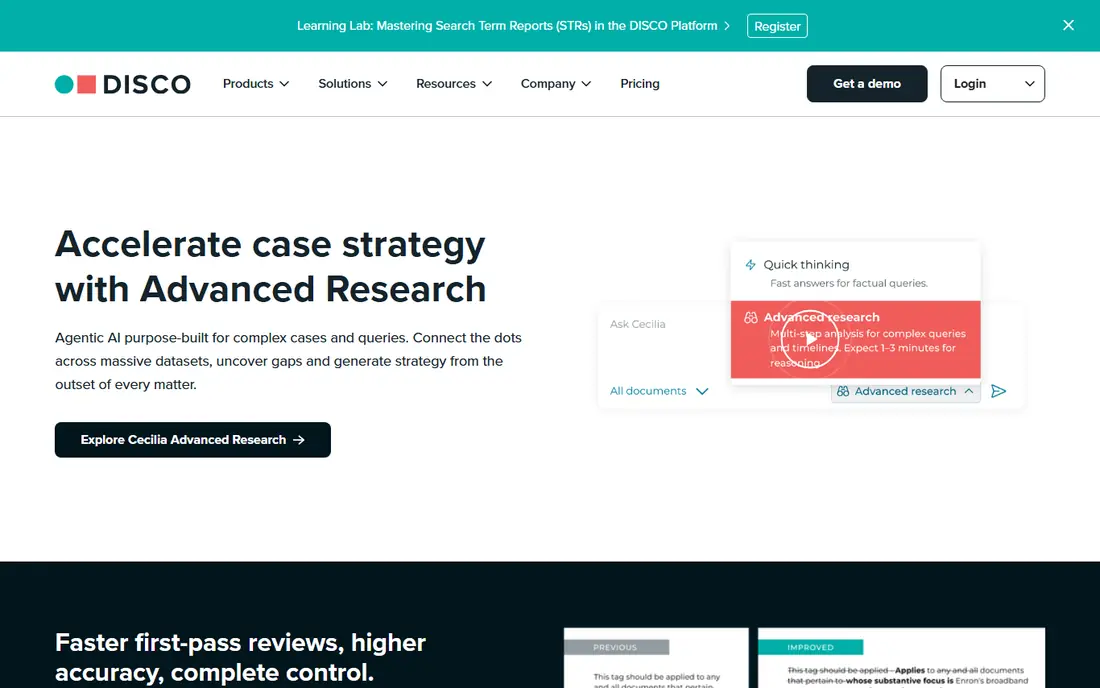
DISCO is built as a cloud-native platform for litigation teams that want AI help across review. Its Cecilia AI features aim to surface key documents, speed first-pass review and give teams a clearer view of a large set. For teams that review huge volumes, that focus on scale and speed is a real advantage, and the platform is designed for multi-team matters.
The limits follow from that enterprise focus. Pricing is custom, so small firms will find budgeting harder, and moving an active matter from another tool needs careful planning around tags, productions and history. DISCO fits best when a firm or legal department handles large, repeat matters and wants AI review as a core part of its workflow.
- Cloud-native review
- AI features for review and insight
- Built to scale for large teams
- Quote-only pricing
- Enterprise focus can price out small firms
- Migration needs planning
Logikcull suits firms that want to run discovery without an enterprise contract. Uploads are simple, processing is handled in the cloud, and the storage-based model is easier to explain to clients than some per-unit models. Legal hold, discovery and review sit together, which helps small teams that handle the whole matter themselves.
Pricing is the part to confirm on a call, because published figures differ across sources and plans change. Logikcull also offers less analytic depth than Relativity for very large matters. For a solo practice or a mid-sized firm that wants a usable tool without a long sales cycle, it remains a strong and practical choice.
- Simple drag-and-drop uploads
- Storage-based pricing model
- Legal hold and discovery in one place
- Published starting price varies by source
- Large matters can still get costly
- Fewer deep analytics than Relativity
GoldFynch stands out for one reason: its pricing is public and simple. Plans start at $27 per month for a 3 GB case, processing is free, and users are unlimited on a case, which makes budgeting easy for small firms. Files upload by drag and drop, OCR and search run in the browser, and a free trial case lets a team test with real files before paying. That clarity is rare in this category.
The catch is scope. GoldFynch is not trying to match every enterprise analytics feature, and very large or highly complex matters may need a bigger platform. For small cases, solo practices and firms that want predictable costs, though, it is hard to beat. We list it as our value pick for that reason.
- Published pricing from $27 per month for a 3 GB case
- Unlimited users on a case
- Free processing
- Smaller feature set than enterprise tools
- Best for small to mid-sized cases
- Support is mainly online
Exterro fits corporations that want to keep more of the discovery process in-house. Legal hold, data collection, processing and review can run in one system, which helps legal operations teams control deadlines and reduce handoffs to outside providers. Governance and reporting features also suit companies with repeat matters and strict internal rules.
That breadth comes with a heavier setup. Pricing is by quote, and implementation for a large company takes planning across IT, legal and security teams. Small firms will find it overbuilt. For in-house teams with ongoing litigation, Exterro is a strong candidate because it covers the full early stages of discovery, not just review.
- Legal hold, collection and review together
- Strong fit for in-house teams
- Governance features
- Quote-only pricing
- Implementation can be involved
- More than a small firm needs
Casepoint offers cloud review with collections from common cloud sources, plus AI features for review support. That combination suits mid-market firms and government teams that need a full platform without building their own stack. Its review tools cover search, tagging, analytics and production, and its cloud collections help when data lives in email and collaboration tools.
Pricing is by quote, so teams need to ask for a matter-sized estimate. The interface, like most full review platforms, takes a short learning period for new reviewers. Casepoint is a good middle-ground choice: more depth than a budget tool, with a clearer focus on mid-sized teams than the largest enterprise platforms.
- Cloud review with built-in AI
- Collections from cloud sources
- Used by government and mid-market teams
- Quote-only pricing
- Interface takes time to learn
- AI features vary by plan
Reveal, formerly Reveal Data, is known for analytics-led review. Concept clustering and visual analytics help teams see themes in a large set before they read every document, and AI features support prioritisation and review. For investigations and large matters where finding the story in the data matters as much as reading files one by one, that approach can save real time.
The platform is enterprise leaning, with quote-only pricing and a setup that benefits from experienced admins. Small firms with a single small case will find it more than they need. For large teams, in-house departments and firms that handle data-heavy matters, Reveal is a credible alternative to Relativity and Everlaw on analytics strength.
- Strong analytics and concept clustering
- AI review support
- Handles large data sets
- Quote-only pricing
- Setup benefits from experienced admins
- Smaller firms may not need its depth
How we picked these
We compared official feature pages, published pricing, trial options and public review summaries, and we favoured tools that are live in 2026 and that cover the core stages from processing through production. We did not claim hands-on testing, and we did not invent prices, ratings or feature claims. Where a vendor prices by quote, we say so plainly, because that fact itself matters to buyers. Our method favours predictable total cost, review quality controls and a fit for the team size named in each entry.
How to choose without overpaying
Price the whole matter, not the headline rate
Ask each vendor for a cost based on your data volume, reviewer count and expected duration. A low per-unit rate can still produce a high bill if processing, hosting and review charges stack up. GoldFynch-style fixed-volume pricing is easier to forecast, while quote-based tools need a written estimate that covers add-ons, AI features and production. Get the renewal and overage terms in writing too.
Check privilege, redaction and production first
Review speed means little if privilege checks, redactions and productions are weak. Test how a tool handles privilege logs, bulk redaction, family relationships and production formats before you commit. Ask who can see what, how audit trails work, and how easily you can export your work if you leave. Those controls protect the case, and they are harder to fix after review has started.
Run a real pilot case
Use a trial or a small live matter with real files, real reviewers and a real deadline. Measure how long processing takes, how clear search feels, and how much training reviewers need. A short pilot reveals problems that a sales demo hides, such as slow uploads, confusing tagging or weak support. Choose the tool your reviewers can use well under pressure, not just the one with the longest feature list.
Frequently asked questions
What is the best ediscovery software?
Relativity is the common pick for large matters, Everlaw is a strong modern cloud option, and GoldFynch is the best value for small cases. The best choice depends on matter size, team size and whether you need deep analytics or simple, predictable pricing.
What is the best ediscovery software for corporations?
Corporations with ongoing matters often evaluate Exterro, RelativityOne and Everlaw, because they support legal hold, collection and review in-house. Ask for total cost across a year of matters, not just one case, before you decide.
What are the best ediscovery platforms for small firms?
GoldFynch and Logikcull are the usual starting points for small firms, because they are easier to start and cheaper to run than enterprise tools. Check data limits, reviewer seats and production options against your largest recent case.
What are the best ediscovery tools with AI review?
Relativity, Everlaw, DISCO, Casepoint and Reveal all offer AI review support in 2026. AI helps prioritise documents, but human reviewers must still check privilege, accuracy and production quality.
How much does ediscovery software cost?
Published small-case pricing starts at $27 per month with GoldFynch, while most enterprise tools price by quote and by data volume. Model processing, hosting, review and production charges together for a realistic total.
What is the best ediscovery review platform for large matters?
RelativityOne, Everlaw and DISCO are the strongest options for large matters, thanks to scale, analytics and provider support. Run a pilot on a slice of real data to compare speed and reviewer experience before signing.
Sources
See where you really rank - block by block
ProMapRanker scans Google Maps across a grid of your service area. Simple monthly plans from $19, white-label on every plan.
Start freeKeep reading
 zscaler alternatives
Best Zscaler Alternatives in 2026
Looking for zscaler alternatives? We compare 9 SASE and zero trust platforms on architecture, data protection, pricing, and fit for your network and team.
Read → zapier alternatives free
Best Zapier Alternatives Free in 2026
Nine automation tools for zapier alternatives free in 2026, all with genuinely free tiers, plus free plan limits, starting prices and upgrade paths explained.
Read → which platform is best for online reputation
Which Platform Is Best for Online Reputation in 2026
Wondering which platform is best for online reputation? We compare 8 review, listing, and response tools for small and multi-location businesses and agencies.
Read →