 ProMapRanker
Top AI Software Development Companies in 2026

Key takeaways
- This is a guide to companies to shortlist, not a verified ranking, since project quality depends on the team, scope, and data you bring.
- Large firms such as EPAM, Cognizant, and Accenture fit enterprise programmes with governance, security, and multi-team delivery needs.
- Specialist firms such as LeewayHertz and InData Labs fit product teams that need AI features built into an existing product.
- Staffing-led options such as Turing fit buyers who already own architecture and delivery and need individual specialists.
- Always ask for named, comparable work, a clear delivery plan, and a written scope before comparing quotes.
Quick comparison
| Pick | Great for | Pricing starts at | Free tier | |
|---|---|---|---|---|
 EPAM Systems | Global enterprise AI programmes | See website | No | Visit |
 N-iX | Nearshore multi-role AI product teams | See website | No | Visit |
 SoftServe | AI joined to cloud modernisation | See website | No | Visit |
 Cognizant | Enterprise AI transformation | See website | No | Visit |
 Accenture | Large-scale enterprise AI delivery | See website | No | Visit |
 Globant | Digital product and AI delivery at scale | See website | No | Visit |
 Turing | Individual remote AI specialists | See website | No | Visit |
 LeewayHertz | AI-first application builds | See website | No | Visit |
 InData Labs | Data-science-heavy applications | See website | No | Visit |
The best ai software development companies
The companies below are presented as a shortlist guide, not a verified ranking. Order reflects a mix of scale, specialism, and fit for different buyers, and you should judge each firm on comparable past work and a written proposal for your project.
EPAM Systems fits large organisations that need AI work delivered across teams, regions, and existing systems, with governance and security handled as part of delivery. Its services cover AI strategy, data engineering, application development, and cloud modernisation, so a programme that touches several systems can stay under one delivery partner. That breadth helps when an AI feature must connect to legacy data, internal tools, and customer-facing products at the same time.
The engagement model is enterprise-scale, so a small, single-feature project may be heavier than a specialist studio can offer. Pricing is by proposal, based on scope, team, and duration. EPAM is a sensible shortlist entry when scale, compliance, and long-term support matter more than a low entry cost.
- Large global delivery capacity
- Enterprise governance experience
- Broad AI and cloud services
- Enterprise engagement model may be heavy for small projects
- Pricing needs a proposal
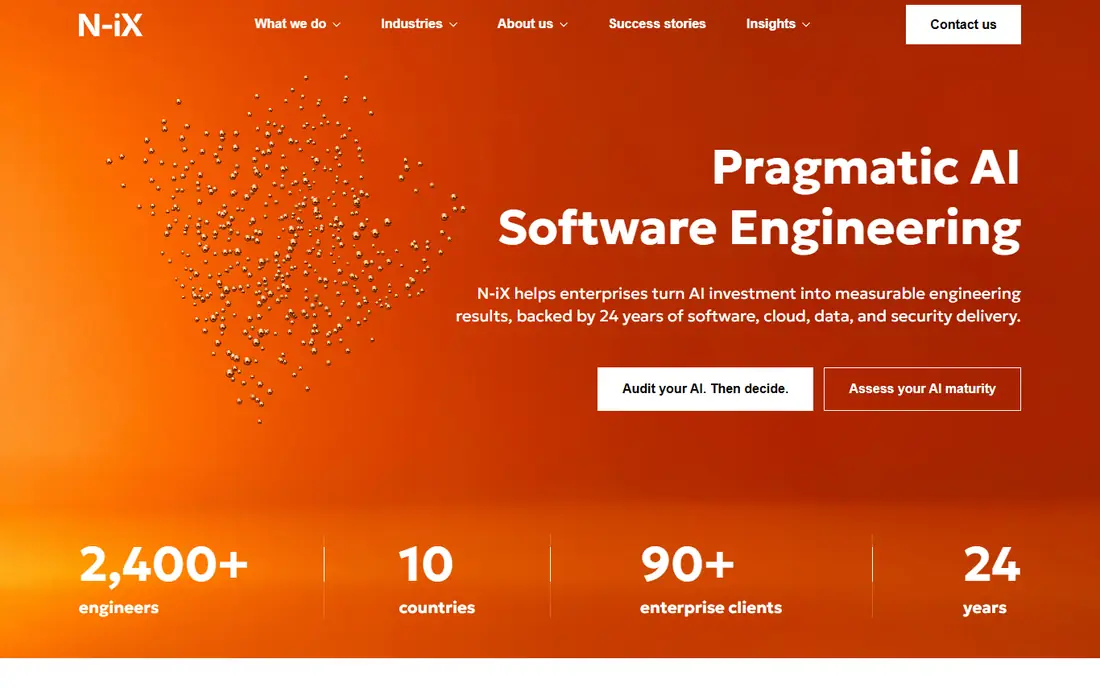
N-iX fits product companies that need a multi-role team, with data, cloud, and application engineers working together on an AI product. That mix matters when an AI feature needs data pipelines, model integration, and a product interface, rather than a single model alone. Its enterprise experience also helps teams that need structured delivery, documentation, and handover to an internal team.
A team-based engagement suits ongoing product work more than a short, fixed task, so buyers with a very small scope should ask how a smaller engagement would work. Pricing is by proposal. N-iX is a strong shortlist entry for a product team that wants to scale several roles together.
- Multi-role product teams
- Cloud, data, and application skills together
- Enterprise experience
- Team-based model suits ongoing work more than a one-off task
- Pricing needs a proposal
SoftServe fits enterprises that want AI work joined to cloud modernisation, data platforms, and existing application estates. Its consulting breadth helps when an AI project is part of a wider modernisation plan, rather than a standalone feature, since data, infrastructure, and product decisions need to align. That approach suits organisations with complex estates and a need for governance around data and model use.
Startups with a single product and a short timeline may find the enterprise process heavier than a specialist studio. Pricing is by proposal, based on scope and team. SoftServe belongs on an enterprise shortlist where AI, cloud, and modernisation are linked.
- Enterprise consulting breadth
- AI and cloud delivery together
- Large delivery capacity
- Enterprise process may be slower for startups
- Pricing needs a proposal
Cognizant fits large enterprises planning AI transformation across business units, with a need for industry knowledge, delivery at scale, and ongoing support. Its services cover AI consulting, data, automation, and application development, so a programme that spans customer service, operations, and internal tools can be delivered under one partner. That scale helps when governance, security, and change management are as important as the model itself.
The large-firm model is not suited to a small product team that needs a fast, narrow build. Pricing is by proposal, and engagement size will reflect enterprise scope. Cognizant is a sensible entry for a large buyer that values scale and industry depth over a boutique approach.
- Very large enterprise delivery capacity
- Industry-specific experience
- AI and automation services
- Large-firm process and cost structure
- Small projects may not fit the model
Accenture fits very large organisations that need AI strategy, delivery, and change support at global scale. It combines consulting, technology, and operations, so an AI programme that affects processes, people, and systems can be planned and delivered as one effort. Its industry coverage also helps buyers in regulated or complex sectors that need sector-specific delivery experience.
As with other large firms, the engagement model suits programmes rather than small builds, and pricing follows a scoping and proposal process. Buyers should ask for a named delivery team and comparable programme examples, not only a firm-level overview. Accenture belongs on a large-enterprise shortlist, not a small-project shortlist.
- Global enterprise scale
- AI strategy and delivery together
- Broad industry coverage
- Enterprise engagement model
- Pricing needs a proposal and scoping work
Globant fits companies that want digital product delivery with AI features, combining design, engineering, and data work in one partner. That mix suits consumer and business products where user experience, product strategy, and AI capability must move together, rather than as separate workstreams. Its global teams also support delivery across time zones for larger programmes.
A small team with a narrow feature may find the scale unnecessary, and pricing is by proposal. Globant is a good shortlist entry for a product company that wants a partner for a full product effort, including AI, rather than a single technical task.
- Product and AI delivery at scale
- Design and engineering together
- Global teams
- Scale may be more than a small team needs
- Pricing needs a proposal
Turing fits buyers who already own product architecture and delivery and need individual AI specialists to join an existing team. It connects companies with remote engineers and data specialists, which helps a team scale quickly without a full agency engagement. That model works when internal leadership can set direction, review work, and manage delivery day to day.
The trade-off is responsibility. Turing provides people, not a full product delivery service, so a buyer without internal technical leadership may struggle to get a coherent result. Pricing is by engagement. Turing is best when you need skilled individuals and already have the plan, not when you need a partner to define the product.
- Access to vetted remote specialists
- Flexible team scaling
- Useful when you own delivery
- You own architecture and management
- Quality depends on the individual match
LeewayHertz fits teams that want an AI-first application built from the ground up, rather than AI added to a large legacy system. Its focus on AI applications, including language model and generative AI work, suits startups and product teams building a new product around AI capability. A specialist studio can often move faster on a defined product than a large enterprise firm, since the team is built around that kind of build.
Scale is smaller than the enterprise firms on this list, so very large programmes may need a different partner. Pricing is by proposal, based on scope and team. LeewayHertz is a useful shortlist entry for a greenfield AI product where specialism matters more than global scale.
- Specialist AI application focus
- Greenfield product builds
- LLM and generative AI experience
- Smaller scale than enterprise firms
- Pricing needs a proposal
InData Labs fits teams whose AI product depends heavily on data science, modelling, and data engineering, not only on an application interface. It combines data science with product engineering, so a project that needs model development, data pipelines, and a working product can stay with one team. That mix helps when data quality, model evaluation, and product integration are the real risks, rather than interface design alone.
A simple AI feature that uses an existing model through an API may not need this depth, and pricing is by proposal. InData Labs belongs on a shortlist where modelling and data work are central to the product, and the buyer wants that expertise alongside engineering.
- Data science and product engineering together
- Modelling and application delivery in one team
- Data-heavy focus may be more than a simple app needs
- Pricing needs a proposal
How we picked these
We reviewed vendor service pages, public company descriptions, and independent comparison guides, and we kept only firms that are live in October 2026 and clearly offer AI software or application development as a core service. We did not assign scores, ratings, or pay figures, since those vary by project and are not comparable without a written proposal. This guide is a shortlist aid, not a verified ranking, and buyers should judge each firm on comparable past work.
How to hire an AI development company
Start with a one-page brief that states the user task, the data you can legally use, the systems the AI feature must connect with, and how you will judge success. A firm that cannot explain its approach to data, evaluation, and release testing in plain terms is not ready for your project, however strong its sales material looks. Ask for two or three comparable projects, with what was built, what data was used, and what happened after launch.
Next, compare proposals on scope, team, and ownership, not only on price. Ask who owns the code, the data pipelines, and the model configuration, and what handover looks like if you move work in-house. Ask how the firm handles model changes, data drift, and security reviews, and what support covers after launch. A clear written scope, with evaluation criteria agreed before build starts, protects both sides.
Questions to ask before you sign
Ask which team members will actually work on your project, and whether they stay for the full engagement. Ask how the firm evaluates model output, handles incorrect or biased results, and tests releases before they reach users. Ask what happens to your data, who can access it, and how it is deleted at the end of the engagement. Ask for a fixed scope for the first phase, with a review point before further work is approved.
Frequently asked questions
Which company has the best reviews for AI development?
There is no single best-reviewed firm, since reviews depend on project type, team, and scope, and different platforms use different methods. Shortlist firms by comparable work in your industry and project size, then check client references directly. A firm with strong reviews for enterprise transformation may not be the best fit for a small AI app, and the reverse is also true.
What are the best AI development companies for startups?
Specialist firms such as LeewayHertz and InData Labs often fit startups better than large enterprise firms, since they focus on product builds and data-heavy applications. Turing can fit a startup that already has technical leadership and needs individual specialists. Startups should favour a fixed first-phase scope and a clear handover plan.
What are the best AI app development companies for enterprise work?
EPAM Systems, Cognizant, Accenture, SoftServe, and Globant all offer enterprise-scale AI delivery, with different strengths in governance, cloud, and product work. N-iX also fits enterprises that need multi-role product teams. Enterprise buyers should run a structured procurement process with comparable proposals and reference checks.
How much does it cost to hire an AI software development company?
Costs vary widely by scope, team size, duration, and location, and firms on this list price by proposal rather than a published rate. A small, defined AI feature and a full enterprise programme are not comparable, so any single price figure would mislead. Ask each shortlisted firm for a written proposal for the same brief, so you can compare scope and team, not only headline cost.
Should I hire a large firm or a specialist studio for AI development?
A large firm fits enterprise programmes with governance, multi-team delivery, and long-term support needs. A specialist studio fits a defined product build where AI specialism and speed matter more than scale. A staffing option fits buyers who already own architecture and delivery. Match the firm type to your internal capacity, not only to the project size.
Sources
See where you really rank - block by block
ProMapRanker scans Google Maps across a grid of your service area. Simple monthly plans from $19, white-label on every plan.
Start freeKeep reading
 zoho inventory alternatives
6 Alternatives to Zoho Inventory, Compared on Price and Fit
Zoho Inventory alternatives: 6 tools compared on price, free plans and fit. Katana leads the list for manufacturers. Fit and flaws are laid out for each entry.
Read → zoho crm alternatives
Best Zoho CRM Alternatives (2026)
Need Zoho CRM alternatives? We compare 7 tools on cost, free access and who each suits. Every pick gets a straight assessment. Built for quick decisions.
Read → zelle alternatives
Best Zelle Alternatives in 2026
Compare the best Zelle alternatives for sending money to friends, paying sellers and moving funds abroad, with honest notes on fees, speed and safety in 2026.
Read →