 ProMapRanker
The Best Lawsuit Funding Companies in 2026


Broad personal injury funding · Pricing starts at: See website
Key takeaways
- Most pre-settlement funding is non-recourse, which means repayment usually comes only from case proceeds, but the total payoff can still grow over time.
- Oasis Financial, USClaims and LawCash cover a broad range of personal injury cases, while other funders focus on smaller or larger advances.
- No funder on this list publishes a single universal rate, so the written payoff table matters more than any headline advance amount.
- Always have your attorney review the contract before you sign, and ask what you will owe at six, twelve and twenty-four months.
- This article is general information only, not financial or legal advice, and fees and terms vary and must be checked in writing.
Quick comparison
| Pick | Great for | Pricing starts at | Free tier | |
|---|---|---|---|---|
| Oasis Financial | Broad personal injury funding | See website | No | Visit |
 USClaims | Larger injury and mass tort cases | See website | No | Visit |
 LawCash | Attorney-assisted injury funding | See website | No | Visit |
 High Rise Financial | Smaller living-expense advances | See website | No | Visit |
 Peachtree Financial Solutions | Settlement and structured payments | See website | No | Visit |
 Tribeca Lawsuit Loans | Fixed-fee style funding | See website | No | Visit |
 Nova Legal Funding | Fast personal injury advances | See website | No | Visit |
 Express Legal Funding | Quick application process | See website | No | Visit |
The best lawsuit funding companies
We compared funders on case types, non-recourse structure, transparency about payoff costs, attorney cooperation and speed described on their own sites. Pre-settlement funding is not a traditional loan in most cases, and the right choice depends on your case, your attorney and the total amount you will owe if the case takes longer than expected.
Oasis Financial is a long-running name in consumer legal funding, and its site describes funding for plaintiffs with an attorney on injury-related cases. Advances are described as ranging from $500 to $100,000, based on case value, and repayment is described as coming from settlement proceeds. For many plaintiffs, that breadth is useful, because the same funder may consider auto accidents, workplace injuries and premises cases.
The main drawback is pricing transparency. Oasis does not publish a universal rate schedule, so you cannot compare its true cost from a web page alone. Ask for the full payoff table in writing, check which states and case types are excluded, and have your attorney review the contract before you accept any advance.
- Broad personal injury coverage
- Non-recourse structure described on its site
- No application fee described
- Full rate details are given after approval, not upfront
- Advance caps apply
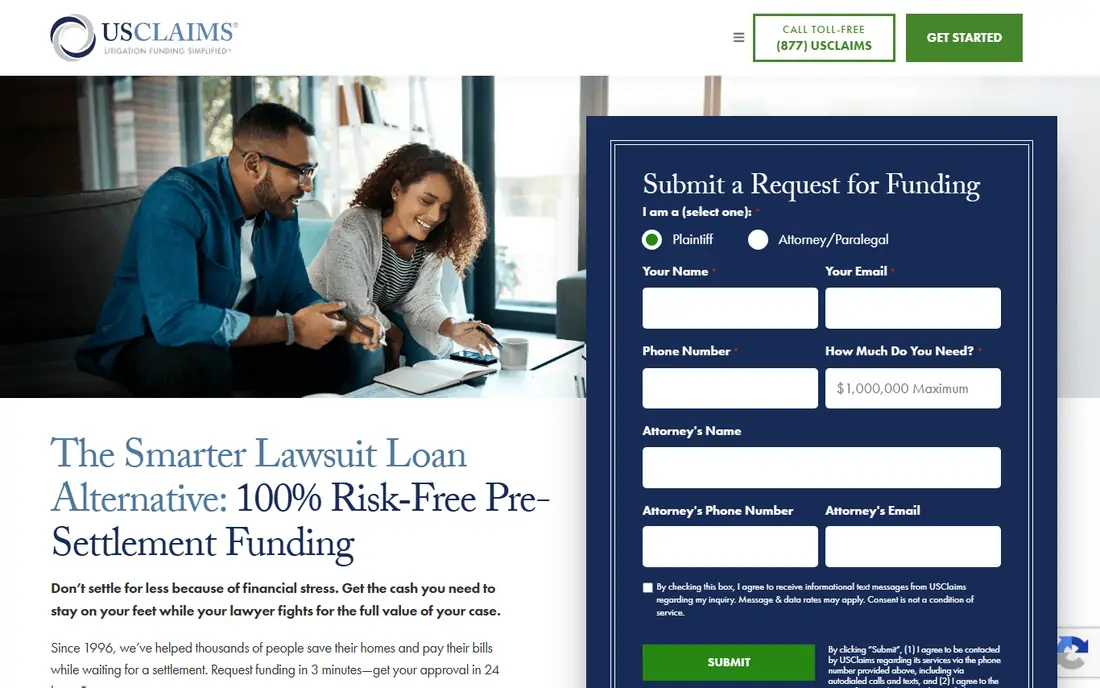
USClaims describes itself as a pre-settlement funding firm in operation since 1996, with a focus on personal injury and mass tort cases. That history makes it a useful option when the advance needed is larger than a small living-expense amount, or when the case involves complex injury claims. Its product is described as non-recourse, which means no recovery generally means no repayment.
Size cuts both ways. A larger advance can help with rent and medical bills during a long case, but it can also consume a meaningful share of the final settlement if fees accrue over many months. Ask for payoff figures at several future dates, and weigh a smaller advance against a longer wait where that is possible.
- Operating since 1996 as described on its site
- Non-recourse funding
- Larger case experience
- Large advances can take a large share of proceeds if a case runs long
- Terms vary by case

LawCash says it has provided litigation funding since 2000, and it covers injury, civil rights and employment-related claims alongside other civil cases. That range helps plaintiffs whose cases do not fit a narrow personal injury box, provided their attorney cooperates with the funding review. Repayment is described as coming from settlement or judgment proceeds, consistent with the non-recourse model used by most funders here.
Approval depends on the strength of the case, the jurisdiction and the expected settlement value, so not every applicant will qualify. As with other funders, the contract matters more than the marketing page. Ask your attorney to check fees, compounding terms if any, and what happens if the case settles for less than expected.
- Funding since 2000 as described on its site
- Injury, civil rights and employment cases
- Repayment from proceeds
- Availability depends heavily on jurisdiction and liability evidence
- Pricing not published as a flat rate
High Rise Financial focuses on fast pre-settlement funding for personal injury plaintiffs who need help with living expenses while a case continues. Its advances are described as non-recourse, and applicants usually need an attorney representing them on contingency. For a plaintiff facing rent or utility bills, that speed and focus can matter more than a funder that handles many case types.
Speed should not be confused with cheap funding. Request the total amount owed at six, twelve, eighteen and twenty-four months before you sign, and compare that total with other funders for the same advance. A smaller advance taken for a shorter period is often safer than a larger advance that runs for years.
- Fast decisions described for personal injury plaintiffs
- Non-recourse advances
- Attorney on contingency usually required
- Fast approval does not mean low cost
- Small advances can still grow with time
Peachtree Financial Solutions
Great for: Settlement and structured payments
Peachtree Financial Solutions is known for structured settlement purchasing as well as pre-settlement funding services. That background helps plaintiffs who already have a settlement in place, or who are weighing a lump sum against future payments. Its team works directly with attorneys to clarify repayment terms, which is an important safeguard in this market.
Because its best-known work is structured settlements, it may not be the first choice for every new personal injury advance. Ask whether your case type is covered, what documents your attorney must supply and what the total payoff will be under different timelines. For structured payment questions in particular, compare more than one offer before you sell future payments.
- Long experience with settlement-related products
- Structured settlement purchasing
- Attorney cooperation described
- Better known for structured settlements than for every pre-settlement case type
- Terms need written confirmation
Tribeca Lawsuit Loans describes low fixed rates, non-compounding terms and no hidden fees, with funding in same-day to 24-hour timeframes in many cases. Its case coverage includes personal injury, medical malpractice, employment and auto accident claims. If a fixed, non-compounding structure is confirmed in your written contract, that can make the total cost easier to predict than a compounding fee model.
Do not rely on a headline claim alone. Confirm in writing whether your offer is fixed or compounding, what fees apply, and what the payoff is at future dates. Third-party review summaries have noted mixed experiences with delays, so ask your attorney to confirm the timeline and the documents needed before you count on a funding date.
- Non-recourse funding
- Personal injury, medical malpractice and employment cases
- Same-day to 24-hour funding described
- Rate details vary by case
- Third-party review summaries are mixed on delays
Nova Legal Funding offers non-recourse funding for auto accidents, medical malpractice, wrongful death and other personal injury cases, with funding within 24 hours described on comparison pages. Its fixed-fee model, where confirmed, can help plaintiffs estimate cost more clearly than a rate that compounds monthly. No credit check is described, because approval rests on case merits and attorney cooperation.
As with every funder here, the written offer is the real product. Ask for the payoff table, confirm whether any fee is capped, and check whether your state or case type is excluded. A fast decision is useful only if the total cost leaves you with a reasonable share of any settlement.
- Non-recourse funding
- Funds within 24 hours described
- Auto, malpractice and wrongful death cases
- Fixed-fee model needs written confirmation for your case
- Pricing not published as a flat schedule
Express Legal Funding describes a fast approval process, no application fees and a non-recourse model for personal injury and civil litigation plaintiffs. That combination suits plaintiffs who want a no-obligation application and a quick answer while their attorney supplies case documents. The absence of an application fee also means you can compare an offer without paying to apply.
The limit is the same as for most funders: pricing is not disclosed as a public schedule, so you must compare the written payoff terms. Ask for total amounts owed at several future dates, and do not accept an advance larger than you need for essential bills. Your attorney should review the contract before you sign.
- No application fees described
- Non-recourse model
- Personal injury and civil litigation cases
- Pricing not disclosed upfront
- Approval depends on case documentation
How we picked these
We compared official funder pages and independent comparison guides on non-recourse structure, case types, funding speed described by the funder, and transparency about payoff costs. We did not invent rates, approval percentages or review scores, and we did not claim hands-on borrowing. Where a funder does not publish a rate, we say so and advise readers to obtain the written payoff table, because that document decides the true cost.
How to compare lawsuit funding offers safely
Start by borrowing only what you need for essential costs, not the largest advance offered. Every extra dollar can increase the payoff, especially if the case takes a year or more. Ask each funder for the same set of numbers: the advance amount, all fees, whether fees compound, and the total payoff at six, twelve, eighteen and twenty-four months.
Next, involve your attorney early. Funders usually need case documents from your attorney, and your attorney can spot terms that reduce your net recovery. Ask what happens if you lose, if the case settles for less than expected, or if you need a second advance later. Those answers matter more than a promise of fast funding.
Finally, check state rules and alternatives. Some states restrict or regulate legal funding, and some case types are excluded in certain states. Consider whether family help, a payment plan with a creditor, or waiting without funding is possible, even if it is difficult. Funding can be useful, but it should be a measured decision, not a rushed one. This article is general information only, not financial or legal advice, and no outcome or rate is promised here.
Frequently asked questions
What are the best pre-settlement loan companies?
The best choice depends on your case type, advance size and total payoff cost, not on a single ranking. Oasis Financial, USClaims and LawCash are broad options for personal injury cases, while High Rise Financial suits smaller living-expense advances. Compare written payoff tables and have your attorney review each contract.
Is lawsuit funding a loan?
In most cases it is described as non-recourse legal funding rather than a traditional loan, because repayment usually comes only from case proceeds. That does not make it free or low cost. Fees can still grow over time, and the contract terms decide what you owe and when.
How fast can I get lawsuit funding?
Several funders describe funding within 24 hours after approval, but approval depends on your attorney supplying case documents. Delays happen when documents are missing or liability is unclear. Ask what documents are needed and what timeline applies to your case specifically.
Do I need a lawyer to get lawsuit funding?
Most funders require you to have an attorney representing you on contingency, because they review case merits through that attorney. If you do not have an attorney, funding is unlikely to be available from the companies on this list. Speak to a personal injury attorney about your case first.
What should I check before signing a funding contract?
Check the advance amount, all fees, whether fees compound, any cap on total payoff, and the total owed at six, twelve and twenty-four months. Also check what happens if you lose or settle for less than expected. Have your attorney review the contract in writing before you sign.
Can lawsuit funding affect my settlement?
Yes, because the funder is repaid from settlement proceeds, plus fees. A large advance taken early can leave a smaller net amount after attorney fees and medical liens. Borrow only what you need, and compare the net settlement effect across offers.
Sources
- https://www.coinabul.com/best-pre-settlement-loans/
- https://www.topconsumerreviews.com/best-lawsuit-funding-companies/detailed-reviews.php
- https://www.oasislegal.com
- https://www.usclaims.com
- https://www.lawcash.net
- https://www.highrisefinancial.com
- https://www.peachtreefinancial.com
- https://www.tribecalawsuitloans.com
See where you really rank - block by block
ProMapRanker scans Google Maps across a grid of your service area. Simple monthly plans from $19, white-label on every plan.
Start freeKeep reading
 zscaler alternatives
Best Zscaler Alternatives in 2026
Looking for zscaler alternatives? We compare 9 SASE and zero trust platforms on architecture, data protection, pricing, and fit for your network and team.
Read → zapier alternatives free
Best Zapier Alternatives Free in 2026
Nine automation tools for zapier alternatives free in 2026, all with genuinely free tiers, plus free plan limits, starting prices and upgrade paths explained.
Read → which platform is best for online reputation
Which Platform Is Best for Online Reputation in 2026
Wondering which platform is best for online reputation? We compare 8 review, listing, and response tools for small and multi-location businesses and agencies.
Read →