 ProMapRanker
Terraform Cloud Alternatives in 2026

Key takeaways
- Scalr, Spacelift, and env0 are the closest managed replacements, with remote runs, state handling, policy checks, and drift detection.
- Atlantis, Digger, Terramate, and Terrateam suit teams that want Terraform automation inside their existing CI system instead of a separate platform.
- Terrakube offers an open source platform model, while Pulumi Cloud suits teams that also manage Pulumi or multi-language infrastructure.
- Pricing models differ sharply: per run, per worker, per apply, and free self-hosted, so compare cost at your real run volume.
- Test state migration, policy enforcement, and private network access before switching, because those are the hardest parts of a move.
Quick comparison
| Pick | Great for | Pricing starts at | Free tier | |
|---|---|---|---|---|
 Spacelift | Multi-tool IaC orchestration | See website | Yes | Visit |
 env0 | Managed IaC with cost controls | Free | Yes | Visit |
 Scalr | Drop-in remote backend replacement | Free | Yes | Visit |
 Atlantis | Self-hosted pull request automation | Free | Yes | Visit |
 Digger | Terraform automation in CI | Free | Yes | Visit |
 Terramate | Stack orchestration on your CI | Free | Yes | Visit |
 Pulumi Cloud | Pulumi plus multi-language IaC | See website | Yes | Visit |
 Terrakube | Open source Terraform platform | Free | Yes | Visit |
 Terrateam | GitHub-native Terraform workflows | Free | Yes | Visit |
The best Terraform Cloud alternatives
We compared platforms that run Terraform or OpenTofu with remote state, plan and apply workflows, policy checks, and team controls. We excluded Terraform Cloud itself from this alternatives list, and we included both managed platforms and self-hosted tools so teams can match their operations capacity.
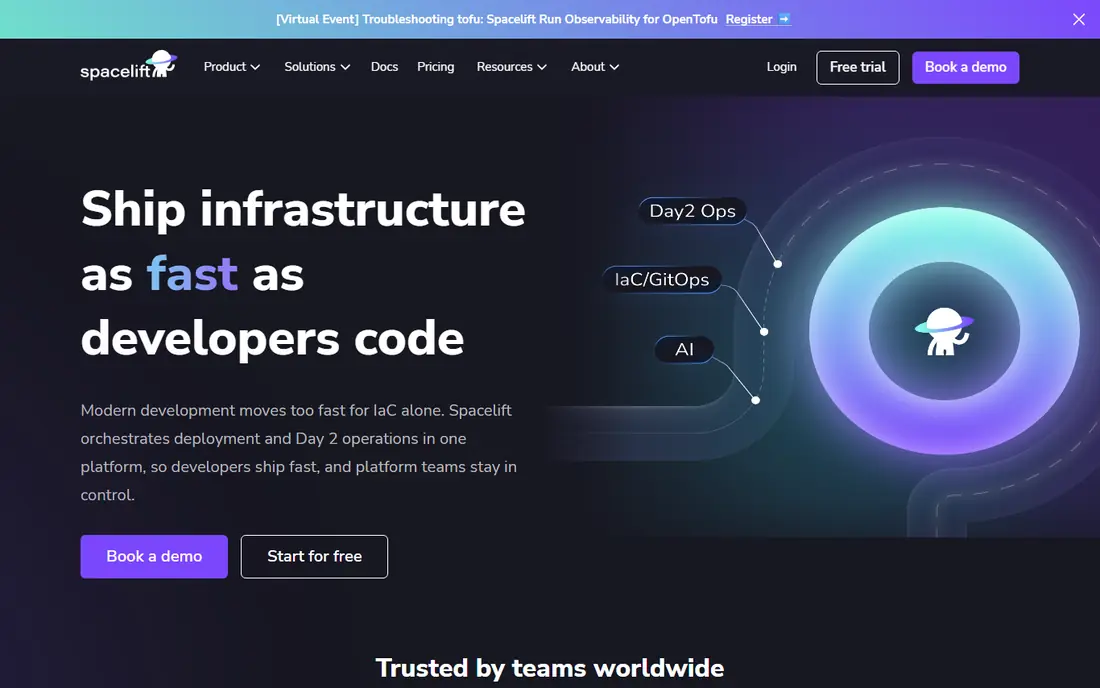
Spacelift is the strongest managed choice for teams that run more than one infrastructure tool. It provides GitOps workflows, private workers, policy as code, drift detection, and dependency handling across stacks, so a platform team can govern Terraform and other tools in one place. Self-hosted workers help when code and cloud access must stay inside a private network.
The main drawback is price for small estates. Spacelift offers a free plan with public workers, but the first paid tiers are priced for teams, not solo users, so small teams should test the free tier and get a written quote early. For larger teams that need governance across many stacks, Spacelift offers the deepest control here.
- Supports Terraform, OpenTofu, Pulumi, CloudFormation, Kubernetes, and Ansible
- Policy and drift tools
- Self-hosted workers
- Paid tiers start at a high annual level for small teams
- Feature depth takes time to configure

env0 suits teams that want a managed Terraform platform with clear cost visibility. It covers environments, variables, state, plan and apply workflows, policy checks, and cost reporting, and it supports OpenTofu alongside Terraform. The free tier covers a limited number of runs and environments, which is enough to test real workflows.
Paid pricing moves to quotes based on applies or environments, so teams with spiky run volumes should model their peak month, not just an average month. env0 also does not offer a fully self-hosted control plane, though agents can run in your network. For teams that want managed operations plus cost controls, env0 is a strong alternative.
- Free tier for small teams
- Supports Terraform, OpenTofu, and other IaC tools
- Cost and policy controls
- Paid pricing is quote-based
- Self-hosting is limited to agents, not the full control plane
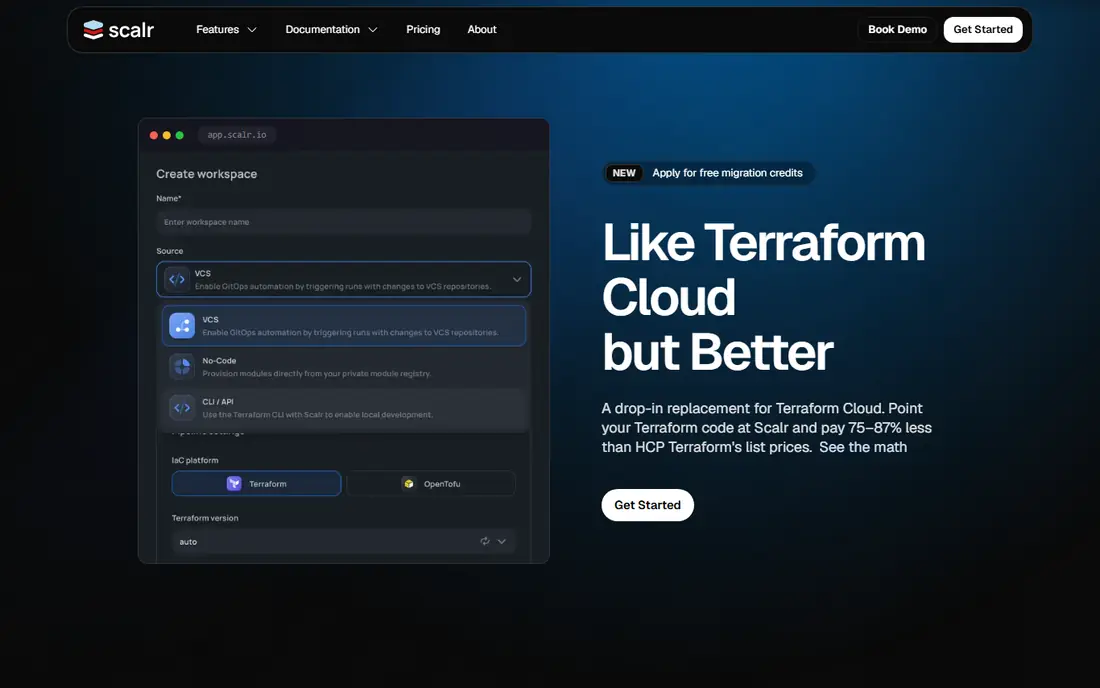
Scalr is the most direct drop-in replacement for teams that mainly run Terraform or OpenTofu. It uses a remote backend model similar to Terraform Cloud, with workspaces, variables, state, runs, policy checks, and drift detection, plus support for Terragrunt. Pricing by run makes costs easy to predict when you know how often you apply.
That model can become costly for teams that apply very often or run many test stacks, so check the free run limit and the per-run price against your real volume. Scalr also covers fewer IaC tools than Spacelift or env0. For Terraform-focused teams that want a familiar platform and transparent run pricing, Scalr is our top managed pick.
- Free tier for small run volumes
- Per-run pricing
- Supports Terraform, OpenTofu, and Terragrunt
- Per-run costs rise with frequent applies
- Multi-tool coverage is narrower than Spacelift
Atlantis is the classic self-hosted alternative for teams that already have a state backend and a version control system. When a developer opens a pull request, Atlantis runs a plan and posts the result as a comment, and approved applies run from the same flow. That keeps Terraform automation inside the code review process developers already use.
Atlantis does not provide a hosted state service, a full policy engine, or a managed UI like Scalr or Spacelift, so governance must come from your own workflows and controls. You also run the server, its credentials, and its access rules. For a single team with solid operations skills and a tight budget, Atlantis remains a reliable free choice.
- Free and open source
- Pull request driven plan and apply
- Works with your existing state backend
- No built-in hosted state or policy engine
- You run and secure the server
Digger takes a different approach: instead of a separate platform, it orchestrates Terraform inside the CI system you already run. Plans and applies happen in GitHub Actions or GitLab CI, with locking, drift checks, and pull request comments, while state stays in your existing backend. That design avoids another control plane and keeps logs where your team already looks.
The trade-off is governance depth. Policy, RBAC, and audit features are thinner than Spacelift or env0, and some enterprise features require a paid edition. For teams that already trust their CI system and want Terraform automation without a new platform bill, Digger is a practical middle path.
- Free open source core
- Runs inside GitHub Actions or GitLab CI
- Pull request plans and applies
- Governance features are thinner than full platforms
- Enterprise features are paid
Terramate helps teams that manage many Terraform stacks from one repository. It detects which stacks changed, orders runs, shares variables, and surfaces drift, while the actual runs happen in your CI system. That stack-first view is useful for platform teams with dozens of environments that share modules and settings.
Terramate is not a full replacement for a managed platform on its own. You still need CI runners, a state backend, and your own policy and access controls, and Terramate Cloud adds paid features on top of the free CLI. For large monorepos where stack ordering is the main pain, Terramate is a focused and effective tool.
- Free open source CLI
- Stack orchestration and change detection
- Drift visibility layered on CI
- Cloud features are paid
- You still need CI and a state backend
Pulumi Cloud suits teams that already use Pulumi, or that want to manage infrastructure in general-purpose languages such as TypeScript, Python, or Go. It provides hosted state, deployments, secrets, policy packs, and team controls, with a free tier for individuals and small teams. That makes it a natural home for Pulumi stacks that need collaboration and audit trails.
Teams that run only Terraform should be careful. Pulumi Cloud can work with Terraform-related workflows in some setups, but it is not a drop-in Terraform Cloud clone in the way Scalr is. If your future work is Pulumi-first, Pulumi Cloud fits well. If your work stays Terraform-only, pick a Terraform-native platform from this list.
- State, deployments, and policy for Pulumi
- Team and organization features
- Supports Terraform workflows in some plans
- Primarily a Pulumi platform
- Terraform coverage is not the same as a Terraform-native tool
Terrakube is the open source platform closest to the Terraform Cloud model. It provides organizations, workspaces, variables, state handling, runs, and a UI, and you can self-host it on your own infrastructure. That makes it attractive for teams that want a platform experience without a vendor subscription or per-resource billing.
As with any self-hosted platform, you own installation, upgrades, backups, and scaling, and the community is smaller than Spacelift or env0. Teams should test it with their real module and provider mix before migrating production state. For open source fans who want a full platform rather than a CI add-on, Terrakube is the most complete free option here.
- Free and open source
- Workspace, state, and run model close to Terraform Cloud
- Self-hosted
- Smaller community than managed platforms
- You run updates and scaling
Terrateam is built for teams that live in GitHub and want Terraform workflows without leaving pull requests. It runs plans, applies, and drift checks from GitHub, with configuration in the repository and results posted where reviewers already work. That tight GitHub fit reduces context switching for developers.
GitLab or Bitbucket teams will need a different tool, and enterprise governance features are thinner than Spacelift or env0. For GitHub-first teams that want a simple, workflow-native alternative to a separate platform, Terrateam is a clean and low-friction choice.
- GitHub-native pull request workflows
- Plan and apply from GitHub
- Free tier for small teams
- GitHub-focused, so GitLab teams need another tool
- Platform governance is thinner than enterprise platforms
How we picked these
We compared official product pages, docs, and pricing pages for IaC platforms that were current in October 2026 and that support Terraform, OpenTofu, or both. We favored tools with remote runs, state handling, and team controls, and we included self-hosted and CI-based tools so readers are not forced into a managed subscription. Where pricing was quote-based or tied to run volume, we wrote See website rather than inventing a single price.
How to migrate from Terraform Cloud safely
Start by inventorying what Terraform Cloud does for you today: state storage, variables, run history, policy checks, private network access, and notifications. A replacement that covers runs but not private access or policy will fail in production even if a demo looks good. List those needs before you shortlist tools.
Move state in stages, not all at once
Migrate one low-risk workspace first, confirm plans show no unexpected changes, and test applies, rollbacks, and variable handling. Keep the old workspace read-only until the new run history is stable, and document the state backend address for each workspace. A staged move costs more calendar time, but it avoids a single cutover that touches every environment at once.
Rebuild policy and access controls early
Policy as code, team permissions, and audit logs often differ between platforms, even when the run model looks similar. Recreate your most important rules first, such as blocking applies without approval and blocking public resource changes, then test them with a deliberately failing change. Do not assume a policy from Terraform Cloud will transfer without rewriting and testing.
Frequently asked questions
What are the best Terraform Cloud alternatives?
Scalr, Spacelift, and env0 are the strongest managed alternatives, while Atlantis, Digger, and Terrakube are the strongest self-hosted or CI-based options. Scalr is the most direct drop-in for Terraform teams, Spacelift covers the widest IaC tool mix, and env0 adds strong cost controls. The best pick depends on run volume, tool mix, and whether you want a managed platform or self-hosting.
Is there a free Terraform Cloud alternative?
Yes. Atlantis, Digger, Terrakube, and Terramate CLI are free and open source for self-hosted or CI use, though you pay for hosting and operations time. Scalr, env0, Spacelift, and Terrateam also offer free tiers with limits on runs, users, or environments. Check those limits against your real run volume before relying on a free tier for production.
Which alternative supports OpenTofu?
Scalr, Spacelift, env0, Atlantis, and Digger all support OpenTofu in current versions, along with Terraform. Support details differ by tool, such as binary handling and provider compatibility, so test your modules with OpenTofu in a staging workspace first. If OpenTofu is a hard requirement, confirm the current docs for your chosen tool before migrating.
How much do Terraform Cloud alternatives cost?
Costs vary by model. Scalr charges per run, Spacelift charges by worker and tier, env0 charges by apply or environment on quoted plans, and self-hosted tools charge only hosting and operations time. Model your monthly runs, applies, workspaces, and concurrency, then request written quotes for the managed options so you compare the same workload.
Can I keep my Terraform state when switching?
Yes, in most cases, by pointing the new platform or backend to your existing state storage or by migrating state files to a supported backend such as S3, GCS, or Azure storage. Test the move on a low-risk workspace first, confirm that plans show no changes, and keep a backup of the old state until the new runs are stable. Never edit state by hand during a migration unless you have a tested restore plan.
Sources
See where you really rank - block by block
ProMapRanker scans Google Maps across a grid of your service area. Simple monthly plans from $19, white-label on every plan.
Start freeKeep reading
 zscaler alternatives
Best Zscaler Alternatives in 2026
Looking for zscaler alternatives? We compare 9 SASE and zero trust platforms on architecture, data protection, pricing, and fit for your network and team.
Read → zapier alternatives free
Best Zapier Alternatives Free in 2026
Nine automation tools for zapier alternatives free in 2026, all with genuinely free tiers, plus free plan limits, starting prices and upgrade paths explained.
Read → which platform is best for online reputation
Which Platform Is Best for Online Reputation in 2026
Wondering which platform is best for online reputation? We compare 8 review, listing, and response tools for small and multi-location businesses and agencies.
Read →