 ProMapRanker
Terraform Alternatives in 2026


Teams that want Terraform workflows without the Business Source License · Pricing starts at: Free
Key takeaways
- OpenTofu is the closest drop-in path for teams that want Terraform-style workflows under a fully open source license.
- Pulumi suits developers who prefer real programming languages over a domain-specific language for infrastructure.
- Ansible fits configuration management and smaller provisioning jobs better than large multi-cloud provisioning.
- Managed control planes such as Spacelift, env0, and Scalr add policy, drift detection, and approvals on top of existing IaC tools.
- Cloud-native tools are strong inside one cloud but weak as a multi-cloud strategy, so match the tool to the estate, not only to the team.
Quick comparison
| Pick | Great for | Pricing starts at | Free tier | |
|---|---|---|---|---|
| OpenTofu | Teams that want Terraform workflows without the Business Source License | Free | Yes | Visit |
 Pulumi | Developers who want infrastructure in Python, TypeScript, Go, or .NET | $40 per month | Yes | Visit |
 Ansible | Configuration management and agentless automation | Free | Yes | Visit |
 AWS CloudFormation | AWS-only teams that want a native provisioning service | Free | Yes | Visit |
 Crossplane | Kubernetes teams building internal platforms | Free | Yes | Visit |
 Spacelift | Platform teams governing Terraform, OpenTofu, and other IaC tools | Free | Yes | Visit |
 env0 | Teams that want managed IaC runs with usage-based billing | Free | Yes | Visit |
 Scalr | Teams that want a straightforward Terraform Cloud replacement | Free | Yes | Visit |
The best Terraform alternatives
These eight tools cover the main ways teams move away from Terraform: a fork, a code-first platform, a configuration tool, a cloud-native service, a Kubernetes control plane, and three managed control planes. We compared official docs, licensing pages, and pricing pages to sort them by workflow, license, and operations model.
OpenTofu
Great for: Teams that want Terraform workflows without the Business Source License
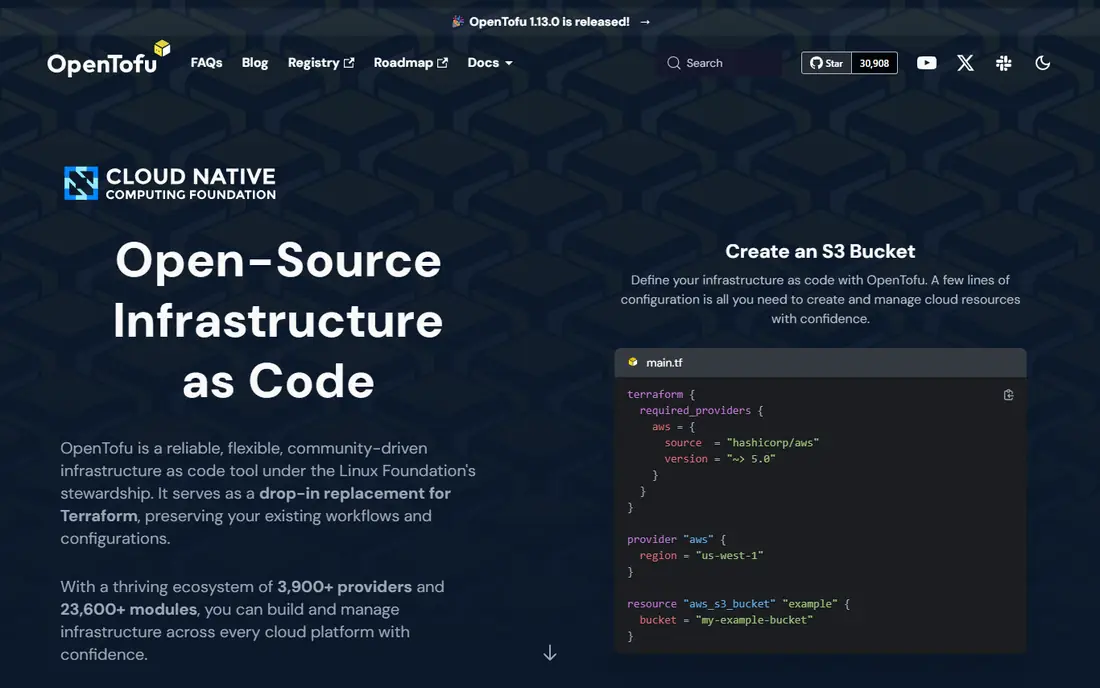
OpenTofu is a fork of Terraform created after HashiCorp moved Terraform to the Business Source License. For many teams, that license change is the whole reason to switch. OpenTofu keeps the familiar write-plan-apply workflow and state format, which makes migration far less disruptive than moving to a different language or model.
The gaps are around managed features. Policy checks, drift detection, and hosted runs that Terraform Cloud bundles often come from separate tools when using OpenTofu alone, or from a managed control plane. Teams that self-manage with CI and object storage can run OpenTofu at very low license cost. Teams that want a managed experience should pair it with Spacelift, env0, or Scalr and compare that combined cost.
- Fully open source under MPL 2.0
- High compatibility with Terraform state and configuration
- Growing provider registry
- Some Terraform Cloud features need third-party tools
- Policy tooling is less built-in than in commercial platforms
Pulumi
Great for: Developers who want infrastructure in Python, TypeScript, Go, or .NET
Pulumi replaces Terraform's HCL with general-purpose programming languages. That change suits teams where developers already write in Python or TypeScript and want to reuse code, tests, and libraries for infrastructure. Conditional logic, loops, and abstraction feel natural in code, and Pulumi supports multiple clouds from the same codebase.
The cost is discipline. Infrastructure as code becomes software, which means code review, testing, and versioning matter even more. Paid Pulumi Cloud tiers start at a modest monthly figure for small teams but rise for larger estates and enterprise features. If your team thinks in code and wants one language across app and infrastructure, Pulumi is the strongest Terraform alternative. If your team prefers declarative config, OpenTofu will feel more familiar.
- Real programming languages with loops and tests
- Strong multi-cloud provider coverage
- Managed Pulumi Cloud option
- Paid tiers rise with scale
- Teams need software engineering habits for infrastructure code
Ansible is often listed as a Terraform alternative, but it solves a related problem rather than the same one. It excels at configuring servers, installing software, and running tasks across many machines without agents. Its YAML playbooks are readable, and its module library covers a wide range of systems and cloud services.
For provisioning, Ansible lacks Terraform's state file and dependency graph, so tracking what exists and what changed is less precise. That makes it a better companion than a replacement for large multi-cloud estates. Many teams use Terraform or OpenTofu to create infrastructure and Ansible to configure what runs on it. If configuration is the main job, Ansible alone may be enough. If provisioning is the main job, pair it with a state-based tool.
- Agentless, YAML-based automation
- Huge module library
- Easy to learn for operations teams
- Not a state-based provisioning tool like Terraform
- Large cloud provisioning is less structured
AWS CloudFormation
Great for: AWS-only teams that want a native provisioning service
AWS CloudFormation is the default provisioning service inside AWS. Templates describe stacks of AWS resources, and AWS handles creation, updates, and rollback. There is no separate license fee for CloudFormation itself, though the AWS resources it creates are billed normally. For teams that live entirely in AWS, that native fit is hard to beat.
The limit is scope. CloudFormation does not provision other clouds or on-premises systems in the same way, so a multi-cloud strategy needs a second tool. Templates can also feel verbose compared with HCL or Pulumi code. Teams committed to AWS, especially those using the AWS CDK to generate templates from code, will find CloudFormation a practical Terraform alternative. Teams with any multi-cloud ambition should look elsewhere.
- Native AWS service with no extra license cost for the service itself
- Deep AWS integration
- Template-based and reviewable
- AWS only
- Template language is more verbose than HCL for many teams
- Multi-cloud work needs another tool
Crossplane turns infrastructure into Kubernetes resources. Platform teams define compositions that let developers request a database or a bucket through a simple claim, while Crossplane handles the underlying cloud resources. That model suits organizations already running Kubernetes and building an internal developer platform.
The catch is the prerequisite. Crossplane assumes Kubernetes knowledge, cluster operations, and a platform mindset. Teams without Kubernetes experience will face a steep learning curve before any benefit appears. For Kubernetes-native shops, Crossplane is a compelling Terraform alternative that unifies app and infrastructure control planes. For other teams, it adds complexity without a clear payoff.
- Kubernetes-native control plane
- Infrastructure as Kubernetes resources
- Strong fit for platform teams
- Requires Kubernetes expertise
- Learning curve for teams without Kubernetes experience
Spacelift
Great for: Platform teams governing Terraform, OpenTofu, and other IaC tools
Spacelift is not a provisioning language. It is a control plane that runs and governs infrastructure code teams already have. It supports Terraform, OpenTofu, Pulumi, CloudFormation, and Ansible, and adds policy checks, drift detection, stack dependencies, and approvals. That neutrality is useful for organizations with mixed IaC estates or a migration in progress.
Pricing is the main barrier. A free tier covers small use, but paid plans start at a substantial annual figure, and higher tiers are quote-based. Small teams may find that cost hard to justify. Larger platform teams that need governance, audit trails, and private workers will find the value clearer. Compare Spacelift with env0 and Scalr on the governance features you actually need, not on the full feature list.
- Multi-tool support including OpenTofu and Pulumi
- Policy, drift detection, and dependencies
- Private workers option
- Paid tiers start at a high annual figure
- Pricing above the entry tier is quote-based
env0 provides a managed platform for running infrastructure code, with environments, approvals, policy checks, and drift detection. It supports Terraform, OpenTofu, and other tools, which makes it a natural home for teams migrating away from Terraform Cloud. A free tier gives small teams a way to try managed runs without an upfront contract.
The pricing model needs attention. Higher tiers are quote-based, and usage-based metering means busy pipelines can raise costs in ways that per-user pricing does not. Teams should model their run frequency before committing. For teams that want managed IaC without running their own CI pipelines for infrastructure, env0 is a strong candidate alongside Spacelift and Scalr.
- Supports Terraform, OpenTofu, and other tools
- Managed runs with approvals and policy
- Free tier for small use
- Higher tiers are quote-based
- Per-apply metering needs monitoring for busy pipelines
Scalr positions itself as a direct replacement for Terraform Cloud, with remote runs, state management, policy, and collaboration for Terraform and OpenTofu. Its pricing is notable for clarity: a free tier covers small use, and paid tiers charge per run rather than per user in the published model. That makes costs easier to model for teams with predictable apply frequency.
Run-based pricing cuts both ways. Teams that apply often, including in busy CI pipelines, will see costs rise with activity. Teams with steady, planned changes may find it cheaper than per-user models. Scalr suits teams that want the Terraform Cloud experience without the license concern, and that value simple, published pricing. Test it with your real run frequency, not only with a handful of manual applies.
- Clear run-based pricing on paid tiers
- Free tier for small use
- Drop-in feel for Terraform Cloud users
- Run-based costs rise with frequent applies
- Enterprise features need higher tiers
How we picked these
We compared official documentation, licensing pages, and pricing pages for tools that are live in October 2026 and that cover provisioning, configuration, or IaC governance. We included a fork, a code-first platform, a configuration tool, a cloud-native service, a Kubernetes control plane, and three managed control planes, so the list reflects real migration paths rather than only language choices. Where pricing was quote-based, we marked it as See website in the comparison where appropriate and noted the free tier in the product block.
What to check before you switch
Start with license and state. If the Business Source License is the reason for moving, OpenTofu plus a control plane is the lowest-friction path, since state and configuration carry over with modest changes. If the reason is workflow, Pulumi or Crossplane may fit better, but both require a larger rewrite and new team habits.
Next, test governance needs honestly. Policy checks, approvals, drift detection, and audit logs are easy to list and hard to live without once a team grows. Self-managed CI can cover small teams, while larger teams usually need a control plane. Model costs on real run frequency and resource counts, not on headline tiers. A short pilot that migrates one real stack, including its policies and approvals, reveals more than a demo of a sample stack.
Frequently asked questions
What is the best Terraform alternative?
OpenTofu is the closest alternative for teams that want Terraform-style workflows under a fully open source license. Pulumi is the best alternative for teams that prefer real programming languages, while Scalr, Spacelift, and env0 are the best managed control planes for teams leaving Terraform Cloud. The best pick depends on license concerns, team skills, and governance needs.
Is OpenTofu a drop-in replacement for Terraform?
OpenTofu is highly compatible with Terraform configuration and state for many workloads, which makes migration easier than switching languages. Some Terraform Cloud features, such as built-in policy tooling, need third-party tools or a managed control plane. Test your providers, modules, and state with a pilot migration before moving production stacks.
What are the best alternatives to Terraform for developers?
Pulumi suits developers who want Python, TypeScript, Go, or .NET for infrastructure, with tests and reusable code. The AWS CDK suits AWS-only developers who want code-generated CloudFormation templates. OpenTofu suits developers who prefer declarative configuration and a familiar Terraform workflow.
Is Ansible a good Terraform alternative?
Ansible is a strong configuration management tool and a useful companion to Terraform or OpenTofu, but it is not a state-based provisioning replacement. It lacks Terraform's dependency graph and state tracking for large cloud estates. Use Ansible to configure servers and applications, and pair it with a provisioning tool for creating cloud resources.
Do Terraform alternatives work across multiple clouds?
OpenTofu, Pulumi, Crossplane, Spacelift, env0, and Scalr are designed for multi-cloud or multi-tool use, though provider coverage varies. AWS CloudFormation is AWS-only, so it does not fit a multi-cloud strategy. Check provider support for the specific cloud services you use before choosing.
Sources
See where you really rank - block by block
ProMapRanker scans Google Maps across a grid of your service area. Simple monthly plans from $19, white-label on every plan.
Start freeKeep reading
 zoho inventory alternatives
6 Alternatives to Zoho Inventory, Compared on Price and Fit
Zoho Inventory alternatives: 6 tools compared on price, free plans and fit. Katana leads the list for manufacturers. Fit and flaws are laid out for each entry.
Read → zoho crm alternatives
Best Zoho CRM Alternatives (2026)
Need Zoho CRM alternatives? We compare 7 tools on cost, free access and who each suits. Every pick gets a straight assessment. Built for quick decisions.
Read → zelle alternatives
Best Zelle Alternatives in 2026
Compare the best Zelle alternatives for sending money to friends, paying sellers and moving funds abroad, with honest notes on fees, speed and safety in 2026.
Read →