 ProMapRanker
Best Terminus Alternatives in 2026

Key takeaways
- Demandbase and 6sense are the closest full-suite replacements for Terminus, with intent data, scoring and activation in one platform.
- RollWorks suits mid-market teams that want account-based advertising without a full enterprise suite.
- HubSpot suits teams already on HubSpot, since ABM tools sit inside the CRM and marketing workflows they already use.
- Most enterprise ABM pricing is custom and quoted by sales, so budget ranges matter more than a single published price.
- A clear target account list and agreed sales and marketing goals matter more than any platform feature.
Quick comparison
| Pick | Great for | Pricing starts at | Free tier | |
|---|---|---|---|---|
 Demandbase | Full-suite enterprise ABM | See website | No | Visit |
 6sense | Predictive intent and scoring | See website | Yes | Visit |
 RollWorks | Mid-market ABM advertising | See website | No | Visit |
 HubSpot | Teams already on HubSpot | $890 per month | No | Visit |
 Madison Logic | Content-led ABM programs | See website | No | Visit |
 ZoomInfo | Data and intent for ABM | See website | No | Visit |
 Influ2 | Person-level ABM advertising | See website | No | Visit |
 Mutiny | Website personalization for ABM | See website | No | Visit |
 Apollo.io | Budget ABM and outbound | Free | Yes | Visit |
The best Terminus alternatives
We compared ABM platforms on intent data, account targeting, advertising, orchestration, CRM integration and pricing transparency, using official product pages and public pricing information. Terminus itself is not listed here, since this guide covers alternatives only.

Demandbase is the most direct suite-for-suite replacement for Terminus in this list. It brings account identification, intent signals, audience building, advertising and measurement together, so a team does not need to stitch several point tools into a single program. That breadth suits large B2B teams with a defined target account list and dedicated marketing operations support.
The trade-off is cost and complexity. Pricing is quoted by sales and sits at enterprise levels, and getting value from the full suite requires clean CRM data and agreed account tiers. Teams without that foundation may find the platform heavy. For enterprises that want one ABM system of record, Demandbase is a strong first call.
- Account intelligence, intent and advertising in one suite
- B2B advertising platform
- Strong Salesforce and HubSpot integration
- Pricing is custom and enterprise-level
- Implementation takes time
- Smaller teams may pay for features they rarely use
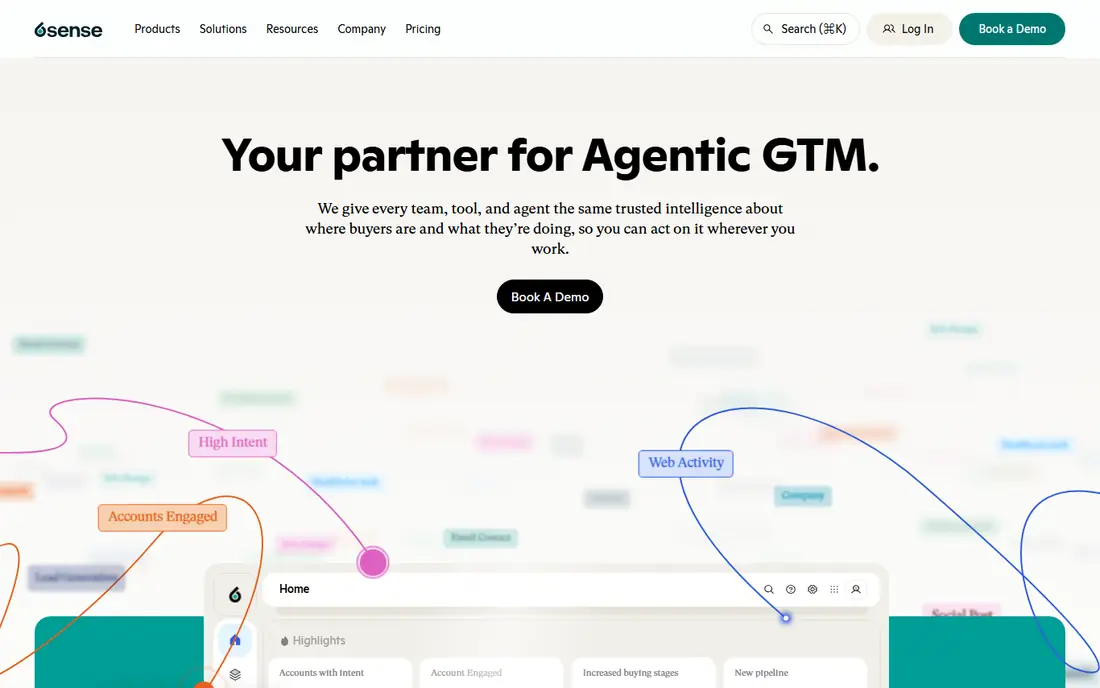
6sense stands out for prediction. The platform turns intent signals, website activity and other buying signals into account scores and predicted buying stages, which helps sales teams focus on accounts that show real movement. That predictive layer is the main reason teams choose 6sense over a simpler advertising tool.
The free tier gives small teams a way to try basic sales intelligence, but full ABM orchestration sits in custom-priced paid plans. Implementation also needs care: scores are only as good as the account list, CRM hygiene and signal sources feeding them. For mid-market and enterprise teams with enough target accounts to make scoring worthwhile, 6sense is a leading pick.
- Predictive buying-stage models
- Broad intent signal coverage
- Free sales intelligence tier for basic use
- Paid plans are custom and costly
- Setup and tuning take time
- Best value comes with larger account volumes

RollWorks, part of the AdRoll group, suits teams that want ABM advertising without buying a full enterprise suite. The platform helps teams build account audiences, run display and retargeting campaigns to those accounts, and report on account engagement. That focused scope makes it easier to launch than a suite with many modules.
The limit is depth. Reporting and orchestration are more basic than at Demandbase or 6sense, and teams that need complex multi-channel plays may need extra tools. Media spend is also separate from platform fees, so the total budget is higher than the platform price alone. For mid-market teams starting or scaling ABM ads, RollWorks is a practical choice.
- Account-based advertising built for mid-market teams
- Audience and engagement reporting
- HubSpot and Salesforce integration
- Pricing is custom
- Measurement is lighter than enterprise suites
- Media spend sits on top of platform fees
HubSpot is the lowest-friction option for teams that already run on HubSpot. Target accounts, buying roles, ABM workflows, smart content and dashboards live inside the same CRM and marketing system, so sales and marketing share one view of each account. That shared view removes a common ABM problem, which is data spread across tools that do not agree.
The catch is tiering. ABM tools require Marketing Hub Professional or Enterprise, with Professional listed around $890 per month in public pricing summaries, and total cost rises with contacts and added hubs. Advertising orchestration is also lighter than at RollWorks or Demandbase. For HubSpot-centred teams, though, the native fit often outweighs those limits.
- ABM tools native to CRM and marketing workflows
- Target accounts, buying roles and dashboards in one place
- No separate ABM login
- ABM features sit in higher Marketing Hub tiers
- Pricing rises with contacts and hubs
- Advertising depth is lighter than dedicated ABM platforms
Madison Logic takes a content-first route to ABM. Rather than selling only a software platform, it runs content syndication and account engagement programs that put relevant content in front of target accounts and report on engagement. That model suits teams whose ABM motion is built around education, reports and webinars rather than display ads alone.
The trade-off is control. Programs are more managed and less self-serve than a platform like RollWorks, and pricing is quoted per program. Teams that want to run every campaign themselves may prefer a software-first tool. For demand teams that want account engagement delivered as a program, Madison Logic is a distinct and useful alternative.
- Content syndication and account engagement programs
- Intent-informed targeting
- Managed campaign support
- Pricing is custom
- Less of a self-serve platform
- Measurement depends on campaign scope
ZoomInfo suits ABM teams whose main gap is data. The platform pairs a large contact and company database with intent signals, so a team can move from a surging account to the buying committee members at that account in one workflow. That data-to-contact step is where pure intent tools often leave a gap.
Pricing is custom, and intent features are often bundled as an add-on, so the total cost depends on seats and modules. Teams should also test data coverage for their specific industries and regions before committing, since no database is even across every segment. For sales-led ABM, where reps need contacts as well as signals, ZoomInfo is a strong fit.
- Very large B2B contact and company database
- Intent signals paired with contact data
- Strong CRM integration
- Pricing is custom and seat-based
- Intent is an add-on in many plans
- Data quality varies by segment
Influ2 changes the targeting unit from the account to the person. Instead of showing ads to anyone at a target company, it targets named buying committee members across LinkedIn, display and other channels, then reports on which people engaged and how that engagement connects to pipeline. That precision suits complex B2B sales with several decision makers.
The model needs a good contact list to work well, since person-level targeting depends on accurate people data. Pricing is custom, and the platform suits teams that already know their buying committees. For teams frustrated by account-level ads that reach the wrong people, Influ2 offers a sharper alternative.
- Advertising targeted to named people, not just accounts
- LinkedIn, display and social channels
- Pipeline and revenue reporting
- Pricing is custom
- Works best with a defined contact list
- Smaller teams may need help with setup
Mutiny focuses on the moment a target account visits your website. The platform lets marketers change headlines, content and calls to action for specific accounts or segments, then test which version converts better. That on-site personalization can lift meeting bookings from accounts that ABM ads already warmed up.
Mutiny is a complement, not a full ABM replacement. It does not provide intent data or advertising on its own, so most teams pair it with a platform like 6sense, Demandbase or HubSpot. It also needs enough traffic from target accounts to run meaningful tests. For teams whose website is a key conversion point, Mutiny adds a layer that ad-only tools miss.
- Personalized website experiences by account or segment
- No-code page changes for marketers
- Experiment and conversion reporting
- Pricing is custom
- It complements rather than replaces an ABM platform
- Needs site traffic volume to test well
Apollo.io is the budget entry point in this list. A free tier gives access to a contact database and basic tools, and paid plans add sequencing, enrichment and more credits. Small teams can build a target account list, find contacts and run outbound sequences without an enterprise contract.
The limit is scope. Apollo.io is stronger for prospecting and outbound than for full ABM orchestration, advertising and predictive scoring. Teams that need those deeper features will still need a platform from higher up this list. For startups and small teams that need ABM-style targeting on a tight budget, Apollo.io is a practical place to start.
- Large contact database with a free tier
- Built-in sequencing for outbound
- Salesforce and HubSpot integration
- ABM orchestration is lighter than enterprise suites
- Data accuracy varies
- Advanced features sit in paid plans
How we picked these
We compared official product pages, pricing pages, integration lists and public ABM guides for platforms that serve B2B teams in October 2026. We kept only tools that support account targeting, intent or engagement signals, and sales and marketing coordination, and that are open to new customers. We left out Terminus itself, tools that are only email or only CRM without ABM features, and tools with no clear ABM use.
We gave weight to intent quality, advertising and orchestration depth, CRM integration, reporting and pricing transparency. We did not claim hands-on testing of enterprise contracts. Since most enterprise pricing is quoted by sales, confirm scope, seats, data limits and contract length before signing.
How to choose an ABM platform
Start with the account list
A platform cannot fix a vague target list. Agree on ideal customer traits, account tiers and buying roles first, then choose a tool that can target and report on those accounts. Teams that skip this step often buy a suite and struggle to show movement.
Match scope to team size
Small teams do better with a focused tool like RollWorks, HubSpot or Apollo.io than with a full suite they cannot staff. Large teams with dedicated operations can justify Demandbase or 6sense, where scoring and orchestration pay off across many accounts and reps.
Check the full cost
Ask what is included in the quoted price: seats, accounts, intent topics, ad spend, data credits and implementation. Media spend, data add-ons and integration work can add a large amount to the platform fee, so get the total in writing.
Frequently asked questions
What is the closest Terminus alternative?
Demandbase and 6sense are the closest full-suite alternatives, since both cover intent, scoring, advertising and orchestration. RollWorks is closer if you mainly want ABM advertising, while HubSpot is closer if you already run on HubSpot.
How much does ABM software cost?
Costs vary widely. Apollo.io offers a free tier, HubSpot ABM sits in higher Marketing Hub tiers, and enterprise platforms like Demandbase and 6sense are custom-priced and often run into tens of thousands of dollars per year. Always ask for the total cost including seats, data and media.
Do I need intent data for ABM?
Intent data helps teams prioritise accounts that show buying research, but it is not required to start. A small team can begin with a clear account list, HubSpot or Apollo.io, and website engagement, then add intent data when volume justifies it.
Can ABM work for small B2B teams?
Yes, with a narrow focus. Pick 20 to 100 target accounts, agree on the buying roles, and use a focused tool rather than a full suite. Measure meetings and pipeline from those accounts, not just ad impressions.
How do ABM platforms connect to a CRM?
Most platforms here integrate with Salesforce and HubSpot, syncing account lists, engagement and scores back to the CRM. Check whether the integration is bi-directional, how often it syncs, and which fields map to your sales workflow before you buy.
Is Terminus still available?
Terminus has changed hands and its standalone positioning has shifted in recent public guides, which is why teams search for alternatives. Confirm current availability and terms directly with the vendor if you are an existing customer, and treat this guide as a list of replacements rather than a statement about any single contract.
Sources
See where you really rank - block by block
ProMapRanker scans Google Maps across a grid of your service area. Simple monthly plans from $19, white-label on every plan.
Start freeKeep reading
 zyte alternatives
Best Zyte Alternatives in 2026
These zyte alternatives cover managed scraping APIs, proxy networks and no code tools for lawful collection from your own or consented sources only in 2026.
Read → zerto alternatives
Best Zerto Alternatives in 2026
Compare the best zerto alternatives for disaster recovery and replication, with recovery targets, cloud options and honest trade-offs for teams in 2026.
Read → zerofox alternatives
Best ZeroFox Alternatives in 2026
We compared 9 zerofox alternatives for brand protection, phishing takedowns, dark web monitoring, and social impersonation, with clear coverage notes.
Read →