 ProMapRanker
Best Teamtailor Alternatives in 2026

Key takeaways
- Workable suits small and mid-size teams that want published pricing and fast setup, while Greenhouse suits teams that need structured hiring at scale.
- Ashby leads for hiring analytics, and Breezy HR leads for flat, visual pipeline pricing with unlimited users.
- Employer branding matters, so check career site tools, not just the internal pipeline, before you choose.
- Quote-based tools can cost far more than the entry figure in reviews, so ask for a written quote at your actual job and user count.
Quick comparison
| Pick | Great for | Pricing starts at | Free tier | |
|---|---|---|---|---|
 Workable | Fast setup and published pricing | $299 per month | Free trial | Visit |
 Greenhouse | Structured hiring at scale | See website | Free trial | Visit |
 Lever | ATS plus talent CRM | See website | Free trial | Visit |
 Ashby | Hiring analytics and reporting | $400 per month | Free trial | Visit |
 Breezy HR | Visual pipelines and flat pricing | $157 per month | Yes | Visit |
 Recruitee | Collaborative hiring in Europe | See website | Free trial | Visit |
 JazzHR | Budget ATS for small teams | $110 per month | Free trial | Visit |
 Zoho Recruit | Low-cost ATS for small teams | $25 per user per month | Free trial | Visit |
 Homerun | Simple hiring for small teams | See website | Free trial | Visit |
The best teamtailor alternatives
Teamtailor is known for employer branding, career sites, and collaborative hiring. The tools below cover those same needs in different ways, from simple pipelines for small teams to structured enterprise hiring, so the right pick depends on hiring volume, team size, and how much reporting you need.
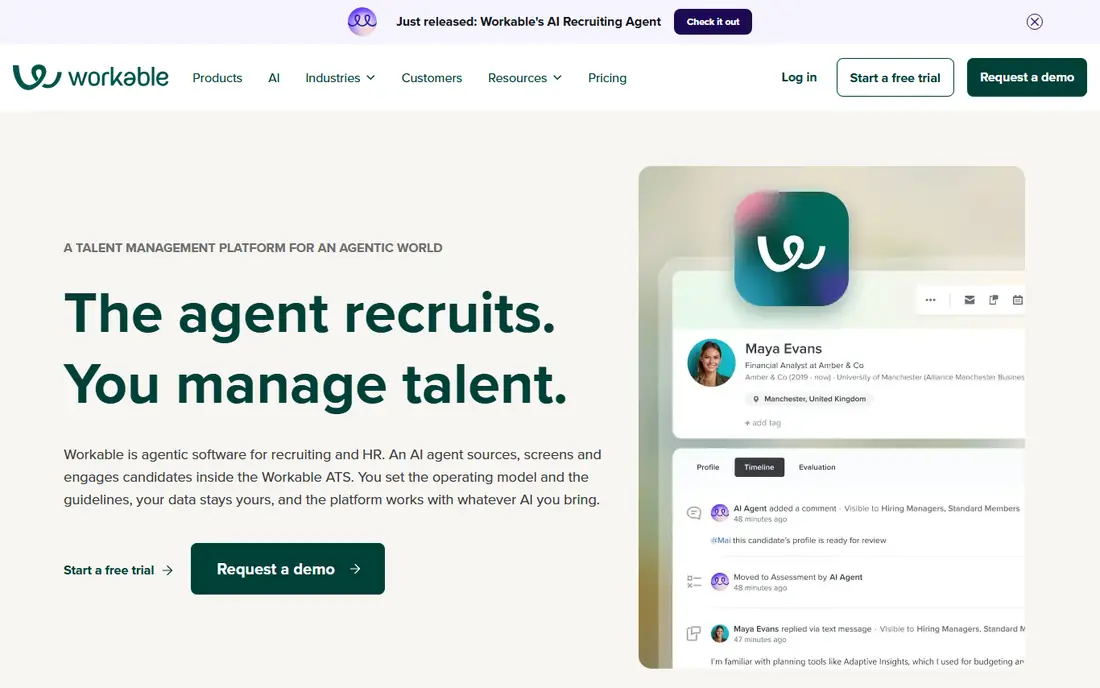
Workable suits teams that want to start hiring quickly without a long sales process. Published pricing, a career site builder, and posting to many job boards help a small or mid-size team move fast, and AI sourcing can widen the candidate pool beyond active applicants. The mobile app and collaboration tools also help hiring managers stay involved without learning a complex system.
The base price does not tell the full story, because texting, video interviews, and assessments are add-ons on some plans, and HR features are priced separately. Price the add-ons you will actually use, and compare the total with a quote-based tool before deciding.
- Published tiers
- AI sourcing tools
- Broad job board posting
- Add-ons raise the real bill
- HR features cost extra
Greenhouse is the standard pick for teams that want consistent, fair hiring across many roles and hiring managers. Interview kits, scorecards, and structured stages help every candidate get a similar process, which improves both decision quality and candidate experience. Reporting and integrations support larger talent teams that need data, not just a pipeline view.
It is quote-based, so small teams should ask for a written quote early and check what sits in the base plan. Setup also takes more care than a simple pipeline tool, but teams that hire at volume usually find the structure worth the effort.
- Structured interviews and scorecards
- Strong reporting
- Deep integrations
- Quote-based pricing
- Setup takes time and care
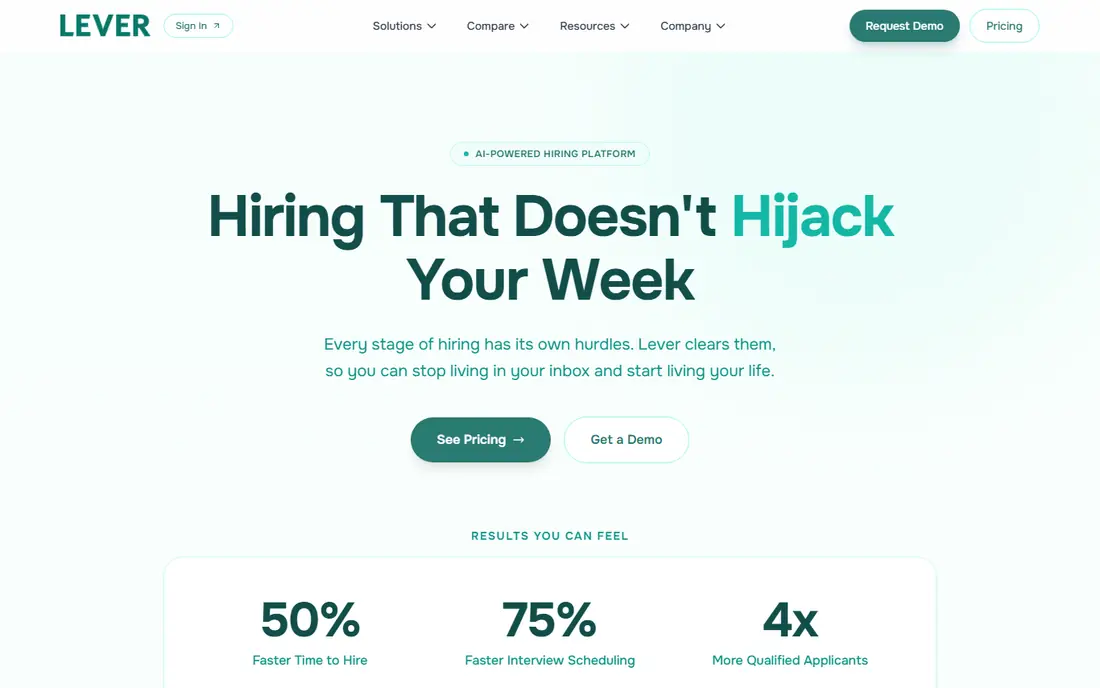
Lever combines an applicant tracking system with a talent CRM, so teams can nurture passive candidates over time, not just process active applicants. Multi-touch nurture flows, sourcing tools, and hiring manager collaboration suit teams that build talent pools for hard-to-fill roles. That CRM layer sets Lever apart from simpler pipeline tools.
Pricing is quote-based and can rise with scale, so budget carefully and compare the total with Greenhouse and Ashby. Lever fits teams that source proactively and need a long-term candidate relationship, not just a job posting tool.
- Built-in talent CRM
- Candidate nurture tools
- Strong hiring manager workflow
- Quote-based pricing
- Cost rises with scale
Ashby suits talent teams that live on hiring data, with analytics, custom reports, and a unified data model that makes pipeline, source, and interviewer performance easier to track. Scheduling for multi-interviewer panels is also strong, which helps teams that run complex interview loops. The interface feels modern compared with older enterprise tools.
The entry price is higher than Breezy or Zoho Recruit, and the reporting power only helps if the team keeps pipeline data clean. Ashby is best for mid-market and larger teams that will actually use the analytics, not for a team that hires a few people a year.
- Deep analytics and custom reporting
- Modern interface
- Strong scheduling
- Higher entry price
- Reporting depth needs data care
Breezy HR is a friendly choice for lean teams that want a visual pipeline and predictable pricing. Unlimited users on paid plans means hiring managers can join without a per-seat fight, and the Kanban view makes pipeline status clear at a glance. A free tier for one active job lets a very small team start without a budget.
Enterprise reporting and compliance tooling are thinner than Greenhouse or Ashby, and there is no full recruitment CRM for long-term nurture. For a growing team that hires steadily and wants simplicity, Breezy offers strong value.
- Flat monthly price with unlimited users
- Visual Kanban pipelines
- Free tier for one job
- Thinner enterprise reporting
- No full recruitment CRM
Recruitee, now part of Tellent, suits mid-size teams that want hiring managers deeply involved in the process. Collaboration, feedback, and career site tools help teams share candidates and decisions without email chains, and sourcing features support proactive outreach. Its European roots also help teams hiring across several countries.
Pricing is quote-based, so ask for a clear quote at your job count and team size. North American teams should also check job board coverage and support hours for their region before committing.
- Easy hiring manager collaboration
- Career site tools
- Sourcing features
- Quote-based pricing
- Smaller North American presence
JazzHR is a practical first ATS for small teams that need a real pipeline without a large contract. Flat-rate pricing with unlimited hiring manager users keeps costs predictable, and posting, screening, and collaboration cover the core hiring workflow. Setup is fast enough for a team hiring its first few roles through a system.
Sourcing and analytics are thinner than Workable, Greenhouse, or Ashby, so teams that rely on proactive outreach may need another tool. For a small team that mainly posts jobs and processes applicants, JazzHR is a solid, low-cost choice.
- Low entry price
- Unlimited hiring manager users
- Simple setup
- Thinner sourcing and analytics
- Fewer advanced features
Zoho Recruit suits cost-conscious teams and staffing firms that want a capable ATS at a low per-user price. It covers job posting, resume parsing, pipeline management, and client or hiring manager portals, and it links well with other Zoho apps. That ecosystem value matters for teams already using Zoho for CRM or HR.
The interface is less modern than Workable or Ashby, and some advanced features sit on higher plans. For a small team that values price and function over polish, Zoho Recruit is hard to beat on cost.
- Low per-user price
- Staffing and corporate hiring options
- Zoho ecosystem links
- Interface feels dated to some users
- Advanced features need higher plans
Homerun focuses on a clean candidate experience, with attractive career pages and a simple application flow that helps small brands look professional. Team collaboration, candidate notes, and pipeline views cover the basics without a steep learning curve. That simplicity suits startups and small companies hiring a handful of roles at a time.
High-volume or enterprise hiring will likely need deeper reporting, automation, and integrations than Homerun offers. For a small team that wants hiring to feel easy for candidates and hiring managers alike, Homerun is a pleasant alternative.
- Simple, attractive career pages
- Easy candidate experience
- Team collaboration
- Less suited to high-volume enterprise hiring
- Fewer advanced analytics
How we picked these
We compared official feature pages, pricing pages, and public reviews for applicant tracking systems live in October 2026. We kept tools that cover job posting, pipelines, career sites, and hiring collaboration, and we favored a mix of published-price tools and established quote-based platforms. Where pricing is quote-based, we used See website rather than a reported range that could mislead.
What to check before you switch
Start with a real hiring workflow, not a feature list. Post a test job, invite a hiring manager to review candidates, and run a mock interview loop, watching where the process slows down. A tool that looks good in a demo can still fail if hiring managers avoid it.
Test the candidate experience
Apply for your own test job on a phone, and check how long it takes, what it asks for, and how the career page looks. A long or clunky application loses candidates before a recruiter ever sees them. Career site branding, mobile fit, and application length matter as much as internal pipeline features.
Price at real hiring volume
Quote-based tools often price by job slots, users, or company size, so ask for a quote at your peak job count, not your current one. For published-price tools, add the cost of texting, video interviews, and assessments if you will use them. A written total at peak volume is the only fair comparison.
Frequently asked questions
What is the best Teamtailor alternative for employer branding?
Teamtailor leads on branding, but Workable, Recruitee, and Homerun all offer career site builders and branded pages. Test the career page on a phone, check how easy it is to update, and confirm that job posts look consistent with your main website before choosing.
Which ATS is best for small teams?
Breezy HR and JazzHR suit small teams with flat, predictable pricing, while Zoho Recruit suits teams that want a low per-user price. Workable suits small teams that want published pricing and AI sourcing, if the budget allows for the base plan and any add-ons.
Do I need a recruitment CRM as well as an ATS?
Not always. A CRM helps teams that source passive candidates and nurture talent pools over months, which is where Lever stands out. Teams that mainly process active applicants can manage well with a strong ATS alone, such as Workable, Greenhouse, or Breezy HR.
How long does it take to switch ATS tools?
Simple tools can be live in days, while structured tools such as Greenhouse can take weeks to set up well. Data migration, career site design, interview templates, and hiring manager training all add time. Run the new tool alongside the old one for one hiring round if possible.
Can I keep my candidate data when switching?
Most tools support candidate export and import, but notes, interview feedback, and custom fields may not move cleanly. Export a full backup before canceling, map custom fields in advance, and test the import with a small batch before moving the full database.
Sources
See where you really rank - block by block
ProMapRanker scans Google Maps across a grid of your service area. Simple monthly plans from $19, white-label on every plan.
Start freeKeep reading
 zoro.to alternatives
Best Zoro.to Alternatives in 2026
We compare the best zoro.to alternatives in 2026, listing only legal licensed anime streaming services, from Crunchyroll to free options for fans today.
Read → zip alternatives
Best Zip Alternatives in 2026
We compare the best zip alternatives for buy now, pay later in 2026, covering pay-in-4 plans, fees, spending limits, and credit reporting options today.
Read → yesware alternatives
Best Yesware Alternatives in 2026
Compare the best yesware alternatives for sales email tracking, templates, and sequences, with current pricing and honest tradeoffs for small sales teams.
Read →