 ProMapRanker
Best Talend Alternatives in 2026

Key takeaways
- Fivetran and Airbyte are the closest managed ELT replacements, with broad connector catalogs and usage based pricing.
- Stitch, Hevo Data and Skyvia suit smaller teams that want simpler setup and clearer entry prices.
- Informatica and Matillion suit large warehouse projects, but both need a larger budget and more planning.
- Apache NiFi is free and open, yet it needs engineering time to run and maintain.
- We did not list Talend itself here, since this article covers alternatives to it.
Quick comparison
| Pick | Great for | Pricing starts at | Free tier | |
|---|---|---|---|---|
 Fivetran | Managed ELT at scale | See website | Yes | Visit |
 Airbyte | Open ELT with self hosting | $20 per month | Yes | Visit |
 Informatica | Enterprise data management | See website | No | Visit |
 Stitch | Simple SaaS to warehouse loads | $100 per month | Free trial | Visit |
 Matillion | Warehouse native ELT | See website | Free trial | Visit |
 Hevo Data | No-code ELT for small teams | See website | Yes | Visit |
 Skyvia | No-code integration and sync | $79 per month | Yes | Visit |
 Apache NiFi | Free open data flows | Free | Yes | Visit |
The best Talend alternatives
Talend is known for visual data integration, transformation and data quality work, now under Qlik. Teams look for alternatives when they want simpler managed ELT, open source control, lower entry cost or a warehouse native design. We compared official feature pages, pricing pages and public documentation, not hands-on pipeline builds.

Fivetran moves data from applications and databases into a warehouse with little manual pipeline work. Connectors handle schema changes and sync scheduling, so data teams spend less time fixing broken loads and more time modelling data in the warehouse. The free tier covers a limited volume of monthly active rows, which is enough to test a few key sources.
The main drawback is cost control. Pricing is based on monthly active rows per connection, so a wide source with many changing rows can cost much more than a small one. Fivetran also pairs best with a transformation tool such as dbt, rather than offering the same visual ETL design surface as Talend. Choose it when reliable managed ingestion matters more than building transforms inside the loader.
- Large managed connector catalog
- Automated schema handling
- Strong reliability features
- Usage based cost can grow fast
- Less visual transformation than Talend Studio
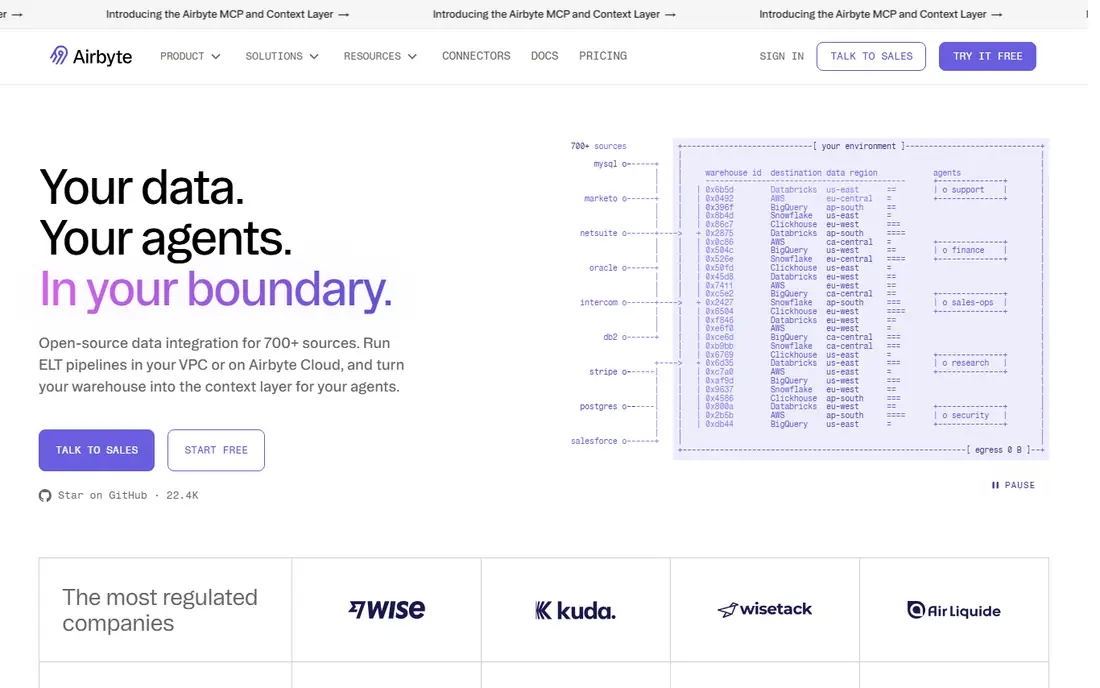
Airbyte is the open alternative that many engineering teams pick first. The open source core can run in your own infrastructure, while Airbyte Cloud offers a managed service with a free Core plan and paid Standard plans from 20 dollars per month. A no-code connector builder helps teams add unusual APIs without writing a full connector from scratch.
Self hosting brings control over data location and cost, but it also brings upgrades, monitoring and scaling work. Cloud pricing is volume based, so large syncs still need a budget check. Airbyte suits teams that value openness, custom connectors and a choice between managed and self hosted deployment, rather than a single vendor hosted path.
- Open source core
- Self hosted option
- Large connector catalog with a builder
- Cloud costs depend on volume
- Self hosting needs engineering effort

Informatica Intelligent Data Management Cloud covers integration, quality, governance, catalog and more in one enterprise platform. That breadth suits large companies that must manage data across many systems, meet compliance needs and govern who can use which data. Its connector range and data quality tools go well beyond simple loading.
The trade-off is scale and cost. Pricing is quote based and aimed at enterprise budgets, and implementation often needs specialist staff and a longer project plan. Small teams with a handful of sources will find it far larger than needed. Choose Informatica when governance, quality and enterprise scope are the real requirements, not just moving a few tables.
- Broad enterprise data platform
- Governance and quality tools
- Many connectors
- Quote only pricing
- Complex setup
- Overkill for small pipelines
Stitch, part of Talend's wider history yet a distinct product, focuses on one job: moving data from SaaS applications and databases into a warehouse. Setup is straightforward, sources are familiar, and row based tiers make the first cost estimate easy to read. Paid plans start at 100 dollars per month for a set row volume and one destination.
Stitch does not offer the transformation depth of Talend Studio or Matillion, and its change data capture is more limited than specialist real time tools. Teams that need heavy in-pipeline transforms will pair it with a warehouse transformation tool. Pick Stitch when you want simple, steady replication without building a complex integration project.
- Simple setup for common sources
- Clear row based tiers
- Reliable for standard loads
- Limited transformation
- Limited change data capture depth
- Entry price is not the cheapest
Matillion builds pipelines that run inside the cloud warehouse, using its compute rather than a separate engine. That design suits teams already committed to Snowflake, BigQuery, Databricks or Redshift, since transforms use warehouse SQL and Python in a visual flow. It also supports orchestration, scheduling and data quality checks in the same workspace.
Pricing is quote based and credit driven, so small teams should ask for a clear estimate based on their workload before committing. Matillion is less useful if your main target is not a cloud warehouse, or if you need broad application to application integration. Choose it when warehouse native transformation is the centre of your data work.
- Runs inside the warehouse
- Visual pipeline design
- Strong for Snowflake, BigQuery and Redshift
- Quote based pricing
- Warehouse specific skills still help
- Less suited to non warehouse targets
Hevo Data targets small and mid-size teams that want ELT without writing pipeline code. Sources connect through a guided setup, change data capture keeps warehouse tables fresh, and built in transformations cover common cleaning tasks. A free tier covers a limited monthly event volume, which is enough to test core sources before paying.
Event based pricing means cost follows data change volume, so busy transactional sources need a careful estimate. Hevo also offers less governance depth than enterprise platforms, which is fine for most growing teams but worth noting for regulated work. Pick Hevo when a small team needs reliable no-code ELT and fast setup.
- No-code setup
- Real time change capture on paid plans
- Free tier for testing
- Event based pricing can rise with volume
- Less enterprise governance than Informatica
Skyvia covers data integration, replication and synchronisation without code, and it also supports reverse ETL back into business applications. Paid integration plans start at 79 dollars per month when billed annually, with a free plan for limited volume. Unlimited users on paid plans help when analysts, operations staff and engineers all need access.
The limit is volume. Plan choice follows records or loads per month, so teams with large tables should model their sync frequency before choosing a tier. Skyvia is less focused on sub-minute streaming than specialist real time tools. Choose it when you need no-code sync and integration across business apps and a warehouse, with a team that shares one account.
- No-code ETL and sync
- Reverse ETL options
- Unlimited users on paid plans
- Volume limits shape plan choice
- Less depth for streaming use cases
Apache NiFi is a free open source system for moving and routing data between systems, with a visual canvas for building flows. It suits real time data routing, file handling, API ingestion and event streams, and it runs where you choose to host it. A large library of processors covers common tasks, and the community extends it further.
The cost is engineering time. You manage installation, scaling, security, monitoring and upgrades, and you need staff who understand flow design and data handling. There is no managed pricing tier from the project itself, though vendors offer supported versions separately. Pick NiFi when openness, real time routing and control matter more than a managed service.
- Free and open source
- Visual flow design
- Strong for real time routing
- Needs infrastructure and maintenance
- Learning curve
- No vendor support by default
How we picked these
We compared official feature pages, pricing pages and public documentation for tools that move, integrate or transform data into warehouses and other systems. We kept only tools that are live in October 2026 and that cover a real Talend job: ELT, ETL, data integration or data flow routing. We left Talend itself off the list, since this article is about alternatives to it. Prices are starting paid prices from vendor pages and roundups checked in October 2026, and usage based costs can change with volume, so confirm the current model before you buy.
What to check before you switch
Map sources, volume and freshness
List every source, the tables you need, how often data changes and how fresh the warehouse must be. Batch replication suits nightly reporting, while change data capture suits dashboards that must stay current. Volume drives cost on most managed tools, so estimate rows or events per month before you compare headline prices.
Decide where transformation happens
Talend users often transform inside the integration tool. Many modern alternatives load first and transform in the warehouse with SQL or dbt. That split can be cleaner, but it changes who builds transforms and which skills your team needs. Check if the tool offers in-pipeline transforms, warehouse native transforms, or neither.
Check connectors and custom source support
A broad catalog helps, but the sources you actually use matter more. Check each must-have source, its sync method and its limits, and check how custom APIs are handled. A connector builder or API support can matter more than a large catalog count when your stack includes niche tools.
Plan migration and testing
Run old and new pipelines side by side for a short period and compare row counts, key fields and freshness. Test schema changes, failed syncs and backfills before you switch reporting over. That parallel run catches silent differences early, when they are still easy to fix.
Frequently asked questions
What is the best free alternative to Talend?
Apache NiFi is free and open source, and Airbyte offers a free self hosted core and a free cloud Core plan. NiFi suits real time data flows, while Airbyte suits warehouse ELT. Both need more engineering effort than a fully managed service, so the free price comes with setup and maintenance work.
Are alternatives to Talend cheaper than Talend?
Many are cheaper to start, especially Airbyte, Stitch, Hevo Data and Skyvia, which publish entry prices or free tiers. Talend pricing is quote based and aimed at larger programs. Managed ELT costs still depend on volume, so a large data estate can cost more than expected on any usage based tool.
Which Talend alternative is best for small teams?
Hevo Data and Skyvia suit small teams that want no-code setup and clear plans. Stitch is also simple for standard SaaS to warehouse loads. Small teams should start with a free tier or trial, connect their two or three most important sources, and check total monthly cost before adding more sources.
Do these tools handle data quality and governance?
Informatica offers the deepest governance and quality features on this list, and Matillion includes quality checks in warehouse pipelines. Fivetran, Airbyte and Stitch focus mainly on reliable loading, with transformation and quality handled in the warehouse. If governance is a core need, shortlist Informatica and check its compliance and catalog features in detail.
Can I self host a Talend alternative?
Yes. Apache NiFi is designed for self hosting, and Airbyte offers a self hosted core alongside its cloud service. Self hosting gives control over data location and infrastructure, but it also adds maintenance, upgrades and monitoring work. Managed cloud plans remove that work at the cost of usage based pricing.
How do I migrate pipelines from Talend?
Start by listing jobs, sources, transforms and schedules, then rebuild the most critical pipelines first in the new tool. Test outputs side by side, check row counts and field mappings, and keep Talend running until the new pipelines prove stable. Complex transforms may need rebuilding in SQL or dbt if the new tool loads first and transforms later.
Sources
See where you really rank - block by block
ProMapRanker scans Google Maps across a grid of your service area. Simple monthly plans from $19, white-label on every plan.
Start freeKeep reading
 zscaler alternatives
Best Zscaler Alternatives in 2026
Looking for zscaler alternatives? We compare 9 SASE and zero trust platforms on architecture, data protection, pricing, and fit for your network and team.
Read → zapier alternatives free
Best Zapier Alternatives Free in 2026
Nine automation tools for zapier alternatives free in 2026, all with genuinely free tiers, plus free plan limits, starting prices and upgrade paths explained.
Read → which platform is best for online reputation
Which Platform Is Best for Online Reputation in 2026
Wondering which platform is best for online reputation? We compare 8 review, listing, and response tools for small and multi-location businesses and agencies.
Read →