 ProMapRanker
Best Syncari Alternatives in 2026

Key takeaways
- Workato and Boomi fit teams that need broad app connections with visual workflow building.
- Informatica and Talend suit larger firms that need deep data quality and governance controls.
- Unito fits teams that mainly need two-way sync between project and work tools.
- Fivetran fits analytics pipelines, but it is not a two-way operational sync tool.
Quick comparison
| Pick | Great for | Pricing starts at | Free tier | |
|---|---|---|---|---|
 Workato | Broad app automation | See website | Free trial | Visit |
 Boomi | Enterprise app integration | See website | Free trial | Visit |
 MuleSoft | API-led enterprise integration | See website | Free trial | Visit |
 Informatica | Data quality and governance | See website | Free trial | Visit |
 Talend | Large data integration projects | See website | Free trial | Visit |
 Tray.ai | Flexible team automation | See website | Free trial | Visit |
 Unito | Two-way tool sync | See website | Free trial | Visit |
 Fivetran | Analytics data pipelines | See website | Free trial | Visit |
The best syncari alternatives
Syncari focuses on unifying customer data, cleaning it, and syncing it both ways across business apps. We compared official feature pages, pricing pages, and public reviews for tools that cover data integration, sync, or unification. Most enterprise tools here are quote-only, so check with each vendor for your record volume.

Workato lets business and IT teams build automated workflows between apps with visual recipes. It connects CRM, finance, HR, and support tools, and it can transform data as it moves. That breadth makes it a good fit when sync is part of wider automation, not just a single data pipe.
The catch is pricing. Workato is quote-only, and costs scale with tasks and connectors, so a busy sync can grow the bill fast. Teams need to model task volume before they commit. Smaller teams with one or two syncs may find Unito cheaper for that narrow job.
We like Workato for ops teams that want one platform for sync plus automation. If your main need is master data governance, Informatica may fit better. For broad app connections with less code, Workato is a strong pick.
- Large connector library
- Visual recipe building
- Strong business and IT use
- Quote-only pricing
- Costs rise with task volume
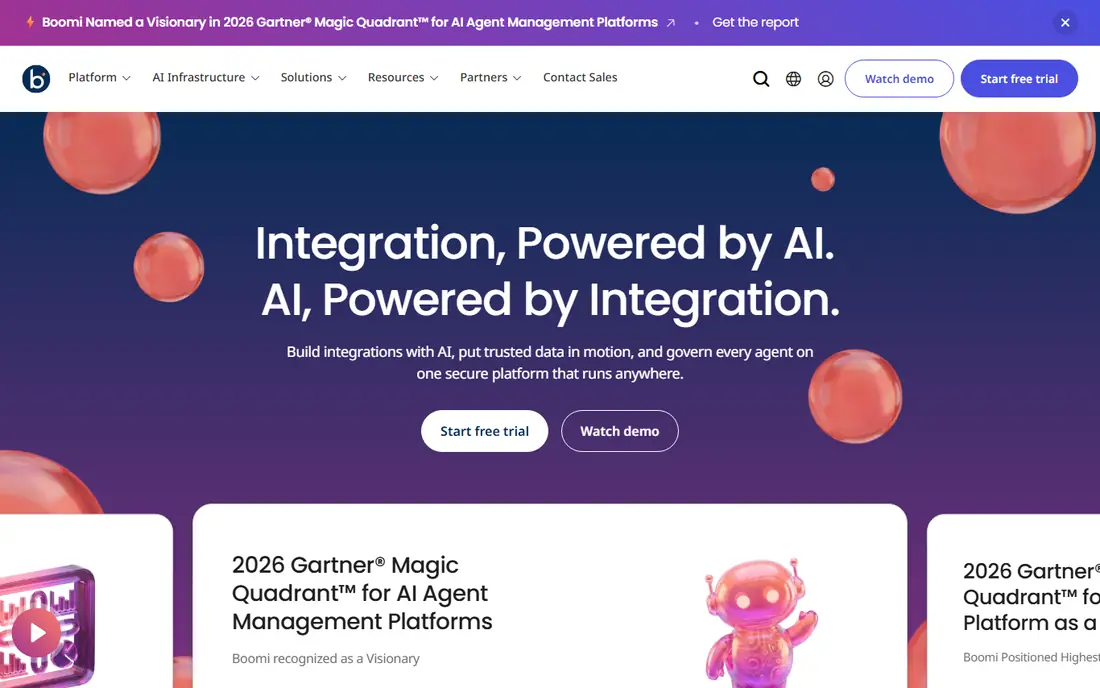
Boomi is a long-standing integration platform that connects cloud and on-premise apps, moves data between them, and applies quality rules along the way. It suits firms with many systems and a need for reliable, managed pipelines. Its data hub features help teams align customer records across apps.
The honest catch is skill and cost. Boomi is quote-only, and complex flows need integration experience to build and maintain. Small teams may find it heavier than they need. Larger firms with an integration team will use its depth well.
Pick Boomi when you have many systems to connect and want a proven platform with support. If you only sync two work tools, Unito is simpler. For enterprise-wide integration, Boomi belongs on the shortlist.
- Mature integration platform
- Many connectors
- Data quality tools
- Quote-only pricing
- Needs integration skill for complex flows

MuleSoft, owned by Salesforce, takes an API-led approach to integration. Teams build reusable APIs, connect systems through them, and govern access in one place. That design suits large firms building a lasting integration layer, not just a one-off sync.
The trade-off is investment. MuleSoft pricing is enterprise-level and quote-based, and it needs developers to build and run well. Mid-size teams without a dedicated integration team may find it overkill. Salesforce-heavy firms gain the most, since links to that ecosystem are deep.
We recommend MuleSoft for large firms with an API strategy and developer capacity. If your need is a quick two-way sync, look at Unito or Tray.ai first. For a governed API foundation, MuleSoft is a leading choice.
- API-led design
- Strong governance
- Deep Salesforce links
- Enterprise pricing
- Needs developer resources
Informatica is the closest enterprise match for Syncari's data unification and governance aims. It offers master data management, data quality, and integration across many systems, with controls for lineage and policy. Large firms use it to build a trusted single view of customers and products.
The catch is complexity. Informatica can feel heavy, and some deployments need consultants to set up well. Pricing is quote-only and enterprise-scale. Smaller firms will find it more platform than they need, and they may move slower with it.
Pick Informatica when governance, quality, and master data are the main goals, not just moving records. If you want a lighter sync tool, start with Workato or Boomi. For regulated or large-scale data programs, Informatica is a serious contender.
- Deep data quality and master data tools
- Broad connectors
- Strong governance
- Complex and consultant-heavy for some firms
- Quote-only pricing
Talend covers data integration, quality, and governance for large projects, with tools for batch and streaming work. It connects many databases, apps, and cloud warehouses, and it can clean and transform data in flight. Teams with data engineering skill use it for pipelines that Syncari-style tools handle more simply.
The honest catch is learning curve. Talend jobs take design care, and pricing is quote-based. Business ops teams without data engineers may find it slower to adopt than Workato. Data teams with existing pipelines will feel more at home.
We like Talend for firms where data engineering owns integration and quality matters at scale. If ops teams need no-code sync, Workato or Unito will move faster. For deep data projects, Talend earns a place on the list.
- Strong data integration and quality tools
- Open-source roots
- Broad sources
- Quote-only pricing
- Learning curve for complex jobs
Tray.ai gives teams a visual builder for connecting apps and automating data flows, with AI assistance for building and mapping fields. It suits ops and IT teams that want flexible logic without writing a full integration codebase. Connectors cover common CRM, support, and finance tools.
The trade-off is pricing shape. Larger use is quote-based, and usage-based costs can rise with volume. Teams should test with real record counts to see the true bill. Very simple two-tool syncs may still be cheaper in Unito.
Pick Tray.ai when you want flexible automation plus sync in one visual tool. If governance is the priority, Informatica fits better. For teams that build many varied workflows, Tray.ai is a strong option.
- Visual builder with AI help
- Many connectors
- Flexible logic
- Quote-only pricing for larger use
- Costs scale with usage
Unito focuses on a clear job: keeping work items in sync both ways between tools such as Jira, Asana, Trello, and Salesforce. Field mapping lets teams decide which fields flow, and changes on either side update the other. That focus makes setup fast for project and ops teams.
The catch is scope. Unito is not a master data platform, so it will not clean, merge, and govern customer records the way Syncari or Informatica aim to do. Teams that need that depth should look higher on this list. Teams that just need two tools to stay aligned will find Unito ideal.
We like Unito for cross-team work where two tools must mirror each other. Test field mapping with your real workflows, since edge cases show up in status and custom fields. For that narrow job, Unito is our pick for most people.
- True two-way sync for work tools
- Simple setup
- Field mapping controls
- Narrower scope than full integration platforms
- Not a master data tool
Fivetran is included with a clear warning about fit. It excels at moving data one way from apps and databases into a warehouse for analytics, with managed pipelines and many connectors. That makes it excellent for reporting, but it does not replace Syncari's two-way operational sync.
The honest catch is direction. If you need a CRM update to flow back to another app in real time, Fivetran is not designed for that job. Teams that buy it expecting two-way sync will be disappointed. Teams that need clean analytics data will be pleased.
Pick Fivetran when your goal is analytics, not operational sync. Pair it with a sync tool above if you need both directions. For warehouse pipelines alone, Fivetran is a leading choice.
- Many source connectors
- Fully managed pipelines
- Reliable warehouse loads
- Mainly one-way to warehouses
- Not built for two-way operational sync
How we picked these
We compared official feature pages, pricing pages, and public reviews for tools that sync, integrate, or unify business data in October 2026. We kept tools that are actively offered and that fit at least one part of Syncari's job, and we noted where a tool covers only one direction. We did not claim hands-on testing that did not happen.
How to choose the right data sync tool
Start by naming the direction and the system of record. Two-way operational sync, one-way analytics loads, and master data governance are different jobs with different tools. If two apps must stay mirrored, Unito or Workato fit. If a warehouse needs clean loads, Fivetran fits. If one trusted customer record must rule, Informatica or Syncari-style governance fits.
Next, test with messy real data, not clean samples. Duplicates, missing fields, and conflicting updates reveal if a tool merges, overwrites, or flags problems. Check conflict rules, error handling, and audit logs, since silent overwrites cause the worst sync failures. Run a pilot on one object, such as contacts, before you sync everything.
Finally, model cost by volume, not by seat count alone. Task, record, and row pricing can dwarf seat fees at scale. Ask each vendor for a quote based on your monthly record and task counts. Pick the smallest tool that handles your conflict rules and volume, then add governance depth only when data quality becomes a real bottleneck.
Frequently asked questions
Is Fivetran a direct Syncari replacement?
No, Fivetran mainly moves data one way into warehouses for analytics. It does not provide two-way operational sync or master data governance in the same way. Use it for analytics, and pick Workato, Boomi, or Unito for operational sync.
Do I need developers to use these tools?
It depends on the tool. Unito and Workato offer visual building for many syncs, while MuleSoft and Talend need more developer skill. Match the tool to your team's capacity, and test building a real sync during a trial.
What is master data management?
Master data management creates one trusted record for each customer, product, or supplier across many systems. It cleans duplicates, applies rules, and governs changes. Informatica and Syncari focus on this, while Unito and Fivetran do not.
How much do Syncari alternatives cost?
Most enterprise tools here are quote-only, with pricing based on records, tasks, or connectors. Smaller tools such as Unito publish tiered pricing on their sites. Ask for a quote using your real volume, since list prices rarely tell the full story.
Can I sync data without code?
Yes, for many common app pairs, visual tools such as Workato, Tray.ai, and Unito handle sync without code. Complex transforms, custom APIs, and governance rules may still need technical help. Start with a pilot to confirm your use case fits no-code building.
Sources
See where you really rank - block by block
ProMapRanker scans Google Maps across a grid of your service area. Simple monthly plans from $19, white-label on every plan.
Start freeKeep reading
 zyte alternatives
Best Zyte Alternatives in 2026
These zyte alternatives cover managed scraping APIs, proxy networks and no code tools for lawful collection from your own or consented sources only in 2026.
Read → zerto alternatives
Best Zerto Alternatives in 2026
Compare the best zerto alternatives for disaster recovery and replication, with recovery targets, cloud options and honest trade-offs for teams in 2026.
Read → zerofox alternatives
Best ZeroFox Alternatives in 2026
We compared 9 zerofox alternatives for brand protection, phishing takedowns, dark web monitoring, and social impersonation, with clear coverage notes.
Read →