 ProMapRanker
Best Swarmia Alternatives in 2026

Key takeaways
- Jellyfish is the broadest pick for leaders who need engineering work tied to business and finance data, while LinearB is strongest for pull request workflow automation.
- DX stands out for teams that want survey based developer experience data alongside delivery metrics, rather than code activity alone.
- Haystack and Typo suit smaller teams that want faster setup and a lower starting cost than enterprise platforms.
- Most tools in this list use quote based pricing, so budget planning should start with a demo and a trial rather than a published price page.
- The right choice depends on your main question: delivery speed, developer experience, AI coding impact, or forecasting.
Quick comparison
| Pick | Great for | Pricing starts at | Free tier | |
|---|---|---|---|---|
 Jellyfish | Engineering and business alignment | See website | No | Visit |
 LinearB | Pull request workflow automation | See website | Free trial | Visit |
 DX | Developer experience measurement | See website | No | Visit |
 Waydev | Git and code level analytics | See website | No | Visit |
 Haystack | Simple delivery visibility | See website | Free trial | Visit |
 Allstacks | Delivery forecasting | See website | No | Visit |
 Typo | AI code review plus analytics | See website | Free trial | Visit |
 Plandek | Custom metrics and value streams | See website | No | Visit |
 Faros AI | Multi tool engineering data | See website | No | Visit |
The best swarmia alternatives
Swarmia focuses on engineering analytics, working agreements, and team level delivery data. The tools below cover the same ground from different angles, so we compared their focus, integrations, and pricing model before ranking them for different team sizes.
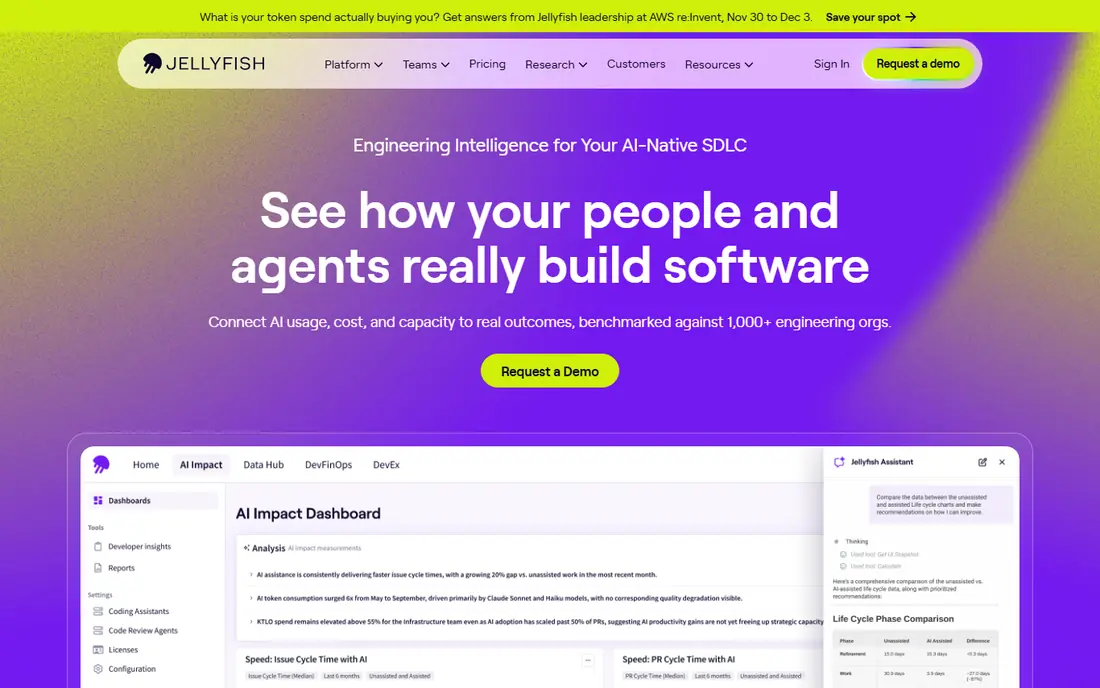
Jellyfish is our pick for larger engineering organisations that need to explain engineering work in business terms. It connects code, project, and people data to allocation, so leaders can show how much effort goes to new features, upkeep, and unplanned work. That link between engineering activity and business outcomes is the main reason it sits at the top of this list for executive reporting.
The trade off is scope and cost. Jellyfish is a full platform with several modules, and pricing is quoted rather than published, so smaller teams may find setup and procurement heavier than they want. If your main need is a simple cycle time chart for one team, a lighter tool below will serve you better. If your main need is defensible reporting for finance and product leaders, Jellyfish is hard to beat.
- Broad allocation and investment reporting
- AI impact and cost tracking
- Covers operations, strategy, and finance in one model
- Quote based pricing
- Can be more platform than a small team needs
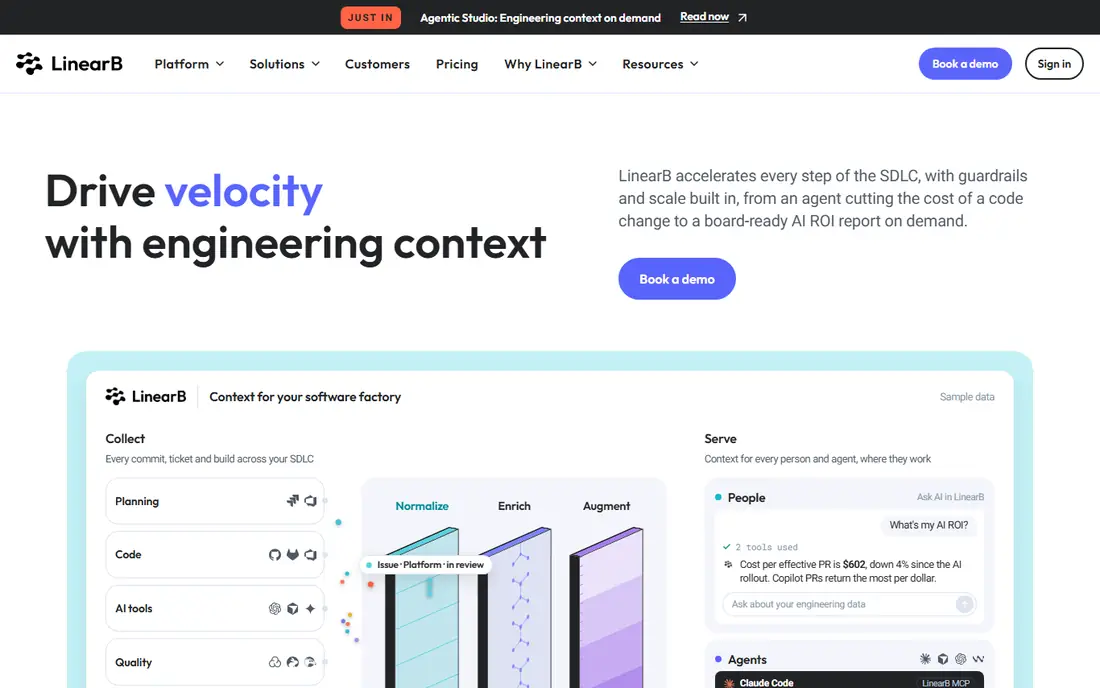
LinearB suits teams whose bottleneck is the review process rather than a lack of charts. Its metrics cover deployment frequency, lead time, and related delivery signals, and its gitStream automation can route reviewers, label risk, and enforce merge checks based on rules you define. That combination of measurement and action is what sets it apart from dashboards that only report.
The honest catch is that automation only helps if you invest in the rules. A team that turns on every check at once can slow reviews down instead of speeding them up. Start with one or two pain points, such as reviewer assignment or risky change labels, and expand once the team trusts the system.
- Strong DORA and delivery metrics
- GitStream automates pull request routing and checks
- Works well with GitHub and Jira
- Quote based pricing on current plans
- Automation rules take time to design well
DX comes from researchers behind widely used developer productivity frameworks, and that background shows in how it treats experience as data. Instead of judging teams only by commits and pull requests, it gathers structured feedback about friction, tooling, and workflow pain, then pairs that feedback with delivery data. The result is a clearer picture of why delivery is slow, not just where it slows down.
The limit is participation. Survey data is only useful if engineers answer regularly and believe the results will lead to change. Teams that already run retrospectives and act on them will get more from DX than teams looking for a purely automatic dashboard.
- Research based developer experience surveys
- Combines survey data with delivery telemetry
- Clear index style reporting for leaders
- Quote based pricing
- Survey value depends on honest, regular responses
Waydev is a strong choice for managers who want to understand work at code level, including review patterns, rework, and contributor trends. Its reporting goes deeper than headline delivery metrics, which helps when you are coaching a team or reviewing how a large project actually progressed. The self hosted option also matters for organisations with strict data rules.
That depth is also the drawback. Waydev gives you a lot of detail, and teams without a clear question can spend time reading charts instead of fixing the one bottleneck that matters. Use it when you have a specific review or delivery problem to investigate, and agree in advance which metrics you will act on.
- Detailed code level and contributor analytics
- DORA and SPACE style reporting
- Self hosted deployment option
- Quote based pricing
- Depth can overwhelm teams that want simple summaries
Haystack is the pick for small and mid sized teams that want delivery metrics without a long implementation. It pulls data from Git and issue tracking tools and presents delivery flow, capacity signals, and planning trends in a compact view. For a team lead who needs to spot a slipping sprint early, that simplicity is a genuine advantage.
The compromise is breadth. Haystack does not try to cover finance reporting, deep developer experience surveys, or highly custom enterprise models. If you outgrow it, you will likely move to Jellyfish or Allstacks. For many teams, though, that is a reasonable path: start simple, learn which metrics you use, then buy a bigger platform with evidence.
- Fast setup from Git and Jira data
- Clear delivery trends and risk alerts
- Lower complexity than enterprise platforms
- Fewer customisation options
- Less suited to complex multi business reporting
Allstacks suits leaders who are tired of status meetings that only confirm a delay after it happens. Its forecasting models use your own past delivery data to flag risk early, and its context view links work to teams, costs, and objectives. That makes it useful for planning conversations where a date, a budget, and a scope trade off all need to be discussed together.
New teams or teams with thin historical data will get less value at first, since forecasts improve as history builds. Allstacks also sits in the enterprise pricing bracket, so it fits organisations that already treat delivery forecasting as a leadership priority rather than a nice extra.
- Machine learning forecasts based on your own delivery history
- Risk alerts before dates slip
- Links activity, cost, and objectives
- Quote based pricing
- Forecasts need enough history to be useful
Typo is interesting because it does two jobs at once: it tracks delivery and developer experience, and it reviews code with AI assistance. That pairing can shorten review cycles while still giving managers visibility into cycle time and throughput. Its anonymous check ins also tend to surface friction that a quarterly survey misses, since they are short and frequent.
The catch is tuning. AI review suggestions are only helpful if they match your coding standards, and teams should review the first weeks of suggestions closely before letting them shape habits. Used with that care, Typo is a strong all round option for teams that want analytics and review help in one tool.
- Combines analytics with AI assisted code review
- Anonymous check ins for developer experience signals
- Practical for mid sized teams
- Pricing varies by plan and team size
- Review features need tuning to match team standards
Plandek fits organisations that do not want a fixed metric set. It lets you shape metrics, dashboards, and reporting around your own value streams, which matters when different business units track delivery differently. Its predictive analysis adds a forward looking view across sprints, epics, and larger programmes of work.
That flexibility requires discipline. Without an agreed set of definitions, custom metrics can drift into competing versions of the same number. Plandek works best when one owner defines the core metrics first, then lets teams add their own views on top of that shared base.
- Custom metrics and reporting structures
- Predictive analysis across sprints and value streams
- API access for custom reporting
- Quote based pricing
- Setup benefits from a clear metrics plan
Faros AI suits enterprises where different teams use different tools and no one wants to standardise first. It connects a wide range of sources into one engineering data model, so leaders can compare delivery and quality signals across teams even when the underlying tools differ. That is a real advantage in large organisations with mixed Git, issue tracking, and CI systems.
The limit is that a data model is not a decision. Faros AI gives you the raw material for analysis, but your team still needs to decide which metrics matter and who acts on them. If you already have that discipline, it is a flexible foundation. If you do not, a more opinionated tool such as Jellyfish or DX may guide you faster.
- Connects many engineering tools without forcing one stack
- Engineering metrics graph for custom analysis
- Useful for varied enterprise toolchains
- Quote based pricing
- Value depends on how many tools you connect
How we picked these
We compared official product pages, pricing pages, and public feature documentation for engineering intelligence platforms that cover delivery metrics, DORA reporting, developer experience, or workflow automation. We kept only tools that are live and actively sold in October 2026, and we favoured tools with clear Git and issue tracking integrations. We did not claim hands on testing, and we used quote based pricing language where vendors do not publish a price.
What to check before you buy
Start with one question
Pick the single question you need answered each week, such as whether cycle time is rising, whether reviews are the bottleneck, or whether AI coding tools are changing throughput. A tool that answers that question clearly beats a broader platform that answers ten questions poorly.
Check your integrations first
Confirm support for your Git host, issue tracker, and CI system before a trial, and check whether data history imports or starts from the trial date. A tool that cannot read your main sources will not help, however good its charts look.
Agree how metrics will be used
Tell engineers what metrics are for and what they are not for. Teams trust analytics when metrics support coaching and process fixes, and they resist them when metrics feel like individual surveillance. Put that agreement in writing before rollout.
Run a short, realistic trial
Use real projects during the trial, not a demo workspace, and review the results with the team that will live with the tool. If no one opens it after two weeks, the fit is wrong, whatever the sales demo promised.
Frequently asked questions
What is Swarmia used for?
Swarmia is an engineering analytics platform that tracks delivery metrics, working agreements, and team visibility from Git and issue tracking data. Teams use it to spot delivery risks, review cycle time, and agree on working practices.
Which swarmia alternative is best for small teams?
Haystack and Typo are strong starting points for smaller teams, since they offer faster setup and a narrower, more practical feature set than enterprise platforms. Jellyfish and Allstacks suit larger organisations with reporting and forecasting needs.
Do these tools replace code review tools?
No, most of them measure and support review rather than replacing it. LinearB and Typo add automation or AI assistance to review, but human review remains part of the process, and teams should keep their own quality standards.
Can these tools measure AI coding impact?
Several can, including Jellyfish, Waydev, and Typo, which track AI tool usage and related changes in throughput, cycle time, or quality. Results vary by team and task, so treat AI impact figures as directional rather than exact.
How much do swarmia alternatives cost?
Pricing varies widely. Most enterprise platforms use quote based pricing, while some smaller tools publish starter prices or offer trials. Ask for a quote based on your developer count and the modules you actually need.
Sources
See where you really rank - block by block
ProMapRanker scans Google Maps across a grid of your service area. Simple monthly plans from $19, white-label on every plan.
Start freeKeep reading
 zoro.to alternatives
Best Zoro.to Alternatives in 2026
We compare the best zoro.to alternatives in 2026, listing only legal licensed anime streaming services, from Crunchyroll to free options for fans today.
Read → zip alternatives
Best Zip Alternatives in 2026
We compare the best zip alternatives for buy now, pay later in 2026, covering pay-in-4 plans, fees, spending limits, and credit reporting options today.
Read → yesware alternatives
Best Yesware Alternatives in 2026
Compare the best yesware alternatives for sales email tracking, templates, and sequences, with current pricing and honest tradeoffs for small sales teams.
Read →