 ProMapRanker
Best Sumsub Alternatives in 2026


Transparent self-serve pricing · Pricing starts at: $0.80 per verification
Key takeaways
- Veriff offers the clearest published self-serve pricing in this group, starting at $0.80 per verification in recent listings.
- Onfido, now Entrust Identity Verification, and Jumio suit enterprises that need broad document coverage and strong fraud controls.
- Persona and Stripe Identity suit product teams that want modular flows and a simpler start.
- Most enterprise verification pricing is quoted, so compare monthly minimums and add-on rates, not just the per-check price.
- Check document coverage for your exact markets, since a vendor strong in one region can be weak in another.
Quick comparison
| Pick | Great for | Pricing starts at | Free tier | |
|---|---|---|---|---|
| Veriff | Transparent self-serve pricing | $0.80 per verification | Free trial | Visit |
 Onfido | Fintech and marketplace verification | See website | Free trial | Visit |
 Jumio | Enterprise fraud controls | See website | Free trial | Visit |
 Persona | Modular verification workflows | $250 per month | Yes | Visit |
 Alloy | Risk and onboarding orchestration | See website | Free trial | Visit |
 Trulioo | Global data and identity checks | See website | Free trial | Visit |
 Socure | Fraud prediction and identity risk | See website | Free trial | Visit |
 iDenfy | Low-cost verification for small teams | $1.35 per verification | Free trial | Visit |
 Stripe Identity | Simple verification for Stripe users | $1.50 per verification | Free trial | Visit |
The best Sumsub alternatives
Sumsub is an identity verification platform for KYC, KYB, AML screening and transaction monitoring, used by fintech, crypto, marketplaces and other regulated businesses. Teams look for alternatives when they want clearer pricing, broader document coverage in a specific region, stronger fraud signals, a simpler developer experience, or a workflow builder that fits their product better. The tools below cover that same job at different scales. We compared official feature pages, pricing pages and independent pricing comparisons, and we kept only platforms that are live and useful in October 2026. This is not legal or compliance advice: check your own regulatory duties before you choose a vendor.
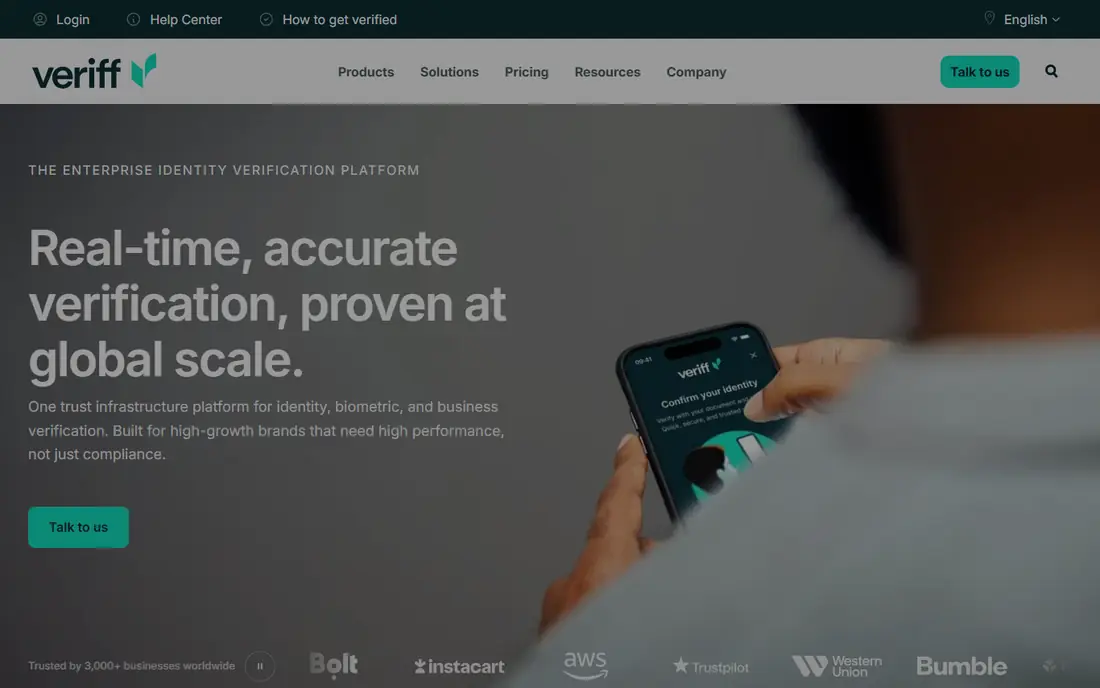
Veriff stands out in this group because it publishes self-serve pricing, which is rare in identity verification. Recent listings show an Essential plan at $0.80 per verification with a $49 a month minimum, with higher Plus and Premium tiers at higher per-check rates and minimums. That transparency makes budgeting easier for a startup that knows its monthly volume, and it lets you compare the true entry cost without a sales call.
The product itself covers document verification with selfie matching, liveness checks and fraud signals, with support for thousands of government documents. The catch is that add-ons and higher-volume plans can change the effective price, and enterprise needs still move to a quote. Veriff fits startups and mid-size teams that want a clear self-serve start, broad coverage and a simple session price. If you need a fully custom enterprise contract, compare its higher tiers with Onfido and Jumio as well.
- Published self-serve rates with monthly minimums
- Broad document coverage
- Document plus selfie matching in one session
- Higher tiers move to quoted pricing
- Add-on checks can raise the per-session cost
- Enterprise support sits on higher plans

Onfido, now trading as Entrust Identity Verification, is a long-standing choice for fintech, gig marketplaces and other consumer platforms. It combines document checks, biometric face matching and liveness detection, with a workflow tool that lets you add extra checks for high-risk users and skip steps for returning users. Document coverage spans thousands of document types across many countries, with particular strength in several regions outside North America.
Pricing is quoted for production use, with per-check estimates in independent comparisons often in the $1 to $3 range depending on volume and checks included, and annual minimums on committed contracts. A free developer sandbox is available for testing. Onfido fits fintech and marketplace teams that need broad coverage, a polished developer experience and a vendor with a long track record. Small teams that want instant self-serve pricing may prefer Veriff or iDenfy first.
- Broad document coverage across many countries
- Polished SDKs and documentation
- Workflow builder for conditional checks
- Production pricing is quoted
- Annual contracts are common
- Smaller teams may find enterprise sales slow

Jumio positions itself as the enterprise option, with AI-driven document checks, biometric matching, liveness detection and fraud signals designed for high-risk and high-volume use. It covers documents across many countries and offers orchestration, risk scoring and compliance tools for regulated businesses. Teams in banking, payments and large marketplaces often shortlist Jumio when fraud prevention matters as much as simple identity matching.
The trade-off is cost and access. Per-verification estimates in independent comparisons are often higher than Veriff or Persona, and annual contracts with minimums are common, which puts Jumio out of reach for a small startup. Jumio fits enterprises that process large volumes, face serious fraud pressure, and need strong controls and support. Smaller teams should test a self-serve vendor first and move to Jumio when volume and risk justify it.
- Strong fraud detection and document forensics
- Broad global coverage
- Enterprise controls and support
- Higher per-check costs in many comparisons
- Annual contracts with minimums
- Less suited to small self-serve teams
Persona appeals to product teams because its workflow builder lets you chain document checks, selfie verification, database lookups and watchlist screens into one flow without writing back-end logic for each step. You can build different flows for different risk levels, such as a light check for low-risk signups and a full check for payouts. Recent listings show an Essential plan at $250 a month on an annual contract, with 500 verifications or reports included and $1.50 per extra check, while higher plans are quoted.
The modular model is flexible, but it also means total cost depends on how many checks each flow uses, so a complex flow can cost more than a simple one. Persona also offers a free tier for testing in some listings. It fits startups and product-led teams that want to design verification flows themselves, iterate quickly, and pay mainly for the checks they use. Enterprises with very high volumes should compare quoted plans with Jumio and Onfido.
- Visual workflow builder for chaining checks
- Modular pricing where you pay for checks used
- Strong developer experience
- Higher plans are quoted
- Per-check costs depend on flow complexity
- Some advanced features need higher tiers
Alloy is less a single document check tool and more an orchestration layer for onboarding and risk. It connects to many data sources, verification vendors and fraud tools, lets you set risk rules, and makes an approve, review or reject decision in one flow. That design suits banks, fintechs and lenders that need to combine identity checks, fraud signals, credit data and compliance screening, rather than running one check in isolation.
Pricing is quoted, and implementation needs careful planning around data sources, rules and compliance duties. Alloy is not the best first pick if you only need a simple document and selfie check for a small app. It fits financial teams that already use several vendors and want one decision layer to manage them, with audit trails and controls that regulators expect.
- Orchestration across many data and verification vendors
- Risk rules and decisioning in one place
- Strong for US financial onboarding
- Pricing is quoted
- Setup needs data and compliance planning
- Less of a direct document check vendor on its own
Trulioo is known for global identity data coverage, with person and business matching across many countries, plus document verification and watchlist screening. That breadth helps when your users are spread across markets where a single vendor document catalog is thin, or when you need to verify identity from data sources rather than only from a document photo. Recent comparisons list per-check estimates around $0.50 for data-based checks, though full document flows cost more and pricing is quoted.
The limit is that document check depth can vary by market, so test coverage for your exact countries before you commit. Trulioo also feels enterprise-oriented, with sales-led pricing and onboarding. It fits global platforms, payments companies and marketplaces with users in many countries, especially where data-based checks are a useful complement to document checks.
- Broad global data coverage for identity matching
- Document and data checks in one platform
- Useful for hard-to-cover markets
- Pricing is quoted
- Document verification depth varies by market
- Setup can feel enterprise-heavy for small teams
Socure focuses on predicting identity fraud and risk, using device, behavior and identity graph signals alongside document and data checks. It is often used when a business wants to approve more good users automatically, while catching synthetic identities and fraud rings that a simple document check might miss. That risk focus is the main reason to shortlist Socure alongside a document vendor, rather than instead of one in every case.
Pricing is quoted, and document coverage is less central than at Veriff, Onfido or Jumio, with a stronger US focus in many listings. Socure fits US-facing fintech, lending and marketplace teams with serious fraud pressure, where risk scoring can reduce manual review. Global teams that need broad document coverage should pair it with, or compare it against, a document-led vendor.
- Strong fraud and risk prediction from device and behavior signals
- Identity graph for matching
- Useful for high-risk onboarding
- Pricing is quoted
- Document check coverage is thinner than pure document vendors
- US focus is stronger than global document coverage
iDenfy is a lower-cost verification platform with published pricing that small teams can actually budget around. Recent listings show a Basic plan at $1.35 per verification with a $135 a month minimum, covering document and selfie checks with liveness, while enterprise plans are quoted. It also offers business verification, fraud prevention and related tools, which helps a small fintech or marketplace cover more than one compliance job with one vendor.
The trade-offs are scale and recognition. Enterprise features, higher volumes and dedicated support sit on quoted plans, and iDenfy is less well known than Onfido or Jumio, which can matter in enterprise procurement. iDenfy fits startups and small teams that want a clear entry price, a working document and selfie flow, and room to grow. Test document coverage for your markets before you rely on it for a global launch.
- Published Basic plan pricing
- Document, selfie and liveness checks
- Fraud tools and business verification options
- Enterprise pricing is quoted
- Support and coverage vary by plan
- Smaller brand recognition than the largest vendors
Stripe Identity is the simplest option if you already use Stripe for payments. You can add identity verification with a hosted flow or an API, verify a government document and selfie, and manage results in the same dashboard as payments. Recent listings show $1.50 per verification for document and selfie checks, with $0.50 per ID number lookup and custom pricing above 2,000 verifications a month.
The limit is depth. Stripe Identity is not a full KYC, KYB and AML orchestration platform like Sumsub, Alloy or Trulioo, and workflow customization is thinner than Persona. It fits Stripe users who need a straightforward identity check for onboarding, payouts or fraud prevention, without a separate vendor contract. Teams with complex compliance, KYB or multi-vendor orchestration needs should look at the specialist platforms above.
- Simple setup for teams already using Stripe
- Document plus selfie verification
- Clear per-verification price in recent listings
- Less customizable than Persona or Alloy
- Verification depth is narrower than specialist vendors
- Custom pricing above higher volumes
How we picked these
We compared official feature pages, pricing pages and independent October 2026 pricing comparisons for identity verification platforms that cover the core Sumsub job: document verification, selfie matching, liveness, watchlist screening and onboarding workflows. We kept platforms that are live in October 2026, that publish a usable product and support path, and that serve a clear audience from startups to enterprises. We left out pure background check tools with no document flow, and tools that only do age checks. Prices in this market are often quoted, so we note quoted pricing plainly and use published figures only where a vendor or a recent comparison lists them. This guide is not legal or compliance advice.
What to check before you switch
Start with your exact regulatory and risk needs. List the checks you must run, such as document verification, selfie matching, liveness, sanctions screening, adverse media and business verification, then check each vendor covers them for your markets. Next, test document coverage for your real users. Ask for a coverage list by country and document type, and run test verifications with documents from your top markets, since coverage gaps cause drop-off and manual review.
Frequently asked questions
What is the best Sumsub alternative?
Veriff is a strong general choice for clear self-serve pricing, Onfido and Jumio suit enterprises, and Persona suits product teams that want modular workflows. The best choice depends on your markets, your volume and whether you need orchestration, fraud prediction or just a document check. Start with coverage and cost for your top markets, not with a brand name alone.
Are there free Sumsub alternatives?
Most verification platforms offer a free sandbox, trial or free tier for testing, but production checks are paid per verification in almost every case. Persona offers a free tier in some listings, and Veriff, iDenfy and Stripe Identity offer trials or low minimum plans for getting started. Budget for per-check costs and monthly minimums for any production launch.
Which Sumsub alternative has the clearest pricing?
Veriff has the clearest published self-serve pricing in this group, with per-verification rates and monthly minimums listed in recent comparisons. iDenfy and Stripe Identity also publish entry per-check prices. Onfido, Jumio, Alloy, Trulioo and Socure mainly quote pricing, so you will need a sales conversation for a firm number.
Do these platforms support KYB and AML screening?
Many do, but coverage varies. Sumsub-style platforms often bundle KYC, KYB, AML screening and monitoring, while simpler tools such as Stripe Identity focus mainly on person verification. Alloy and Trulioo offer broader orchestration and screening, and Persona can chain watchlist checks into flows. Check KYB, sanctions and monitoring support separately if your business needs them.
How do I choose between document checks and data checks?
Document checks read a government ID and match a selfie, which suits high-assurance onboarding. Data checks match identity details against databases, which can be faster and cheaper where data coverage is strong. Many platforms combine both, using data checks for low-risk users and document checks for higher risk. Match the method to your risk level, your markets and your regulatory duties.
Sources
See where you really rank - block by block
ProMapRanker scans Google Maps across a grid of your service area. Simple monthly plans from $19, white-label on every plan.
Start freeKeep reading
 zscaler alternatives
Best Zscaler Alternatives in 2026
Looking for zscaler alternatives? We compare 9 SASE and zero trust platforms on architecture, data protection, pricing, and fit for your network and team.
Read → zapier alternatives free
Best Zapier Alternatives Free in 2026
Nine automation tools for zapier alternatives free in 2026, all with genuinely free tiers, plus free plan limits, starting prices and upgrade paths explained.
Read → which platform is best for online reputation
Which Platform Is Best for Online Reputation in 2026
Wondering which platform is best for online reputation? We compare 8 review, listing, and response tools for small and multi-location businesses and agencies.
Read →